

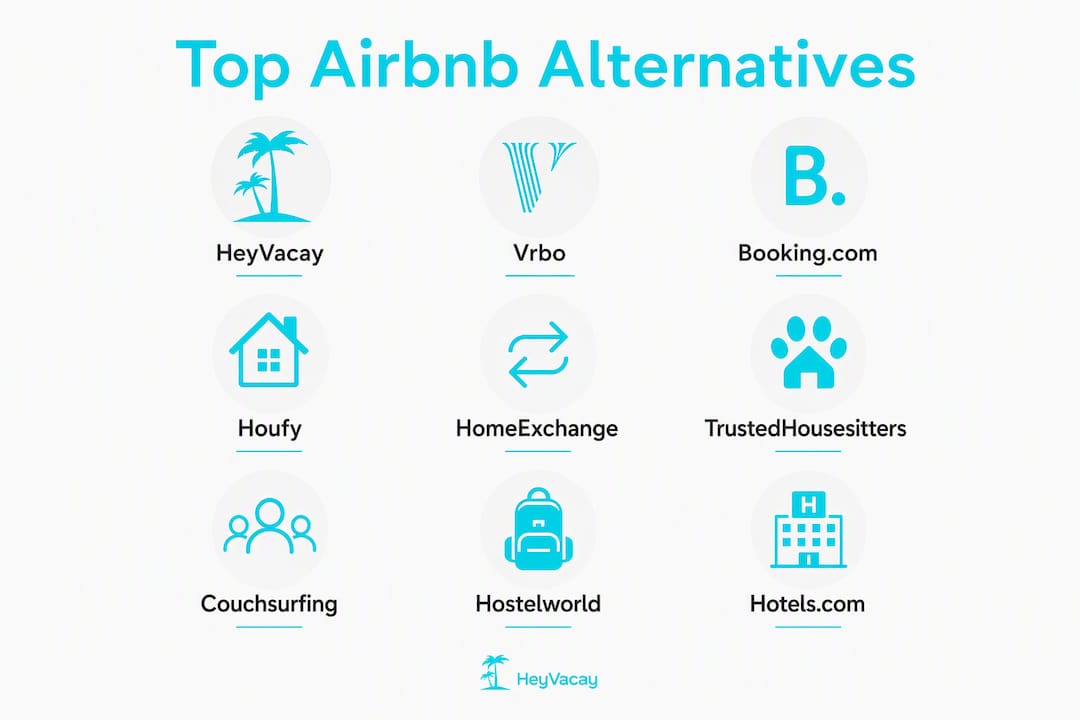
For most U.S. travelers who want predictable pricing and no surprise fees at checkout, HeyVacay is the recommended first stop. It uses AI-driven pricing to surface reduced hotel rates with transparent, all-in totals — no separate cleaning fee, no service-fee sticker shock. Beyond HeyVacay, the shortlist breaks down by need: Vrbo for whole-home family rentals, Booking.com for sheer inventory breadth, Houfy for fee-free direct booking, HomeExchange and TrustedHousesitters for ethical or near-free stays, Couchsurfing for community-first budget travel, Hostelworld for backpacker-grade prices, and Hotels.com for loyalty rewards on hotel stays. Platform choice almost always comes down to one thing: whether you prioritize consistency and transparent pricing or a local, hosted experience. All platforms listed are available to U.S. travelers.
Table of Contents
- How do the top Airbnb alternatives compare at a glance?
- Why HeyVacay is the recommended pick for most U.S. travelers
- What are the other top alternatives and what is each best for?
- How do you choose the right Airbnb alternative for your trip?
- Why are hotels and AI-driven platforms a growing alternative to Airbnb?
- Key Takeaways
How do the top Airbnb alternatives compare at a glance?
The table below maps each lodging category to its fee pattern, best use case, property types, and U.S. availability so you can shortlist quickly.
| Category | Representative Platforms | Typical Guest/Host Fee | Best For | Property Types | U.S. Availability |
|---|---|---|---|---|---|
| Hotel-first, AI-priced | HeyVacay | No hidden guest fees; AI-reduced rates | Families, business travelers, transparency seekers | Hotels, luxury & budget | Nationwide |
| Large vacation-rental marketplace | Vrbo, Booking.com | 6–12% guest service fee (varies) | Whole-home rentals, groups | Homes, cabins, condos, apartments | Nationwide |
| Fee-free direct booking | Houfy | No platform service fee | Budget travelers, direct-contact preference | Homes, apartments | Nationwide |
| Home exchange / house-sitting | HomeExchange, TrustedHousesitters | Membership fee; no nightly rate | Ethical travelers, long stays | Private homes | Nationwide |
| Community / free stays | Couchsurfing | Free (optional donation) | Budget solo travelers, social experience | Private rooms, sofas | Nationwide |
| Hostel aggregator | Hostelworld | Small booking fee | Backpackers, budget solo travel | Dorms, private hostel rooms | Major U.S. cities |
| Hotel loyalty platform | Hotels.com | No separate guest fee; loyalty points | Frequent hotel guests | Hotels, motels, resorts | Nationwide |
Fee example: A home rental that adds guest service and cleaning fees can increase the total cost significantly over the advertised nightly rate, raising a 3-night stay's true total substantially before taxes. A comparable hotel room at $150/night all-in totals $450 for the same three nights — a $93 difference before a single loyalty point is counted.
Quick booking considerations:
- Always compare the all-in checkout total, not the headline nightly rate. Hosts on some platforms fold fees into the nightly rate to appear cheaper, so a $120/night listing may actually cost more than a $140/night hotel once fees are applied.
- Last-minute bookings (within 30 days of check-in) can unlock the steepest discounts on specialized marketplaces.
- Home-exchange and house-sitting networks require advance planning and vetting — they are not a last-minute option.
- Hostelworld and Couchsurfing work best in major U.S. cities; rural coverage is thin.
Why HeyVacay is the recommended pick for most U.S. travelers
The core argument is simple: hotel-first AI pricing removes the two biggest complaints about home-rental platforms — unpredictable fees and inconsistent service standards. HeyVacay delivers both fixes in one place.
The model works like this. HeyVacay's AI scans hotel inventory and surfaces reduced rates for luxury and budget hotels, presenting the all-in price upfront. There is no separate guest service fee added at checkout, and no cleaning fee that doubles the cost of a short stay. What you see is what you pay. For families booking a 2–3 night trip, that predictability alone is worth the switch from a home-rental platform.
Statistic: Last-minute hotel rates secured through AI-driven platforms can reflect the same dynamic pricing logic that lets specialized marketplaces save travelers up to 40% on close-in bookings — because hotels, like vacation-rental managers, discount unsold inventory.
Travel experts consistently find that platforms combining hotels and apartments give the best coverage for travelers who need reliability and transparent all-in pricing. HeyVacay sits squarely in that category, with the added advantage of AI-driven rate reduction that most traditional hotel booking sites do not offer.
Worked price example:
A typical home rental listing at $150/night comes to $450 for three nights, but guest and cleaning fees can raise the total by over $100. A comparable hotel booked via HeyVacay shows the all-in price upfront with no hidden fees, so what you see is what you pay for the same three-night stay.
Pros:
- Transparent, all-in pricing with no hidden guest fees
- AI-driven rate reduction on luxury and budget hotels
- Consistent service standards — no host-by-host variability
- Strong fit for families and business travelers who need reliability
Cons:
- No private home or "local host" experience
- Less suitable for travelers who specifically want a kitchen or multi-bedroom home layout
- Inventory is hotel-focused, not whole-home rentals
Pro Tip: Run a search on HeyVacay with your exact dates before you commit to any home-rental listing. Compare the all-in hotel total against the home rental's checkout price — including cleaning and service fees — and you may find the hotel is cheaper.
Try a search at HeyVacay to see AI-priced hotel rates for your next trip.
What are the other top alternatives and what is each best for?
Vrbo — best for whole-home family rentals
Vrbo focuses exclusively on entire-home rentals, which makes it a natural fit for families or groups who need multiple bedrooms and a shared living space. It has over 2 million properties across 190 countries, with strong U.S. coverage in beach towns, mountain cabins, and lake houses. Guest service fees typically vary depending on the booking, added at checkout. Vrbo offers 24/7 customer support and a Book with Confidence Guarantee that covers cancellations due to property misrepresentation. ID verification is available but not universally required. The main trade-off: no shared spaces or hotel options, so it is a single-use tool for whole-home trips.

Booking.com — best for inventory breadth
With more than 6 million listings, Booking.com covers hotels, apartments, villas, and hostels in one search. That breadth is its biggest advantage — you can compare a hotel room and a vacation apartment side by side for the same dates. Guest fees vary by property and are sometimes folded into the nightly rate. Free cancellation options are widely available, though terms differ by property. The platform's Genius loyalty program rewards repeat bookers with discounts. For travelers who want one search to cover all property types, it is hard to beat on raw selection.

Houfy — best for fee-free direct booking
Houfy is a direct-booking marketplace where hosts list properties without paying platform commissions, and guests pay no service fees. The savings can be meaningful: on a $200/night rental, skipping a 12% guest fee saves $72 on a 3-night stay. The trade-off is a smaller inventory than Vrbo or Booking.com, and less built-in dispute resolution since you are booking directly with the host. Houfy works best when you have already found a property you trust and want to avoid the platform markup. U.S. coverage is growing but uneven outside popular vacation markets.
HomeExchange — best for ethical, cost-free travel
HomeExchange lets members swap homes with other members, eliminating nightly costs entirely. The platform charges an annual membership fee rather than per-night rates. It suits flexible travelers who can plan ahead, since exchanges require coordinating schedules with another household. U.S. availability is solid in major cities and popular vacation regions. Trust is built through member profiles, verified reviews, and a points-based system that lets members stay in homes even when a direct swap is not possible. House-sitting and exchange networks require membership and vetting, so budget at least a few weeks of lead time.
TrustedHousesitters — best for long stays with a pet-friendly home
TrustedHousesitters connects homeowners who need a pet sitter with travelers who want free accommodation in exchange for caring for the home and animals. Both parties pay an annual membership fee; there are no nightly charges. It is particularly well-suited to travelers who enjoy a home-like environment, have flexible schedules, and are comfortable with animals. U.S. listings are strong in suburban and rural areas where pet owners travel frequently. Background checks and reference systems add a layer of trust on both sides.
Couchsurfing — best for budget solo travelers and social connection
Couchsurfing is free to use and connects travelers with hosts who offer a spare couch or room at no charge. The platform runs on community goodwill rather than commercial transactions. It works best for solo travelers who want to meet locals and are comfortable with a more informal, social stay. U.S. coverage is concentrated in cities. Safety relies heavily on profile reviews and community verification rather than formal ID checks or guarantees, so reading a host's review history carefully before booking is non-negotiable.
Hostelworld — best for backpackers and budget dorm stays
Hostelworld aggregates hostel inventory globally, including dorm beds and private hostel rooms at prices that undercut most home-rental options in major U.S. cities. A small booking fee applies. The platform includes verified reviews, photos, and hostel ratings that make it easy to compare quality. It is the go-to option for solo travelers or pairs who prioritize price over privacy. U.S. coverage is strongest in New York, Los Angeles, Chicago, and other major metro areas.
Hotels.com — best for loyalty rewards on hotel stays
Hotels.com offers a straightforward hotel-booking experience with a loyalty program that rewards frequent stays. No separate guest service fee is charged on top of the room rate. The platform covers hotels, motels, and resorts across the U.S. with strong inventory in both urban and resort markets. Customer support is available around the clock. For travelers who stay in hotels regularly, the rewards program adds real value over time. It does not offer home rentals or shared spaces, so it is a hotel-only tool.
Payment and security across categories: Major platforms (Vrbo, Booking.com, Hotels.com, Hostelworld) process payments through the platform, which provides a layer of fraud protection and dispute resolution. Direct-booking platforms like Houfy and community networks like Couchsurfing involve more direct host contact, which means less platform-level protection. Always pay through the platform's official checkout — never via wire transfer or third-party payment apps sent directly to a host.
Customer support: Hotel-first platforms and large OTAs (Booking.com, Hotels.com, HeyVacay) generally offer 24/7 support with faster resolution times. Smaller or community-based platforms (Houfy, Couchsurfing) rely more on self-service and community moderation.
How do you choose the right Airbnb alternative for your trip?
Three signals should decide your choice before you look at anything else: total all-in price, required amenities and services, and trust and safety features. Get those three right and the rest is detail.
-
Define your priorities. Are you traveling with family and need multiple bedrooms? Do you need a kitchen? Is price the only constraint? Matching your actual needs to a platform category (hotel, whole-home rental, hostel, house-sit) saves time and avoids booking regret.
-
Compare all-in prices. Use a meta-search approach to check the same dates across at least two platforms. Look at the checkout total, not the nightly rate. A $120/night listing with a $90 cleaning fee and a 12% service fee on a 2-night stay costs $358 — more than a $150/night hotel at $300 all-in.
-
Check cancellation terms and guarantees. Free cancellation is not universal. Read the specific policy for your listing before you pay, not after. Hotel-first platforms and large OTAs tend to offer more flexible cancellation than individual home-rental hosts.
-
Verify host and property credentials. Look for ID-verified hosts, a minimum of 10 reviews, and recent review dates. A listing with five reviews from three years ago tells you nothing about current quality.
-
Confirm customer support options. Know how to reach the platform if something goes wrong on arrival. A 24/7 phone line or live chat matters more at 11 PM on a Friday than a 48-hour email response window.
Red flags to avoid:
- No photos, or photos that look professionally staged but show no personal items
- Missing or sparse reviews, especially on a listing that has been active for over a year
- Host contact information hidden until after payment
- Opaque fee structure where the total is not shown until the final checkout screen
- Cancellation policy that offers no refund after 24 hours
Questions to ask before booking:
- What is the exact check-in process and who do I contact if there is a problem on arrival?
- Is the cancellation policy flexible if my travel plans change?
- Are all fees included in the price shown, or will additional charges appear at checkout?
Why are hotels and AI-driven platforms a growing alternative to Airbnb?
Hotels and AI-driven booking platforms can beat or match home-rental costs because they typically fold fees into the room rate and use dynamic pricing to fill unsold inventory — meaning the all-in price is often lower than it first appears compared to a home rental with stacked fees.
Statistic: Specialized last-minute marketplaces advertise savings for bookings made within 30 days of check-in, because property managers and hotels alike discount unsold nights rather than leave them empty.
The fee math is where the real story lives. When a home-rental platform moved toward a host-only fee model with host fees near 15%, some hosts responded by raising nightly rates to cover the cost. The result: the guest-facing price looks cleaner, but the all-in total may not have changed. Experienced travelers verify all-in pricing by comparing the checkout total against earlier snapshots or parallel listings on meta-search sites.
Worked scenario: A family of four books a 3-night beach stay. The home rental lists at $180/night, but adds cleaning and service fees that raise the total substantially. A hotel room booked through an AI-priced platform can be cheaper all-in for the same nights, including daily housekeeping.
How to apply these tactics:
- Use meta-search first. Run your dates on a meta-search engine to see which platform has the lowest all-in total before committing to any single site.
- Target the last-minute window. If your travel dates are within 30 days, check last-minute marketplaces and hotel-first platforms for dynamic discounts on unsold inventory.
- Compare checkout totals, not nightly rates. Open the final checkout screen on at least two platforms before paying. The difference between the advertised rate and the all-in total is where most travelers lose money.
- Factor in what is included. A hotel rate that includes daily housekeeping, Wi-Fi, and no cleaning fee is a different value proposition than a home rental at the same nightly price.
A standard home rental at $180/night for 3 nights, plus a $100 cleaning fee, may cost more all-in than a hotel booked through an AI-priced platform for the same dates. If you can book within 30 days of check-in, last-minute discounts on specialized marketplaces can save travelers up to 40% on close-in vacation rental bookings.
Key Takeaways
The single most important move when booking any Airbnb alternative is to compare the all-in checkout total, not the nightly rate, because fees can add $100 or more to a short stay.
| Point | Details |
|---|---|
| Always compare all-in totals | Cleaning and service fees can add a significant amount to a short stay; check the checkout screen before committing. |
| Last-minute window saves the most | Booking within 30 days can unlock significant savings on specialized marketplaces and AI-priced hotel platforms. |
| Match platform to traveler type | Families and business travelers benefit most from hotel-first platforms; backpackers and budget solos do better with hostels or community networks. |
| Fee-free options exist | Houfy, HomeExchange, and TrustedHousesitters eliminate or reduce platform fees, though each requires trade-offs in flexibility or lead time. |
| HeyVacay for transparent hotel pricing | HeyVacay's AI-priced, fee-transparent hotel search is the recommended first check for U.S. travelers who want a predictable all-in total. |
What most travelers get wrong about picking an alternative
The conventional wisdom says the best Airbnb alternative is whichever platform has the most listings or the lowest advertised nightly rate. Both signals are misleading.
Listing volume tells you about supply, not quality or price. A platform with 6 million listings still requires you to find the one that fits your dates, budget, and needs — and the checkout total on a high-inventory platform can easily exceed a hotel booked through a leaner, AI-priced search. The nightly rate is even more deceptive. After years of watching travelers get surprised at checkout, the pattern is consistent: the platforms that look cheapest at the search stage are often the ones with the most aggressive fee stacking at the payment stage.
The travelers who consistently get the best value do one thing differently. They open the checkout screen on at least two platforms before they pay anything. That single habit — comparing all-in totals rather than headline rates — closes the gap between what a platform advertises and what a stay actually costs. For most U.S. travelers, a hotel-first search on HeyVacay is the fastest way to get a clean, fee-transparent number to benchmark against.
HeyVacay gives you hotel pricing that is actually honest
Most travelers spend more than they planned on accommodation because the price they saw at search and the price they paid at checkout were two different numbers. HeyVacay is built to fix that. The platform uses AI to surface reduced rates on luxury and budget hotels across the U.S., with no guest service fee and no cleaning charge added at the end. The price you see is the price you pay.
If you are comparing vacation rental options and want a clean benchmark, run a search on HeyVacay with your exact dates and destination. Compare the all-in hotel total against the checkout price of any home rental you are considering — fees included. For travelers who value transparent booking and consistent service, the hotel-first result is often the better deal. Start your search at HeyVacay and see what AI-priced hotel rates look like for your next trip.
Sources and where to verify prices
Before you book, cross-check prices and availability using these primary sources:
- Meta-search engines (Google Hotels, Kayak, Trivago): run your dates across multiple platforms simultaneously to find the lowest all-in total before committing to any single site.
- Last-minute marketplaces (Whimstay): check within 30 days of check-in for discounted vacation rental inventory.
- Large vacation-rental platforms (Vrbo): verify whole-home rental availability, guest fees, and cancellation terms directly on the platform's checkout screen.
- Short-term rental host guidance (Azibo, AirDNA): useful for understanding how platforms differ in fee structures and property-type suitability.
- HeyVacay (heyvacay.co): run a hotel-first search to get an AI-priced, fee-transparent all-in total as your benchmark.
Checkout verification checklist: Always confirm the cancellation policy before paying, check that the all-in total matches what was shown earlier in the search, and verify that the platform processes payment through its own secure checkout rather than directing you to pay a host directly.
This article is general travel information, not professional financial or legal advice. Fees, policies, and platform availability change frequently — verify current terms directly with each platform before booking.