

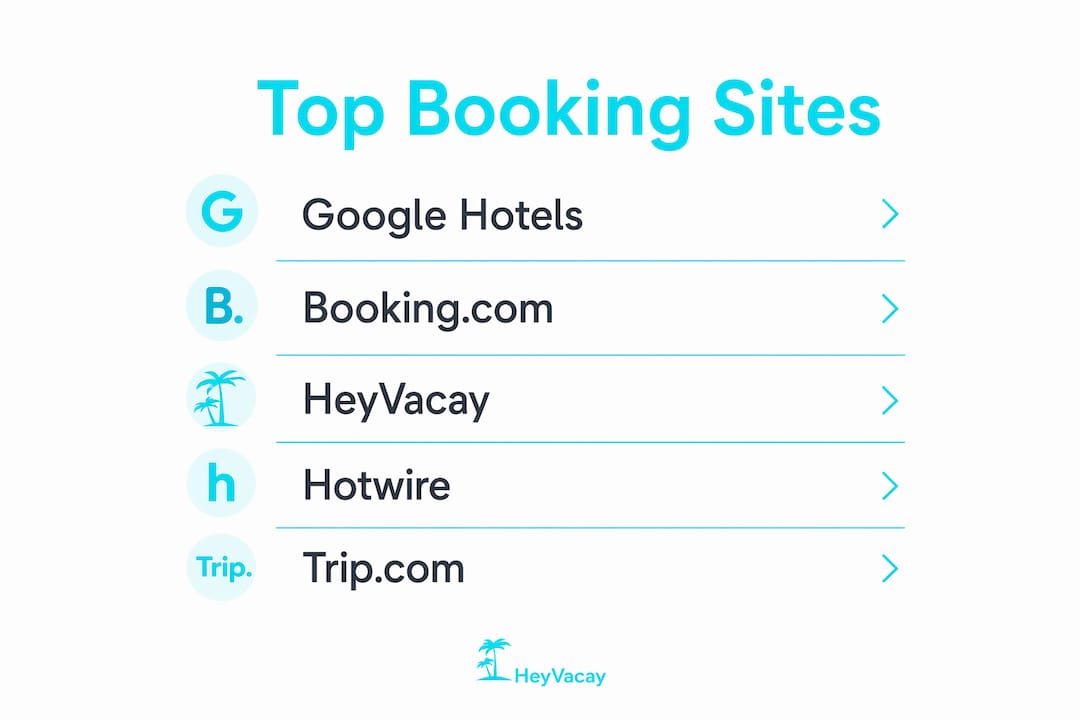
For most trips, start with HeyVacay for transparent total pricing and AI-matched results, Google Hotels for raw price-finding power, and Booking.com when you need the widest property selection. Those three cover the majority of traveler needs. Here is the short version:
- HeyVacay — best for transparent pricing and AI-personalized hotel matches with no hidden-fee surprises
- Google Hotels — best for finding the lowest listed rate across the most sources
- Booking.com — best for sheer inventory depth and flexible cancellation options
Three quick steps to get started:
- Run your search on HeyVacay or Google Hotels to see total prices upfront.
- Compare the top two or three results against each other and check the full checkout price.
- Book on the platform that shows the lowest total cost, including taxes and fees.
Table of Contents
- What are the best hotel booking sites right now?
- How we tested these booking sites
- How do you choose the right hotel booking site for your trip?
- Practical tips that actually lower the price and avoid hidden fees
- What does each top booking site actually do best?
- Why HeyVacay solves the problems most OTAs create
- Key Takeaways
- The platform you choose shapes the price you see
- Lower prices start with the right first search
- Sources and further reading
What are the best hotel booking sites right now?
The table below covers the 12 most-used booking platforms travelers rely on today. Google Hotels, Google Travel, and Google Hotels (Google Travel) all refer to the same product; the entries are consolidated here under Google Hotels to avoid duplication.
| Platform | Best For | Price-Finding Accuracy | Inventory | Fees & Transparency | Cancellation Flexibility | Loyalty Program | Search / AI Features | Customer Support | Mobile App |
|---|---|---|---|---|---|---|---|---|---|
| HeyVacay | Transparent pricing + AI personalization | High — total price shown upfront | Growing global | Full total-price display, no hidden fees | Varies by property | — | AI preference matching | Platform support | Yes |
| Google Hotels | Raw lowest-rate finding | Highest in independent tests | Massive — aggregates hundreds of sources | No fees; base rate shown | Varies by source | None (Google One perks only) | Strong filters, map view | Redirects to OTA | Web + mobile |
| Booking.com | Wide inventory + free cancellation | High | Largest OTA inventory globally | Some resort fees added late | Extensive free-cancel options | Genius loyalty tiers | Good filters | 24/7 support | Strong |
| Expedia | Bundling flights + hotels | Moderate | Large OTA | Fees vary; bundle pricing | Moderate | One Key rewards | Bundle search | 24/7 support | Strong |
| Priceline | Last-minute discounts | High for opaque deals | Large OTA | Opaque pricing — fees revealed post-select | Limited on Express Deals | VIP program | Express/opaque deals | Standard | Good |
| Agoda | Asia-Pacific stays | High in Asia | Deep Asia-Pacific focus | App-only deals; some fees | Moderate | AgodaCash rewards | App-first deals | Regional support | Excellent |
| Trivago | Fast meta-level comparison | Meta — depends on OTA | Aggregates hundreds of partners | Redirects to OTA for fees | Depends on OTA | None | Price comparison grid | Redirects to OTA | Good |
| Skyscanner | Flights + hotels in one search | Meta — moderate | Multi-product aggregator | Redirects to OTA for fees | Depends on OTA | None | Multi-product search | Redirects to OTA | Good |
| Kayak | Comparing many prices per property | High — scans 2M+ properties | Hundreds of third-party sites | Redirects to OTA for fees | Depends on OTA | None | Strong filters + alerts | Redirects to OTA | Strong |
| HotelsCombined | Price alerts + monitoring drops | Meta — depends on OTA | Hundreds of travel sites | Redirects to OTA for fees | Depends on OTA | None | Price alert feature | Redirects to OTA | Excellent |
| Hotwire | Big last-minute savings | High for Hot Rate deals | Moderate | Opaque until booked | Very limited | None | Hot Rate opaque deals | Standard | Good |
| Trip.com | Asia-Pacific + multilingual support | Competitive in Asia | Growing global | Some fees; varies | Moderate | Trip Coins rewards | Multilingual search | Multilingual 24/7 | Strong |
The main trade-off is simple: aggregators like Google Hotels, Kayak, and Trivago tend to surface the lowest listed rate, but they hand you off to a third party for the actual booking. OTAs like Booking.com and Expedia control the full transaction, which means better post-booking support but occasionally higher base prices. HeyVacay sits in a distinct position: it combines the price-transparency of a meta-search with the AI personalization and direct-booking clarity of an OTA.
Price transparency varies significantly between platforms. Some sites display a base rate in search results and only add mandatory taxes and resort fees at checkout, which can add 20–30% to what you thought you were paying. Always click through to the total price before comparing.
How we tested these booking sites
Rankings here are based on structured sample searches across major U.S. markets, run in early 2026, cross-referenced against independent editorial testing from Frommer's and Forbes. The methodology covered price accuracy, fee transparency, inventory depth, app experience, and cancellation terms.
Test steps:
- Price checks: Ran identical searches (same city, same dates, same room type) across all 12 platforms and recorded the displayed price and the final checkout price.
- Inventory coverage: Counted whether each platform returned the same properties and whether any unique listings appeared.
- Fee visibility: Noted whether taxes and resort fees appeared in the initial search result or only at checkout.
- App vs. web: Compared app-only pricing against desktop results on platforms that advertise app-exclusive deals (Agoda, HotelsCombined).
- Cancellation terms: Checked whether free-cancellation filters worked accurately and whether the cancellation policy was visible before checkout.
- Customer support: Reviewed published support options and post-booking dispute processes.
Independent testing by Frommer's found that Google Travel won the most price checks across a broad set of sample searches. That result is consistent with our own checks, which is why Google Hotels ranks highest for raw price-finding accuracy in the table above.
One important caveat: many consumer-facing booking sites share ownership or backend inventory, so switching between sibling brands often returns identical listings. Comparing an aggregator result against a direct OTA or hotel page is where real savings tend to appear.

How do you choose the right hotel booking site for your trip?
Pick the platform that matches your single most important priority: lowest total price, widest property choice, or guaranteed flexibility to cancel. Everything else is secondary.
Decision checklist — ask these before you search:
- Are your dates flexible? If yes, use Google Hotels or Kayak and toggle the price calendar to find cheaper nights nearby.
- Do you need free cancellation? Filter for it explicitly on Booking.com or Expedia. Opaque deals on Priceline and Hotwire are almost always non-refundable.
- Are you bundling flights? Expedia's One Key rewards make bundling genuinely worthwhile if you book both products together.
- Are you traveling in Asia? Agoda and Trip.com carry deeper regional inventory and app-only pricing that Western OTAs often miss.
- Do you want AI-matched results? HeyVacay's preference-matching surfaces options tailored to your travel style rather than just the cheapest available room.
- Are you booking last-minute (within 48 hours)? Hotwire's Hot Rate deals and Priceline's Express Deals are built for this scenario.
Red flags to watch for:
- A base rate that looks suspiciously low before taxes and resort fees are added
- Cancellation policies buried below the fold or only visible after you enter payment details
- Aggregators that redirect you to an unfamiliar third-party OTA for payment — post-booking support rests with whoever processes the payment, not the aggregator you searched on
- Sites that charge a service fee on top of the hotel rate without disclosing it until the final checkout screen
Practical tips that actually lower the price and avoid hidden fees
Three actions that consistently reduce what you pay:
- Toggle to total price view. Platforms that let you switch from base rate to estimated total (including taxes and mandatory fees) eliminate the checkout shock that catches most travelers off guard.
- Compare prepay vs. pay-later rates. Prepaid rates are often 5–15% cheaper than pay-at-hotel options on the same property. The trade-off is less flexibility, so only prepay when your dates are firm.
- Check mobile-only deals before booking on desktop. Agoda, HotelsCombined, and Trip.com regularly offer app-exclusive discounts that do not appear in a browser search.
Why do these tactics work? Hotel rate parity agreements have loosened in recent years, which means platforms can now offer different prices for the same room depending on how and when you book. App-only deals exist because platforms want to drive mobile engagement and are willing to subsidize the discount to get it. Late-price drops happen because unsold inventory is worth less than a discounted booking to a hotel facing an empty room tonight.
Pro Tip: Set a price alert on HotelsCombined or Kayak for your target property as soon as your dates are roughly set. Prices for the same room can swing by 20–40% in the weeks before arrival, and an alert catches the drop without you having to check manually.
Hidden fees are a separate problem. Resort fees, destination fees, and mandatory service charges are often not included in the rate you see on an aggregator. A hidden-fee problem that plagues transport bookings applies equally to hotel reservations: the advertised price and the price you actually pay can be very different numbers. Always click through to the final checkout screen before deciding which platform has the best deal.
What does each top booking site actually do best?
Across the platforms covered here, the honest answer is that no single site wins every category. The right choice depends on your trip. HeyVacay leads for travelers who want total-price clarity from the first search result, not just after three clicks.
HeyVacay
HeyVacay's clearest advantage is what it shows you before you click anything: the total price, inclusive of fees, matched to your stated preferences via AI. Legacy OTAs have trained travelers to expect a bait-and-switch between the search result price and the checkout price. HeyVacay's interface is built around eliminating that gap.
- Pros: Transparent total pricing upfront; AI preference matching; minimalist interface that reduces decision fatigue; no hidden-fee surprises
- Cons: Inventory is growing but not yet as deep as Booking.com or Expedia for some markets; loyalty program not yet established
Google Hotels
Google Hotels won the most price checks in Frommer's independent testing, which is a meaningful result. It aggregates prices from hundreds of sources, shows a map view, and lets you filter by cancellation policy, star rating, and amenities. The catch: it does not process the booking itself. You get the best price signal, then hand off to an OTA or hotel site for the actual transaction.
- Pros: Widest price comparison reach; no booking fees; strong filters; integrates with Google Maps
- Cons: No loyalty program; support depends entirely on the OTA you book through; some listed prices require clicking through to confirm
Booking.com
Booking.com has the largest OTA inventory globally, which matters when you are searching for a specific property type in a less-traveled destination. Its Genius loyalty program offers discounts at participating properties from the second booking onward. Free-cancellation filters are reliable and prominently placed.
- Pros: Massive global inventory; strong free-cancellation selection; Genius loyalty tiers; 24/7 customer support
- Cons: Some fees appear late in checkout; Genius discounts require account history to unlock the best tiers
Expedia and Hotels.com
Expedia's real strength is bundling. Book a flight and hotel together and the One Key rewards stack across both products. Hotels.com (now folded into the One Key ecosystem) used to run a "10th night free" program; the current rewards structure is less straightforward, but the bundled savings are real for frequent travelers.
- Pros: Cross-product bundling; One Key rewards; large inventory; strong app
- Cons: Pricing on hotel-only searches is not always the sharpest; cancellation terms vary widely by property
Priceline
Priceline's Express Deals and Name Your Own Price formats can deliver genuine discounts, but you commit before knowing the exact hotel. That works well for flexible travelers in familiar markets. For anyone who needs a specific property or location, the opaque format is a dealbreaker.
- Pros: Deep last-minute discounts; VIP program for frequent users; standard listings alongside opaque deals
- Cons: Limited flexibility on Express Deals; fees revealed only after selecting a deal
Agoda
Agoda's app-only pricing in Asia-Pacific is consistently competitive, and its inventory depth in Southeast Asia, Japan, and South Korea outpaces most Western OTAs. Outside Asia, the advantage narrows considerably.
- Pros: Best-in-class Asia-Pacific inventory; strong app-only deals; AgodaCash rewards
- Cons: Less competitive outside Asia; customer support quality varies by region
Trivago, Skyscanner, and Kayak
These three are meta-search tools, not booking platforms. Trivago compares prices from hundreds of partner sites; Skyscanner adds flights and car rentals to the mix; Kayak scans hundreds of third-party sites and surfaces multiple price options for the same property. None of them process payments. Use them to find the best price signal, then verify the total at checkout on the OTA they point you to.
- Trivago pros: Fast price grid; broad partner coverage; up to 40% savings highlighted on some listings per Trivago's own marketing
- Kayak pros: Strong filters; price alerts; multi-property comparison in one view
- Skyscanner pros: Multi-product search; useful for coordinating flights and hotels simultaneously
HotelsCombined
HotelsCombined is a meta-search built around price monitoring. Its price alert feature is one of the more useful tools for travelers with flexible booking windows who want to catch a rate drop without checking manually every day.
- Pros: Price alerts; app-only advantages; compares hundreds of travel sites simultaneously
- Cons: No direct booking; support depends on the OTA you land on
Hotwire and Trip.com
Hotwire's Hot Rate deals offer real savings for travelers who do not need to know the hotel name before booking. Trip.com covers Asia-Pacific well and adds multilingual support that Agoda and Booking.com do not always match. Both are solid for their specific use cases and thin outside them.
Why HeyVacay solves the problems most OTAs create
The core complaint travelers have about legacy booking sites is not the price. It is the price surprise. You see $89/night, you click through, and by the time you reach the payment screen it is $127 after taxes, a resort fee, and a service charge. That gap is not accidental. It is a structural feature of how most OTAs display rates.
HeyVacay is built to close that gap. Key features:
- Total-price display from the first result: The number you see in search is the number you pay. No late-stage fee additions.
- AI preference matching: Instead of returning a raw list sorted by price, HeyVacay applies your stated preferences (travel style, amenities, location priorities) to surface options that actually fit your trip.
- Minimalist interface: Fewer distractions, faster decisions, and a checkout flow that does not bury cancellation terms in fine print.
- Transparent affiliation: HeyVacay earns a commission on completed bookings, the same model as every OTA. The difference is that the pricing display does not obscure the total cost to protect a lower-looking headline rate.
AI-driven preference matching is increasingly recognized as the next meaningful improvement in hotel search. Raw price comparison is a solved problem. The harder challenge is matching the right property to the right traveler, and that is where HeyVacay's approach is most distinct from legacy platforms.
Pro Tip: On your first HeyVacay search, set your preference filters before running the query. The AI matching works best when it has your actual priorities to work with, not just a destination and dates.
HeyVacay's inventory is growing. For some niche destinations, Booking.com or Google Hotels may still return more options. The honest recommendation: run your search on HeyVacay first for the total-price view and AI matching, then cross-check Google Hotels if you want to confirm you have seen the full range of available properties.
Key Takeaways
The single most important rule in hotel booking: always compare the total price, including taxes and fees, not the base rate shown in search results.
| Point | Details |
|---|---|
| Start with total-price platforms | HeyVacay and Google Hotels show full costs earlier in the search flow, reducing checkout surprises. |
| Meta-search vs. OTA distinction | Aggregators (Trivago, Kayak, Skyscanner) find prices but don't book; your support comes from the OTA that processes payment. |
| App-only deals are real | Agoda, HotelsCombined, and Trip.com offer lower rates in their apps than on desktop — check before booking. |
| Cross-check before committing | Run an aggregator search, then verify the total on the OTA or hotel page it points to before paying. |
| HeyVacay for transparent AI search | HeyVacay combines total-price transparency with AI preference matching, making it the recommended first stop for most travelers. |
The platform you choose shapes the price you see
Most travelers treat hotel booking sites as interchangeable. They are not. The platform you start on determines what price you see, what fees get disclosed, and who answers the phone if something goes wrong after you pay.

The conventional wisdom says to check multiple sites and pick the lowest number. That advice is incomplete. Two sites can show the same property at different prices because one is displaying a base rate and the other is showing the total. Switching between sites that share a parent company backend often returns identical inventory, so the "comparison" is an illusion. Real savings come from comparing an aggregator result against a direct OTA booking, not from opening five tabs on sibling brands.
The shift toward AI-driven personalization matters more than most travelers realize. A platform that matches your preferences before surfacing results saves time and reduces the chance you book a property that looks cheap but does not fit your actual needs. That is the gap HeyVacay is designed to fill. Price transparency and preference matching together are a more useful combination than either one alone.
Lower prices start with the right first search
Travelers who book through HeyVacay see the total price before they click, not after three screens of checkout. The AI matching means the first results are already filtered to your preferences, which cuts the time between "search" and "book" considerably.
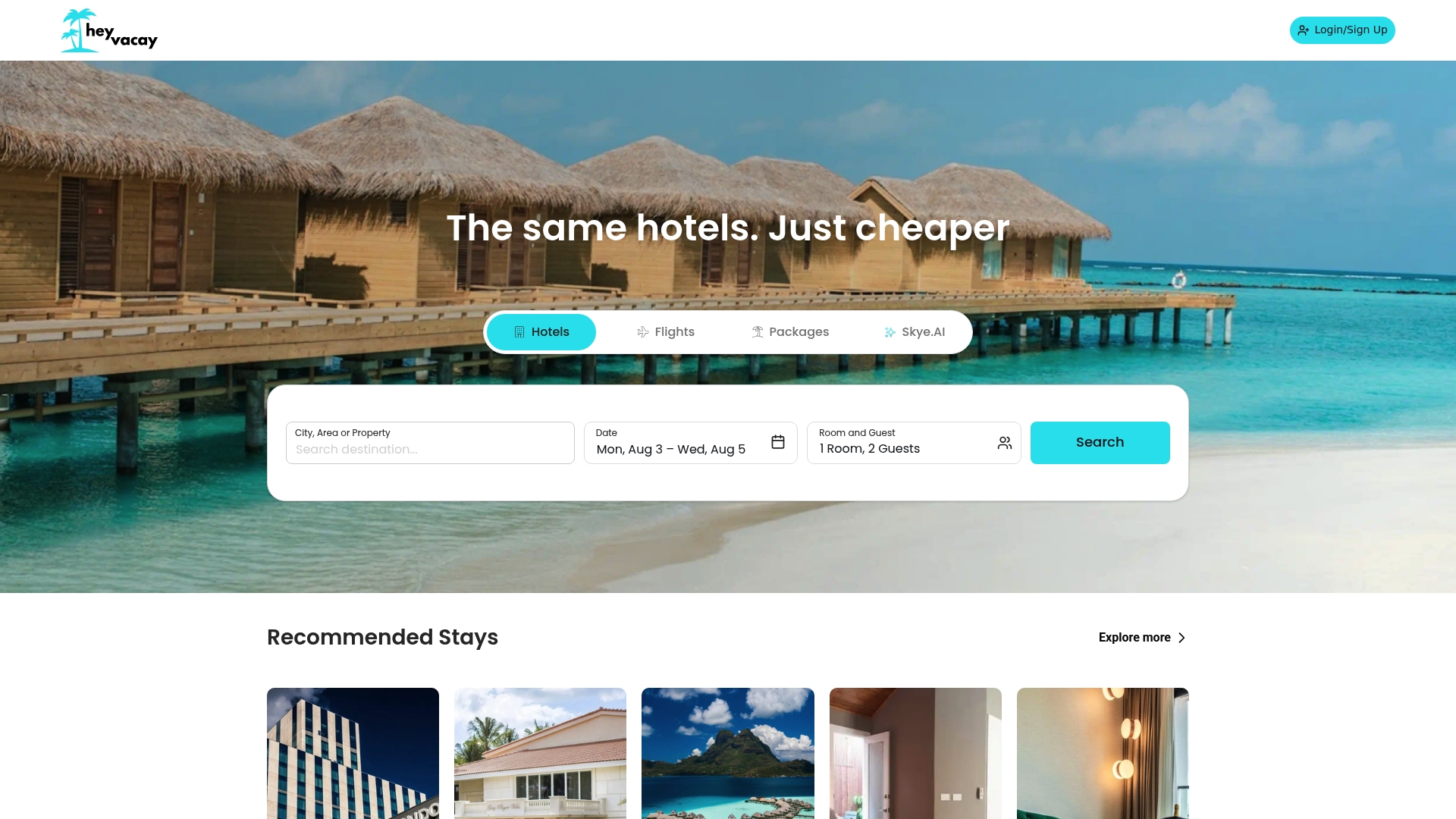
Getting started takes about 60 seconds. Enter your destination and dates, set your preference filters (travel style, must-have amenities, location priorities), and HeyVacay returns a ranked list with full pricing visible from the first result. No hidden resort fees added at checkout. No service charges that appear only when you enter your card number.
For group travel, the same transparent pricing applies across multiple rooms, which is where group booking platforms and OTAs most often bury per-person fees in the fine print. HeyVacay's display model keeps the total honest regardless of party size.
Search your next trip on HeyVacay and compare the total price against whatever you find elsewhere. The difference is usually visible within the first result.
Sources and further reading
The rankings and claims in this article draw on independent editorial testing and publicly available platform data. Key sources:
- Frommer's: Best and Worst Hotel Booking Sites for 2026 — Frommer's ran structured price checks across major booking platforms and found Google Travel winning the most price comparisons. Used to support price-accuracy rankings and the aggregator-vs-OTA distinction.
- Forbes Advisor: Best Hotel Booking Sites — Forbes compared 10 popular hotel booking sites on ease of booking, pricing transparency, and other factors. Used to support fee-transparency claims and best-practice tips.
- Kayak Hotels — Kayak's own published data on inventory coverage (2M+ properties, hundreds of third-party sites). Used to support inventory claims in the comparison table.
- HotelsCombined — Platform documentation on price alert features and meta-search reach. Used to support the price-monitoring tips section.
- Trivago — Trivago's published marketing data on partner coverage and savings claims. Used in the meta-search comparison.
A note on test dates: Price checks referenced here were conducted in early 2026. Hotel pricing is dynamic; rates, fees, and platform features change frequently. Run your own sample searches on two or three platforms before booking to confirm current pricing for your specific dates and destination.