

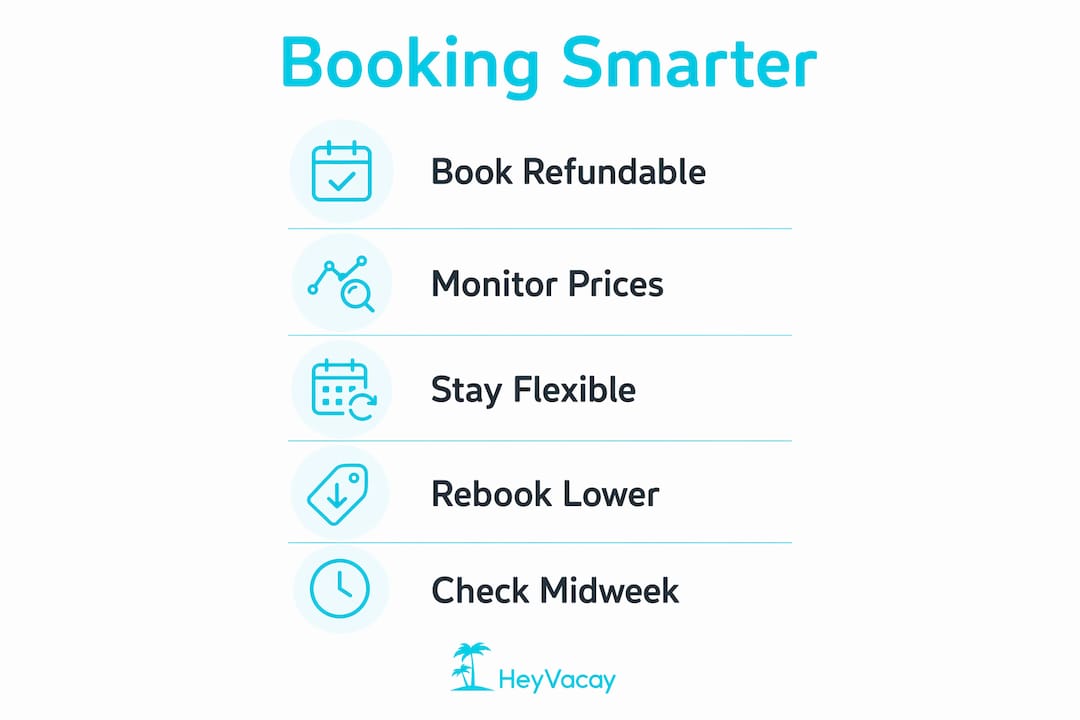
Hotel dynamic pricing means room rates change automatically based on real-time demand signals, sometimes multiple times per day. The single most effective thing you can do right now: book a refundable rate, then monitor for price drops and rebook if the rate falls. That one habit beats every "magic day" theory out there.
TL;DR
- Book refundable first, monitor prices, rebook if they drop
- Flexible dates beat fixed dates almost every time
- Set price alerts so you catch drops without watching manually
- For U.S. domestic trips, the sweet spot is generally 14–21 days before check-in
- Local events and low occupancy are the two biggest rate movers
Pro Tip: Book the refundable version of any rate you like, even if it costs a few dollars more. You keep your room, and if the price drops before your stay, you cancel and rebook at the lower rate.
Table of Contents
- How do hotels actually set prices in real time?
- Why a low hotel rate is often a smart buy, not a warning sign
- Step-by-step tactics to find lower hotel rates
- When should you book? Lead times that actually work
- How business travelers can work with dynamic pricing
- Red flags to watch before you rebook or cancel
- Key Takeaways
- The part most booking advice gets wrong
- Lower hotel rates without the manual work
- Useful sources and further reading
How do hotels actually set prices in real time?
Hotels don't set a rate and forget it. A revenue management system (RMS) pulls in live data and adjusts prices continuously, often without a human touching a single number.
The core signals driving those adjustments:
- Occupancy pace: If a property is filling faster than expected, rates climb. If rooms are sitting empty, rates drop.
- Local events: A conference, a concert, or a major sports game can push rates up sharply for specific nights.
- Day of week: Weekends spike in leisure markets; weekdays spike near business districts.
- Lead time: Prices often rise as the check-in date approaches and inventory shrinks.
- Length of stay: Some hotels price shorter stays higher to protect longer-stay revenue.
- Distribution channel: Rates can differ between a hotel's own site, OTAs, and corporate portals because each channel carries different commission costs.
The RMS pushes rate changes through a channel manager to every distribution point simultaneously. Dynamic pricing ingests real-time signals and can update rates multiple times per day to optimize occupancy and revenue. A human analyst checking a spreadsheet twice a week simply cannot compete with that cadence.
Industry data suggests AI-powered dynamic pricing can lift RevPAR and ADR meaningfully compared with static pricing models, which is exactly why virtually every major hotel brand now runs some form of algorithmic rate management.

Pro Tip: Check rates on a Tuesday or Wednesday for the same weekend stay. Mid-week searches often catch a rate refresh before weekend demand pushes prices back up.
Why a low hotel rate is often a smart buy, not a warning sign
A discounted rate usually means the hotel has unsold inventory and needs to fill it. That's a revenue-management decision, not a quality signal.
Hotels lower rates strategically during slow periods to avoid zero revenue on an empty room. Rate decreases are a tactical lever during shoulder and off seasons, not a sign something is wrong with the property. Common triggers for price cuts include low booking pace for the week, recent cancellations that opened inventory, weather or flight disruptions reducing demand, and shoulder-season lulls between peak periods.
A low rate is worth taking when:
- The rate is refundable (you can cancel if something better appears)
- The property has strong recent reviews and a verified rating
- The rate dropped recently rather than sitting low for weeks
- No major local event is coming that would normally push prices up
Pro Tip: Sort results by "recently reduced" or check whether a rate dropped in the last 24–48 hours. A fresh price cut often means the hotel just opened inventory and wants it filled fast.
Step-by-step tactics to find lower hotel rates
Work through these in order. The early steps take two minutes; the later ones reward a bit more effort.
- Book a refundable rate immediately. Lock in availability at today's price. You're not committed; you're holding a spot.
- Set a price alert for the same property and dates. Most price-tracking tools and booking platforms let you watch a specific listing.
- Run a flexible-date search. Shift your check-in by one or two days. A Thursday arrival instead of Friday can cut rates significantly in leisure markets.
- Try a weekday swap. Sunday–Thursday stays are almost always cheaper than Friday–Saturday in resort and city-center hotels.
- Search alternate neighborhoods. A hotel two miles from a downtown venue often prices 20–30% lower for the same quality tier.
- Consider a split stay. Booking two shorter stays at different properties can undercut a single longer booking when one of those windows has a rate spike.
- Check the hotel's direct site after finding a rate on an OTA. Some properties offer a price-match or a small loyalty perk for booking direct.
- Apply loyalty points or status. Even a basic loyalty tier can unlock member rates that aren't visible to anonymous searchers.
- Rebook after a price drop. Cancel the original refundable reservation and rebook at the lower rate. Price monitoring tools and automated alerts are among the most effective responses to fast-changing hotel rates.
Pairing flexible travel dates with flexible hotel searches compounds the savings. Moving a flight by a day often unlocks a hotel rate drop at the same time.
Pro Tip: Don't cancel a non-refundable rate to chase a lower price. Only the rebook strategy works when your original booking is fully refundable.
When should you book? Lead times that actually work
There is no single magic day to book a hotel. The right window depends on your destination, trip type, and the property itself.
| Trip type | Typical sweet spot | Notes |
|---|---|---|
| U.S. domestic, flexible market | 14–21 days out | Rates often drop in this window as hotels push to fill rooms |
| U.S. domestic, peak season | 14–21 days out | Popular properties sell out; waiting risks premium pricing |
| International | 1–3 months out | More lead time needed for availability and price stability |
| Boutique or small property | 4–8 weeks out | Limited inventory means fewer last-minute deals |
| Large urban chain hotel | 2–4 weeks out | High supply means last-minute deals are more common |
Booking too early can lock you into launch prices before the market has settled. Booking too late in a high-demand destination risks both sellouts and premium last-minute pricing.
Rules of thumb:
- Book refundable and monitor: works in almost every scenario
- Commit early for peak-season travel, boutique properties, and major-event weekends
- Wait for off-season or high-supply urban markets where last-minute deals are common
- Never book non-refundable in advance unless the savings are substantial and your plans are fixed
How business travelers can work with dynamic pricing
Corporate travel policies built around static rate caps often fail travelers in dynamic-pricing environments. A fixed cap of, say, $200 per night works fine in slow markets but forces travelers into substandard properties during high-demand periods.
Dynamic price caps replace a fixed ceiling with a median-market-based adjustment, keeping travelers within budget while capturing real market savings. Amex GBT describes this approach as a way to align policy with actual market conditions rather than arbitrary fixed numbers.
Practical steps for business travelers:
- Confirm your company's current cap type (static vs. dynamic) before booking
- Use your company's approved booking tool, which may already apply dynamic caps automatically
- Choose refundable rates whenever policy allows — it protects the company if plans change
- Save all receipts and rate screenshots; rate changes can trigger expense-report questions
- Flag unusually high rates to your travel manager with a market-context note rather than just booking over policy
Travel managers benefit from reviewing cap structures at least quarterly. A cap set in January may be significantly off-market by June if a major event season shifts local demand.
Red flags to watch before you rebook or cancel
Chasing a lower rate can cost you more than you save if you miss the fine print.
Watch for these warning signs:
- A "deal" that is non-refundable when a refundable option exists at a small premium
- Third-party booking fees that appear only at checkout, after the displayed rate
- Room type mismatches (the cheaper rate is for a smaller room or a different bed configuration)
- Cancellation windows that differ between the OTA listing and the hotel's own policy
- Rates that look lower but exclude taxes and resort fees that the original booking included
Before you cancel and rebook:
- Confirm the new rate is fully refundable or that you're within the cancellation window of the original booking.
- Verify the room type, floor, and amenities match your original reservation.
- Add all taxes and fees to both rates before comparing the final totals.
- Check recent reviews dated within the last 90 days, not just the overall score.
- Read the new cancellation policy line by line — OTA and direct policies sometimes differ for the same property.
Hotel pricing is not designed to discriminate by personal characteristics. Rate differences you see reflect demand signals, booking channel, and timing, not who you are.
Key Takeaways
Hotel dynamic pricing rewards travelers who book refundable, monitor prices, and stay flexible on dates — those three habits consistently outperform any fixed booking-day strategy.
| Point | Details |
|---|---|
| Book refundable first | Lock in a rate now, then monitor and rebook if prices drop before your stay. |
| Flexible dates save money | Shifting check-in by one or two days, especially to midweek, often cuts rates significantly. |
| Domestic sweet spot | U.S. domestic trips often see the best rates 14–21 days before check-in. |
| Business travelers need dynamic caps | Static corporate rate caps can fail in dynamic markets; median-based caps capture real savings. |
| Use HeyVacay to automate monitoring | HeyVacay's AI tracks price changes and surfaces lower rates so you don't have to watch manually. |
The part most booking advice gets wrong
Most articles about hotel pricing tell you to find the right day to book, as if there's a calendar trick that unlocks cheap rates. There isn't. Hotels aren't running a weekly sale on Tuesdays. They're running a continuous auction where the price reflects exactly how many rooms are left and how many people want them right now.
The real opportunity isn't timing a single booking decision perfectly. It's treating your initial booking as a placeholder and staying in the game until check-in. A refundable reservation costs you nothing to hold. A price drop of $40 per night on a four-night stay is $160 back in your pocket with a two-minute rebook. That's the actual edge.
What most travelers underestimate is how often prices fall after an initial booking, not just before it. Cancellations open inventory. Slow booking pace triggers automatic rate cuts. Weather forecasts shift demand. The hotel's algorithm responds to all of it, and if you're watching, you benefit.
The travelers who consistently pay less aren't the ones who guessed the right booking day. They're the ones who booked refundable, set an alert, and showed up to rebook when the algorithm did its job.
Lower hotel rates without the manual work
Tracking price drops across multiple properties and dates is exactly the kind of task that drains time without requiring much skill. HeyVacay handles it automatically.
The platform uses AI to search luxury and budget hotels at lower rates, with transparent pricing and no hidden fees at checkout. You see the real total before you commit.

What HeyVacay does for you:
- Monitors real-time hotel rates so you catch price drops without checking manually
- Surfaces refundable options first, so the rebook strategy is always available
- Presents full pricing upfront, including taxes and fees, so comparisons are honest
- Covers multi-destination searches for trips with more than one stop
If the tactics in this article sound useful but the manual monitoring sounds like work, start your search on HeyVacay and let the platform do the watching for you.
Useful sources and further reading
- SiteMinder: Hotel Dynamic Pricing Complete Guide — Detailed breakdown of how RMS systems ingest real-time signals and push rate updates across channels; primary source for algorithmic pricing behavior.
- Mews: Hotel Dynamic Pricing Strategies — Covers revenue uplift data and practical strategies for hotels; useful for understanding why AI-driven pricing has become standard.
- Amex GBT: What Is Hotel Dynamic Pricing? — Best available source on dynamic price caps and corporate travel policy adaptation.
- RateRanger: Best Time to Book a Hotel — Aggregated OTA data on domestic and international booking windows; primary source for the 14–21 day domestic sweet spot.
- Travel + Leisure: Best Time to Book a Hotel Room — Expert consensus debunking the single "magic day" myth and supporting flexibility as the core savings strategy.