

If your group needs 9 or more rooms, requesting a dedicated group rate is worth the effort. For 1–8 rooms, skip the formal process entirely and run a quick AI-assisted multi-room price check instead. That single decision saves most small-group travelers hours of back-and-forth with hotel sales desks.
Here's how the math breaks down by group size:
- 1–8 rooms: Book individually or use an AI-assisted search like Heyvacay to compare side-by-side multi-room pricing instantly. Experts agree that traditional group channels are usually unnecessary at this scale.
- 9–24 rooms: Submit a group request directly to the hotel or use an AI-assisted group quoting tool. This is where group hotel rates start to make financial sense.
- 25+ rooms: Contact the hotel directly or submit a formal RFP. Hilton allows self-service booking for a limited number of guest rooms online; larger requests require direct contact or a formal pricing request.
Heyvacay is the fastest AI-assisted path for small groups who want transparent, side-by-side multi-room pricing without the contract complexity.
Table of Contents
- When should you request group rates vs. book individually?
- How do hotels actually set group rates?
- How to request and confirm a group hotel rate
- When does hiring a group agent actually make sense?
- Heyvacay makes multi-room pricing transparent for small groups
- Key Takeaways
- Why speed and transparency matter more than the headline rate
- Sources and further reading
When should you request group rates vs. book individually?
The right channel depends on your room count, your flexibility, and whether you need guaranteed perks like meeting space or contiguous rooms.
1–4 rooms: Book individually, full stop. Hotels rarely offer meaningful discounts at this size, and the contract terms (attrition, deposits, cutoff dates) add risk with no real upside. An AI-assisted multi-room search gives you the same visibility in minutes.
5–8 rooms: Still a gray zone. Individual booking often wins on price, but if you need everyone on the same floor or a shared common area, a quick group inquiry is worth sending. Run a side-by-side per-room price check first to see whether a negotiated block actually saves anything.
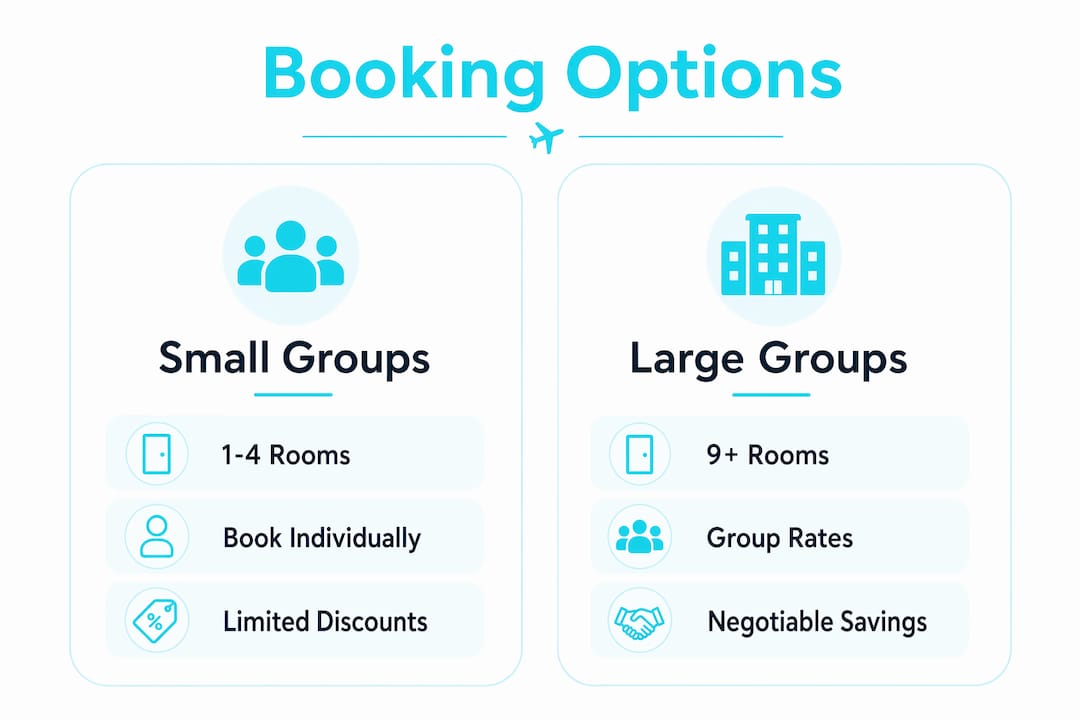
9–24 rooms: This is where a formal group request pays off. Hotels take blocks this size seriously, and you can negotiate concessions like complimentary rooms, free breakfast, or waived parking. Hotels prioritize larger blocks for their deepest discounts, but the 9–24 range is enough to get meaningful attention from a group sales desk.
25+ rooms: Go direct or submit an RFP. At this scale, a dedicated group agent or hotel sales manager will handle your account, and the contract terms become complex enough to warrant careful review.
Triggers that push you toward a group contract regardless of size:
- You need guaranteed contiguous rooms or a specific floor
- Meeting space, banquet service, or AV equipment is required
- Your organization has a fixed per-person accommodation budget
- Arrivals and departures are staggered across multiple days
- You need consolidated billing for expense reporting
Pro Tip: Before contacting any hotel group desk, run an AI-assisted multi-room search for your exact dates and room count. If the per-room price matches or beats what a group rate would likely offer, you have your answer in under two minutes.

How do hotels actually set group rates?
The advertised nightly rate is just the starting point. Hotels calculate group pricing using a cluster of factors, and the final cost per occupied room often looks different from the headline number.
What drives the rate:
- Block size: Larger blocks unlock deeper discounts. Smaller blocks under roughly 10 rooms rarely get the same contract flexibility or concessions as larger groups.
- Demand and season: Peak dates, local events, and blackout periods shrink negotiating room fast.
- Minimum night stay: Many group contracts require a two-night minimum, which affects total budget even when the nightly rate looks attractive.
- Negotiated concessions: Complimentary rooms for the coordinator, free Wi-Fi, parking waivers, and breakfast packages are all on the table. Platforms and agents routinely negotiate comp rooms, vouchers, and local planner support as part of standard group contracts.
- Loyalty program status: Some chains factor in your loyalty tier when setting initial group pricing.
Key contract terms, plain-language:
| Term | What it means |
|---|---|
| Attrition clause | You pay for a percentage of reserved rooms even if guests don't show. Typically 80–90% of the block. |
| Cutoff date | The deadline by which guests must book their rooms. Unreserved rooms revert to the hotel's general inventory. |
| Deposit schedule | Upfront payments required to hold the block, often non-refundable. |
| Complimentary rooms | Free rooms earned at a ratio (e.g., 1 comp per 40 paid rooms). |
| Rooming list | The document you submit with each guest's name, room type, and arrival/departure date. |
Choice Hotels, for instance, makes group rates available when booking 10 or more rooms at participating properties, and requests for more than 40 rooms require a separate group request form.
"The total group cost is more than the nightly rate. Contracts often include attrition clauses, deposits, and cancellation terms that change the effective price per occupied room — even when the per-night rate looks lower than what you'd pay booking individually." — Expedia Group, group booking guidance
Group booking platforms sometimes advertise savings of up to 30% compared to published standard rates, but those figures don't account for attrition penalties or extras that can push the effective cost back up.
How to request and confirm a group hotel rate
A clean, complete request gets a faster response and better terms. Here's the sequence:
- Scope your needs first. Lock in your exact arrival and departure dates, room types (king, double, accessible), estimated room count, and any meeting or amenity requirements before contacting anyone.
- Set a target budget. Know your per-room-per-night ceiling going in. Hotels respond better to a specific number than a vague "looking for a deal."
- Identify the right contact. For chains like Hilton (up to 25 rooms online) or Marriott, the group booking page is your first stop. For independent hotels, call the sales office directly.
- Send a complete request. Include: exact dates, room count by type, target nightly rate, meeting/amenity needs, flexibility window (±2 days if you have it), and your preferred attrition tolerance.
- Follow up within 48 hours if you haven't heard back. Group desks handle volume, and a polite follow-up moves your request to the top.
- Compare at least two properties before signing anything. Competing bids are your strongest negotiating lever.
- Review the full contract before paying any deposit. Check attrition percentage, cutoff date, cancellation terms, and deposit schedule.
- Confirm the rooming list deadline and communicate it to your group immediately after signing.
Timeline to set: AI-assisted quoting tools return competing hotel offers near-instantly. Direct RFPs typically take 24–72 hours. Full contract negotiations for complex events can run longer.
Sample request message:
Pro Tip: Mentioning that you're comparing competing bids almost always prompts a hotel to sharpen its initial offer. You don't need to name the other property.
When does hiring a group agent actually make sense?
For most small groups, a dedicated agent is overkill. But there are situations where the cost is clearly justified.
Match your situation to the right channel:
- Weekend reunion, 8–15 rooms, one property: DIY with an AI-assisted group quoting tool. The contract is simple enough to review yourself.
- Corporate offsite, 20 rooms, meeting space required: Hotel direct or a group quoting platform with contract review support. The meeting-space logistics add enough complexity to warrant a closer look at terms.
- Wedding room block, 30–60 rooms, multiple arrival days: A dedicated group agent earns their fee here. They handle attrition negotiation, consolidated billing, and guest communication.
- Sports team travel, multi-city routing: Agent, without question. Multi-property coordination across cities is where agents prevent costly mistakes.
Agents provide contract negotiation, attrition protection, consolidated billing, and event logistics management. Those services matter most when your booking involves meeting space or strict arrival rules. For a straightforward room block, group booking convenience is often about keeping a party consolidated rather than guaranteeing the lowest per-night price.
Escalate to a live agent when:
- You need rooms at multiple properties or across multiple cities
- Your company has strict internal travel policies requiring contract review
- The event includes banquet service, AV, or dedicated event staff
- Your group exceeds 25 rooms and involves staggered arrivals
For groups needing up to 25 rooms, an AI-assisted platform handles the comparison and quoting faster than any agent can.
Heyvacay makes multi-room pricing transparent for small groups
Most small-group travelers don't need a formal group contract. They need to see real per-room pricing for multiple rooms on the same dates, side by side, without hidden fees buried in the fine print.
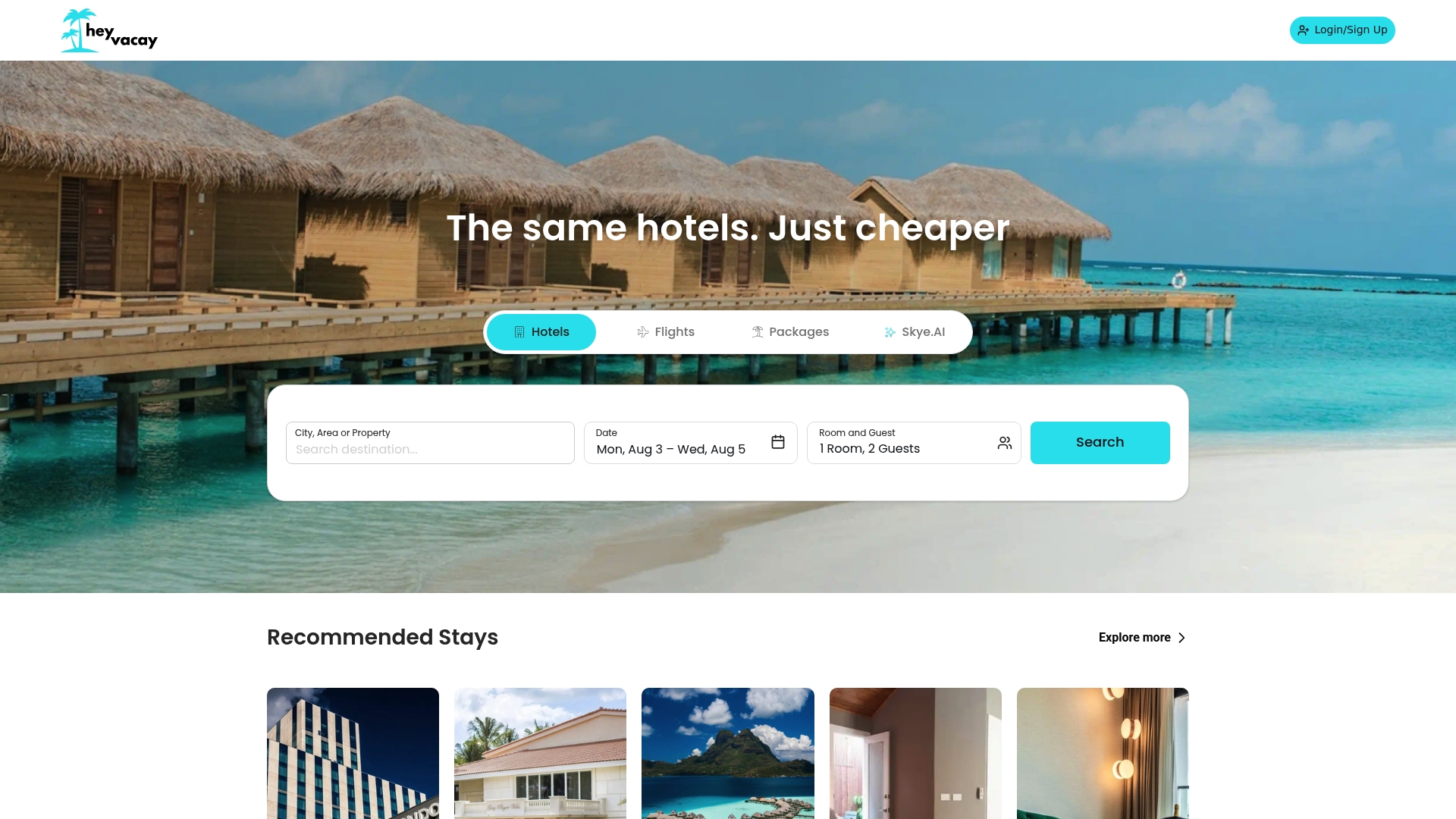
Heyvacay does exactly that. Its AI-assisted search surfaces hotel options across budget and luxury tiers, shows per-room line items for multi-room searches, and keeps pricing transparent from the first result to check out. No surprise fees, no rate inflation at the payment screen. For groups of 2–24 rooms that don't need a formal block contract, Heyvacay cuts the research time from hours to minutes and gives you the side-by-side comparison you'd otherwise have to build manually across three or four booking sites.
Start your multi-room search at Heyvacay and see what your group's stay actually costs before you commit to anything.
Key Takeaways
For groups of 9 or more rooms, a formal group rate request is worth pursuing; for smaller groups, an AI-assisted multi-room price check is faster and often equally competitive.
| Room count drives the decision | Groups of 1–8 rooms rarely benefit from formal group contracts; 9–25 is the practical threshold for a group rate request. Requests for more than 25 rooms require direct hotel contact or a formal pricing request. | Contract terms change total cost | Attrition clauses, deposits, and cutoff dates can raise effective cost above the advertised nightly rate. | | Agents suit complex bookings | Hire a group agent for 25+ rooms, multi-city routing, or events requiring meeting space and logistics. | | Response times vary widely | AI-assisted tools return quotes near-instantly; direct RFPs take 24–72 hours or more. | | Heyvacay for small groups | Heyvacay's AI-assisted search shows transparent per-room pricing for 2–24 rooms with no hidden fees. |
Why speed and transparency matter more than the headline rate
The group hotel market has a transparency problem that most travelers don't notice until they're already locked into a contract. A quoted nightly rate looks attractive, then the attrition clause, deposit schedule, and cancellation penalty turn a "30% savings" into a wash or worse. The travelers who come out ahead aren't the ones who negotiated the lowest headline rate. They're the ones who read the full contract before signing and compared the effective per-person cost, not just the nightly number.
For small groups, the fastest way to get that clarity is an AI-assisted multi-room search that shows total cost upfront. That's the approach I'd recommend before any group booking conversation, regardless of size.
Sources and further reading
- Find the Best Hotel Group Rates and Book Room Blocks — Hilton
- Group Hotel Quote Request — Expedia Group
- Find the Best Group Travel Rates and Offers — Choice Hotels
- Group Reservation Booking — Marriott Bonvoy
- GroupHotelRates — expert guidance on group booking thresholds
- Hotel Group Bookings and Rates — Extended Stay America
- Group Hotel Quote Request — Hotels.com Groups