

The best Priceline alternatives for most U.S. travelers are HeyVacay (hotels, transparent pricing), Google Flights (flights, price tracking), Booking.com (global hotel inventory), Kayak (aggregator, price alerts), and Expedia (bundled trips). Each one solves a specific gap Priceline leaves open, whether that's opaque deal trade-offs, limited loyalty rewards, or murky cancellation terms.
Here's the short version:
- HeyVacay — AI-driven hotel search with no hidden fees; best for hotel-first travelers who want clear pricing
- Google Flights — best free flight aggregator with a flexible-date calendar and price tracking
- Booking.com — widest global hotel inventory with free-cancellation filters
- Kayak — best all-in-one aggregator for flights, hotels, and cars with price alert tools
- Expedia — best for bundling flights, hotels, and cars into one discounted package
- Skyscanner — best for finding cheap international flights across hundreds of carriers
- Hopper — best for flight price prediction and fare-lock features
- Agoda — best for Asia-Pacific hotel deals with deep discount inventory
- Hotwire — best for opaque last-minute hotel deals at steep discounts
- Momondo — best for travelers who want the broadest fare comparison in one search
Table of Contents
- How do these Priceline alternatives actually compare?
- Which alternative fits your specific trip?
- How do you pick the right booking site for your trip?
- What made Priceline different, and do alternatives match it?
- Tactics that actually lower your price on these platforms
- How these recommendations were put together
- What's the final recommendation?
- Key Takeaways
- The booking site landscape rewards skeptics, not loyalists
- HeyVacay finds you better hotel rates without the guesswork
- Useful sources
How do these Priceline alternatives actually compare?
The table below covers the dimensions that matter most when you're deciding where to book. Booking model terminology: OTA means the platform handles your reservation; aggregator means it redirects you to book elsewhere; opaque means the hotel name is hidden until after payment.
| Platform | Best for | Inventory | Fees & transparency | Loyalty/discounts | Booking model | Cancellation flexibility | Payment options | Mobile UX | Customer service |
|---|---|---|---|---|---|---|---|---|---|
| HeyVacay | Hotel value, clear pricing | Hotels | No hidden fees, AI-matched rates | Transparent deal matching | OTA/marketplace | Varies by property | Standard | Clean, fast | Direct support |
| Google Flights | Flight price tracking | Flights only | No booking fees | None (redirects) | Aggregator | Depends on airline | Via airline | Excellent | None (redirects) |
| Booking.com | Global hotel inventory | Hotels, some flights/cars | Service fees vary | Genius loyalty tiers | OTA | Strong free-cancel filters | Credit card, some BNPL | Strong | — |
| Kayak | Multi-product search | Flights, hotels, cars, packages | No booking fees | None (redirects) | Aggregator | Depends on provider | Via provider | Excellent, price alerts | None (redirects) |
| Expedia | Bundled trips | Flights, hotels, cars, packages | Service fees on some bookings | One Key rewards | OTA | Varies by bundle | Credit card, Affirm | Strong | — |
| Skyscanner | Cheap international flights | Flights, hotels, cars | No booking fees | None (redirects) | Aggregator | Depends on airline | Via airline/OTA | Good | None (redirects) |
| Hopper | Fare prediction, price locks | Flights, hotels, cars | Fare-lock fee applies | Carrot Cash rewards | OTA/aggregator | Varies; some fees | Credit card, BNPL | App-first, excellent | In-app only |
| Agoda | Asia-Pacific hotels | Hotels, flights | Agoda Cash discounts | AgodaCash rewards | OTA | Varies by property | Multiple, incl. PayPal | Strong | — |
| Hotwire | Opaque last-minute hotels | Hotels, cars | Low fees, opaque pricing | None | Opaque OTA | Mostly non-refundable | Credit card | Decent | Limited |
| Momondo | Broadest fare comparison | Flights, hotels, cars | No booking fees | None (redirects) | Aggregator | Depends on provider | Via provider | Good | None (redirects) |
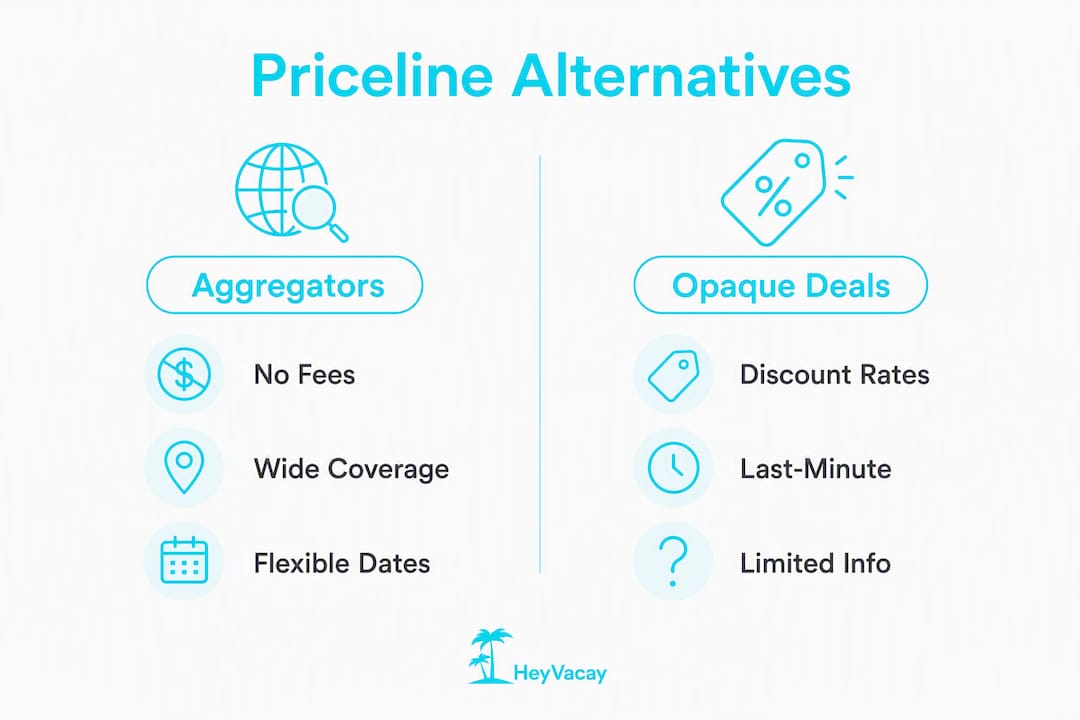
The biggest trade-off to notice: aggregators like Google Flights, Kayak, Skyscanner, and Momondo charge no booking fees and give you the widest price view, but they hand you off to a third party to complete the booking. That means customer service, cancellation terms, and payment options all depend on whoever you land on. OTAs like Booking.com, Expedia, and HeyVacay keep the booking in-house, which usually means clearer accountability when something goes wrong.
Which alternative fits your specific trip?
Best for flights: Google Flights
Google Flights is the fastest way to scan fares across hundreds of airlines. The flexible-date calendar color-codes cheapest days at a glance, and the price-tracking feature sends alerts when a fare drops. No booking fee, no markup. The catch: you book directly with the airline, so baggage policies and change fees are entirely the airline's rules.
Best for hotels: HeyVacay
HeyVacay uses AI to surface hotel options at lower rates without burying the final price in resort fees or service charges. If you're booking a hotel and want to know exactly what you'll pay before you confirm, this is the cleaner path. No opaque deals, no mystery rooms.

Best for bundling flights, hotels, and cars: Expedia
Expedia's bundle discounts are real. Combining a flight, hotel, and car rental in one transaction typically shaves more off the total than booking each separately, and the One Key rewards program lets you earn points across Expedia properties. Service fees can appear on some bookings, so check the final total before confirming.

Best for last-minute hotel deals: Hotwire
Hotwire uses the same opaque model Priceline pioneered. You see the star rating, neighborhood, and amenities, but the hotel name stays hidden until you pay. Rates are often well below standard OTA prices. The trade-off is firm: most Hotwire hotel bookings are non-refundable, so use this only when your dates are locked.
Best for international flights: Skyscanner
Skyscanner scans a wider range of carriers than most U.S.-focused tools, including budget airlines that don't appear on Google Flights. Useful for routes to Europe, Southeast Asia, or Latin America where low-cost carriers dominate. Like other aggregators, it redirects you to book elsewhere.
Best for Asia-Pacific hotels: Agoda
Agoda has deep inventory across Southeast Asia, Japan, South Korea, and Australia, often with rates and deal structures that other OTAs don't match in those markets. AgodaCash rewards can offset future bookings. Less useful for domestic U.S. trips.
Best for fare prediction: Hopper
Hopper's algorithm predicts whether a flight price will rise or fall and tells you whether to book now or wait. The fare-lock feature lets you hold a price for a fee, which is useful when you're not ready to commit. Hopper is app-only for most features, and some of its add-on fees (cancel-for-any-reason, price-freeze) can add up if you're not paying attention.
Best for broad hotel inventory: Booking.com
Booking.com lists properties in virtually every country, from budget hostels to boutique hotels, with strong free-cancellation filtering. The Genius loyalty program offers discounts at participating properties after a few bookings. Direct booking with a hotel chain can still beat Booking.com on perks like room upgrades, but for independent properties, Booking.com's inventory is hard to match.
How do you pick the right booking site for your trip?
Work through these steps before you commit to any platform.
- Define your top priority. Price, flexibility, or rewards? If you need free cancellation, filter for it first. If you're chasing the lowest number, be ready to accept non-refundable terms.
- Check inventory coverage. Not every platform covers every route or property type. Agoda is thin on domestic U.S. hotels. Hotwire doesn't cover most international flights. Confirm the platform actually has what you need before investing time in it.
- Read cancellation and change fees before booking. OTAs and airlines each set their own rules, and they vary wildly. A "free cancellation" label on an aggregator result may not survive the click-through to the actual booking page.
- Confirm payment terms. If you're using buy-now-pay-later (BNPL), read the financing terms before you select it. Some BNPL arrangements report to credit bureaus, and missed payments can carry fees or affect your credit score.
- Test the mobile app if you're booking last-minute. App-only deals exist on several platforms. If the app is clunky or the booking flow buries fees until the final screen, that's a signal to book elsewhere.
Red flags to watch for:
- Cancellation terms that only appear on the final confirmation screen
- Resort fees listed separately from the nightly rate (common on OTAs and direct hotel sites alike)
- Third-party payment holds that tie up your card for days after check-out
- Opaque deals with no room-type details when you need a specific bed configuration
Pro Tip: Run your search on an aggregator like Kayak or Google Flights to find the best-looking rate, then open the hotel's direct website in a second tab. Compare the final total, including taxes and resort fees, before you book. Direct hotel bookings sometimes match the OTA price and add perks like free breakfast or late checkout that don't show up on third-party sites.
What made Priceline different, and do alternatives match it?
Priceline built its reputation on two features most other platforms don't replicate: Name Your Price (now largely retired) and Express Deals, which are opaque bookings where you get a steep discount in exchange for not knowing the hotel name until after payment.
The trade-offs with opaque deals are specific:
- What you give up: hotel identity before booking, the ability to earn loyalty points at the property, and usually any chance of a refund
- What you gain: rates that can run significantly below standard OTA prices, especially for last-minute hotel nights in major cities
Hotwire is the closest direct match to Priceline's opaque hotel model. For flights, no major U.S. platform currently offers a true bidding mechanic.
Other booking models work differently:
- Aggregators (Google Flights, Kayak, Skyscanner, Momondo) show transparent prices across many suppliers with no markup. You see the hotel or airline name upfront. No mystery, but also no opaque discount.
- Standard OTAs (Booking.com, Expedia, Agoda) show full property details and let you filter by cancellation policy. Rates are competitive but rarely as low as a well-timed opaque deal.
- HeyVacay uses AI to surface hotel rates that are lower than standard OTA pricing while keeping the hotel name and pricing fully visible. That's the opposite of the opaque model: you get the deal without the guesswork.
Pro Tip: If you're considering an opaque deal on Hotwire, search the same dates and star rating on a transparent OTA first. If the price gap is less than $30 per night, the transparent booking is almost always worth it for the flexibility and loyalty credit alone.
Tactics that actually lower your price on these platforms
- Set price alerts on Kayak or Google Flights. Both tools track fare volatility and notify you when a price drops. This removes the need to recheck manually every few days.
- Use flexible-date calendars. Shifting a flight by one or two days can cut fares meaningfully. Google Flights and Skyscanner both show color-coded calendars that make the cheapest windows obvious.
- Search nearby airports. Flying into a secondary airport 60–90 minutes from your destination often costs less, especially on domestic routes.
- Bundle when you can on Expedia. Adding a hotel to a flight booking, or a car to both, typically unlocks a package discount that beats booking each piece separately.
- Check Agoda for Asia-Pacific routes. Its discount structure in that region often undercuts what you'd find on a U.S.-focused OTA.
On payment options: BNPL services like Affirm (available through Expedia and Hopper) let you lock a price without paying the full amount upfront. That's useful when fares are low but your travel date is months away. The risk is real, though. BNPL financing terms vary by provider, and if you miss a payment, you may face interest charges or a credit bureau report. Always confirm the repayment schedule and whether the service reports to credit bureaus before selecting it at checkout.
Pro Tip: After finding a strong hotel rate on an aggregator, open the hotel's own site and compare the final total including taxes and any resort fees. The aggregator price sometimes looks better until you reach the payment screen.
How these recommendations were put together
Recommendations here are based on a structured comparison across platforms covering domestic U.S. routes (New York to Los Angeles, Chicago to Miami) and international routes (New York to London, Los Angeles to Tokyo), with sample date ranges spanning both peak and off-peak periods in 2026.
| Dimension evaluated | What was checked |
|---|---|
| Flight pricing | Sample round-trip fares on identical routes and dates |
| Hotel pricing | Mid-range and upscale properties in major U.S. cities |
| Booking flow | Steps to complete a reservation, fee visibility at each stage |
| Mobile app | Ease of search, alert setup, and checkout on iOS |
| Cancellation clarity | Where cancellation terms appear and how clearly they're stated |
| Customer service | Availability of live support and refund process transparency |
Platform selection was informed by traffic and competitor data showing which sites draw the most volume in Priceline's category, cross-referenced with industry competitor profiles and user-priority research identifying the pain points travelers most commonly cite when leaving Priceline.
Limitations: Prices fluctuate constantly. Any specific fare or rate mentioned as an example reflects a point-in-time check and will differ when you search. Platform availability for certain features (BNPL, price locks) may vary by region within the U.S.
What's the final recommendation?
For most U.S. travelers, start with Google Flights or Kayak to scan the market, then book through the platform that best matches your specific need.
- Best for hotel-first travelers: HeyVacay. Transparent pricing, AI-matched rates, and no hidden fees make it the cleaner choice when accommodation is your main cost.
- Best for flights: Google Flights for domestic; Skyscanner for international routes with budget carriers.
- Best for bundles: Expedia, especially when combining flights, hotels, and cars in one transaction.
- Best for last-minute opaque deals: Hotwire, when your dates are firm and you don't need a refund option.
When none of those fit, Booking.com covers the widest hotel inventory globally, and Hopper is worth checking if you want algorithmic guidance on whether to book now or wait.
Action step: Run your search on Kayak or Google Flights first to establish a baseline price. Then check HeyVacay for hotel-specific rates and compare the final totals, including all taxes and fees, before confirming.
Key Takeaways
For hotel-focused travelers, HeyVacay's transparent, AI-driven pricing is the most direct alternative to Priceline's opaque model, while Google Flights and Kayak lead for flight discovery.
| Point | Details |
|---|---|
| Start with an aggregator | Use Kayak or Google Flights to establish a baseline price before committing to any platform. |
| Match platform to trip type | Hotels: HeyVacay; flights: Google Flights or Skyscanner; bundles: Expedia; last-minute opaque: Hotwire. |
| Watch for hidden fees | Resort fees, service charges, and BNPL interest can erase apparent savings; always check the final total. |
| Cross-check direct hotel sites | Direct bookings sometimes match OTA prices and add perks like upgrades or flexible cancellation. |
| HeyVacay for hotel value | HeyVacay's AI-matched rates and no-hidden-fee model make it the recommended pick for hotel-first travelers. |
The booking site landscape rewards skeptics, not loyalists
Most travelers pick one platform and stick with it out of habit. That's exactly what the platforms count on. Loyalty programs are designed to make switching feel costly, but the actual price difference between platforms on any given search can be significant, and the platform that won last time may not win this time.
The more interesting shift happening right now is the move away from opaque deals. Priceline built a business on the idea that travelers would trade information (the hotel name) for a lower price. That model made sense when online booking was new and inventory was scarce. Today, with aggregators scanning hundreds of suppliers in real time and AI-driven tools like HeyVacay surfacing competitive hotel rates with full transparency, you rarely have to choose between a good price and knowing what you're buying.
The travelers who consistently pay less aren't the ones who found the perfect platform. They're the ones who run a quick multi-site check, read the cancellation terms before clicking confirm, and know when a "deal" is actually just a non-refundable rate dressed up as a discount.
HeyVacay finds you better hotel rates without the guesswork
Most booking sites make you choose: pay less or know what you're getting. HeyVacay removes that trade-off. The platform uses AI to match you with hotels at lower rates, shows the full price upfront with no hidden fees, and skips the opaque-deal mechanics that leave you guessing until after you've paid.
For travelers who care most about where they sleep, HeyVacay is built around that priority. Search across luxury and budget properties, compare real final prices, and book without worrying that a resort fee will surface at checkout. If you're planning a multi-destination trip, the platform handles that too.
Search hotels on HeyVacay and see what the AI surfaces for your dates before you commit anywhere else.
HeyVacay is the publisher of this article and a recommended option in the comparison above. Recommendations are based on platform features and publicly available pricing; HeyVacay earns a commission on completed hotel bookings made through the platform.
Useful sources
- BECU: Buy now, pay later pros and cons for travel — Explains BNPL financing terms, repayment risks, and credit implications for travel bookings.
- SmarterTravel: Should you book hotels direct or through an OTA? — Covers the practical trade-offs between direct hotel bookings and OTA reservations, including loyalty perks and cancellation clarity.
- SimilarWeb: Priceline competitors — Traffic and market-level data on platforms competing in Priceline's category.
- Owler: Priceline competitors and alternatives — Corporate-level competitor profiles used to validate the platform shortlist.
- HeyVacay — AI-driven hotel booking platform with transparent pricing and no hidden fees.