

AI travel apps, in the sense that matters for booking a room, are AI-powered hotel search platforms that scan thousands of rates in real time and surface the cheapest option with every mandatory fee already included. The verdict: the good ones save you real money and show the full price before you pay, which is why HeyVacay is built around that exact promise. New federal rules on fee disclosure make this kind of transparency less optional than it used to be.
TL;DR:
- AI hotel apps must show total prices upfront, including mandatory fees, due to new federal regulations enforced from May 12, 2025.
- Accurate rate sourcing from multiple channels and transparent fee breakdowns are key signals of a trustworthy app that can truly save money.
- Dynamic pricing and demand forecasting by AI can lower rates, but only if the app updates prices frequently and displays all-in costs before booking.
- Protect your privacy by reviewing the platform’s data policies, avoiding platforms that require excessive permissions, and rechecking the total price before payment.
- Using refundable rates, searching flexible dates, and verifying total costs upfront can maximize savings with AI-driven hotel booking apps.
Table of Contents
- What Are AI Travel Apps for Hotel Booking?
- Why Does Total-Price Transparency Matter Now?
- How Do You Choose an AI Hotel App That Actually Saves You Money?
- How Can You Use an AI Hotel App to Lower Your Total Cost?
- Can AI Travel Apps Handle Flights and Car Rentals Too?
- Is Your Data Safe With AI Hotel-Booking Apps?
- How Does AI Personalization Actually Improve Your Hotel Search?
- Where Do AI Hotel Recommendations Get It Wrong?
- HeyVacay's Perspective on Transparent AI Savings
- Try HeyVacay: Book Smarter, Not Just Faster
- Sources
What Are AI Travel Apps for Hotel Booking?
An AI hotel-booking app is software that pulls live rate data from dozens of sources at once and uses machine learning to rank, match, and sometimes predict prices, instead of showing you one static list from one hotel chain. Think of it as the difference between checking a single store's price tag and having someone check every store in town, including the ones that don't advertise their best deals publicly.
These platforms pull from several distinct pools of data:
- Online travel agencies (OTAs) like the big aggregator sites, which list negotiated bulk rates.
- Hotel direct channels, where a property sometimes undercuts its own OTA listings to avoid commission fees.
- Metasearch feeds, which compare prices across multiple booking sites simultaneously.
- Private or member-only rates, unlocked through loyalty programs or app-specific partnerships.
The AI layer does three things with that raw data. It runs continuous rate checks (some hotel revenue systems now adjust prices dozens of times a day, so a price you saw at 9 a.m. may not exist by noon). It forecasts demand using signals like flight searches, local events, and even weather, a technique detailed by hospitality tech analysts. And increasingly, it matches prices automatically. Radisson Hotel Group, for example, launched an AI-powered system that detects and matches lower publicly available rates without a guest having to ask.
The catch: none of this guarantees a fee-free total. An app can find you the lowest base rate on the internet and still bury a resort fee or a service charge in the fine print unless it's specifically built to display the all-in price upfront. That distinction is where the next section matters.
Why Does Total-Price Transparency Matter Now?
It matters because it's no longer just a nice feature. As of May 12, 2025, the FTC's rule on unfair or deceptive fees requires businesses advertising short-term lodging to clearly disclose the total price, including mandatory fees, at the time a price is first shown, not buried at checkout.
That single change reshapes what you should expect from any hotel app:
- The price you see in search results should already include mandatory fees, not just the nightly rate.
- Optional charges (parking, breakfast) can still be listed separately, but mandatory ones cannot.
- Enforcement applies at the federal level, which means platforms have real legal exposure for hiding costs.
The FTC has estimated the rule could save consumers as much as 53 million hours a year that would otherwise go toward hunting down the real price of a room. Momentum is also building behind the Hotel Fees Transparency Act, and industry reporting from Skift notes that major platforms, including Airbnb, have already started showing total prices upfront in response to the pressure.
Pro Tip: Screenshot the total price at the moment you see it, before you click "book." If the checkout total differs, you have a paper trail for a dispute or a chargeback.
For travelers, this translates into fewer surprises at checkout and a much easier time comparing two apps side by side, since both are now legally required to show the same kind of number.
How Do You Choose an AI Hotel App That Actually Saves You Money?
Not every app that claims to use AI is actually finding you a better deal, some are just running a search box in front of the same OTA inventory everyone else has. Here's how to tell the difference in under two minutes:
- Check whether the total price is shown before checkout. If you have to click through three screens to find the resort fee, that's a red flag, not a technical limitation.
- Look for a fee breakdown. A trustworthy app itemizes taxes and mandatory charges instead of lumping them into a vague "additional fees" line.
- Ask where the rates come from. Apps that pull from direct hotel channels as well as third-party listings tend to surface better deals than those relying on a single data feed.
- Test how fast the prices update. Search the same hotel twice in one day; if the number never moves, the "AI" branding is likely marketing, not machine learning.
- Read the refund and rebooking policy before you book, not after. Can you cancel free of charge? Can you rebook if the price drops later?
- Confirm the app has a real support channel. A chatbot that can't answer a billing question isn't customer support.
Trust signals worth looking for include a published explanation of how the app sources rates, plain-language terms and conditions, and a visible privacy policy that spells out what happens to your search and payment data.
Pro Tip: If a platform pre-checks an optional add-on, like travel insurance or a room upgrade, during checkout, back out and rebook from scratch. Pre-selected upsells are one of the oldest tricks in the hidden-fee playbook.
Red flags to walk away from: booking flows that hide the "skip" button on extras, support that only exists through a form with a 48-hour response window, and any app that can't tell you in plain language whether your rate is refundable.
How Can You Use an AI Hotel App to Lower Your Total Cost?
The apps do the searching, but a few habits on your end make a real difference in what you actually pay.
- Book a refundable rate first, then keep watching. Because AI repricing happens often, travel experts recommend booking refundable and rebooking at the lower price if one appears, rather than waiting and hoping. You lock in a room now and still get to benefit from a price drop later.
- Search flexible or last-minute dates. Hotels with soft occupancy on a given night often get algorithmically discounted; shifting your check-in by even a day can unlock those rates.
- Grab flat cashback where it's offered. A fixed percentage back on a booking isn't affected by the hotel's dynamic pricing swings, so it's savings you keep regardless of what the algorithm does next.
- Verify the total before you pay. Confirm mandatory fees are already folded into the number on screen, and keep a copy of that final total for your records.
Pro Tip: Set a calendar reminder to recheck your refundable booking three or four days before check-in. That's often when hotels adjust rates to fill remaining rooms.
Can AI Travel Apps Handle Flights and Car Rentals Too?
Some can, though the level of integration varies a lot from one platform to the next. The strongest AI hotel apps now connect hotel search with flight data, car rental availability, and even day-by-day scheduling, so you're not juggling four separate tabs and four separate total prices.

The practical benefit shows up in timing. An app that sees your flight lands at 11 p.m. can flag hotels with 24-hour check-in, or warn you if your rental car pickup window closes before your flight's scheduled arrival. That kind of cross-referencing is only possible when the AI layer has access to more than just room inventory.
It also helps with total trip cost, not just hotel cost. A slightly pricier hotel near the airport might beat a cheaper one downtown once you add up the rental car and the extra hour of driving. Apps that model the full trip, rather than optimizing hotel price in isolation, tend to produce a more honest bottom line.
That said, integration isn't universal, and it shouldn't be assumed. Some platforms are genuinely built end to end; others bolt on a flight search widget that doesn't talk to the hotel engine at all. If holistic trip planning matters to you, check whether the app actually shares data across categories or just displays them next to each other. The difference shows up the moment your flight gets delayed and the hotel side has no idea.
Is Your Data Safe With AI Hotel-Booking Apps?
AI hotel apps need a fair amount of personal data to work well, your search history, payment details, sometimes your location, and that raises legitimate questions about where that information goes and who else sees it.
The core concern is twofold: data storage and data sharing. Storage risk is about how securely your payment information sits on a company's servers. Sharing risk is about whether your search behavior gets sold or handed to advertisers, hotel chains, or third-party data brokers without your explicit knowledge.
A few practical checks help here. Read whether the privacy policy specifies a retention period for your data, rather than an open-ended "as needed" clause. Look for language about encryption during payment processing, not just a padlock icon on the page. And check whether the app requires account creation with excessive permissions, like access to your contacts or camera, that have nothing to do with booking a hotel room.
It's also worth remembering that AI recommendation engines learn from your behavior specifically to personalize results, which means the more you use an app, the more it knows about your habits, your budget range, even your travel dates well in advance. That's not inherently a problem, personalization genuinely improves search results, but it does mean the privacy policy deserves an actual read, not just a scroll past the "Accept" button.
How Does AI Personalization Actually Improve Your Hotel Search?
Recommendation engines and chatbots aren't just gimmicks bolted onto a search bar. When they work well, they cut down the time between "I need a hotel" and "I found one I actually like."
A recommendation engine learns from patterns: the price range you tend to book, whether you consistently pick properties with pools, whether you favor downtown locations over airport proximity. Over time, the search results narrow toward what you'd actually choose anyway, instead of showing you the same generic top-ten list everyone else sees. That kind of matching is closely tied to why personalized travel experiences tend to produce higher traveler satisfaction than one-size-fits-all listings.
Chatbots handle the friction points that used to require a phone call: "Is this room pet-friendly?" "Can I get a late checkout?" A well-trained bot answers instantly instead of routing you through hold music. The weaker versions just recite the FAQ page, so treat a chatbot's usefulness as a real test of an app's quality, not a throwaway feature.
Review data plays into this too. Apps that factor in guest review patterns alongside price, rather than price alone, tend to steer you away from a hotel that's cheap for a reason. A five-star bargain with a two-star cleanliness record isn't actually a deal.
Where Do AI Hotel Recommendations Get It Wrong?
AI recommendation engines are pattern-matchers, not judgment calls, and that gap shows up in specific, predictable ways.
One is recency bias. If you searched budget hostels for a friend's bachelor trip last month, the algorithm may keep pushing budget options even though this trip is a work retreat that calls for something nicer. The system doesn't know your intent, it knows your click history.
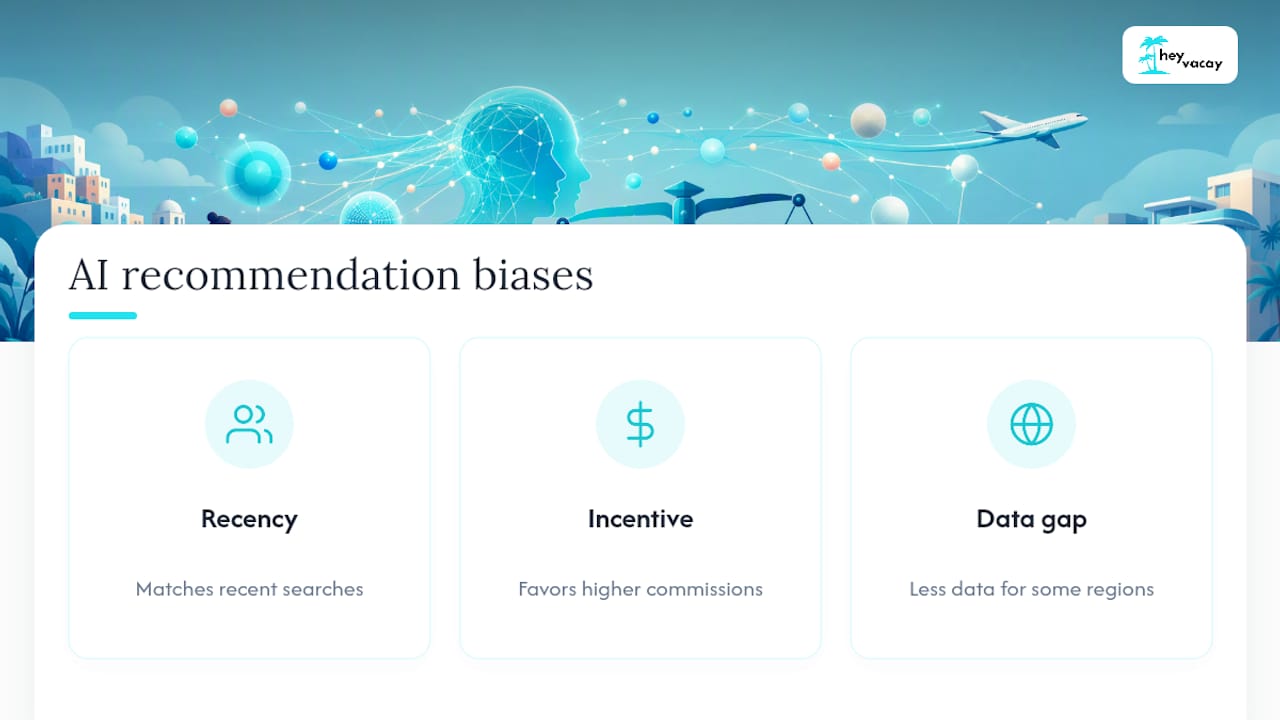
Another is incentive bias. Some platforms rank listings partly by which properties pay higher commissions, not purely by best fit for the traveler. That's not a flaw unique to AI, human-curated travel guides have the same problem, but AI can make it less visible because a ranked list feels objective even when it isn't.
There's also a data-gap problem. An AI system trained mostly on Western hotel chains may underperform when recommending properties in regions with less digitized inventory, smaller family-run guesthouses, independent lodges, places that simply don't feed as much data into the model.
The practical fix isn't to distrust AI recommendations outright, it's to treat the top result as a strong starting point, not a final answer. Cross-check a recommended property's reviews independently, glance at two or three alternatives the algorithm ranked lower, and remember that "recommended for you" sometimes means "matches your past behavior" more than it means "objectively best."
HeyVacay's Perspective on Transparent AI Savings
HeyVacay was built around a simple frustration: AI made hotel search faster, but it didn't automatically make it honest. Speed without transparency just means you find a misleading price quickly instead of slowly.
Our approach at HeyVacay is to pair AI-driven rate discovery with pricing that shows the total cost upfront, no asterisks, no fees that appear only at checkout. We measure our own product against the same checklist we'd hand a reader: can you see the full price immediately, do you know where the rate came from, and is the refund policy written in plain language before you pay. That's not a marketing claim, it's the actual bar we hold ourselves to as fee-disclosure rules tighten across the industry.
— HeyVacay
Try HeyVacay: Book Smarter, Not Just Faster
HeyVacay's edge is straightforward: AI that hunts down lower rates on the exact same hotels you'd book anyway, with the total price, fees included, shown before you ever reach checkout. No comparing five tabs to figure out which site is hiding a resort fee.

If you're used to the usual booking sites where the "deal" price and the checkout price never quite match, this is the difference worth testing. Start with something low stakes: search a city you're actually planning to visit, or try a last-minute date range and watch how the price compares to what a traditional site quotes for the same room. You'll see the full total the first time it appears, not the third time after you've clicked through upsells. For a deeper look at how the pricing engine works and how it stacks up against traditional dynamic pricing, HeyVacay's guide on dynamic pricing hotels breaks down the mechanics further. When you're ready to book, head to HeyVacay and search your next stay.
Sources
For deeper detail, see the FTC's fee disclosure rule, Skift's coverage of the industry response, and HeyVacay's breakdown of last-minute hotel deals.
- The Rule on Unfair or Deceptive Fees: Frequently Asked Questions | Federal Trade Commission
- No more hidden hotel fees: new FTC rule and legislation target price transparency | Skift
- Radisson Hotel Group launches hospitality industry-leading AI-powered real-time price matching technology | eHotelier