

Choose a chain hotel for business travel, unfamiliar cities, or anytime you need a guaranteed standard of service. Choose an independent or boutique property for leisure trips, milestone occasions, or destinations where local character matters more than predictability. That's the whole decision in one sentence, but the details change what "predictable" and "authentic" actually cost you.
Chains win on:
- Consistent rooms, amenities, and service standards across properties
- Loyalty points, elite status, and easier troubleshooting when something goes wrong
Independents win on:
- Design, personality, and a sense of place a corporate brand rarely replicates.
- Direct relationships with owners or managers who can bend the rules for you
Scroll to the 90-second checklist below if you want a repeatable test instead of a rule of thumb.
Key Takeaways
Match hotel type to trip purpose: chains for predictability and unfamiliar destinations, independents for personalization and leisure trips, since neither wins on every factor.
| Point | Details |
|---|---|
| Trip purpose decides more than price | Business and unfamiliar-city trips favor chains; leisure and milestone trips favor independents. |
| Independents carry higher OTA dependency | Independents source about 63.4% of bookings through OTAs versus roughly 35% for chains, making direct calls worth trying. |
| Boutique premiums cluster in upscale tiers | Independent hotels often charge more in luxury and upscale segments, less so at budget levels. |
| Loyalty points matter most to frequent travelers | Chain status perks like upgrades and late checkout rarely translate to independents. |
| HeyVacay compares both types transparently | HeyVacay's AI search surfaces chain and independent pricing side by side with no hidden fees. |
Table of Contents
- What Is a Chain Hotel vs an Independent Hotel?
- How Do Chains and Independents Compare on the Factors That Actually Matter?
- How Do You Choose in Under 90 Seconds?
- What Does the Research Say About Getting the Best Rate?
- Is There Really a Right Answer Between Chains and Independents?
- How Can HeyVacay Help You Book the Right Hotel at the Right Price?
- Sources
What Is a Chain Hotel vs an Independent Hotel?
A chain hotel operates under a shared brand umbrella, whether that's a global name with hundreds of properties or a regional group with a dozen. The property follows corporate design standards, uses centralized reservation systems, and typically belongs to a loyalty program that rewards repeat stays. Franchise owners often run the day-to-day operation, but the brand dictates the thread count, the breakfast menu format, and the customer service scripts. That structure is what lets a traveler book a room in Denver and know almost exactly what the bathroom will look like in Dallas.
An independent hotel has no such parent company. A boutique property, a family-run inn, or a single standalone hotel makes its own decisions about design, staffing, pricing, and partnerships. According to hospitality education resources at Les Roches, boutique hotels differentiate through personalized service and a strong local identity rather than scale. There's no regional manager approving the lobby art or the pillow menu. The owner picks it, or someone they trust picks it, and that's why two boutique hotels three blocks apart can feel like they exist in different decades.
These structural differences ripple into everything a guest experiences:
- Predictability. Chains standardize the guest experience through training manuals and inspection audits. Independents vary property to property, sometimes room to room.
- Innovation speed. A boutique owner can redesign a lobby or add a new amenity in weeks. A chain typically needs corporate sign-off, which slows change but also prevents costly missteps.
- Pricing power. Chains negotiate group rates with vendors (linens, food service, cleaning supplies) that independents can't always match at scale.
- Review patterns. Independent hotels tend to generate more polarized reviews, since one owner's quirky choices can delight some guests and frustrate others. Chain reviews cluster tighter around a predictable average.
According to a comparison from Mews, independent hotels deliver personalized, unique experiences while chains lean on consistency, brand recognition, and economies of scale. Neither structure is objectively better. They're built to solve different problems, and the right one depends entirely on what you need from a given stay.
How Do Chains and Independents Compare on the Factors That Actually Matter?
Here's where the decision gets specific. Six factors decide most bookings, and they don't all point the same direction.
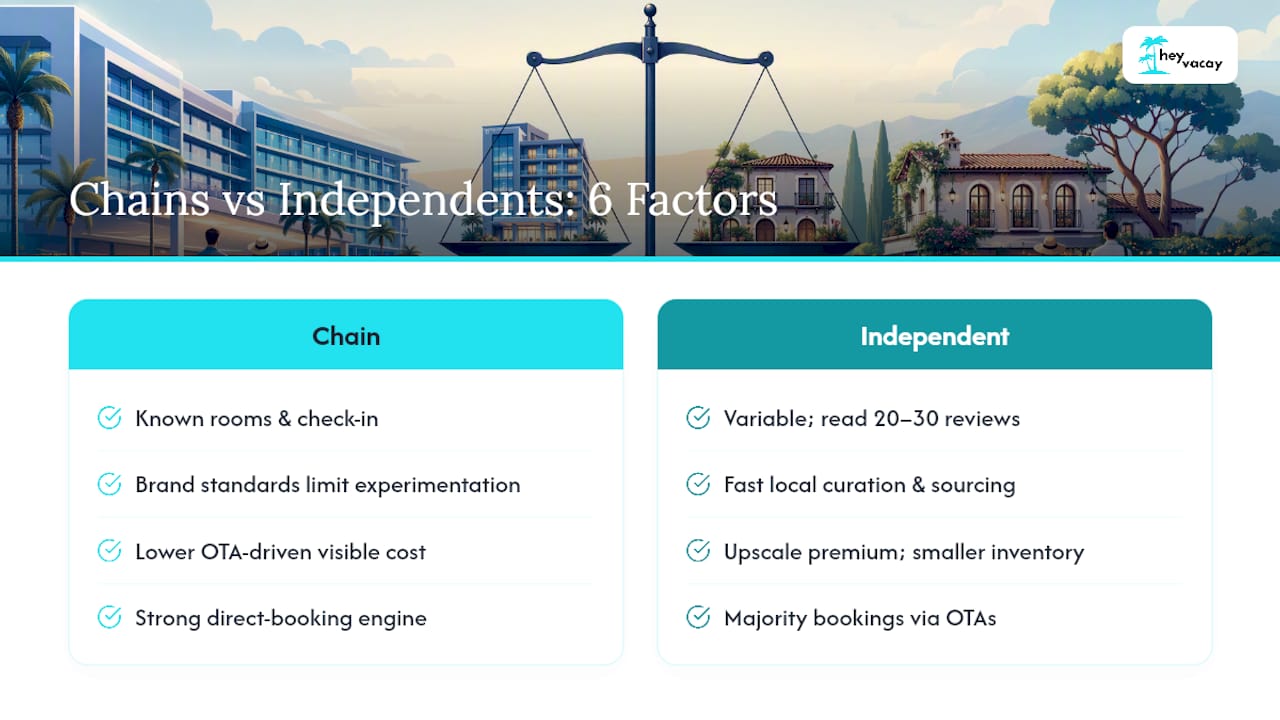
Consistency and reliability. A major chain brand promises a known room configuration, a known check-in process, and a customer service escalation path if something breaks. Independents can match or exceed that consistency, but you have to verify it yourself, usually by reading the last 20 to 30 reviews rather than the overall star rating. A hotel with a 4.6 average built on 40 reviews tells you less than a 4.3 average built on 2,000.

Personalization and local immersion. This is where independents earn their reputation. A locally owned property is more likely to source coffee from a nearby roaster, hire staff who actually live in the neighborhood, and adjust the experience based on direct owner feedback. Operator commentary collected by Hotels Magazine points out that independents can move fast on curating a local experience, while chains carry the weight of brand standards that slow that kind of experimentation.
Price dynamics. Boutique and independent properties often carry a price premium in upscale and luxury tiers, according to average daily rate data referenced by RateRanger. That premium reflects design investment and lower room inventory, not automatically better value. Meanwhile, OTA commissions eat into an independent's visible online rate more than they do for a chain with its own strong direct-booking engine, which can make an independent's sticker price look higher than its real cost.
Statistic callout: Independent hotels source a majority of bookings through OTAs, a notably higher share than branded hotels, according to Cloudbeds data cited by RateRanger. That gap is exactly why calling an independent property directly can surface a better rate than the OTA listing shows.
Loyalty program value. Chain loyalty points matter most for frequent travelers who rack up 10+ nights a year. Elite status can mean free upgrades, late checkout, or lounge access, benefits that independents rarely offer at all, though some belong to soft-brand collections that provide partial loyalty perks.
Booking channels. Chains built massive direct-booking infrastructure over the past decade specifically to reduce OTA dependency. Independents haven't had the same resources, so they lean harder on OTAs, which is exactly why direct outreach pays off more for a boutique stay than for a global chain, where the direct rate rarely beats the app price anyway.
Safety and quality floor in unfamiliar destinations. Academic research on foreign demand patterns found that chain-affiliated hotels attract more international visibility and perform better with foreign guests, especially in lower-star categories and destinations with limited chain presence, according to a study published in Economic Research. Brand recognition functions as a trust shortcut when you can't read local reviews in the local language.
How Do You Choose in Under 90 Seconds?
Run this three-question test before you book anything.
- What's the trip for? Business or a first visit to an unfamiliar city points toward a chain hotel prioritizing convenience. Leisure, a special occasion, or a destination you already know well points toward an independent.
- How familiar are you with the city? Low familiarity favors brand recognition and the predictability it buys. High familiarity means you can vet an independent property with confidence.
- Does loyalty math actually help you here? If you're close to a status threshold or a free-night redemption, that tips toward staying within your chain ecosystem. If you have no meaningful point balance, the calculation disappears.
Once you have an answer, scan the listing itself for these signals:
- Photos posted within the last 12 months, not stock images from a decade-old renovation
- At least 50 recent reviews, not just a high average built on a handful
- A cancellation policy that matches your trip's certainty (flexible for uncertain plans, prepaid discount for locked-in dates)
- Any direct-booking perks listed on the property's own site (breakfast, parking, early check-in)
Red flags for independents: no phone number listed, reviews that mention maintenance issues, or a website that hasn't been updated in years. Red flags for chains: a franchise location with a noticeably lower review average than the brand's typical standard, which usually signals a local ownership or management problem the brand hasn't fixed yet.
Pro Tip: For a two-night business trip to a city you've never visited, book the chain and bank the points. For a weekend anniversary trip to a city you've visited three times, book the independent and call ahead for a room with a view.

What Does the Research Say About Getting the Best Rate?
The clearest, most actionable finding in hotel pricing research: independent hotels frequently match or beat their own OTA listing when you book directly. Reporting from HospitalityNet found that independents competing with big chains increasingly rely on direct-booking incentives like free breakfast or room upgrades to offset the commission they'd otherwise pay an OTA.
Before you book anywhere, run this quick comparison:
- Check the OTA price, then check the hotel's own website for the same dates
- Call the property and ask if they can beat the online rate or add a perk
- Calculate whether chain loyalty points offset a lower independent rate
- Compare cancellation flexibility, since a slightly higher fully-refundable rate often beats a cheaper non-refundable one
This is exactly the kind of comparison HeyVacay was built to speed up. Its AI-driven search pulls transparent pricing across chains and independents side by side, so you can see the real gap before you pick up the phone. It won't replace calling a boutique property for a perk they don't advertise, but it removes the guesswork of figuring out which type is even in your price range.
Is There Really a Right Answer Between Chains and Independents?
There isn't one, and pretending otherwise is how a lot of travel advice goes wrong. The honest answer is that trip purpose decides more of this than brand loyalty, price, or design ever will. A service-quality comparison using SERVQUAL methodology found chains scoring higher on reliability and infrastructure while independents scored higher on personalization and local engagement, and a hybrid approach delivered the best overall guest satisfaction. That finding matches what shows up in the pricing and booking data too: neither model wins outright, they win at different jobs.
HeyVacay's approach reflects that. Instead of pushing one hotel type, it surfaces transparent pricing across both so travelers can get boutique character or chain predictability, whichever the trip calls for, without overpaying for either.
— HeyVacay
How Can HeyVacay Help You Book the Right Hotel at the Right Price?
There's no shortage of ways to search for a hotel; the problem is most of them make you choose between speed and a fair price. HeyVacay closes that gap by running AI-driven comparisons across chain and independent properties at once, showing you transparent rates with no hidden fees stacked on at checkout.
Use HeyVacay when you want a fast, side-by-side read on where the real value sits between a familiar brand and a local boutique for your exact dates. Still call the property directly if you spot an independent hotel you love and want to ask about a perk that isn't listed. For planning a multi-room family trip, HeyVacay's guidance on group hotel rates also breaks down how to negotiate better pricing across both hotel types. Start comparing your options now at HeyVacay and see what a transparent rate actually looks like before you commit.
Sources
- Independent vs Chain Hotels: Pros, Cons and Differences
- Service quality comparison between chain and standalone hotels
- Boutique vs Chain Hotels: The Bookie's Honest Verdict After 50 Destinations - Hotels Bookie
- Independent vs brand: who has the advantage? — Hotels Magazine