

A hotel cancellation policy sets the deadline for canceling without a fee, the penalty you owe if you miss it, and who is responsible for the refund. If you're staring at a booking confirmation right now, do this first: find the cancellation deadline, check what time zone it's listed in, and confirm whether the hotel or a third-party site charged your card.
Two outcomes cover most bookings:
- Cancel before the deadline: full refund, usually back on your card within a few business days to two weeks.
- Cancel after the deadline (or no-show): you're charged one night, a deposit, or the full prepaid amount, depending on the rate type.
Before you do anything else, run this quick checklist:
- Open your confirmation email and find the exact cancellation cutoff.
- Note whether that time is listed in the hotel's local time zone (it usually is).
- Check your payment confirmation to see if the hotel or an online travel agency processed the charge.
- If you're within 24 hours of the deadline, cancel now rather than waiting.
Key Takeaways
Hotel cancellation policies come down to three things: a deadline, a penalty if you miss it, and who controls your refund.
| Point | Details |
|---|---|
| Check the deadline and time zone | Cancellation cutoffs are usually listed in the hotel's local time, a common source of missed windows. |
| Identify who charged your card | The hotel or the booking platform controls refund timing, not necessarily whoever set the policy. |
| Save the deadline immediately | Set a calendar reminder 48 hours before the cutoff the same day you book. |
| Rebook before you cancel | Confirm a new reservation first so you're never without a room while waiting on a refund. |
| Compare rate types before booking | Use HeyVacay to see refundable versus non-refundable pricing and terms clearly before you commit. |
If you miss a deadline, expect a one-night charge, a lost deposit, or the full prepaid amount depending on your rate, and escalate quickly with documentation if you believe your situation qualifies for an exception.
Table of Contents
- What Is a Hotel Cancellation Policy, and Why Does It Exist?
- Types of Hotel Cancellation Policies and What Each One Costs You
- How Hotel Refunds and Fees Actually Work
- Typical Cancellation Windows: 24 Hours vs. 72 Hours vs. Tiered Schedules
- No-Show and Late-Arrival Rules You Need to Know
- Group Bookings and Long Stays Play by Different Rules
- Seven Ways to Avoid Cancellation Fees
- How to Actually Get an Exception to a Strict Policy
- Sample Policy Wording and Red Flags to Watch For
- A Traveler's Honest Take on Cancellation Policies
- Find Flexible, Transparent Rates With HeyVacay
- Sources
- FAQ
What Is a Hotel Cancellation Policy, and Why Does It Exist?
A hotel cancellation policy is the set of rules that determines whether you get money back if you cancel a reservation, and how much you forfeit if you cancel late or don't show up. It's built around three moving parts: a deadline, a penalty structure, and a payment path that decides who actually issues your refund.
Hotels use these policies because empty rooms cost money they can't recover. A canceled room the night before check-in is nearly impossible to resell, so properties price that risk into their rates. Clear, enforced cancellation terms protect hotel revenue and, done right, protect guest trust too. Industry guidance on hotel operations points out that automating cancellation enforcement in a property management system cuts down on manual staff work while still leaving room for a front desk manager to make exceptions when something legitimate goes wrong.

That last part matters more than most travelers realize. A policy isn't just a wall of legal text. It's a forecasting tool. Hotels use historical no-show and cancellation data to decide how many rooms to overbook, how to price refundable versus non-refundable rates, and how strict a deposit needs to be for a wedding block booked eight months out.
Quick fact: the fee you're charged for canceling late almost always maps to one of four things: one night's rate, a flat deposit, a percentage of the total stay, or the entire prepaid balance. Which one applies depends entirely on the rate type you picked at booking.
Types of Hotel Cancellation Policies and What Each One Costs You
Most reservations fall into one of five buckets. Knowing which one you booked before you need to cancel saves you from an unpleasant surprise on your credit card statement.
- Free/flexible: No charge if you cancel before a stated deadline, commonly 24 to 48 hours before arrival, though some chain hotels extend that window to 72 hours. Example wording: "Free cancellation until 6:00 PM, March 14, hotel local time."
- Non-refundable (prepaid): You pay in full at booking in exchange for a lower rate, and canceling for any reason forfeits that entire amount. Example wording: "This reservation is non-refundable. No changes or cancellations permitted."
- Partially refundable / tiered: A portion of your payment (often the deposit) is non-refundable, while the remainder can be returned if you cancel early enough. Example wording: "Deposit is non-refundable; remaining balance refunded if canceled 7+ days prior."
- One-night-penalty: You get a full refund on everything except the first night's rate and taxes, which is charged if you cancel after the deadline. Example wording: "Cancel after 48 hours before arrival: one night's stay will be charged."
- No-show: You never showed up and never called, so the hotel charges the maximum penalty allowed under the rate, sometimes the entire stay.
"Free cancellation until March 14" sounds unconditional until you notice it doesn't say what time zone that date refers to. It almost always means the hotel's local time, not yours, and that gap is the single most common reason travelers get charged when they thought they'd canceled in time.
Pro Tip: Screenshot the exact cancellation deadline and time zone the moment you book. Confirmation emails get overwritten or reformatted when hotels update pricing, and you want a timestamped record of what you actually agreed to.
A refundable rate typically runs 5% to 15% more per night than the non-refundable version of the same room. On a $150-a-night room, that's roughly an $8 to $25 premium, purely for the right to change your mind.
How Hotel Refunds and Fees Actually Work
The single biggest factor in how fast (and whether) you get your money back is who charged your card in the first place. That's the payment path, and it decides everything downstream.
If the hotel itself processed your payment, the hotel controls your refund timeline. If you booked through an online travel agency, that platform usually controls the refund and how long it takes, even though the hotel set the original cancellation rule. This is why calling the hotel directly sometimes gets you nowhere: they can confirm the cancellation happened, but they can't push a refund that a third party is holding.
Common fee types you'll run into:
- One-night charge: the most frequent penalty for late cancellation on flexible rates.
- Deposit forfeiture: typical for group blocks and vacation rentals with an upfront deposit.
- Percentage-based charge: a set share of the total booking value, common at resorts during peak weeks.
- Full prepayment loss: the entire non-refundable rate, no exceptions barring documented extenuating circumstances.
| Refund Step | Typical Timeline |
|---|---|
| Cancellation confirmation | Immediate to same day |
| Pre-authorization release (card holds) | 1 to 5 business days |
| Refund initiated by hotel or OTA | 3 to 15 business days |
| Funds visible in your account | Up to 15 business days total |
That final timeline comes straight from hotel guidance: refund processing can take up to 15 business days depending on your payment method and how quickly your bank posts the credit. Debit card refunds tend to move slower than credit card ones, since banks often hold debit reversals longer.
If you booked through a third party, keep the confirmation number from both the OTA and, if you have it, the hotel. You'll need both if the refund stalls and you have to escalate.
Typical Cancellation Windows: 24 Hours vs. 72 Hours vs. Tiered Schedules
The deadline window is where most of the confusion (and most of the money) lives. Here's how the common structures compare.
| Window Before Arrival | Typical Penalty |
|---|---|
| 7+ days out | Full refund, no penalty |
| 72 hours out | Full refund at many resort and chain properties |
| 48 hours out | Full refund at most standard hotels |
| 24 hours out | Refund on some rates; one-night charge on others |
| Inside 24 hours / no-show | One-night charge, deposit loss, or full charge |
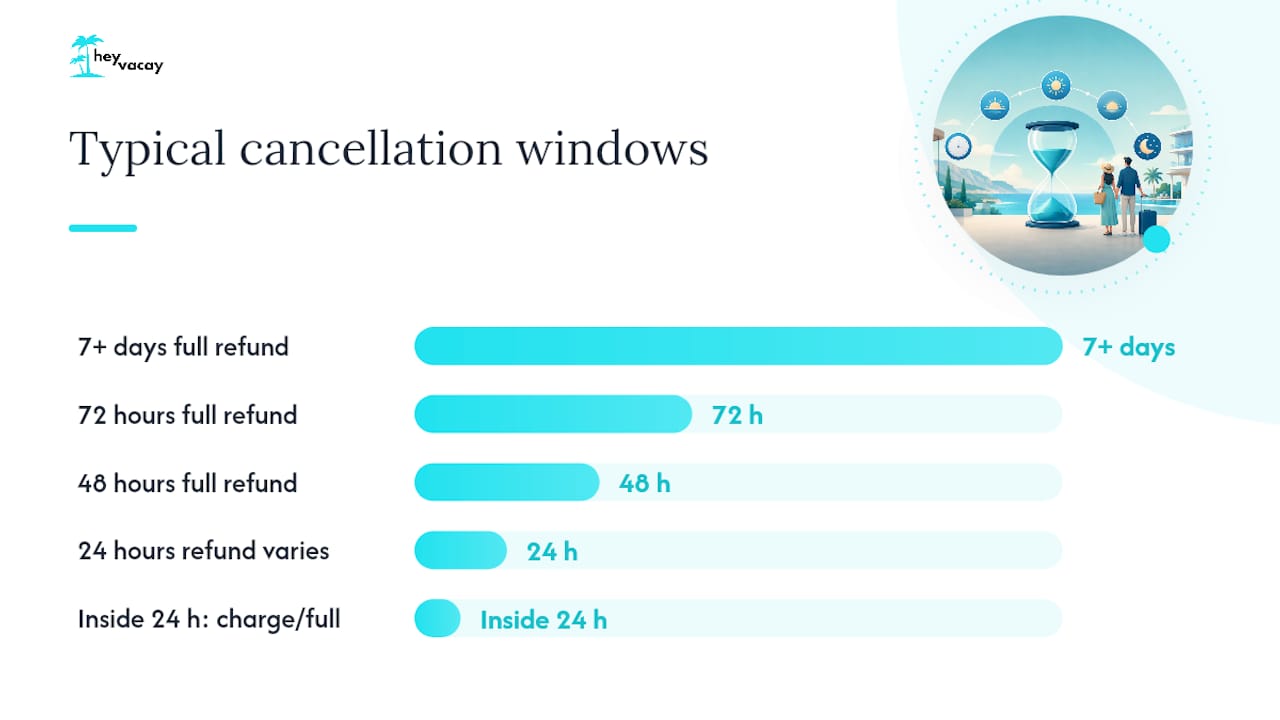
Free-cancellation windows of 24 to 48 hours are the most common across the industry, with a smaller number of chains stretching that to 72 hours as a loyalty or brand differentiator.
Here's where the math actually matters. Say you booked a non-refundable rate at $135 a night for two nights ($270 total) instead of a refundable rate at $155 a night ($310 total). If your plans change and you'd otherwise eat the full $270 non-refundable charge, the $40 premium for the refundable rate would have looked cheap in hindsight. But if your plans never change, you pocketed that $40 by taking the risk. The refundable rate isn't objectively "better." It's insurance, and insurance only pays off when you need it.
Peak seasons complicate this further. Hotels near convention centers, during festival weekends, or around major sporting events frequently tighten their windows and add tiered penalty schedules: free cancellation until 14 days out, a one-night penalty between 14 and 3 days, and a full-stay charge inside 72 hours or on no-show. Always check whether your travel dates overlap with a local event before assuming standard rules apply.
No-Show and Late-Arrival Rules You Need to Know
A no-show means you never arrived and never contacted the hotel, and it almost always triggers the harshest penalty available under your rate, up to the full stay. Hotels typically release an unclaimed room by a set hour, often between 6:00 PM and midnight, after which they may resell it, though you're still charged regardless of whether the room gets rebooked.
Late arrival is different from a no-show, but hotels can't always tell the difference until you communicate. If your flight is delayed or traffic is brutal, take these steps in order:
- Call the hotel directly, not just the booking platform, the moment you know you'll be late.
- Ask specifically whether they have a "late check-in guarantee" or hold policy tied to your rate.
- If you booked through an OTA, also send a message through that platform's app so there's a timestamped record.
- Get a name or confirmation number from whoever you speak with at the front desk.
Pro Tip: A pre-authorization hold on your card isn't the same as a charge. Hotels often place a temporary hold for the estimated total, which can make your available credit shrink even before you check in. If you're canceling within the allowed window, ask the front desk to release the hold immediately rather than waiting for it to expire on its own, since holds can sit for several days and quietly eat into your available balance.
Group Bookings and Long Stays Play by Different Rules
Group reservations and extended stays operate on a stricter, slower timeline than a standard one or two-night booking, mainly because the hotel's financial exposure is much higher.
Where a single-room booking might require 24 to 48 hours' notice, group blocks and long-stay contracts commonly require 14 to 30 days, sometimes more for wedding blocks or corporate retreats. Deposits are standard, often non-refundable past a certain date, and many contracts use a tiered penalty schedule tied to how many rooms you release and when.
Before signing a group contract or booking an extended stay, ask:
- What's the deposit amount, and at what point does it become non-refundable?
- Can unused rooms in the block be released without penalty, and how many days before arrival?
- Does the rate get "repriced" if the group shrinks below the original room count?
- What are your rebooking rights if the event itself gets postponed?
Watch for contract language like "attrition clause": if your group books fewer rooms than the contracted minimum, the hotel can charge you for the shortfall as if those rooms had been occupied. It's one of the most expensive surprises in group travel, and it's rarely explained until you ask directly.
If you're planning a family reunion or multi-room trip, our guide to group hotel rates walks through deposit norms and how far ahead you should lock in a block.
Seven Ways to Avoid Cancellation Fees
You can't control a hotel's policy, but you can control how you book against it. Work through these in order the next time you're reserving a room.
- Choose the rate type deliberately. Don't default to the cheapest option without checking whether it's non-refundable. Compare the price gap against how firm your plans actually are.
- Save the deadline to your calendar the day you book. Not "sometime before the trip." An exact date and time, with a reminder set 48 hours ahead of it.
- Convert the deadline to your own time zone immediately. Hotel deadlines run on local time, and that single gap causes most accidental penalties.
- Book directly with the hotel when refund speed matters. Direct bookings often mean one fewer party in the refund chain, which can shave days off processing.
- Use your credit card's built-in protections. Some cards offer trip cancellation or interruption coverage automatically; check your card's benefits guide before assuming you're unprotected.
- Buy travel insurance for non-refundable or high-value bookings. It's worth the cost on prepaid rates where you'd otherwise lose the entire amount.
- Rebook before you cancel, not after. If you're switching hotels or dates, confirm the new reservation first so you're never without a room while you wait on a refund.
A few smaller habits reinforce all seven: set a phone reminder the moment you book, not the week before your trip, and always check the "refund path" line on your confirmation so you know upfront whether the hotel or the booking site handles cancellations. If your plans are shifting because of pricing, our piece on dynamic pricing and hotel booking explains how refundable rates work as a hedge against rate drops, not just a cancellation safety net.
How to Actually Get an Exception to a Strict Policy
Exceptions to a "no refund" policy are possible, but they depend almost entirely on documentation and how quickly, and how politely, you escalate. Waiting until after the fact rarely works. Acting the moment you know your plans have changed works far better.
Here's the sequence that tends to succeed:
- Gather your documentation first. A flight cancellation notice, a doctor's note, a death certificate, or an official disaster declaration all carry weight. A vague excuse doesn't.
- Contact whoever processed your payment. If it was the hotel, call the hotel directly. If it was an OTA, start there, since some platforms will mediate with the property on your behalf when you can show extenuating circumstances.
- Ask for a supervisor or manager if the first agent says no. Front-line staff often have less authority to override a policy than a manager does.
- State your booking reference, dates, and the specific remedy you want. "I'd like a full refund" is clearer than "I need help with my reservation."
- Propose a fallback if a full refund is unlikely. A future travel credit or a date change is often easier for a hotel to approve than cash back.
Pro Tip: If every channel says no and you believe you were charged unfairly, a credit-card chargeback is a real last resort, not a first move. File it only after you've exhausted the hotel and the booking platform directly, since chargebacks can take weeks to resolve and sour any future dealings with that property.
Sample Policy Wording and Red Flags to Watch For
Reading the fine print carefully at booking time saves you the entire headache of disputing a charge later. Here's what clear language looks like, compared with the vague wording that should make you pause.
Clear, trustworthy examples:
Compare that to language you should question before confirming a booking:
- Ambiguous deadlines: "Cancel in advance to avoid a fee" with no specific date or time listed.
- Missing time zone: A deadline listed only as "March 14" with no indication of whose clock it's measured against.
- Unclear refund path: No statement of whether the hotel or the booking platform issues the refund.
- Hidden processing fees: Fine print mentioning a "cancellation processing fee" separate from the penalty itself.
- Contradictory OTA vs. hotel terms: The booking site's cancellation policy differs from what the hotel's own website states for the same room type.
If you spot any of these before you book, contact the hotel or platform and ask them to confirm the exact deadline, time zone, and refund path in writing. It's a two-minute email that can save you a multi-week dispute. Worth noting too: even a non-refundable rate sometimes allows a date change or a travel credit instead of a cash refund, so it's worth asking directly rather than assuming the booking is completely locked.
A Traveler's Honest Take on Cancellation Policies
The real trade-off with hotel cancellation policies isn't complicated, it just gets buried under fine print. You're choosing between paying a little more for the right to change your mind or paying a little less and accepting the risk that you won't need to. Neither choice is wrong. What's wrong is not knowing which one you picked.
Research on cancellation framing suggests that clearer policy language reduces disputes and improves guest satisfaction precisely because ambiguity is what creates conflict, not the penalty itself. Travelers rarely get angry about a fee they understood going in. They get angry about a fee they didn't see coming.
If there's one behavior worth adopting from everything above, it's this: the moment you book, write down the exact cancellation deadline, in the hotel's time zone, and put a reminder on your phone 48 hours before it. That single habit prevents more accidental charges than any amount of reading fine print after the fact.
Find Flexible, Transparent Rates With HeyVacay
Comparing cancellation terms across a dozen browser tabs is exactly the kind of friction HeyVacay exists to remove. The platform surfaces rate type clearly at the search stage, so you can see whether a room is refundable or prepaid before you click, and it compares prices across options so you're not paying a premium for flexibility you don't need.

Because HeyVacay is upfront about pricing with no hidden fees, you also know exactly what you'd be charged if a rate turns out to be non-refundable, instead of discovering it buried in a confirmation email later. That clarity matters most on the rates covered throughout this article: the ones where the difference between "free cancellation" and "no refund" comes down to a single line of fine print. If your travel dates aren't locked in yet, start comparing hotel rates on HeyVacay and check the cancellation terms before you commit to anything.
Sources
- Hotel Cancellation Policy: Best Practices & Templates | Mews
- Hotel Free Cancellation Guide | Rate Ranger
- Hotel Cancellation Policy Guide
- Booking.com Refund Policy: How Cancellations Actually Work
Policies vary by country, chain, and even by property within the same brand, so always treat your specific booking confirmation as the final word over any general guidance, including this one.
FAQ
What does "free cancellation" actually mean on a hotel booking? It means you can cancel without penalty up until a specific deadline, almost always listed in the hotel's local time. After that cutoff, standard penalties (usually a one-night charge) apply.
What's the difference between refundable and non-refundable hotel rates? A refundable rate lets you cancel for a full refund before the deadline, typically at a 5% to 15% price premium. A non-refundable rate locks in a lower price but forfeits the entire amount if you cancel for any reason.
How long does a hotel refund take to process? It varies by payment method and bank, but refunds commonly take anywhere from a few business days up to 15 business days to fully post to your account.
Can I get a refund on a non-refundable booking? Sometimes, if you have documentation for extenuating circumstances like a medical emergency or a canceled flight. Contact whoever processed your payment, ask for a supervisor if needed, and propose a travel credit as a fallback if a cash refund isn't possible.
Does booking directly with a hotel offer better cancellation terms than an OTA? Not always, but it can simplify the refund process since there's one fewer party involved. Always compare the exact cancellation terms shown at checkout regardless of which channel you use.