
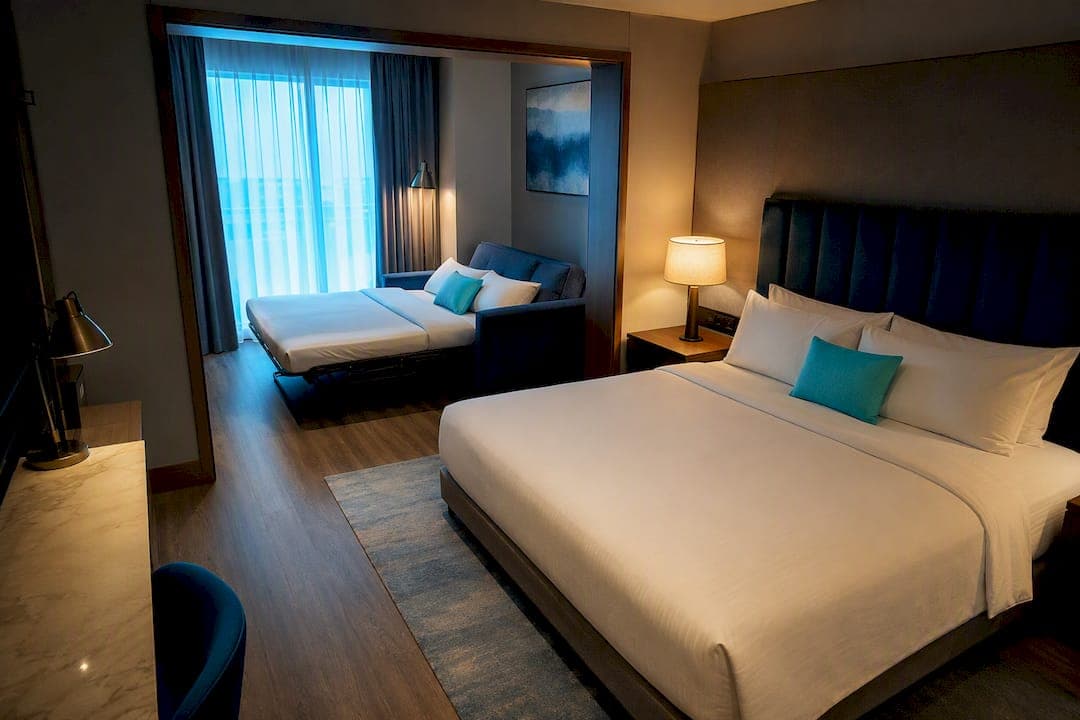
Hotel room types break down into three practical groupings: occupancy and bed setup, physical layout, and a hotel-specific quality tier that runs from standard up through suite. The labels themselves aren't standardized, so the booking rule is simple: check square footage, bed configuration, and the amenity list before trusting a name like "deluxe" to tell you anything real.
TL;DR:
- Always verify square footage, bed arrangements, and amenities rather than relying on hotel category names like "deluxe" or "suite."
- Check whether a "double" refers to one or two beds depending on the region, and clarify room configurations if "sleeps four" seems unrealistic.
- The internal hotel tier system usually ranks from standard to suite, with actual value determined by features like size, bathroom type, view, and included services.
- Suites vary from junior to penthouse, with physical separations or additional square footage, but their value depends more on layout and amenities than on marketing labels.
- Attribute-Based Selling allows paying directly for specific features such as a quiet room or a higher floor, offering more transparency than traditional room categories.
Table of Contents
- Hotel Room Types Explained: The Four Classification Axes
- Common Occupancy and Bed-Configuration Room Types
- Standard, Superior, and Deluxe: How the Tier Ladder Works
- Suites Explained: Junior, Executive, One-Bedroom, Presidential, Penthouse
- Specialty Room Types: Studios, Family Rooms, and Accessible Options
- How to Choose the Right Hotel Room: A Booking Checklist
- Attribute-Based Selling: Why Hotels Are Unbundling Room Features
- Our Take: Stop Trusting the Room Name
- Sources
Hotel Room Types Explained: The Four Classification Axes
Every hotel room label you'll ever see gets built from four overlapping axes: occupancy and bed configuration, layout and function, tier or quality level, and view or location. Stack them together and "Deluxe King Ocean View" isn't one category, it's four decisions layered on top of each other.
Occupancy tells you how many people and what beds. Layout tells you whether you're getting one room or a suite with a separate living area. Tier signals where the room sits in that hotel's internal pricing ladder. View and location can often move the price more than the tier label does, depending on whether the view is partial, obstructed, or premium.
Here's what each axis typically controls:
- Occupancy/bed: drives base pricing and determines if a room fits your group without a rollaway.
- Layout/function: separates a single room from a suite, studio, or connecting configuration.
- Tier/quality: hotel-defined ranking, usually tied to size, furnishings, and floor.
- View/location: can add 20 to 40 percent to a rate independent of the room's actual size.
Because room category names aren't standardized, a "Superior" at one property might match a "Standard" at another. Always cross-check the listing's specs, not just its name.
Common Occupancy and Bed-Configuration Room Types
Occupancy labels are where most booking confusion starts, mainly because "double" means different things depending on where you're booking. In American hotels, a double room usually means two double beds, meant for four people. In much of Europe, "double" often means one bed for two people, the equivalent of a US queen room. That gap trips up more travelers than any suite terminology ever will.
Here's how the core occupancy types typically break down:
- Single room. One bed, built for one guest. Common in business hotels and increasingly rare in leisure properties, where singles get converted into higher-yield doubles.
- Double room. One or two beds depending on region, sized for two adults. Always check the bed count in the listing description, not just the room name.
- Twin room. Two separate single beds. Popular with friends, siblings, or business colleagues who want separate sleeping surfaces without booking two rooms.
- Triple room. Fits three people, usually a double bed plus a single, or three singles. Ideal for small families or a parent traveling with two kids.
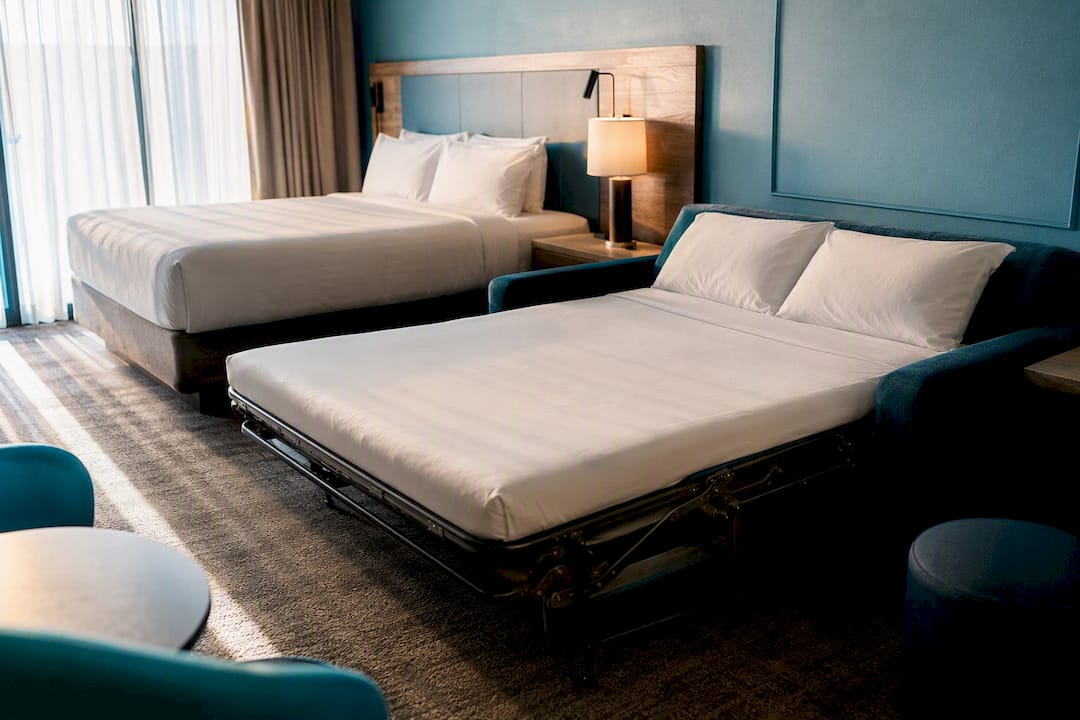
- Quad room. Sleeps four, typically two doubles or a combination with a sofa bed. Common in family and group bookings where cost-splitting matters.
If you're traveling with a larger group, connecting or adjoining rooms solve the privacy problem that quad rooms can't. Two locked doors that open into each other give you separate spaces for parents and teenagers, with a shared threshold instead of one crowded room. Ask specifically whether rooms are "connecting" (a shared interior door) or just "adjoining" (next door, no interior access) because hotels use those terms loosely.
Pro Tip: When a listing says "sleeps four" but shows only one king bed in the photos, call the property and ask exactly what a fourth guest sleeps on. A pull-out sofa 10 feet from a king bed is a very different trip than a true quad configuration.
Standard, Superior, and Deluxe: How the Tier Ladder Works
The tier ladder is the part of hotel room types explained that generates the most confusion, and also the part with the clearest underlying logic. Most properties structure their internal pricing the same way: Standard sits at the bottom, then Superior, then Deluxe, then Junior Suite, then Suite. Every room type in a hotel's inventory gets measured against that baseline Standard room.
That price sequence is more trustworthy than any name on the door. If a "Deluxe" room costs $40 more per night than the "Superior" at the same property, the hotel is telling you, in the clearest language it has, that Deluxe is the better room. What you can't assume is that a Deluxe at a budget chain matches a Deluxe at a luxury resort. Comparing tiers only makes sense within a single property.
Before paying extra for an upgrade, verify what you're actually getting:
- Square footage difference (ask for the number of years, not just "more spacious")
- Bathroom type: tub versus shower-only, single versus double vanity
- View quality and floor level
- Furnishings: seating area, work desk, upgraded linens
- Included services: welcome amenity, late checkout, breakfast
Paying up the ladder usually earns its cost on longer stays, when you need real workspace, or when a family needs the extra square footage to avoid living on top of each other for a week. For a two-night city trip where you'll barely use the room, the jump from Standard to Deluxe is often money spent on a better view you won't be awake to see.
Suites Explained: Junior, Executive, One-Bedroom, Presidential, Penthouse
Suites solve a different problem than tiers do. Where Standard-to-Deluxe measures quality within one room, suites add actual square footage and, in most cases, physical separation between where you sleep and where you sit. A junior suite is a single room with a distinct seating area, while a true one-bedroom suite has a wall and a door between the bedroom and the living space. That structural difference matters more than any marketing copy attached to it.
- Junior suite: one open room, larger than standard, with a sofa or armchair zone separated by furniture rather than a wall.
- Executive suite/room: often defined less by square footage and more by lounge access, enhanced workspace, and bundled perks like breakfast or evening cocktails.
- One-bedroom suite: genuine wall separation between bedroom and living room, useful for entertaining or working while someone else sleeps.
- Presidential suite: the top of most hotel hierarchies, typically multiple bedrooms, a dining area, and sometimes a private terrace.
- Penthouse suite: top-floor placement is the defining feature, usually paired with presidential-level square footage and private elevator access.
Executive rooms are the trickiest to evaluate because the value is service-based, not spatial. If you're a business traveler, lounge access and included workspace often deliver more practical value per dollar than extra square footage, especially on a two or three-night trip where you'll barely spend time in the room itself. Families almost always come out ahead with a one-bedroom suite instead, since separation of space matters more than a lounge you won't use with kids in tow, a point worth checking against our family suite guide before booking.
Specialty Room Types: Studios, Family Rooms, and Accessible Options
Beyond occupancy and tier, some room types exist to solve a specific logistical problem rather than to signal quality. A studio room folds a kitchenette into the layout, useful for extended stays where you want to cook instead of eating out every meal. Family rooms typically combine a queen bed with bunks or a sofa bed, built around kid-friendly spacing rather than luxury finishes.
Accessible rooms deserve extra scrutiny before booking. ADA-oriented rooms commonly include roll-in showers, grab bars, lowered switches, and wider clear floor space, but "accessible" on a listing page doesn't guarantee every feature you need. Call the property directly and confirm the exact equipment installed in that specific room, not just the category it's filed under.
- Studio/aparthotel room: kitchenette, often a fold-out sofa, best for stays over four nights.
- Family room: combined bed types built for kids, sometimes with room dividers.
- Connecting/adjoining rooms: shared or adjacent doors for groups needing separate sleeping spaces.
- Accessible room: confirm roll-in showers, grab bars, and door width directly with the property.
- View-based rooms: an ocean view room may only offer a partial or angled view, while oceanfront means direct, unobstructed water access, and upper floors typically trade less street noise for a longer elevator wait.
How to Choose the Right Hotel Room: A Booking Checklist
Once you understand the axes, choosing a room becomes a matter of running through a short checklist instead of guessing at what a name implies. Work through it in this order:
- Confirm occupancy and exact bed type. Don't trust "sleeps 4," ask what beds are actually in the room.
- Get the square footage. A number lets you compare rooms across hotels in a way names never will.
- Check the bathroom layout. Tub versus shower, single versus double sink, these change daily comfort more than most tier upgrades.
- List included services. Lounge access, breakfast, late checkout, these often justify a jump in tier more than size does.
- Ask about floor and view. Higher floors usually mean quieter, but confirm elevator wait times if you're traveling with kids or luggage.
- Map the property's price order. When names feel inconsistent, the hotel's own price sequence is the most reliable signal of which room is actually better.
- Call about connecting doors and rollaway availability if you're traveling with a group larger than the base occupancy.
Pro Tip: If noise matters more to you than square footage, skip the upgrade budget entirely and just ask reception for a room away from elevators, ice machines, and the pool deck. That request is free and usually matters more than a Deluxe label.
Comparing prices across dates and properties gets easier once you understand how dynamic pricing shifts room rates throughout the week, since the same "Deluxe" room can cost 30 percent more on a Saturday than a Tuesday at the identical hotel.
Attribute-Based Selling: Why Hotels Are Unbundling Room Features
Attribute-Based Selling, ABS for short, is reshaping how rooms get sold. Instead of bundling everything into a fixed named category, hotels increasingly let travelers pay for specific attributes, a guaranteed high floor, a corner room, a balcony, a quiet location away from the elevator, separately from the base room type.
That shift benefits travelers who know what they actually want. If a view doesn't matter to you but a quiet room does, ABS lets you pay only for quiet instead of buying a "Deluxe Ocean View" package that bundles a feature you don't care about.
Watch for these signals when comparing listings:
- Filter options for floor level, view, or bed type shown separately from the room name
- Add-on pricing for specific attributes rather than a flat tier upgrade
- Listings that show square footage and bed configuration explicitly, not just a category name
HeyVacay's AI-assisted search is built around this exact shift, matching travelers to rooms based on the attributes that matter to them, at transparent rates with no hidden fees layered onto the base price.
Our Take: Stop Trusting the Room Name
The biggest mistake travelers make with hotel room types is treating the label as information. It isn't. "Deluxe" is a marketing word a hotel chose, not a certified standard, and two properties three blocks apart can use it to mean completely different rooms. The only honest signal is the property's own price ladder and the specs attached to the listing.
Where conventional advice falls short is treating suites and tiers as universally comparable. They aren't. A junior suite at a budget property might be smaller than a standard room at a luxury resort. Comparing across hotels by category name alone is a losing game.
What we'd prioritize first: square footage and bed configuration, always, before anything else. Then check whether the price difference between tiers buys you a real amenity or just a nicer name. Attribute-Based Selling is pushing the industry toward more honesty here, letting you pay for the specific thing you want instead of a bundled guess. That's the direction booking should have gone years ago.
— HeyVacay
Sources
- Standard room category & hotel pricing (Pricelabs)
- Executive room definition and perks (AltexSoft)
- Types of hotel rooms explained (Octorate)
- Types of hotel rooms (EHL Insights)