
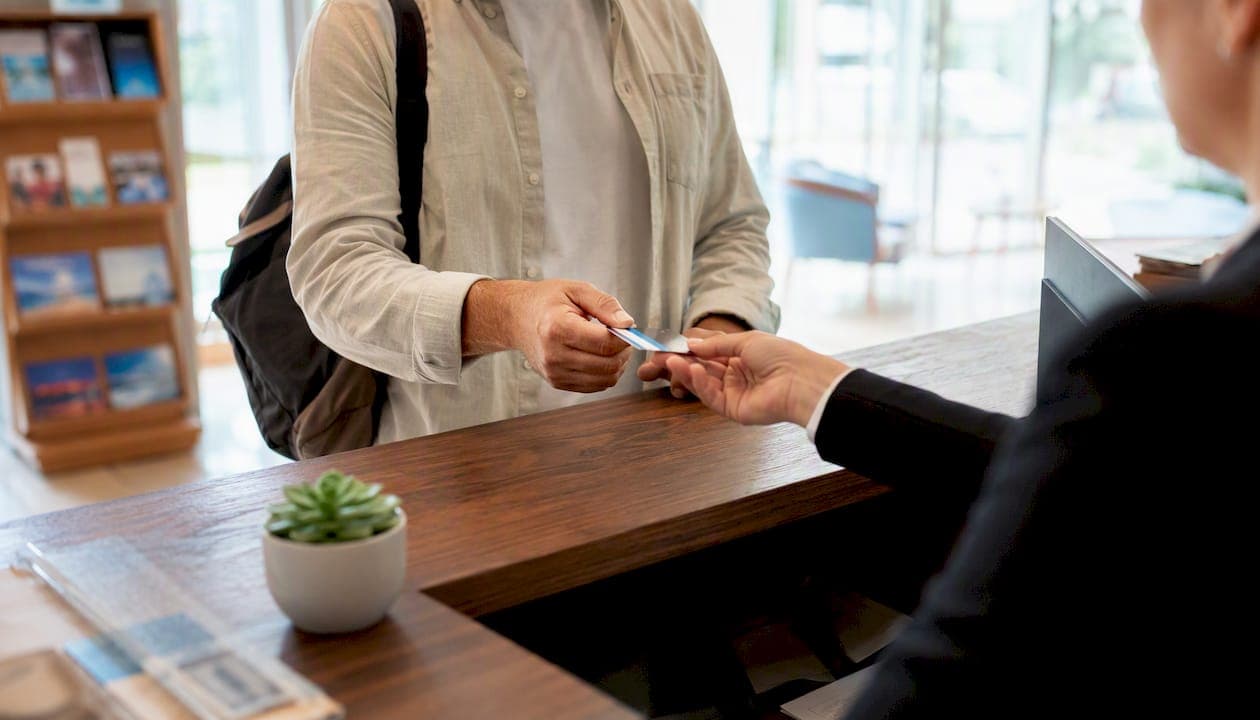
The fastest ways to get hotel room upgrades are to ask politely at check-in, book direct, use loyalty status or upgrade certificates, time your arrival for mid-afternoon, or accept a pre-arrival paid offer. Most upgrades are discretionary, meaning the hotel decides on the spot, but a few programs let you lock one in before you arrive.
Top tactics, roughly in order of reliability:
- Join a hotel loyalty program and build status (or use an upgrade certificate)
- Book direct with the hotel, not through a third-party site
- Avoid the absolute cheapest room category when booking
- Arrive mid-afternoon (2–5 PM) when inventory is visible
- Call the hotel 2–3 hours before arrival and ask about availability
- Accept a discounted pre-arrival upgrade offer from the hotel
Two types of upgrades exist: guaranteed and discretionary. Guaranteed upgrades are confirmed in advance through program certificates or milestone rewards. World of Hyatt and Marriott Bonvoy both offer certificate paths that can confirm a specific room type before you check in. Everything else is at the hotel's discretion, no matter how nicely you ask.
Key Takeaways
Combining a direct booking, loyalty status or certificates, and mid-afternoon arrival gives you the highest realistic chance of a free hotel room upgrade without relying on luck.
| Point | Details |
|---|---|
| Book direct with loyalty attached | Direct bookings get richer guest profiles and better upgrade consideration than OTA reservations. |
| Use certificates before relying on discretion | Guaranteed upgrade certificates from programs like World of Hyatt or Marriott Bonvoy beat polite asking every time. |
| Arrive 3–5 PM and call ahead | Mid-afternoon arrival and a call 2–3 hours before check-in give you the clearest inventory window. |
| Accept pre-arrival paid offers | Hotels send discounted upgrade offers 3–7 days out; these are often the best-priced path to a better room. |
| HeyVacay lowers your base cost | Booking through HeyVacay reduces what you pay for the base room, making paid upgrades more affordable and free ones more valuable. |
Table of Contents
- How hotel loyalty programs actually unlock upgrades
- Why your booking channel and room choice change upgrade odds
- How timing and seasonality affect your upgrade chances
- Exactly what to say at check-in to get an upgrade
- When paying for an upgrade is the smarter move
- Guaranteed vs. discretionary upgrades: what's actually the difference?
- Tipping for upgrades: what actually crosses the line
- Your pre-check-in checklist (run this 72–2 hours before arrival)
- HeyVacay's take on the upgrade game
- Save on your base room, and upgrades get easier
- Sources
How hotel loyalty programs actually unlock upgrades
Loyalty programs are the most reliable non-paid path to a better room. The mechanics differ by brand, so knowing what your program actually offers matters.
World of Hyatt gives Globalist members (the top tier) confirmed suite upgrades at check-in, space available. More usefully, Hyatt's milestone rewards include Suite Upgrade Awards that can be confirmed up to 24 hours before arrival at most properties. Marriott Bonvoy offers Nightly Upgrade Awards to Platinum members and above, applied at check-in on a space-available basis. Suite Night Awards (earned at 50 nights) can be confirmed 5 days before arrival. IHG One Rewards provides confirmable upgrades to Diamond Elite members at select properties, though the window and availability vary by hotel.
Upgrade certificates have a catch: most carry blackout dates, category caps (a standard suite, not the presidential), and redemption windows. Hyatt Suite Upgrade Awards, for example, can only be confirmed within a specific advance window. Redeem too early and the hotel may not have finalized inventory; too late and the room is gone.
Credit cards can shortcut years of status-building. The Amex Platinum card's access to Fine Hotels + Resorts delivers near-elite perks, including room upgrade consideration, to travelers who stay at luxury properties only a few times a year. Some cards also grant automatic mid-tier status with Marriott Bonvoy or Hilton Honors just for holding the card.
Pro Tip: Combine a Suite Upgrade Award or Nightly Upgrade Award with a direct booking and a pre-arrival call to the hotel. That triple-layer approach converts a space-available hope into something much closer to a sure thing.
Why your booking channel and room choice change upgrade odds
Where you book and which room category you select at the time of purchase both affect whether you get considered for a complimentary upgrade at all.
Booking direct gives the hotel the full room rate with no OTA commission cut, and it creates a richer reservation profile the front desk can actually see. When a hotel agent is deciding who gets the open junior suite, the direct-booking guest with a loyalty number attached almost always beats the Expedia booking with no profile data.
Avoiding the cheapest coded rate matters for a related reason. Hotels categorize rooms in their property management systems, and the lowest-tier rate codes often carry restrictions that make upgrades administratively harder to apply. Booking a mid-level base category gives the property room to move you up one tier without jumping multiple categories, which is a much easier decision for a front-desk agent to make.
Third-party loyalty programs like Booking.com's Genius tier can occasionally surface upgrade consideration at participating properties, but the benefit is inconsistent and property-dependent. Travel advisor networks like Virtuoso work differently: a Virtuoso advisor books on your behalf through a preferred-partner agreement, which often includes upgrade consideration as a contracted perk, not a discretionary one. For a once-a-year luxury trip, a Virtuoso advisor can deliver perks that would otherwise require Globalist or Ambassador status. Travel agents using modern AI-powered workflows can also flag VIP requests and pre-arrival notes more efficiently, which helps the property prepare.
When to skip chasing an upgrade and just book the room you want:
- The price difference between your preferred room and the base category is under $40–60 per night
- You're traveling with family and need specific beds or square footage (consider family suite options directly)
- The property is at high occupancy and upgrades are unlikely
- The trip is short enough that the upgrade would only apply to one night
How timing and seasonality affect your upgrade chances
Arrival timing is operational, not psychological. Mid-afternoon check-ins produce better upgrade outcomes because housekeeping has cleared most rooms by 2–3 PM and the front desk has a real picture of what's available. Arriving at 8 AM means the hotel is still running on the previous night's occupancy data.
Off-season and midweek stays raise upgrade odds significantly. A business hotel on a Tuesday in January has far more flexibility than the same property on a Friday in July. Resort hotels follow the opposite pattern: weekends and peak season are their revenue drivers, so midweek shoulder-season stays are where discretionary upgrades happen most.
Short stays are generally easier to upgrade than long ones. Moving a guest into a suite for two nights costs the hotel less in opportunity cost than doing the same for a week. Group and conference bookings almost always reduce discretionary upgrade availability because room blocks are pre-assigned and inventory is locked. If your hotel is hosting a large event during your stay, group booking dynamics work against you.
Practical timing checklist:
- 3–7 days before arrival: email or call the hotel directly to add a polite upgrade request to your reservation notes
- 2–3 hours before check-in: call the front desk to ask about room availability
- Aim to arrive between 3–5 PM for the best inventory visibility
- Avoid arriving during shift changes (typically 7 AM and 3 PM) when agents are distracted
Exactly what to say at check-in to get an upgrade
The single most effective framing: ask politely while acknowledging that availability is the deciding factor, not your preference. Agents respond to guests who make the ask easy to say yes to.
Three scripts you can use as-is:
-
Pre-arrival email (3–7 days out): "Hi, I have a reservation arriving [date] under [name]. I'm a [loyalty tier] member and would love to be considered for a complimentary upgrade if anything is available. I completely understand if inventory doesn't allow it. Thank you so much."
-
Phone call 2–3 hours before arrival: "Hi, I'm checking in this afternoon under [name]. I wanted to ask if by any chance there's a nicer room available. I'm flexible on the exact type. No worries at all if not."
-
Front-desk one-liner at check-in: "Is there any chance a room upgrade might be available? I'd really appreciate it if so."
Dos and don'ts:
- Do use the agent's name if it's visible on their badge
- Do mention a special occasion briefly: "We're celebrating our anniversary" is a legitimate signal, and hotels often reserve discretionary upgrades for these moments
- Do make a genuine human connection at check-in — smile, be specific, be brief
- Don't demand, complain about your current room category, or imply you deserve an upgrade
- Don't lie about status, special needs, or occasions you're not actually celebrating
- Don't ask during a long check-in line when the agent is under pressure
If the front-desk agent can't help, ask politely whether a supervisor or guest relations manager might be able to. Accept a paid upgrade offer gracefully if a free one isn't available.
When paying for an upgrade is the smarter move
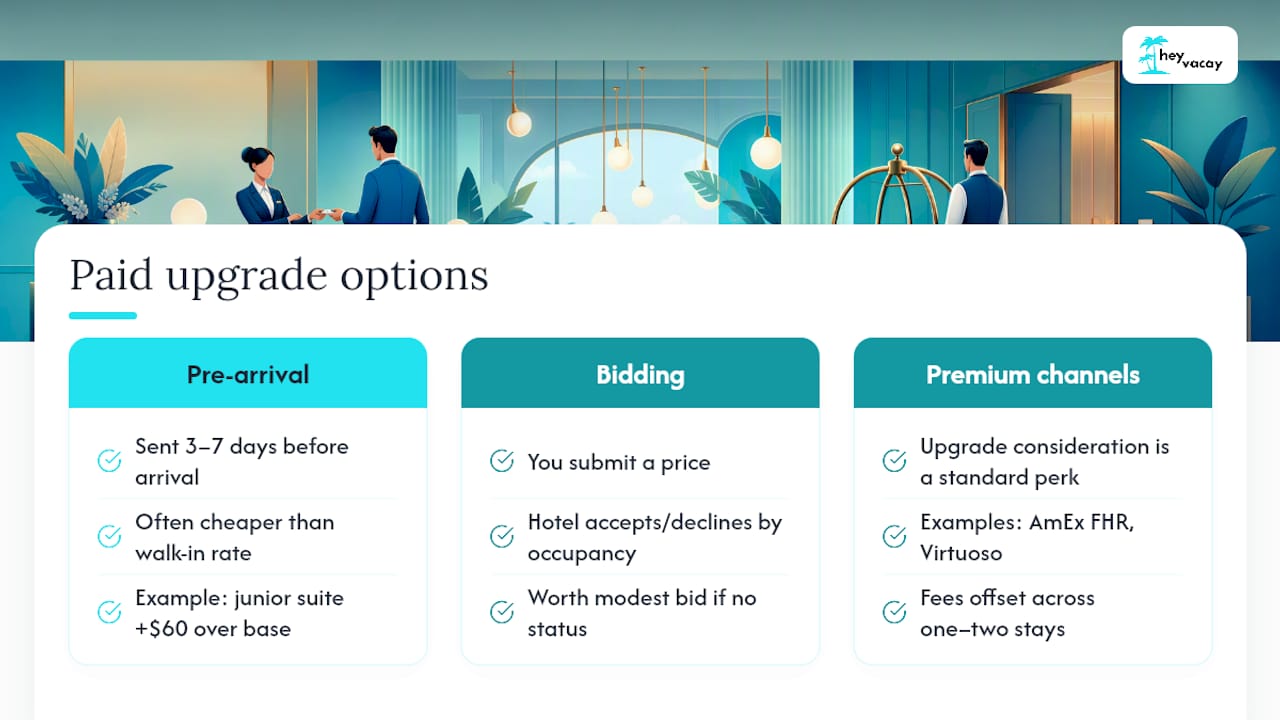
Pre-arrival paid upgrade offers are worth taking seriously. Hotels typically send these 3–7 days before arrival, and the pricing is often meaningfully lower than the walk-in rate for the same room. If you've been monitoring your pre-arrival emails and see an offer for a junior suite at $60 above your base rate, that's frequently the best deal you'll get.
Upgrade bidding programs, used by some larger hotel groups, let you submit a price you're willing to pay for a better room. The hotel accepts or declines based on occupancy. These are worth a modest bid if you have a preference but no status to leverage.
Premium booking channels like American Express Fine Hotels + Resorts and Virtuoso-affiliated advisors include upgrade consideration as a standard perk, not a bid or a hope. For infrequent luxury travelers, the math often works out: the card's annual fee or the advisor's service fee is offset by the perks received across one or two stays.
Before accepting any paid upgrade, ask the front desk two questions: exactly which room you'd be moving to (floor, view, square footage) and what the rate difference is compared to booking that room outright. Sometimes the upgrade offer is priced above the direct-book rate for the better room.
Guaranteed vs. discretionary upgrades: what's actually the difference?
This distinction matters more than most upgrade guides acknowledge.
A guaranteed upgrade is confirmed before you arrive. It's tied to a specific program certificate, a milestone reward, or a booking channel perk. Hyatt Suite Upgrade Awards, when redeemed within the confirmation window, lock in a specific room type. Marriott Suite Night Awards can be confirmed up to 5 days before arrival. These are contractual, not favors.
A discretionary upgrade is everything else. Space-available elite benefits, polite requests, special occasion mentions, front-desk rapport — all of these improve your odds, but none of them guarantee anything. The hotel retains full discretion.
| Method | Timing | Predictability | Who qualifies |
|---|---|---|---|
| Guaranteed certificate | Confirmed days in advance | High | Program members with earned certificates |
| Confirmable upgrade reward | 5 days before arrival (varies) | Medium-high | Mid-to-top tier elite members |
| Space-available elite benefit | At check-in | Medium | Elite status holders |
| Paid pre-arrival offer | 3–7 days before arrival | High | Any guest |
| Discretionary (polite ask) | At check-in | Low-medium | Any guest |
Pro Tip: To convert a discretionary upgrade into something more predictable, stack your actions: book direct, attach your loyalty number, call 3–7 days before arrival to add a request to your reservation, and use a certificate if you have one. Each layer independently improves your odds; together they shift the outcome.
Tipping for upgrades: what actually crosses the line
Slipping a $20 bill across the front desk and asking for a better room is widely considered inappropriate, and many hotel professionals say it puts them in an uncomfortable position. Tipping specifically to request an upgrade can read as a bribe, which most agents are trained to decline or report.
That said, context matters. A small gratuity given after exceptional service, with no strings attached, is standard hospitality etiquette. The line is the quid pro quo: "Here's $20, can you find me something better?" is the version that backfires.
Etiquette rules that actually help:
- Dress reasonably well. First impressions affect discretionary decisions.
- Be brief and warm. A 30-second genuine exchange beats a long negotiation.
- Never pressure an agent publicly or in front of other guests.
- Don't fabricate loyalty status, medical needs, or occasions you're not celebrating.
- If you receive an upgrade, a thank-you note or a specific mention in a post-stay review is the most valuable thing you can offer.
Your pre-check-in checklist (run this 72–2 hours before arrival)
- Confirm your booking is direct (or has your loyalty number attached if booked elsewhere)
- Add a polite upgrade request to your reservation notes via the hotel's website or a direct call
- Check your loyalty account for available upgrade certificates or elite benefits
- Monitor your email for pre-arrival paid upgrade offers from the hotel
- Call 2–3 hours before arrival and ask about room availability
- Plan your arrival for 3–5 PM when inventory is clearest
Ready-to-use phone script: "Hi, I'm arriving this afternoon under [name]. I just wanted to check in and ask if there's any chance of a room upgrade being available. I'm a [loyalty tier] member. No worries at all if not — just thought I'd ask."
If no upgrade materializes, book the room you actually need. Chasing a free upgrade on a trip that matters is a gamble; last-minute booking strategies can sometimes surface better base rooms at lower prices, which is a more reliable path to comfort than hoping for discretionary generosity.
HeyVacay's take on the upgrade game
Most upgrade advice treats the base room price as fixed and tells you to work around it. That framing misses something. When you pay less for your base room, a paid upgrade becomes proportionally more valuable and less painful to accept. Lower base cost changes the math on every upgrade decision you make.
HeyVacay's AI-powered search surfaces the same luxury hotels at lower rates, with transparent pricing and no hidden fees. That means the tactics in this article, especially paid pre-arrival offers and upgrade certificates, work harder for you when your starting point is already optimized. Upgrades should be a bonus, not a necessity you're counting on to make a mediocre room tolerable.
Save on your base room, and upgrades get easier
When your base room costs less, every upgrade option in this article gets more attractive. A pre-arrival paid offer that felt steep at full price becomes an easy yes when you've already saved on the booking.
HeyVacay uses AI to find the same hotels you'd book elsewhere, at lower rates, with no hidden fees and full pricing transparency. Search a property you're already considering and see what the real price looks like before you commit. Then use the tactics in this article to go from a good room to a great one.
Search hotels smarter on HeyVacay and start your next trip with a lower base cost already locked in.
Sources
- How to get hotel upgrades | The Points Guy
- How to Get a Free Hotel Room Upgrade: 9 Tactics That Actually Work | RateRanger
- How to Get a Free Hotel Room Upgrade Every Time - Jet Set Travel Tips
- How to get a hotel room upgrade - American Express