

A hotel's star rating tells you the minimum level of amenities, facilities, and service you can expect — but it does not guarantee quality, and it is not issued by the same authority everywhere. Before you book, here is what actually matters:
- Use stars as a starting filter, not a final verdict. A 4-star listing narrows your options; it does not confirm a great stay.
- Check who issued the rating. An AAA Diamond or Forbes Travel Guide star means an inspector walked through the property. A platform-assigned "hotel class" on a booking site is an algorithm's estimate.
- Read recent guest reviews (last 90 days). CNN's travel reporting finds that recent verified reviews often predict the actual stay better than the star label alone.
- Verify specific amenities. Stars describe categories, not individual rooms. Confirm pool hours, bed size, and Wi-Fi quality before you pay.
- Named bodies like AAA, Forbes Travel Guide, and Hotelstars Union run inspection-based systems with published criteria. Most U.S. hotel listings on booking platforms do not.
Key Takeaways
Stars are a reliable starting filter, but the rater behind the label and recent verified guest reviews matter more than the number alone when choosing a hotel.
| Point | Details |
|---|---|
| Stars are category filters | Use star ratings to narrow your search, then verify with amenity lists and recent reviews. |
| Rater identity matters | AAA Diamonds and Forbes stars come from inspectors; platform "hotel class" labels are often algorithmic. |
| 3-star quality varies widely | Top 3-star hotels regularly outperform low 4-star properties in guest experience and value. |
| 4 vs 5 stars: it's about service | The real difference is anticipatory service — concierge, turndown, butler — not just room finishes. |
| HeyVacay for transparent booking | HeyVacay compares hotel prices with no hidden fees, helping you match star-level expectations to real value. |
Table of Contents
- How hotel star ratings work — and why they vary
- What each star level actually means for travelers
- Who assigns star ratings: U.S. organizations vs international systems
- How star ratings are actually determined
- Why two hotels with the same star count can feel very different
- How to use star ratings when booking
- Special cases and myths: diamonds, "seven stars," and platform classes
- The honest case for using stars as one signal, not the whole story
- Find the right hotel faster with HeyVacay
- Sources
How hotel star ratings work — and why they vary
Star ratings are classification tools. At their best, they summarize a property's facilities, service level, and minimum standards into a single symbol so travelers can compare options at a glance. SiteMinder's industry overview describes them as an international shorthand for quality, cleanliness, and standards — with the important caveat that the exact criteria differ by system and market.
That caveat matters more than most travelers realize. Wikipedia's hotel rating overview makes the point plainly: there is no single global standard. Countries run their own systems, private organizations issue their own classifications, and online travel agencies (OTAs) apply proprietary labels that may have nothing to do with any inspection. A 4-star hotel in Paris was assessed against France's national tourism board criteria. A 4-star listing on a U.S. booking platform may be a self-declared category or an algorithmic assignment.
The main sources of variation come down to four things: whether the system is government-mandated or voluntary, whether inspections are independent and regular, whether the hotel self-assigned its rating, and what the local market expects at each price tier. In France and Germany, classification is mandatory and independently audited, which makes stars more reliably predictive of minimum standards. In the United States, there is no federal hotel-rating law. Most stars you see on U.S. listings are either platform-assigned or come from voluntary programs like AAA or Forbes.
Pro Tip: When booking in Europe, look for the national tourism board classification — it carries legal weight. In the U.S., treat the star as a rough category and lean harder on the specific amenity list and recent guest reviews.
What each star level actually means for travelers
In practice, each star tier sets a floor, not a ceiling. Here is what you can realistically expect at each level, based on Les Roches hospitality research and industry-standard criteria.
1 Star: Clean, functional, and not much else. Expect a private room with a bed, basic bathroom, and daily housekeeping. No on-site restaurant, no concierge, limited reception hours. Best for travelers who need a place to sleep and nothing more — budget road trips, overnight layovers.
2 Stars: A step up in comfort. Rooms are slightly larger, linens are better, and there is usually a small breakfast option or vending area. Reception hours extend but may not be 24/7. Good for budget-conscious travelers who want a reliable base without paying for amenities they will not use.
3 Stars: The most varied category on the market. A solid 3-star typically offers 24-hour reception, an on-site restaurant or bar, a fitness room, and rooms with proper work desks and decent Wi-Fi. HotelGroundTruth's analysis notes that top-performing 3-star hotels regularly outcompete low 4-star properties in guest experience and value — so this tier rewards research. Business travelers on moderate budgets and families doing city trips often land here.

4 Stars: Noticeably more polished. Expect larger rooms, higher-quality bedding, a full-service restaurant, a spa or pool, valet or concierge service, and 24-hour room service at most properties. Service is attentive and responsive. The gap between a strong 4-star and a weak 5-star is often smaller than the price difference suggests.
5 Stars: The defining difference at this level is not the marble lobby — it is the service. Forbes Travel Guide emphasizes anticipatory, personalized service as the key distinction: staff who remember your preferences, proactive concierge outreach, turndown service, and butler options at the top end. Multiple dining outlets, a full spa, and premium room finishes are standard. Modern Traveler's comparison reinforces this: 5-star properties require consistent, anticipatory service and multiple high-quality food, beverage, and wellness outlets — not just upgraded décor.

| Feature | 1 Star | 2 Stars | 3 Stars | 4 Stars | 5 Stars |
|---|---|---|---|---|---|
| Reception hours | Limited | Extended | 24-hour | 24-hour | 24-hour, multilingual |
| On-site dining | None | Breakfast only | Restaurant/bar | Full-service restaurant | Multiple outlets |
| Concierge | No | No | Basic | Full concierge | Dedicated/butler |
| Spa or pool | No | No | Fitness room | Pool and spa | Full wellness center |
| Room quality | Basic | Comfortable | Standard plus | Superior | Luxury, personalized |
| Room service | No | No | Limited hours | 24-hour | 24-hour, premium |
Who assigns star ratings: U.S. organizations vs international systems
Rating authority falls into four broad categories: government or national tourism boards, industry associations, independent guides, and OTA/platform classifications. Each operates differently, and the label they produce carries different weight.
In the United States, there is no federal classification system. The two most credible voluntary programs are:
- AAA (American Automobile Association): Issues Diamond ratings (1–5 Diamonds) through trained inspectors who visit properties unannounced. AAA publishes its criteria and updates inspections regularly. A 4- or 5-Diamond AAA rating is one of the most reliable signals of quality in the U.S. market.
- Forbes Travel Guide: Uses independent inspectors and evaluates properties against hundreds of service and facility criteria. Forbes Travel Guide places particular weight on anticipatory, personalized service — the kind that distinguishes a genuinely 5-star experience from a well-appointed room. Forbes ratings are voluntary and cover a smaller set of luxury properties.
Internationally, the most structured system in Europe is:
- Hotelstars Union: Covers more than 20 European countries and uses a publicly available criteria catalogue with minimum thresholds, point-based scoring, and regular on-site audits. Properties that exceed the minimum for their star level can earn a "Superior" designation. This is one of the most transparent classification systems available to travelers.
On booking platforms, you will encounter:
- Google (hotel class / hotel attributes): Google assigns a "hotel class" based on a combination of amenity data, user-submitted attributes, and algorithmic inference. It is not an inspection. The label reflects what the platform's data suggests about the property, not what an inspector confirmed.
- Hotels.com: Aggregates star ratings from multiple sources, including hotel self-reporting and partner data. The displayed star may reflect the hotel's own claim, a partner feed, or a blended score. Always check the source of the rating when it matters.
When it counts, prefer an inspected label from AAA or Forbes over a platform-assigned class. For European bookings, a Hotelstars Union rating is a reliable floor.
How star ratings are actually determined
The method behind a star label shapes how much you should trust it. Three main approaches exist.
Inspection-based systems use trained evaluators who visit properties and assess them against a checklist of mandatory and optional criteria. Points accumulate, and the total determines the star level. Hotelstars Union's catalogue, for example, covers hundreds of criteria across categories like room size, bathroom fixtures, reception services, and food and beverage. Mandatory criteria must be met; optional ones add points toward higher classifications or the Superior flag. This approach has real enforcement: properties are audited on a regular cycle, and ratings can be withdrawn.
Mystery-guest programs go further. Forbes Travel Guide sends anonymous inspectors who experience the property as a paying guest — checking in, ordering room service, requesting concierge help, and noting every service interaction. This method captures service behaviors that a checklist alone cannot measure, which is why Forbes ratings carry weight at the luxury end of the market.
Algorithmic and aggregated classifications are what most travelers actually see on booking platforms. Google's hotel class, for instance, is inferred from amenity data, user-contributed attributes, and review signals. No inspector visits. The system is fast and broad, but it can lag behind renovations, miss service quality entirely, and reflect outdated amenity data. Hotels.com and similar platforms blend self-reported data with partner feeds, which means the star you see may be exactly what the hotel told the platform it was.
| Method | What it measures | Enforcement | Strengths | Weaknesses |
|---|---|---|---|---|
| Inspection (checklist) | Facilities, minimum standards | Regular audits | Consistent, verifiable | Slow to update |
| Mystery guest | Service behavior, guest experience | Per inspection cycle | Captures service quality | Covers fewer properties |
| Algorithmic/platform | Amenities, reviews, self-reported data | None | Broad coverage | No independent verification |
Pro Tip: When comparing hotels, look for three things together: a named rater (AAA, Forbes, or a national board), published criteria you can read, and recent verified guest reviews. Any one of those alone is weaker than all three combined.
Why two hotels with the same star count can feel very different
Stars set a category floor, but they do not control everything that shapes a stay. Several factors explain why a 3-star in one city feels nothing like a 3-star in another.
- Property age and renovation status. A hotel rated 15 years ago and never re-inspected may carry a star that reflects what it was, not what it is. Recent renovations can push a property well above its rated category; deferred maintenance can do the opposite.
- Brand standards vs. independent hotels. A branded 4-star from a major chain operates against the chain's own standards in addition to any external rating. An independent 4-star has no such backstop — it can be exceptional or disappointing depending on ownership.
- Staff-to-guest ratio. This is rarely listed anywhere, but it drives the service experience more than almost any amenity. A 4-star with a lean staff during peak season will feel different from the same property at 60% occupancy.
- Local market pricing expectations. A 4-star in a secondary U.S. city competes at a different price point than a 4-star in Manhattan or San Francisco. The star is the same; the value proposition is not.
- Enforcement frequency. In markets without mandatory re-inspection, a hotel can hold a star indefinitely. HotelGroundTruth's guide notes that in markets with mandatory classification and independent audits, star labels align better with expected minimum standards.
Before booking, run these checks: look at photos uploaded in the last six months (not the hotel's own marketing shots), filter guest reviews to the most recent 90 days, confirm specific amenity details like pool hours and gym equipment, and verify the bed configuration and room size in square feet. Stars are starting filters, not guarantees.
How to use star ratings when booking
A practical booking workflow that combines star ratings with verified data gets you to the right hotel faster than either alone.
- Set your budget and non-negotiables first. Decide what you actually need: free breakfast, a pool, a specific neighborhood, a king bed. These constraints narrow the field before stars enter the picture.
- Use the star rating to set the category. If you need a full-service restaurant and a gym, start at 3 stars and above. If you want anticipatory service and a spa, start at 4 stars and above. Stars are efficient category filters.
- Verify who issued the rating. An AAA Diamond or Forbes star means an inspector visited. A platform class means an algorithm estimated. Weight them accordingly.
- Read reviews from the last 90 days. Filter specifically for mentions of cleanliness, Wi-Fi reliability, and noise. A hotel can have a strong overall score and a recent pattern of complaints about a specific issue — the recent reviews will show it.
- Check the amenity specifics. Pool open year-round or seasonal? Gym with actual equipment or a treadmill and a mirror? Breakfast included or a paid add-on? The star does not answer these questions.
- Compare price against the star tier. Use a platform like HeyVacay to see what the same property costs across sources, with transparent pricing and no hidden fees. A top 4-star at the right price often beats an underperforming 5-star at a premium.
- Confirm refund and cancellation terms. Star level has no bearing on flexibility. A 5-star can have a strict no-refund policy; a 3-star can offer free cancellation up to 24 hours before arrival.
Pro Tip: When comparing a 4-star and a 5-star at similar prices, look at service indicators first: dedicated concierge, turndown service, and butler availability. If the 5-star cannot confirm those, the 4-star is likely the better value.
Pro Tip: For families, a strong 3-star with connecting rooms and a pool often delivers more practical value than a 4-star with no family-specific amenities. Check the family suite options before defaulting to a higher star.
The value-vs-prestige trade-off is real. A top-performing 4-star with recent renovations, strong service scores, and a great location will outperform a low-rated 5-star that is coasting on its classification. Stars tell you the category; reviews and amenity checks tell you the property.
Special cases and myths: diamonds, "seven stars," and platform classes
Not every rating symbol you encounter is a star, and not every star comes from the same place.
- AAA Diamonds: AAA uses a Diamond system (1–5 Diamonds) rather than stars. The criteria overlap with star-based systems in many ways, but Diamonds are AAA's proprietary classification, not a national law or government standard. A 5-Diamond property is among the most rigorously inspected hotels in the U.S. market.
- "Seven-star" hotels: This is a marketing term, not an industry classification. No recognized rating body issues a 7-star rating. Properties that use this label are making a brand claim, not reporting an inspection result. Translate it back to what it actually means: a luxury property positioning itself above the standard 5-star tier.
- OTA "hotel class" labels: Google, Hotels.com, and similar platforms display star-like classifications that are often algorithmic or self-reported. These are useful for rough filtering but carry no inspection authority. A "4-class" label on a platform is not the same as a 4-Diamond AAA rating.
- "Superior" designations: Hotelstars Union awards a "Superior" flag to properties that exceed the minimum point threshold for their star level without reaching the next tier. It signals a property that punches above its category — useful to look for when booking in Europe.
- Half-stars and proprietary symbols: Some platforms display half-star increments or their own internal quality scores. These are platform-specific and not comparable across sites. When you see them, check whether the platform explains the methodology — most do not.
The practical rule: translate any unusual label back into what matters to you. What facilities does the property have? Who inspected it, and when? What do recent guests say about the service?
The honest case for using stars as one signal, not the whole story
Star ratings are genuinely useful — but the travel industry has a habit of treating them as more definitive than they are, and travelers pay for that assumption.
The most common mistake is booking a 5-star expecting a 5-star experience without checking whether the rating came from an inspector or an algorithm. In the U.S., where there is no mandatory classification system, a significant share of "5-star" listings on major platforms reflect the hotel's own self-assessment or a platform's data inference. That is not fraud — it is just a different kind of signal, and it deserves a different level of trust.

The second mistake is dismissing a 3-star out of hand. The 3-star category is the most diverse tier in the market. A well-run independent 3-star with recent renovations, a strong local reputation, and a 4.6 guest score on verified reviews will consistently outperform a neglected 4-star holding onto a classification it earned a decade ago. CNN's travel reporting makes exactly this point: recent verified reviews predict the actual stay better than the star label in most markets.
The most useful approach is to treat stars as a category filter, then do the work that the star cannot do for you: read recent reviews, verify the amenity list, and compare prices across sources. That combination — star category, inspection source, recent reviews, transparent pricing — is what actually gets you to the right hotel.
Find the right hotel faster with HeyVacay
Knowing what a star rating means is half the work. The other half is finding a property that delivers on it at a price that makes sense.
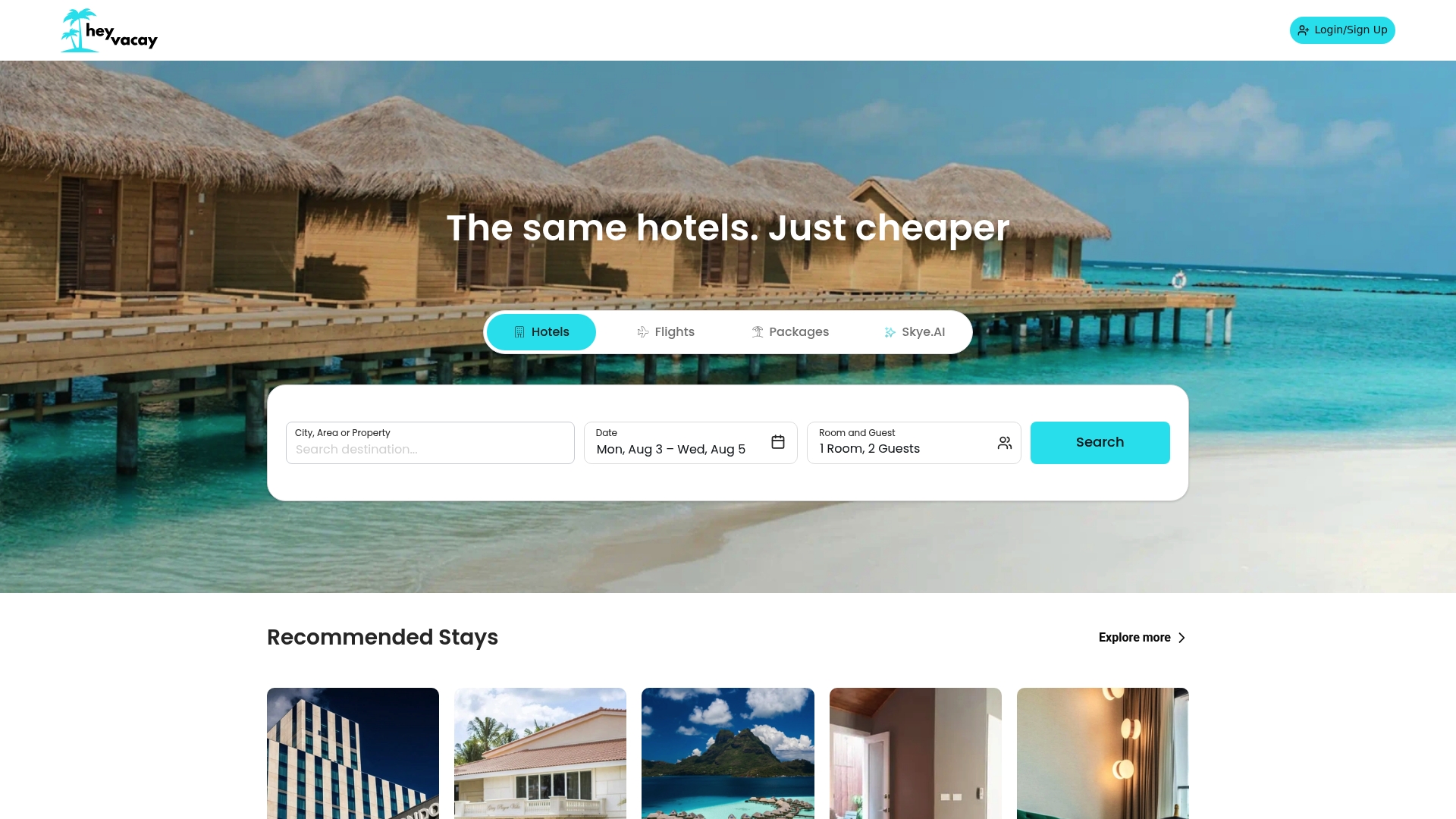
HeyVacay cuts the gap between star-level knowledge and a confirmed booking. The platform uses AI to surface the same hotels you would find elsewhere — including luxury properties — at lower rates, with transparent pricing and no hidden fees. You can filter by amenity, compare options side by side, and see exactly what you are paying for before you commit. No algorithmic star label is going to tell you whether the rooftop pool is heated or whether the "full-service restaurant" closes at 9 PM. HeyVacay's search puts that detail front and center, alongside price comparisons that show you when a 4-star is genuinely the better value over a 5-star at a premium. Search hotels on HeyVacay and book with the full picture in hand.
Sources
When you want to verify a rating or understand the criteria behind it, these are the sources worth consulting:
- Hotel rating - Wikipedia
- Forbes Travel Guide
- What hotel star ratings actually mean today | CNN
- Hotel star rating system: Meaning and how it works - SiteMinder
- What Hotel Star Ratings Actually Mean in 2026 (The Honest Guide) - HotelGroundTruth
Prefer inspected, regularly audited sources over platform-assigned classifications whenever the choice matters. For most U.S. bookings, AAA and Forbes are your most reliable anchors.