

Properties in the United States may legally charge late checkout fees, provided the fee is disclosed before or at the time of booking. Skip the disclosure, and the charge becomes vulnerable to a chargeback. That single rule shapes everything else about how these fees work.
The most common fee structures you'll encounter:
- Flat fee: A fixed dollar amount regardless of how late the guest stays, typically $25–$75 at mid-range hotels.
- Hourly rate: A per-hour charge, usually $15–$50 per hour, applied after the standard checkout time.
- Half-day or full-day rate: A percentage of the nightly rate (commonly 25%–50% for a half-day, up to 100% for a full-day extension) when the guest stays well into the afternoon.
- Card-on-file charge: The property charges the authorized card post-stay, which works smoothly when authorization was captured at check-in.
For hosts, the immediate priority is getting the fee into the booking confirmation and listing before the guest arrives. For guests, the move is simple: ask about checkout time when you book, and save a timestamped record of when you actually left.
Pro Tip: Add a single sentence to your booking confirmation that states the exact cutoff time and fee amount. That one line eliminates the majority of disputes before they start.
Key Takeaways
Late checkout fees are legal in the U.S. when disclosed at booking, and the single most effective thing both hosts and guests can do is document the policy and the departure time in writing.
| Point | Details |
|---|---|
| Disclosure is the legal threshold | Fees disclosed before booking are enforceable; undisclosed fees are disputable via chargeback. |
| Typical fee ranges | Flat fees typically range in the tens of dollars; hourly rates are generally modest per hour; percentage-based fees vary according to length of late stay. |
| Hosts: capture authorization early | Pre-authorization at check-in is the cleanest collection method and reduces post-stay disputes. |
| Guests: ask and document | Request late checkout 24–48 hours ahead, confirm in writing, and save your booking confirmation. |
| HeyVacay shows full pricing upfront | HeyVacay displays all fees before booking so travelers avoid unexpected charges at checkout. |
Table of Contents
- What counts as a late checkout?
- How much do late checkout fees typically cost?
- Legal and consumer-protection issues in the U.S.
- How to add a late checkout fee to your policy
- What to do when a guest refuses to pay
- If you're a guest: how to avoid or contest a late checkout fee
- Why properties charge late checkout fees: the operational reality
- HeyVacay's take on transparent pricing and fair fees
- Book hotels with pricing you can actually trust
- Sources
What counts as a late checkout?
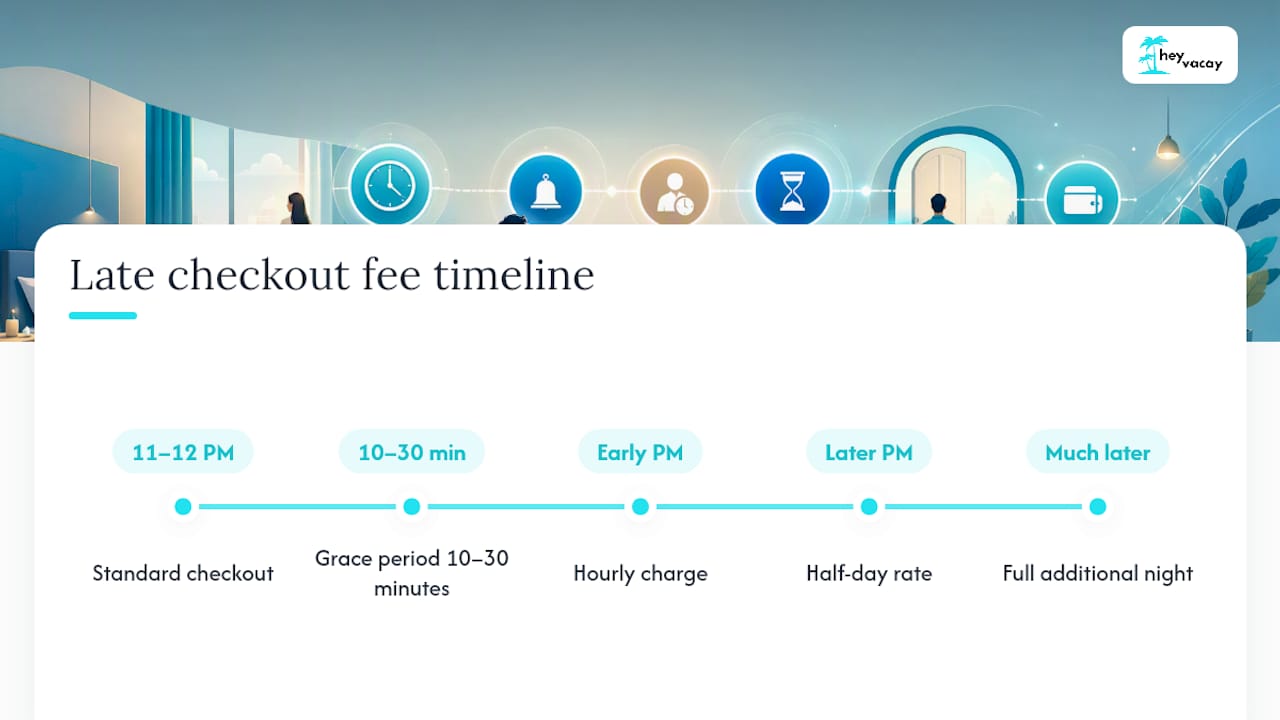
Standard checkout time at U.S. hotels runs 11 AM or 12 PM, depending on the property. Anything after that window is technically late, though most properties build in a grace period of 10–30 minutes before any charge applies. Short-term rental hosts on platforms like Airbnb typically set their own cutoff, often 10 AM or 11 AM, written directly into the house rules.
The terminology varies by property type. Hotels tend to use "late check-out" or "extended stay." Vacation rental hosts often write "late departure fee" in their house rules. Day-use bookings are a separate category entirely: a guest who books a room for daytime hours only, without an overnight stay, is paying a day-use rate rather than incurring a late checkout penalty.
A practical timeline looks like this: a hotel with a 12 PM checkout might apply an hourly charge for early afternoon extensions, switch to a half-day rate for later departures, and charge for a full additional night for much later checkouts. Those thresholds aren't universal, but they reflect common practice across mid-scale and upscale U.S. properties.
According to The Points Guy, guests aren't always legally required to check out formally at the front desk. Contactless systems and mobile checkout have made in-person checkout optional at many properties. The practical reason to do it anyway: a formal checkout creates a timestamped record that protects both sides if a billing question comes up later.
How much do late checkout fees typically cost?
Fee amounts vary more than most guests expect. A budget motel might charge nothing at all; a luxury resort might add $150 for a 3 PM departure. The range in between reflects occupancy pressure, market segment, and how much the housekeeping team's schedule is disrupted.
Hotel Chantelle's industry guide reports flat fees typically fall between $20 and $100, with hourly rates running $15–$50 per hour. For percentage-based pricing, TripGain's corporate travel glossary notes fees structured as a percentage of the nightly rate increasing with the lateness of the guest's departure.
Key factors that push fees higher or lower:
- Occupancy rate: A sold-out Friday night means housekeeping has zero flexibility. Fees go up, or late checkout simply isn't offered.
- Market segment: Urban business hotels in New York or San Francisco charge more than rural vacation rentals.
- Loyalty status: Elite members at major hotel chains often receive complimentary late checkout as a standard benefit, which effectively sets the fee to zero for that segment.
- Housekeeping window: If the next guest checks in at 3 PM, a 2 PM departure costs the property almost nothing. A 4 PM departure costs real labor.
It's easy to explain and hard to dispute.
Legal and consumer-protection issues in the U.S.
The legal framework for late checkout fees in the U.S. comes down to one principle: disclose first, charge later. There is no federal statute that prohibits these fees outright. What federal consumer-protection law does regulate is how and when fees are presented.
The FTC's rule on unfair or deceptive fees, which took effect May 12, 2025, strengthens the obligation for businesses to disclose fees upfront in advertising and at the point of sale. A late checkout fee buried in fine print or revealed only at checkout violates the spirit of that rule and creates real chargeback exposure.
Tax treatment adds another layer. CBS Boston's reporting found that some hotels categorize early check-in and late checkout charges as ancillary service fees rather than room-rate components. That categorization can shift the applicable tax from a higher occupancy tax rate to a lower sales tax rate, which increases the property's retained revenue. Guests who notice a line-item fee taxed differently from their room rate aren't imagining things.
When a guest refuses to pay, hosts have a few legitimate paths: charge the card on file (if authorization was captured), file a dispute through the booking platform, or pursue small-claims court as a last resort. What hosts cannot do is threaten, harass, or withhold a security deposit for a fee that was never disclosed. A guest who was never shown the policy can dispute the charge through their card issuer as an undisclosed fee, and they often win.
Pro Tip: State and local consumer-protection laws vary. In some jurisdictions, hotel fees above a certain threshold require specific written consent. If you're setting fees above $100 or operating in a heavily regulated market like California or New York City, a quick review with a local attorney is worth the hour.
How to add a late checkout fee to your policy
The mechanics of implementation matter as much as the policy itself. A fee that exists but isn't findable is legally and operationally useless.
Implementation checklist for hosts:
- Add the fee to your listing description (Airbnb house rules, hotel website, OTA listing).
- Include it in the booking confirmation email with the exact cutoff time and dollar amount.
- Post it at the front desk or in a printed house rules card inside the rental.
- Add it to your internal housekeeping schedule so staff know when rooms are expected to turn.
Sample policy language (strict version): "Checkout is at 11:00 AM. Guests departing after 11:00 AM will be charged $50 per hour. Guests departing after 3:00 PM will be charged one additional night's rate."
Sample policy language (flexible version): "Standard checkout is 11:00 AM. Late checkout until 1:00 PM may be available upon request at no charge, subject to availability. Departures after 1:00 PM incur a $40 fee."
Sample policy language (loyalty-exemption version): "Checkout is 12:00 PM. Gold and Platinum members receive complimentary late checkout until 2:00 PM. All other guests departing after 12:00 PM are charged $30 per hour."
For collection, the cleanest method is a pre-authorization hold captured at check-in. If a guest departs late, you add the fee to the final charge before releasing the hold. Post-stay charges on a card-on-file work too, but they require documented consent in the original booking terms. Platform-specific collection on Airbnb runs through the Resolution Center; VRBO handles it through its damage and extras claim process.
SiteMinder's hotel operations guide frames late checkout fees as an inventory-management tool, not just a revenue line. Coordinating the fee policy with your housekeeping schedule is what makes it operationally coherent. If housekeeping isn't notified that a guest has paid for a 2 PM checkout, you'll have a cleaner knocking on the door at noon.
Pro Tip: Log every late checkout in your property-management system with the departure time, fee charged, and staff initials. That log is your primary evidence if a dispute surfaces 60 days later.
What to do when a guest refuses to pay
Most refusals come from guests who claim they weren't told about the fee. The response that works best is calm, documented, and sequential.
Step one: address it in person or by phone, politely. Remind the guest of the policy location (confirmation email, house rules) and the amount. Many guests pay once they see the written policy in front of them.
Step two: follow up in writing. Send an email that references the booking confirmation, states the departure time, and specifies the fee. Keep the tone factual, not adversarial.
Step three: if the guest still refuses, charge the card on file if you have documented authorization. The authorization language in your booking terms is your legal basis.
Step four: if the card charge is disputed, file a response through the platform's resolution process. Evidence that wins disputes: a screenshot of the published policy, the booking confirmation showing the fee terms, timestamped housekeeping notes, key-return records, and any access-log data from a smart lock.
Step five: small-claims court is available for amounts typically up to $10,000 in most U.S. states, with no attorney required. It's rarely worth pursuing for a $50 fee, but for a full-night charge on a luxury property, it's a real option.
Pro Tip: Never skip the written follow-up email. A platform arbitrator reviewing a dispute will almost always side with the party that has a paper trail. The guest's "I didn't know" defense collapses when you can show the confirmation email they received.
If you're a guest: how to avoid or contest a late checkout fee
The easiest way to avoid a late checkout fee is to ask before you arrive. Most properties will tell you whether late checkout is available and at what cost. Some will waive it entirely if occupancy is low.
Pre-trip checklist:
- Confirm the checkout time when you book, not when you arrive.
- Request late checkout 24–48 hours before your stay ends, either through the app or by calling the front desk directly.
- Check your loyalty status. Elite tiers at Marriott Bonvoy, Hilton Honors, and World of Hyatt routinely include complimentary late checkout as a stated benefit.
- Save a copy of your booking confirmation showing the original terms.
Negotiation works more often than guests expect. Offering to pay a smaller flat fee instead of an hourly rate, or proposing a specific departure time ("I can be out by 1 PM"), gives the front desk something concrete to approve. A polite ask costs nothing.
If you're contesting a fee you believe was never disclosed, the process is straightforward. Request an itemized folio at checkout. Ask to speak with a supervisor and point to the booking confirmation. If the fee doesn't appear in the original terms, file a dispute with your card issuer as an undisclosed charge. CBS Boston's reporting confirms that undisclosed fees are among the most successfully disputed charges in the hospitality category.
Chargeback is a last resort, not a first move. Use it when the fee was genuinely absent from your booking terms and the property won't resolve it directly.
Why properties charge late checkout fees: the operational reality
The operational driver is simpler than most guests realize. A hotel room that checks out at 3 PM instead of 11 AM compresses the housekeeping window from four hours to one. During high occupancy, that's not a minor inconvenience; it's a scheduling crisis that may require overtime labor or delay the next guest's check-in.
SiteMinder's operations research frames late checkout fees as an inventory-management mechanism. The fee either compensates for the disruption or discourages the behavior. Both outcomes serve the property's operational interest.
The revenue angle is real too. As CBS Boston reported, categorizing these charges as ancillary service fees rather than room-rate components can shift the tax treatment in the property's favor. That's not a guest-hostile practice by itself, but it does mean the fee line on your folio may carry a different tax rate than the room charge above it.

Technology is changing the dispute landscape. Contactless checkout systems and property-management software now generate automatic timestamps when a guest's key is deactivated or a mobile checkout is confirmed. Fodor's coverage of modern checkout practices notes that digital folios and mobile checkout confirmations reduce billing errors and give both sides a cleaner record. For hosts, that timestamp is evidence. For guests, it's protection against being charged for a late departure that didn't happen.
Pro Tip: If your property uses a smart-lock or PMS with mobile checkout, configure it to send the guest a timestamped departure receipt automatically. That single automation cuts dispute rates significantly and costs nothing to implement.
HeyVacay's take on transparent pricing and fair fees
Hidden fees are the single most common complaint in travel. Late checkout fees aren't inherently unfair; the problem is when they appear on a folio that never mentioned them at booking. Clear disclosure, stated at the time of reservation, is what separates a legitimate policy from a deceptive one.
HeyVacay's position is that every fee a traveler might encounter should be visible before they confirm a booking. That's the standard we hold ourselves to, and it's the standard we'd encourage every host and hotel to apply. If you're a host looking to understand how dynamic pricing and ancillary fees interact with your overall rate strategy, or how last-minute inventory affects your checkout flexibility, those resources are worth your time.
Book hotels with pricing you can actually trust
Hidden fees are a real cost, and late checkout charges are just one example. HeyVacay shows you the full price of a hotel stay before you book, with no surprises at checkout.

Search luxury and mid-range hotels at lower rates, with transparent pricing on every listing. Whether you're planning a trip where you need a flexible checkout or just want to know exactly what you're paying, HeyVacay gives you that clarity upfront. Browse available hotels and confirmed rates at Heyvacay and book the stay that actually fits your schedule.
Sources
These are the primary sources behind the legal and operational claims in this article.
- More hotels charging fees for early check-in, late check-out - CBS Boston
- Ftc
- Hotel check out: Procedure and strategies for hotels - SiteMinder
- Late Check-Out Fee In Hotels | Corporate Travel Costs Explained
- How and when to ask for late checkout at a hotel - The Points Guy