

Flexible plans? Book pay at hotel. Dates locked in and the discount is real? Pay now usually wins. That one-sentence rule covers about 80% of decisions, but the mechanics underneath it matter more than most travelers realize.
- Price: Prepaid rates are often cheaper because the hotel eliminates no-show risk. That discount disappears fast if you lose a refund or accept a dynamic currency conversion (DCC) charge at the front desk.
- Flexibility: Pay-at-hotel bookings typically let you cancel or modify closer to arrival, but they can still trigger card holds or deposits before you check in.
- Who collects payment: Whether the platform (like HeyVacay) or the property charges your card determines who you call for a refund and how long it takes. Visa and Mastercard dispute timelines differ from a hotel's own refund policy. BNPL services like Klarna add a third party to that chain.
Key Takeaways
Choosing between prepaying and paying at the hotel comes down to one core trade-off: a lower price now versus the right to change your mind later.
| Point | Details |
|---|---|
| Prepaid saves money conditionally | Advance-purchase discounts are real but evaporate if you cancel a non-refundable rate. |
| "Pay at hotel" still touches your card | Pre-authorization holds and incidental deposits can freeze hundreds in available credit at check-in. |
| DCC is the biggest hidden cost | Accepting a home-currency charge at the front desk typically costs more than any prepay discount saves. |
| Merchant of record controls refunds | Who charged your card determines who issues the refund and how long it takes. |
| Screenshot the checkout page | The cancellation deadline, penalty, and charging party on that page are your evidence in any dispute. |
| HeyVacay surfaces both options | HeyVacay shows refundable and prepaid rates with transparent pricing so you can compare the real cost. |
Table of Contents
- Pay now vs pay at hotel: pros and cons at a glance
- What actually happens behind the scenes
- When prepaid actually saves money (and when it doesn't)
- How cancellation rules and refunds actually work
- Hidden gotchas that can turn a small decision into a big cost
- A practical checklist: which option fits your trip
- What to check on the booking page before you confirm
- HeyVacay's take on the pay-now trade-off
- Book smarter with HeyVacay
- Sources
Pay now vs pay at hotel: pros and cons at a glance
Pay now — pros
- Lower rate, often 5–15% off the flexible price
- Guaranteed reservation; no risk of walk-in price spikes
- Good for: fixed dates, high-demand periods, budget-conscious trips
Pay now — cons
- Non-refundable or strict cancellation terms are common
- Refunds take longer when a third-party platform is the merchant of record
- Currency risk if you prepay in a foreign currency that moves before arrival
Pay at hotel — pros
- Cancel or modify with more lead time, often penalty-free
- No money leaves your account until check-in or check-out
- Easier to switch properties if plans shift
Pay at hotel — cons
- Standard (higher) rate applies in most cases
- Pre-authorizations and incidental holds can still freeze available credit
- No-show fees can apply if you skip without canceling
What actually happens behind the scenes
The label on a booking page ("pay now" or "pay at hotel") describes when money moves, not whether your card gets touched. Understanding the actual flow changes how you read the fine print.
Pay now flow: You enter card details, the payment gateway authorizes and captures the charge in one step, and funds move to the merchant's account. If the platform is the merchant of record, the hotel gets a payout later on a schedule the platform controls. That matters for refunds: the money has already left your card and sits with the OTA or processor, not the hotel. Stripe's hotel payment processing overview explains how capture timing and payout schedules affect who can issue a refund and how fast.
Pay at hotel flow: The platform holds your reservation with a card on file. At check-in, the hotel typically runs a pre-authorization, which is not a charge but does reduce your available credit. The final capture happens at check-out, or earlier if a no-show fee kicks in. The phrase "pay at hotel" does not mean your card sits untouched until you arrive.
Merchant of record: This is the entity that actually charged your card. If it is the OTA, your dispute goes to the OTA. If it is the hotel, you deal with the property directly. The checkout page should name the charging party, but it is often buried in small print.
BNPL in the booking flow: Buy Now Pay Later options are increasingly common for hotel bookings. Services like Klarna or Affirm let you split the cost into installments, which can help with cash flow. The catch: the BNPL provider becomes a third party in any refund or dispute, which can slow resolution.
Pro Tip: Before you confirm, scroll to the checkout summary and look for two things: the name of the entity charging your card and the exact cancellation deadline. Screenshot both.
When prepaid actually saves money (and when it doesn't)
Prepaid rates are cheaper for a reason. Hotels and OTAs price them lower because they get guaranteed cash earlier and eliminate the no-show risk. That discount is real, but it comes with conditions that can erase it.
A typical advance-purchase rate runs 5–15% below the flexible rate for the same room. On a $200/night stay, that is $10–$30 per night. If you cancel and the rate is non-refundable, you lose the entire amount. One change of plans and the "savings" become a loss.
Currency conversion is the other trap. Worse, dynamic currency conversion at the front desk adds a markup when a hotel offers to charge you in your home currency. Always pay in local currency and decline DCC.
| Dimension | Pay now | Pay at hotel |
|---|---|---|
| Price | Often 5–15% lower (advance-purchase rate) | Standard rate; no prepay discount |
| Flexibility | Strict; often non-refundable | More flexible; cancel closer to arrival |
| Refund speed | Slower if OTA is merchant of record | Faster; hotel handles directly |
| Card holds/deposits | Charged at booking | Pre-auth hold at check-in |
| Consumer protection | Dispute with OTA or card network | Dispute directly with property |
| Convenience | Paid and confirmed instantly | Card needed at check-in |
Your trip gets canceled two weeks out. The rate is non-refundable. You lose $162 per night. The "savings" of $18/night cost you the full stay.
Example scenario B: You book the same room pay at hotel at $180/night. Plans change, you cancel within the free-cancellation window, and you owe nothing. The $18/night "discount" you skipped was worth less than the flexibility you kept.

How cancellation rules and refunds actually work
Prepaid rates and pay-at-hotel rates follow different cancellation logic, and the gap between them is wider than most travelers expect.
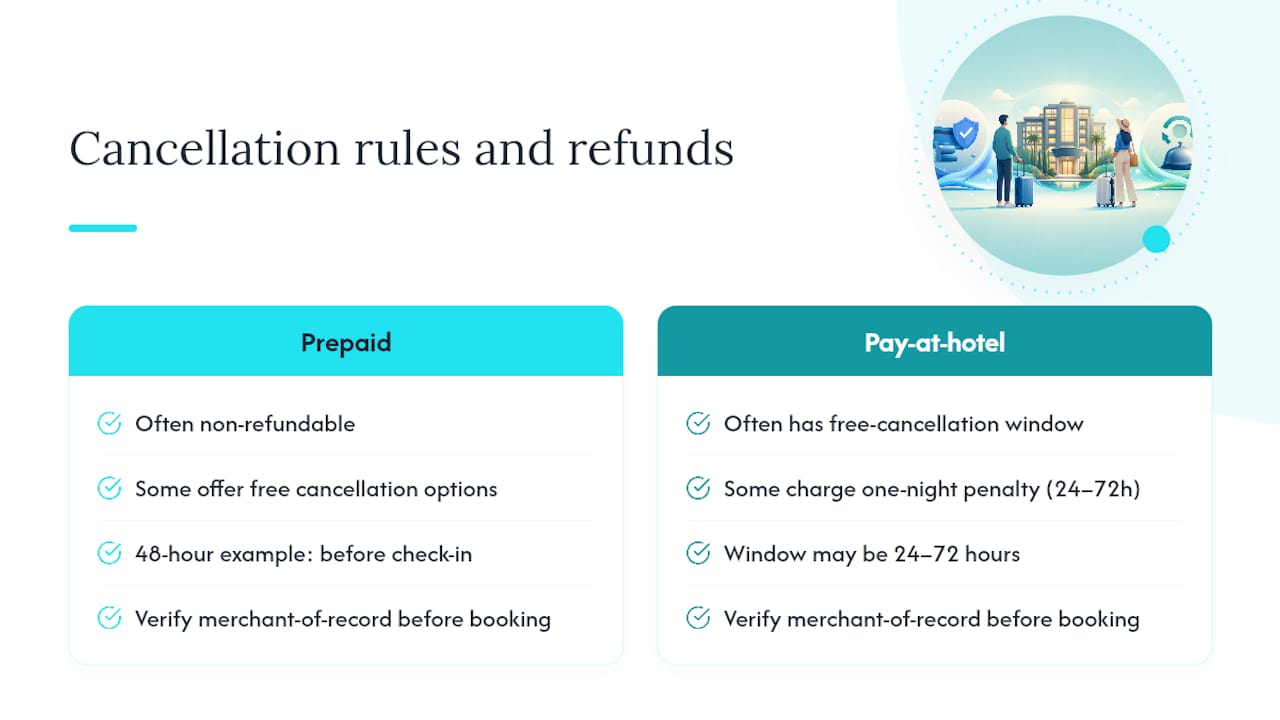
Non-refundable prepaid rates are exactly that. Cancel for any reason, and the hotel or OTA keeps the money. Some platforms offer a "free cancellation" prepaid rate, which sounds like a contradiction but is real: you pay upfront, and if you cancel before a specific deadline, you get a full refund. Read the exact deadline language. "Free cancellation until 48 hours before arrival" means 48 hours before your check-in time, not 48 hours before the calendar date.
Pay-at-hotel bookings usually carry a free-cancellation window, but not always. Some pay-later rates still charge a one-night penalty if you cancel inside 24–72 hours of arrival. The label "pay at hotel" does not automatically mean penalty-free cancellation.
Refund timelines are where the merchant-of-record question becomes expensive. When the hotel charges your card directly, a refund can appear in 3–5 business days. When an OTA or platform is the merchant of record, the refund must travel back through the platform's payment processor before it reaches your card issuer, which can add days or weeks to the timeline. Verifying who will charge your card before you book tells you exactly who to contact if something goes wrong.
Pro Tip: Screenshot the checkout page and the confirmation email showing the cancellation deadline and penalty amount. If a dispute arises, that screenshot is your primary evidence.
Hidden gotchas that can turn a small decision into a big cost
Most travelers focus on the rate. The real cost surprises tend to come from four other places.
- Pre-authorization holds: Even on a pay-at-hotel booking, the front desk typically places a hold for the estimated stay plus an incidental buffer. That hold can be $200–$500 on top of your room cost, reducing your available credit for the duration of your stay. Bankrate's breakdown of hotel card holds explains how these authorizations work and when they release.
- Incidental deposits: Some properties, particularly independent hotels and resorts, require a cash or card deposit at check-in regardless of whether you prepaid online. This is separate from the room charge.
- First-night or no-show charges: If you book pay at hotel and don't show up without canceling, many hotels charge the first night's rate to the card on file. That charge can arrive even if you thought you had a free-cancellation booking.
- DCC at the front desk: A hotel clerk offers to charge your card in your home currency "for convenience." That convenience typically costs 3–8% above the interbank rate. Decline it every time. Pay in local currency.
- Third-party merchant complexity: If you prepaid through an OTA and the hotel claims you owe money at check-in, you have two separate billing relationships to untangle. Keep your booking confirmation and the OTA's payment receipt accessible.
Pro Tip: Travel with a credit card that has a credit limit at least $500 above your expected room total. Pre-authorization holds are real and can block other purchases during your stay. Debit cards are riskier here because holds freeze actual cash.
A practical checklist: which option fits your trip
Use these rules to decide in under a minute.
- Dates firm, discount meaningful, rate refundable? Pay now. Lock the lower rate and keep the cancellation window as a safety net.
- Dates firm, discount meaningful, rate non-refundable? Pay now only if you have zero chance of canceling. Otherwise, the flexibility of pay at hotel is worth the price difference.
- Dates uncertain or plans likely to shift? Pay at hotel, every time. The standard rate is the cost of keeping your options open.
- Business traveler with reimbursement requirements? Pay at hotel often simplifies expense reporting because the charge appears on your card at the actual stay date. Confirm your company's policy first.
- International trip with currency concerns? If you prepay, use a no-foreign-transaction-fee card and pay in local currency. If you pay at the hotel, decline DCC at the desk and pay in local currency there too.
- Using BNPL to split the cost? BNPL usually appears on prepaid bookings. Confirm the refund policy with the BNPL provider before booking, not after. For last-minute hotel deals, pay-at-hotel rates are often the only option available anyway.
For group bookings with fixed dates, locking a group hotel rate early with a prepaid option can protect inventory and price simultaneously.
What to check on the booking page before you confirm
The booking page contains everything that determines your outcome in a dispute. Most travelers skip it. Here is what to read before clicking confirm.
- Payment timing line: Does it say "charged today," "charged at check-in," or "charged at check-out"? This tells you when money moves.
- Merchant of record: Who charges your card? Look for a line like "You will be charged by [Platform Name]" or "Payment processed by [Hotel Name]." If it is absent, check the terms and conditions link.
- Cancellation deadline and penalty: The exact date and time, and the exact penalty (first night, full stay, percentage). Vague language like "flexible cancellation" is not a policy.
- Total price breakdown: Taxes, resort fees, and service charges should appear before you confirm, not as a surprise at check-in. Prepaying without seeing the full fee breakdown is one of the most common sources of post-stay disputes.
- Currency of the final charge: Is the total shown in the local currency or your home currency? If it is your home currency, ask whether DCC is being applied.
- Non-refundable or advance-purchase label: These phrases carry legal weight. A rate marked "advance purchase" is almost always non-refundable regardless of how the cancellation policy reads.
- BNPL option at checkout: If Klarna, Affirm, or a similar service appears, note that choosing it changes the merchant-of-record chain for refunds.
Save the confirmation email and screenshot the checkout summary. Those two documents are your evidence if the hotel or platform disputes your version of the terms.
HeyVacay's take on the pay-now trade-off
At HeyVacay, we think the pay-now vs pay-at-hotel decision gets harder than it needs to be because payment terms are buried. Most booking pages lead with the rate and push the cancellation policy into a collapsed section most travelers never open.
Our position is straightforward: transparent pricing means showing the full cost and the full conditions before the confirmation click, not after. That includes surfacing whether a rate is refundable or non-refundable, who will charge your card, and what the cancellation deadline actually is in plain language. Travelers who can see those details side by side make better decisions, and they have fewer disputes.
Book smarter with HeyVacay
Sorting through payment terms across dozens of rates is where most travelers lose time and money. HeyVacay's AI-powered search surfaces hotel options with clear pricing and highlights whether a rate is refundable or prepaid, so you can compare the real cost of each option before you commit.

One caveat worth stating plainly: always verify the property's specific payment and cancellation policy at checkout. HeyVacay surfaces the terms as listed, but hotel policies can update, and the checkout confirmation is the binding document.
Search hotels on HeyVacay to compare prepaid and pay-at-hotel rates side by side, with no hidden fees added on our end.
Sources
- Do hotels charge when you book? — Bankrate
- Hotel payment processing — Stripe
- Pay Now vs Pay at Hotel: Which Option Is Safer? — TravelFinePrint
- Pay Now vs Pay at Hotel: The Hidden Cost Nobody Counts — HotelsBookie
- 10 most popular hotel payment methods in 2026 — Planet