
The fastest way to lock a genuine pet friendly hotel deal is simple: run a pet-filtered search on a platform that shows total pricing, then call the property directly to confirm the current policy and ask for a fee waiver. That two-step habit saves more money than any coupon code.
- Filter first: Use a pet-focused directory or OTA with a pet filter to build your shortlist.
- Verify second: Call the property and confirm fee type, weight limits, and species rules before booking.
- Ask third: Request a fee reduction, waiver, or loyalty benefit directly from the front desk or manager.
Key Takeaways
The single most effective way to secure a verified, low-cost pet-friendly stay is to combine a total-price search with a direct property call and a targeted ask for a fee waiver.
| Point | Details |
|---|---|
| Filter for total cost | Per-night pet fees compound fast; always compare total trip cost, not just the room rate. |
| Call the property directly | Online listings go stale; a phone call is the only reliable way to confirm today's fee and rules. |
| Declare pets at booking | Declaring at check-in risks denial if the property is at pet capacity or has location restrictions. |
| Ask for a waiver | Loyalty status and direct booking give you the best leverage to reduce or eliminate pet fees. |
| Use HeyVacay | HeyVacay's AI price transparency surfaces total costs upfront, reducing hidden-fee surprises for pet travelers. |
Table of Contents
- Where can you find the best pet friendly hotel deals?
- What should you compare in a property's pet policy?
- Which hotel chains are known for generous pet policies?
- How can you reduce or avoid pet fees when booking?
- What should you confirm before completing a reservation?
- How does HeyVacay help you find verified pet-friendly hotel deals?
- What cancellation policies apply to pet-friendly bookings?
- What amenities do pet-friendly hotels actually offer?
- How do you verify that a pet-friendly claim is actually true?
- What most travelers miss about pet-friendly hotel stays
- Search smarter for pet-friendly hotel deals with HeyVacay
- Sources
Where can you find the best pet friendly hotel deals?
Not all search tools are equal when you're traveling with a dog or cat. The platform you start with shapes how much time you spend verifying policies and how many hidden fees you catch before checkout.
Pet-focused directories like BringFido aggregate lodging specifically for traveling pet owners, with detailed policy fields and traveler-reported notes on actual pet experiences. That community layer matters: a listing that says "pets welcome" reads very differently when a dozen guests have flagged a $75 nightly surcharge in the reviews.
Large OTAs and meta-search engines (think Expedia, Hotels.com, or Google Hotels) offer broad inventory and price-comparison tools. Most now include a pet-friendly filter, which is useful for narrowing a wide search. The catch is that policy details on OTA listings can lag behind what the property actually enforces today.
Hotel chain sites and direct booking give you the clearest policy language and access to loyalty rates. Booking direct also puts you in a better position to negotiate, since you're talking to someone who can actually adjust a fee rather than a third-party agent with no authority to do so.
HeyVacay combines AI-driven price transparency with a clean search interface that surfaces total costs rather than teaser rates. That matters specifically for pet owners because the "deal" you see on a standard OTA often excludes the pet fee, which can add additional pet charges on top of the room rate. HeyVacay's approach to best hotel booking sites reduces that surprise by making the full cost visible earlier in the search.
Community ratings on sites like Sniffspot distinguish between "basic pet tolerance" (the hotel allows your dog in the room) and "full pet hospitality" (beds, treats, walking areas, a pet concierge). That distinction helps you decide whether you want a cheap, no-frills stop or a stay where your dog is actually treated well.
Pro Tip: Build a shortlist of three to five properties from your preferred platform, then call each one. Online listings go stale. A five-minute phone call is the only reliable way to confirm today's fee, weight limit, and availability for pets.
What should you compare in a property's pet policy?
A low room rate with a steep pet fee is not a deal. Before you book, run the actual math on total trip cost.
The policy fields that move the number most:
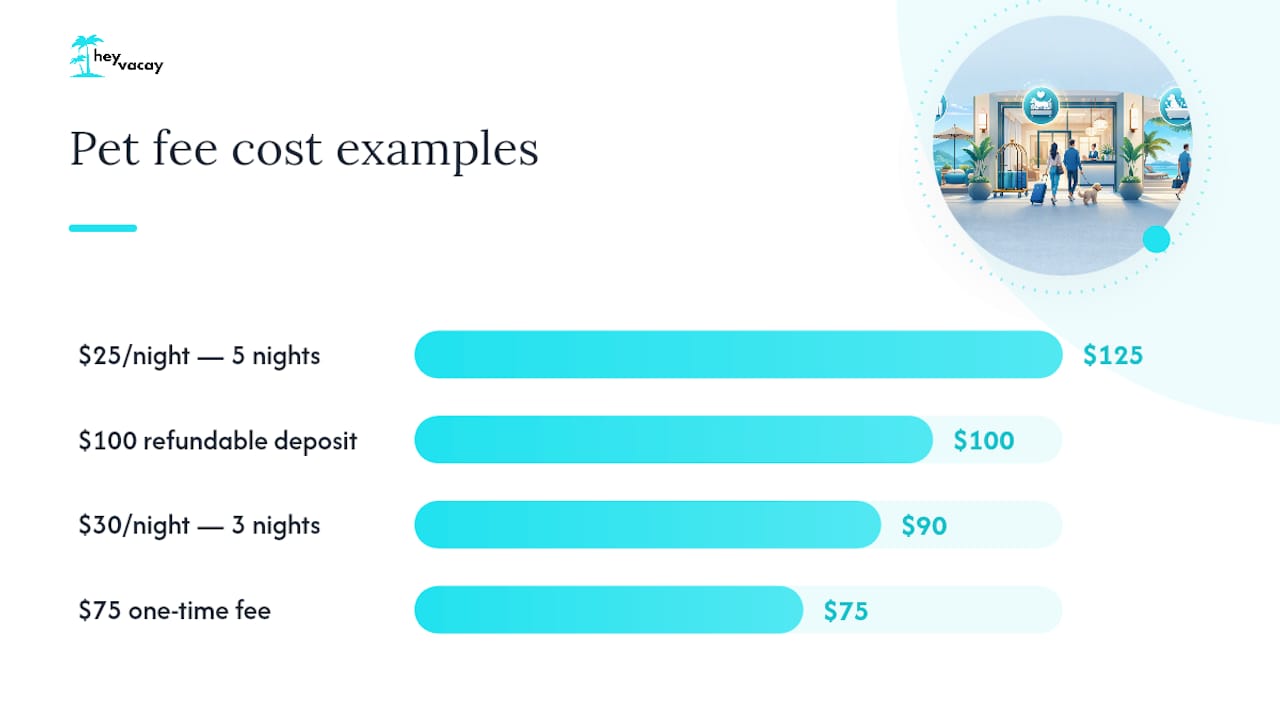
- Fee type: Per-night fees compound fast. A $25/night pet fee on a five-night stay adds $125. A one-time $50 fee on the same trip is half the cost.
- Refundable deposit: Some properties charge $100–$200 upfront and return it at checkout if there's no damage. That's not a fee, but it ties up cash.
- Cleaning surcharge: Separate from the pet fee, charged regardless of whether your pet caused any mess.
- Weight and breed limits: A 25-pound limit rules out most medium and large dogs. Breed bans (often targeting pit bulls, Rottweilers, or Dobermans) can catch owners off guard at check-in.
- Number of pets: Many properties cap at one or two pets per room.
- Species: Some hotels accept dogs only. Others welcome cats. Fewer still allow birds or small animals.
Sample math: A hotel charges a $30/night pet fee plus a $100 refundable deposit. For a three-night stay, that's $90 in non-refundable fees plus $100 held temporarily. Compare that to a property with a $75 one-time fee and no deposit: the second option costs $15 less and ties up no extra cash.
La Quinta by Wyndham caps pet charges per stay at many locations, which makes it a strong option for stays of three nights or longer where per-night models would cost more.
When you call to verify, ask for the policy in writing. A quick email confirmation protects you if the front desk quotes a different number at check-in. The GoPetFriendly chain policy guide notes that fee structures vary significantly not just by brand but by individual property, so always get the specific location's current rules.
Which hotel chains are known for generous pet policies?
Three brands come up consistently when pet owners compare discount pet accommodations in the U.S. Each has a different fee structure, and each comes with the same caveat: property-level policies can differ from brand-level marketing.
Kimpton Hotels is the benchmark for no-fee pet stays. According to the American Kennel Club's hotel chain guide, Kimpton typically charges no pet fees and no deposits, and welcomes pets of all sizes and species. That's genuinely rare. The trade-off is price: Kimpton is a boutique lifestyle brand, so room rates are higher than budget chains. Still, if your dog is large or your cat would trigger a fee elsewhere, Kimpton's policy can make the total cost competitive.
Red Roof Inn sits at the opposite end of the price spectrum. Many locations allow one pet and charge no extra fee, though weight limits apply at some properties. For a solo traveler with one dog looking for cheap pet friendly hotels on a road trip, Red Roof Inn is one of the most practical starting points.
La Quinta by Wyndham caps pet charges per stay rather than charging per night, which benefits anyone staying more than two nights. The per-stay cap model is one of the more traveler-friendly fee structures in the mid-scale segment.
| Chain | Typical fee structure | Weight/breed limits | Species |
|---|---|---|---|
| Kimpton Hotels | No fee, no deposit (typically) | None typically | All sizes and species |
| Red Roof Inn | Often free for one pet | Weight limits at some locations | Dogs primarily |
| La Quinta by Wyndham | Per-stay cap (up to $75 at many locations) | Varies by property | Dogs and cats |
The caveat applies to all three. Brand-level statements are starting points, not guarantees. A franchised Red Roof Inn in one city may charge a fee that a corporate-managed location in another city waives. Always verify with the specific property before booking.
How can you reduce or avoid pet fees when booking?
Most pet fees are negotiable more often than hotels let on. The key is knowing when and how to ask.
Loyalty status is the most reliable lever. Members of Wyndham Rewards, IHG One Rewards, or similar programs often get fee waivers or reduced rates as a perk, either automatically or on request. If you're not enrolled, sign up before you call.
Book direct and ask. OTAs rarely have authority to waive fees. When you call the property directly, ask to speak with a manager and frame the request around your loyalty or the length of your stay. A longer stay gives you more negotiating room.
Long-stay caps. Some properties that charge per night will agree to cap the total pet charge if you're staying four or more nights. Ask explicitly: "Is there a maximum pet fee for my stay?"
Off-peak timing. Hotels with low occupancy are more likely to waive fees to fill rooms. Last-minute hotel deals booked 24–48 hours out, especially on weekdays, often come with more flexibility on add-on charges. Understanding dynamic pricing helps you spot when a property is likely to negotiate.
Pro Tip: When you call, try this script: "I'm looking at a three-night stay and I have one dog under 20 pounds. I noticed there's a pet fee listed. Is that something you're able to waive for direct bookings or loyalty members?" Short, polite, specific. It works more often than you'd expect.
Here's a quick sequence to follow before every booking:
- Search and shortlist three properties using a pet filter.
- Call each property and confirm the current fee, weight limit, and species rules.
- Ask whether the fee can be waived or capped for your stay length or loyalty status.
- Request written confirmation of any waiver or adjusted fee via email.
- Book direct when a waiver is offered, since OTA bookings often lock in the listed fee.
What should you confirm before completing a reservation?
Run through this checklist before you hit "Book Now":
- Fee type confirmed (per-night vs. one-time) and exact dollar amount
- Species and weight rules verified for your specific pet
- Number of pets allowed confirmed
- Deposit amount and refund conditions clarified
- Policy on leaving pets unattended in the room (most properties prohibit this)
- Cancellation policy reviewed, including whether pet fees are refundable if you cancel
- Written confirmation of any verbal waiver or adjusted fee received via email
Questions to ask the front desk verbatim:
- "Can I leave my pet alone in the room, and if so, for how long?"
- "Is the pet fee refundable if I cancel before the deadline?"
- "Do you require proof of vaccination at check-in?"
Have these documents ready: current vaccination records (rabies certificate at minimum), and if your pet is a service animal, the relevant documentation under the ADA. Always declare your pet at booking, not at check-in. Properties that are at pet capacity can deny entry if you show up unannounced with an animal.
How does HeyVacay help you find verified pet-friendly hotel deals?
HeyVacay's AI price transparency is particularly useful for pet owners because it surfaces total costs rather than base room rates. When a standard search shows you a $99/night room that actually costs $134/night with the pet fee added, that's not a deal. HeyVacay's approach to pricing reduces that gap.
Key features for pet travelers:
- Pet-filtered search to narrow results to verified pet-welcoming properties
- Total price display that accounts for known fees upfront
- Side-by-side comparison to spot which properties charge per-night vs. one-time fees
- Saved search alerts so you catch rate drops on your target properties
How to use it in four steps:
- Enter your destination and travel dates, then apply the pet-friendly filter.
- Sort results by total price (not base rate) to see the real cost comparison.
- Shortlist two or three properties and call each one to confirm the current policy.
- Book through HeyVacay once you've verified the policy directly with the property.
Pro Tip: Even after booking through any platform, call the property to reconfirm your pet's details. Reservation systems don't always carry pet notes through to the front desk, and a quick call 48 hours before arrival prevents check-in friction.
What cancellation policies apply to pet-friendly bookings?
Pet-friendly bookings carry a few cancellation wrinkles that standard reservations don't. The pet fee itself is often non-refundable even when the room rate is, so read the cancellation terms for both line items separately.
Most mid-scale chains use a 24–72 hour cancellation window for a full room refund. The pet fee, however, may be treated as a service charge rather than part of the room rate, which means it stays with the hotel even if you cancel within the free-cancellation window. Ask explicitly: "If I cancel before the deadline, is the pet fee refunded?"
Refundable deposits are different. A damage deposit held on your card is typically released within 5–10 business days after checkout, assuming no damage claim. Get the deposit amount and release timeline in writing at check-in.
For non-refundable bookings, the calculus changes. A cheaper non-refundable rate with a non-refundable pet fee is a real financial risk if your plans shift. Unless the savings are significant, a refundable rate gives you more flexibility when traveling with pets, since unexpected vet visits or pet illness can force last-minute cancellations.
What amenities do pet-friendly hotels actually offer?
There's a wide gap between a hotel that tolerates your dog and one that's genuinely set up for pet travel. The difference shows up in small details that affect both your comfort and your pet's stress level.
Basic pet tolerance typically means: pets allowed in the room, possibly a designated outdoor relief area, and nothing else. That's fine for a one-night road trip stop.
Full pet hospitality, as community ratings on platforms like Sniffspot describe it, includes in-room pet beds and food bowls, welcome treats at check-in, a pet concierge or local pet services list, designated walking trails or off-leash areas on property, and sometimes pet-sitting or dog-walking referrals. Kimpton is the most cited example of this tier, with some locations offering pet menus and loaner gear.
Mid-tier chains like La Quinta typically land in between: outdoor relief areas and pet-friendly room assignments, but no dedicated amenities. For most travelers with dogs, that's enough.
If amenities matter to you, ask specifically: "Do you have an outdoor area for dogs?" and "Is there a pet bed or bowls provided?" Don't assume a "pet-friendly" label includes anything beyond permission to bring your animal.
How do you verify that a pet-friendly claim is actually true?
"Pet-friendly" is one of the most inconsistently applied labels in the hotel industry.
Three-step verification that actually works:
Step 1: Cross-reference sources. Check the chain's corporate policy page, the OTA listing, and a community site like BringFido or GoPetFriendly. If the three sources disagree on fee or weight limit, that's a signal the listing data is stale.
Step 2: Call the specific property. Not the brand's 800 number. The front desk of the exact location you're booking. Ask for the current pet fee, weight limit, breed restrictions, and whether pets can be left unattended. Note the name of the person you spoke with and the date.
Step 3: Get it in writing. Ask the front desk to email you a brief confirmation of the policy details they quoted. A hotel that won't do this is a hotel worth skipping.
When verifying multi-leg trips that include transport, the same habit applies. Confirming pet policies for ferry or transit legs of your journey prevents the same kind of last-minute surprises that catch pet owners off guard at hotel check-in.
What most travelers miss about pet-friendly hotel stays
The verification habit is the right instinct, but most pet owners stop there. What they underestimate is how much their pet's routine affects the hotel experience, and by extension, the cost.
A dog that barks for two hours after check-in because the environment is unfamiliar is a dog that generates noise complaints. Noise complaints can result in being asked to move rooms, pay a cleaning fee, or in the worst case, check out early with no refund. None of that shows up in any fee comparison.
The practical fix is simple: bring something that smells like home. A familiar blanket, a worn t-shirt, a toy your dog has had for years. Hotels that offer pet beds and bowls are thoughtful, but your dog doesn't care about the hotel's amenities. They care about familiar scent cues. That one behavioral detail reduces stress for your pet and reduces the chance of a complaint that costs you money.
The other overlooked point: the cheapest pet-friendly rate is not always the lowest total cost. A $79/night property with a $40/night pet fee and a noise-complaint risk costs more than a $110/night property with no pet fee and a proper outdoor relief area where your dog can decompress before settling in.
Search smarter for pet-friendly hotel deals with HeyVacay
Pet owners who've done the math know that the sticker rate on a hotel room tells you almost nothing about the real cost of a stay. HeyVacay shows you the full picture: AI-driven price transparency that surfaces total costs, not just base rates, so you can compare affordable pet-friendly stays without doing the fee math yourself.

Search pet-friendly hotels on HeyVacay, apply the pet filter, and sort by total price to see which properties actually deliver the best value for you and your pet. Once you've shortlisted your options, call the property to confirm the current policy, then book with confidence.
Sources
- A guide to pet-friendly hotel chains in the United States
- Pet Policies For All U.S. Hotel Chains | GoPetFriendly
- Most Dog-Friendly Hotel Chains (2026)
- BringFido: Pet Friendly Hotels & Dog Travel Directory