
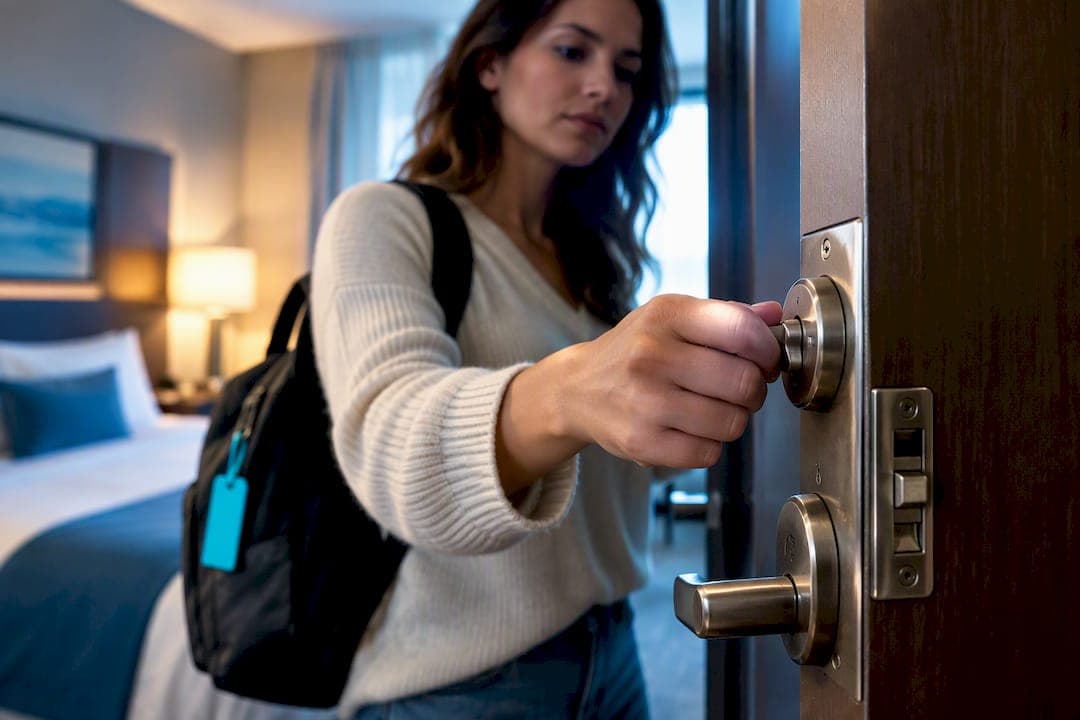
Book your room in advance, inspect it the moment you get the key, secure the door with more than the factory lock, and text a trusted contact your room number and plans. The State Department notes that solo travelers face the highest risk right after arrival, which is exactly why these small, low-effort steps matter more than any gadget you pack. Some online platforms help with the first step by letting you compare vetted properties before you ever land.
TL;DR:
- Booking a hotel at least a few days in advance and confirming reservation details 24 to 72 hours prior helps prevent scams and ensures safety features are in place.
- Hotels with 24/7 staffed reception, controlled access via key cards, and visible surveillance are generally safer, especially for solo travelers.
- Checking locks, windows, and alarms immediately upon arrival is critical, as is testing the room phone and locating the nearest fire exit before unpacking.
- Reporting issues like loose locks or improper key issuance immediately to staff and obtaining written confirmation can prevent potential security breaches.
- Using portable safety devices like door alarms or power banks provides extra security when hotel procedures or staff responsiveness are lacking.
Table of Contents
- Your hotel safety checklist from booking to checkout
- How to pick a hotel that takes security seriously
- What to check inside your room the moment you arrive
- Talking to staff and reporting problems that come up
- Portable safety gear that actually earns its space in your bag
- Red flags that mean it's time to move
- Why the basics still get overlooked
- Start your safety-first search on HeyVacay
- Where to read more before you go
- Sources
- FAQ
Your hotel safety checklist from booking to checkout
Most hotel safety advice gets scattered across blog posts that never quite connect the booking decision to what happens once you are standing in the room. This checklist follows the actual timeline of a trip: what to lock down before you leave home, what to check the moment you arrive, what to do inside the room, and how to move safely once you step back outside.
Before you book:
- Reserve your room at least a few days ahead rather than walking in cold, and keep a backup property in mind in case something feels wrong when you arrive, a step the State Department specifically recommends.
- Read recent reviews specifically for mentions of broken locks, staff behavior, or security incidents, not just cleanliness or breakfast quality.
- Prioritize properties with 24/7 front desk coverage and controlled entry, such as key-card access to elevators or stairwells.
- Confirm your reservation details 24 to 72 hours before arrival, including room type and cancellation terms, which also helps you catch booking scams before they cost you a night's stay.
At check-in and arrival:
- Arrange transport from the airport or station in advance so you are not negotiating with strangers at midnight.
- Save the hotel's address, phone number, and your embassy's contact information somewhere you can reach without a data connection.
- Avoid saying your room number out loud at the front desk, and ask staff to write it down or hand you a card instead.
- Ask how the hotel verifies identity before issuing a new key or a duplicate, since loose policies here are one of the clearest signs of weak security.
Once you are in the room:
- Check the locks, peephole, and window latches before you unpack anything.
- Test the room phone for a dial tone, since a nonworking phone can leave you without backup if your cell battery dies or signal drops.
- Locate the nearest fire exit and count the doors between your room and the stairwell.
- Close curtains fully and consider a portable door lock or alarm for extra peace of mind at night.
Leaving and getting around:
- Use hotel-arranged or well-reviewed rideshare and taxi services rather than unmarked cars waiting outside.
- Share your estimated arrival and return times with someone at home, especially on nights you are out late.
- Stick to well-lit, populated routes between the hotel entrance and your transport, even if it adds a few minutes.
- Keep your phone charged above 50% before heading out, and carry a small power bank as backup.
Pro Tip: Screenshot your hotel's address and phone number in your language and the local language before you land, in case you lose signal or need to show a driver where to go.
None of these steps require special equipment or fluency in the local language. They are procedural habits, the kind that take thirty extra seconds at check-in but close off the most common openings for something to go wrong later.
How to pick a hotel that takes security seriously
Star ratings and glossy photos tell you almost nothing about how a hotel actually handles security. A 2020 conference study on hotel security design found that operational consistency, meaning staffed front desks around the clock and controlled access to guest floors, often predicts safety better than the property's luxury tier. A three-star hotel that verifies every key request can be safer than a five-star property with lax front-desk habits.
Look for these attributes when you are comparing listings:
- 24/7 staffed reception, not just a night bell or an unattended lobby after a certain hour.
- Key-card access on elevators or stairwells, which limits who can reach guest floors at all.
- Visible CCTV in hallways and parking areas, a detail often mentioned in photos or property descriptions.
- A written policy for issuing replacement keys, which you can ask about directly by phone.
Calling ahead takes five minutes and gives you information no review site will show. Ask the front desk: "What ID do you require issuing a room key or a replacement?" and "Is the elevator restricted by key card after a certain hour?" A hotel that answers clearly and confidently is usually one that trains its staff on these procedures. A vague or annoyed response is itself useful data.
Reviews are worth mining specifically for safety language rather than general sentiment. Search within reviews for words like "lock," "safe," "staff," or "key" to surface comments that a five-star average might otherwise bury. A 2024 study on solo female travelers found that tangible measures like sturdy locks and monitored hallways, combined with attentive staff behavior, shape how safe women actually feel during a stay, more so than amenities or décor. A hotel heavy on technology but light on staff training still leaves a gap that disproportionately affects solo female guests.
What to check inside your room the moment you arrive
The first ten minutes in a hotel room matter more than most travelers realize. The State Department's lodging guidance recommends checking behind curtains, under the bed, and confirming smoke and carbon monoxide detectors are present and functional, all before you unpack a single bag.
Run through this sequence:
- Test every lock on the main door, including the deadbolt and any secondary latch, and confirm the peephole is clear and unobstructed.
- Check windows and balcony doors for working latches, especially on lower floors where outside access is easier.
- Pull back curtains and glance behind them and under the bed, a quick habit the State Department specifically flags for arriving travelers.
- Pick up the room phone and listen for a dial tone before you need it in an emergency.
- Scan the room briefly for anything unusual, like an object angled oddly on a shelf or nightstand.
- Walk to the nearest stairwell and count the doors between it and your room so you can find it without light if needed.
- Confirm the curtains close fully, leaving no gap that faces a walkway or parking area.
Room phones are sometimes nonfunctional in budget and mid-range properties, and testing yours immediately at check-in avoids relying on a dead line during an actual emergency. (Travel.State.Gov)
A few habits round out the routine without adding real effort. Ask housekeeping what times they typically knock, and keep your room key separate from anything printed with your room number, since a lost keycard with your room written on it hands a stranger exactly what they need. If the front desk offers a paper key sleeve with the number written on it, ask for a blank one or memorize the number instead.

Talking to staff and reporting problems that come up
Most hotel safety issues get resolved at the front desk if you ask directly and clearly. If your lock feels loose, your key was issued to someone else by mistake, or a staff member says something that makes you uncomfortable, say so immediately rather than waiting to see if it happens again.
A simple script works well: "I'd like to switch rooms. The lock on this door doesn't feel secure, and I want written confirmation of the new room number." Asking for that confirmation in writing, even a text or email, creates a record if you need to escalate later.
BBC reporting on hotel guest safety has documented cases where improper key issuance and front-desk errors led to real incidents, prompting some hotels to review and change their policies afterward. Casual handling of keys, like reissuing one without checking ID, is a documented failure point, not a rare fluke.
If a hotel does not take a concern seriously:
- Photograph the lock, the key packet, or anything relevant, and note the time.
- Get the name of the staff member you spoke with, or ask for a manager by title.
- Keep any written correspondence, including texts or emails confirming a room change.
- Contact local police for anything involving theft, unauthorized entry, or threats.
- Reach your embassy or consulate if you are traveling abroad and the hotel or local authorities are unresponsive.
Pro Tip: Ask for a manager's direct contact or a case number if you report anything serious. A hotel that hesitates to provide either is telling you something about how it handles complaints.
Portable safety gear that actually earns its space in your bag
A few compact items add a real layer of security without weighing down your luggage. None of them replace basic hotel vetting, but they cover the gap between check-in and whatever the hotel's own systems miss.
- Portable door lock or door wedge alarm: slides under or over the door and either blocks it physically or sounds an alarm if someone tries to force it open, useful even when the room's main lock is solid.
- Personal alarm or whistle: clips to a bag or keychain and draws attention fast if you feel unsafe walking to or from the hotel.
- Compact power bank: keeps your phone charged for maps, calls, and translation apps when you are out past dark.
- Travel door viewer: a small clip-on peephole alternative for rooms where the built-in one is scratched, painted over, or missing.
- RFID-blocking wallet or sleeve: protects card data in crowded lobbies or transit hubs where skimming devices sometimes operate.
Gadgets work best as backup, not as a substitute for choosing a hotel with solid staff practices in the first place. A door alarm cannot fix a front desk that hands out keys without checking ID. Before packing anything like pepper spray, check the destination's laws, since rules on carrying it vary widely and some countries restrict or ban it entirely, along with local transport rules on what you can bring aboard trains or planes.
Red flags that mean it's time to move
Some warning signs are obvious. Others are procedural and easy to miss until something goes wrong. Watch for:
- Staff saying your room number out loud at the desk or in a hallway where others can hear it.
- A new key issued without checking your ID, even if you did not ask for one.
- A room phone that does not work, especially paired with a spotty cell signal.
- Elevators or stairwells with no card restriction on guest floors after hours.
Certain situations call for extra caution beyond the room itself. Hotel conference after-parties and late-night business events can bring outside guests into areas meant for registered guests only. Therefore, keep your door locked and avoid opening it for anyone you have not verified. Isolated guesthouses with no other staff on-site after a certain hour deserve the same caution: confirm there is a working phone and a clear way to reach help before you settle in.
If something feels consistently off, whether it is a broken lock nobody fixed after you reported it or a staff member who will not answer basic security questions, ask for a room change in writing or move to your backup hotel. Trust the pattern over any single explanation.
Why the basics still get overlooked
The advice that actually protects solo female travelers is rarely glamorous. It is testing a phone line, asking a blunt question at the front desk, and refusing to say your room number out loud. Conventional travel safety content leans hard on personal gear and general vigilance, but the research on hotel security points somewhere more specific: procedures around key issuance and staffed access control matter more than star ratings or how safe a lobby looks.
The gap in most advice is that it treats hotels as passive backdrops rather than operational systems with their own failure points. A door alarm is a fine backup. It is not a substitute for a front desk that verifies ID before handing over a key. If you take one thing from this, prioritize the properties and habits that reduce how often you have to rely on gadgets at all, and save the gear for the moments those systems genuinely fall short.
— HeyVacay
Start your safety-first search on HeyVacay
Comparing hotels one tab at a time makes it easy to miss the operational details that matter most. Some travel booking platforms bring luxury and budget properties into one comparison with transparent pricing, so you can weigh location, reviews, and amenities side by side before you commit. Check listed amenities for 24-hour reception and secure access, then cross-reference recent reviews for mentions of locks or staff responsiveness before booking.
| What to check first | Why it matters |
|---|---|
| 24/7 front desk listed | Staffed reception reduces unauthorized access after hours |
| Recent reviews mentioning locks or staff | Surfaces safety details star ratings do not capture |
| Cancellation terms | Keeps a backup option realistic if the room feels wrong |
Start comparing hotels on HeyVacay and build your shortlist with safety details in view from the first search.
Where to read more before you go
- Lodging safety guidance from the U.S. State Department, covering room checks and backup planning.
- Peer-reviewed research on solo female travelers' hospitality experiences, on staff behavior and perceived safety.
- BBC reporting on hotel guest safety failures, documenting key-issuance and front-desk incidents.
- HeyVacay's guide to confirming a hotel reservation, for pre-arrival checks.
- HeyVacay's guide to spotting hotel booking scams, for verifying a listing before you pay.
Sources
- Travel
- Empowering solo female travelers: safety perceptions, choices and hospitality's pivotal role
- Who is responsible for keeping hotel guests safe? - BBC News
FAQ
How to keep yourself safe in a hotel room as a woman?
Check the locks, peephole, and window latches as soon as you arrive, and test the room phone for a dial tone. The State Department also recommends checking behind curtains and under the bed before you settle in.
Where is the safest place to travel as a solo female?
There is no single safest destination, since safety depends on the specific hotel, neighborhood, and how you plan your arrival and transport. Focus on booking properties with 24/7 staffed reception and controlled floor access rather than judging safety by country or city alone.
How to stay safe as a solo female traveler?
Book accommodations in advance, keep a backup option ready, and share your itinerary with someone you trust, steps the State Department outlines for travelers arriving somewhere new. Pair that with in-room checks on arrival and cautious, well-lit transport choices at night.
Do hotels put cameras in rooms?
Hidden cameras in guest rooms are not standard practice and would violate most hotels' policies and local privacy laws, though isolated cases of hidden devices have been reported at individual properties over the years. Checking smoke detectors, outlets, and clock radios for anything unusual on arrival is a reasonable precaution, alongside the other room checks recommended by the State Department.