
The two biggest hotel booking scams right now are reservation hijacking and fake or "shadow" listings, both of which rely on making a fraudulent message look exactly like something your hotel or booking site would actually send. The single rule that stops nearly all of them: verify through your original confirmation email or the hotel's official phone number, never through a link in a message that showed up out of nowhere. Scammers often quote your real check-in date, room type, and confirmation number, then wrap it in urgent language about a "payment failure" to make you drop your guard.
TL;DR:
- Verify all booking messages directly through the hotel's official website or phone number, avoiding links or contacts in suspicious messages.
- Scammers often obtain genuine reservation details from hotel breaches, enabling them to craft convincing phishing messages referencing real data.
- Look out for urgent language, mismatched sender information, or requests to re-enter card details outside trusted channels as warning signs.
- Use strong security practices like multi-factor authentication and keep your original confirmation email for reference to detect fraudulent messages.
- Booking through unknown third-party sites increases risks, especially if they lack transparent contact details or have a history of complaints.
Table of Contents
- What are the most common hotel booking scams?
- How do scammers get your real booking details?
- What are the red flags and how do you verify a message?
- What should you do if you already entered payment details?
- How can you prevent hotel booking fraud before it starts?
- What do secure hotel booking sites actually publish?
- Why third-party booking sites carry extra risk
- How do chargebacks and dispute resolution actually work?
- Who's actually responsible for stopping these scams?
- Sources
What are the most common hotel booking scams?
Reservation hijacking sits at the top of the list. It starts with phishing messages sent by email, text, or WhatsApp that contain your actual reservation details, pulled from a compromised hotel system rather than guessed. Norton's research on these scams found that because the message includes your real dates and room number, most people assume it came from the property itself.
Fake or shadow listings are the second major threat. Some properties post AI-generated photos and duplicate branding across booking platforms to disguise a rundown building as a "boutique resort." One investigation traced two supposedly separate Las Vegas hotels advertising with AI-manipulated photos back to a single, poorly rated property.
Beyond those two, watch for:
- Deceptive pricing and hidden fees: a room advertised at one price that balloons at checkout with mandatory "resort fees" or currency-conversion markups never disclosed up front.
- Payment-page phishing: a fake "update your payment method" page that mimics a hotel's real portal but harvests your card number and billing address.
- Compromised-account impersonation: a scammer sending messages from a genuinely hacked hotel or platform account, so the message arrives in a thread you already trust.
Each of these tactics works because it borrows credibility from something real, whether that's your actual booking data, a familiar-looking domain, or an account you've messaged before.
How do scammers get your real booking details?
Attackers rarely target you first. They go after the hotel's property management system, its channel manager, or a third-party vendor that handles bookings for dozens of properties at once. A single breach at one of these vendors can expose reservation data for guests across many hotels simultaneously, which is exactly what happened in a wave of attacks against hotel IT providers documented by the German outlet Heise.
Once attackers have your name, dates, and confirmation number, the scam usually follows a predictable sequence:
- You receive a message, often by WhatsApp or SMS, referencing your exact reservation.
- The message claims a payment issue, a card decline, or a "verification" requirement.
- A link leads to a page styled like the hotel's site, asking you to re-enter your card number.
- The form captures your data and the page redirects you to something that looks like a normal confirmation, so you don't immediately suspect anything.
Wired's reporting found hundreds of hotels worldwide caught up in this pattern, with attackers repurposing real reservation details into spear-phishing messages precise enough to fool experienced travelers. BBC coverage of the Booking.com breach described the same mechanism at a larger scale, where stolen reservation data fed an entire wave of targeted follow-up scams.
What are the red flags and how do you verify a message?
A handful of signals show up again and again in confirmed hotel scam reports. Any request to re-enter your full card number outside the platform you originally booked through is the biggest one. Urgency language ("your reservation will be canceled in 24 hours") is another, since legitimate hotels rarely operate on artificial deadlines. A sender number or email domain that doesn't match your original confirmation, or a message arriving through an unusual channel like WhatsApp when you booked entirely by email, both deserve suspicion.
Run this sequence before you act on any booking message; for more details on verification, see Explaining Digital Reservations.
- Pause before clicking anything, even if the message includes your correct dates and confirmation number.
- Pull up your original confirmation email and compare the sender address and phone number character by character.
- Log into the booking site or app directly, typing the address yourself rather than tapping a link.
- Call the hotel using the number from your original confirmation or its official website, not the number listed in the suspicious message.
The Better Business Bureau also warns that scam sites sometimes buy search ads or rank in organic results, so a quick domain and HTTPS check matters even before you click through from a search page. If a message arrives inside your booking platform's own inbox, treat it the same way: reply through the platform's messaging system rather than any external link it contains, since that keeps the conversation inside a channel the platform can audit.
Pro Tip: Save your original confirmation email in a labeled folder before your trip. If anything about a later message feels off, you'll have a clean reference sitting one search away.
What should you do if you already entered payment details?
Move fast, and work through these steps in order.
- Call your card issuer immediately to block the card and dispute any pending or posted charges; ask whether a freeze or replacement card makes sense given what was exposed.
- Change the passwords on your email and booking-platform accounts, and turn on multi-factor authentication everywhere it's offered.
- Report the incident to both the booking platform and the hotel directly, attaching screenshots of the message, the sender's contact info, and any URLs involved.
- File a report with the appropriate authority. In the United States, that's the FBI's Internet Crime Complaint Center; most other countries maintain a comparable national cybercrime reporting center.
Security researchers who track these cases consistently point to one detail: the scam message often looks more legitimate than the real hotel emails you've already received, because it's built directly from your actual reservation. That's precisely why independent verification matters more than how convincing a message feels.
Keep every piece of evidence, including timestamps, screenshots, and the original phishing message itself. Banks and platforms move faster on disputes when you hand them a complete paper trail instead of a verbal description.
How can you prevent hotel booking fraud before it starts?
Prevention breaks down into three windows: before you book, at the moment you book, and after your reservation is confirmed.
Before booking: stick to platforms with a track record and published contact details, check that the domain matches the brand exactly, and pay with a credit card rather than a debit card, gift card, or wire transfer. Credit cards carry stronger chargeback protections and legal limits on your liability that other payment methods simply don't offer.

At booking: save your confirmation email the moment it arrives, and write down the hotel's official phone number and website separately from any link in that email. Never agree to a "payment update" requested through a third-party message, even one that references your exact reservation.
After booking: manage any changes through the official portal or app you originally used, not through a link texted to you later. Enable multi-factor authentication on your email and booking accounts, since a compromised inbox is often the first domino in a hijacked reservation. Comparing prices through a platform that shows transparent, all-in pricing also makes it easier to spot a bait-and-switch fee later, because you already know what the honest number looked like.
Pro Tip: If a message contains your correct reservation number but asks you to click somewhere new to "confirm" payment, that combination alone is worth an independent phone call to the hotel before you touch your card.
What do secure hotel booking sites actually publish?
A trustworthy platform makes its safeguards visible rather than implied. Look for clear, all-in pricing with no fees revealed only at checkout, confirmation emails sent immediately and consistently, secure payment processing, and a published policy for handling fraud reports. On the operational side, platforms worth using require multi-factor authentication for account access, audit the vendors and channel managers that touch reservation data, train staff to recognize credential-phishing attempts, and maintain a real incident-response channel rather than a generic contact form.
HeyVacay builds its listings around transparent pricing with no hidden fees added after you've already committed to a room, and its guide to evaluating booking sites walks through the same signals travelers should demand from any platform they use. The goal isn't just finding a cheaper rate. It's knowing exactly what you're paying and exactly who to call if something looks wrong.
Why third-party booking sites carry extra risk
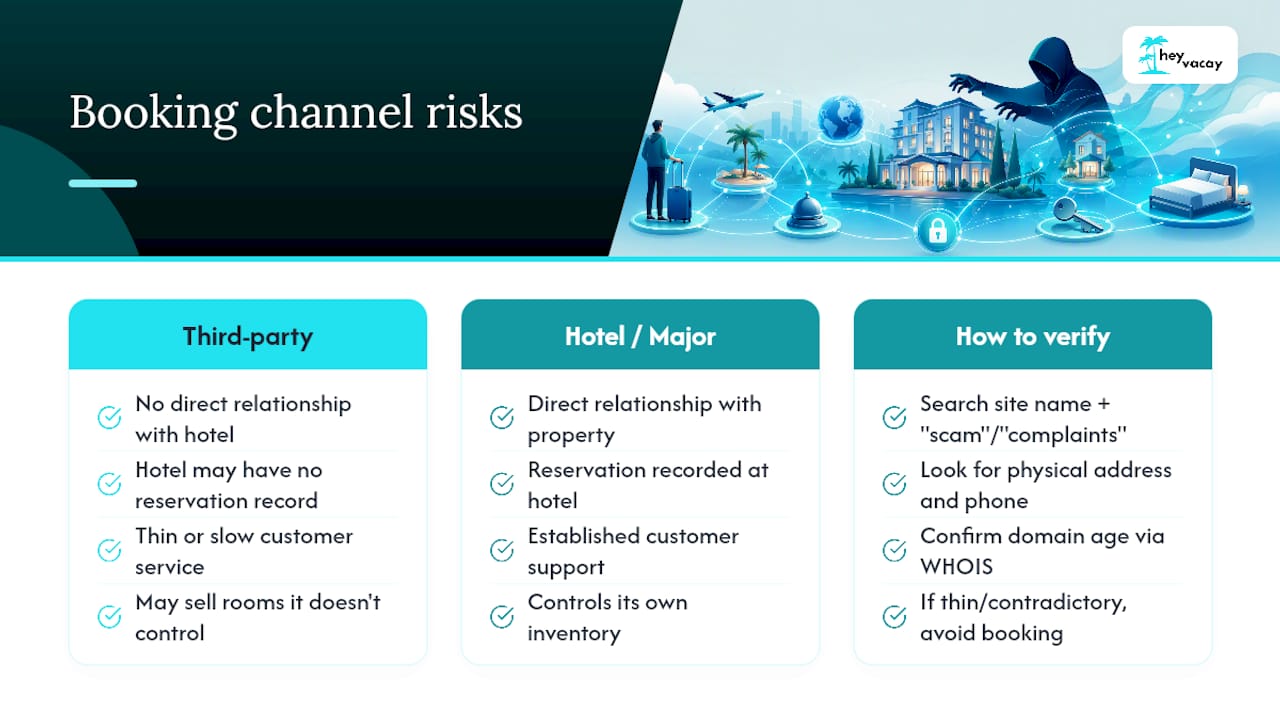
Booking through an unfamiliar third-party site, rather than a major platform or the hotel directly, multiplies your exposure in ways that aren't always obvious. Many of these sites operate as resellers with no direct relationship to the property, which means the hotel has no record of your reservation if the third-party site disappears or the transaction falls through. You end up with a confirmation number that means nothing at the front desk.
These sites also tend to have thinner customer-service infrastructure. When a dispute arises, you're often emailing an address that goes unanswered for days, with no phone line and no physical business address listed anywhere. That gap becomes critical the moment you need to prove a charge was fraudulent or a room was never actually available.
Unauthorized resellers sometimes list rooms they don't actually control, effectively selling inventory they've scraped from another site without a real agreement with the hotel. When you show up, the property has no reservation on file, and you're left negotiating a walk-in rate while the third-party site keeps your original payment.
Before booking anywhere unfamiliar, search the site name alongside the word "scam" or "complaints," check whether it lists a real physical address and phone number, and confirm the domain has existed for more than a few months using a basic WHOIS lookup. If any of that comes back thin or contradictory, book direct or through an established platform instead.
How do chargebacks and dispute resolution actually work?
Filing a chargeback starts with your card issuer, not the hotel or the booking site. Call the number on the back of your card, explain that the charge was fraudulent or that services weren't delivered as described, and ask for the dispute process in writing. Most issuers give you a window, often 60 days from the statement date, to file a formal dispute, so don't wait if something looks wrong.
Gather your evidence before you call: the original confirmation email, screenshots of the fraudulent message, the hotel's actual policies if the dispute involves a legitimate booking gone wrong, and any correspondence with the platform or property. Card networks generally side with the consumer faster when the paper trail is complete and timestamped.
If the issuer denies the initial dispute, ask for the specific reason and whether you can appeal with additional documentation. Persistence matters here. Reservation-hijack cases in particular tend to succeed on appeal once the cardholder shows the message referenced real booking data obtained through a breach rather than information they volunteered.
Report the underlying fraud to the platform and hotel in parallel with your bank dispute, since a documented fraud report on file with the merchant often strengthens your case with the card network. Keep every reference number the bank gives you, and follow up in writing if you don't hear back within the timeframe they quote.
Who's actually responsible for stopping these scams?
These scams have gotten harder to spot because they're built from real data, not guesswork, and that trend isn't reversing. Travelers can follow every verification step in this guide and still get a message that looks flawless, which is why platforms carry real responsibility here too.
At HeyVacay, that means transparent pricing, clear contact channels, and no surprise requests for payment outside the platform itself. Demand the same from anywhere else you book: a real phone number, a real address, and a payment process that never asks you to "re-verify" a card you already entered.
— HeyVacay
Sources
- Reservation Hijack scam: How fake hotel booking messages steal your info
- Phishing waves: Cyberattacks on IT service providers for hotels
- Scammers Are Using Your Real Hotel Reservations to Trick You With Spear-Phishing Attacks | WIRED
- IC3 Annual Report 2025