
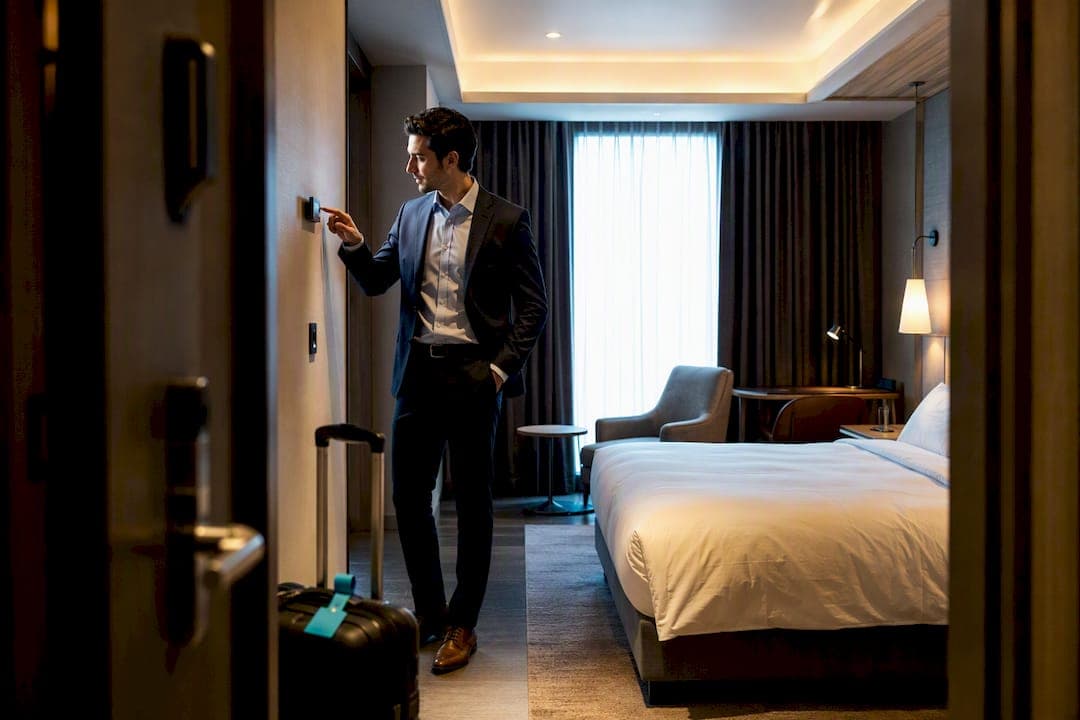
Match the hotel category to your trip's actual shape, then get three things confirmed in writing before you commit: Wi-Fi speed, workspace quality, and your transfer plan. Everything else is negotiable; those three aren't. A structured decision flow that starts with trip type and filters down to non-negotiables beats picking by star rating or brand loyalty alone, and tools like HeyVacay let you filter for exactly these criteria before you ever call the front desk.
TL;DR:
- Confirm Wi-Fi speeds, workspace outlets, and transfer details in writing before booking, as these directly impact your productivity and schedule.
- Book directly with hotels for elite perks like guaranteed availability and late checkout, especially in cities you frequently visit.
- Test Wi-Fi, inspect outlets, and set room ergonomics within the first 10 minutes of check-in to avoid issues during important calls.
- Use a wired connection, mobile hotspot, or portable Wi-Fi as backups to ensure reliable internet during critical video calls.
- Focus loyalty perks such as guaranteed rooms, lounge access, and upgrades, which support daily operations and reduce travel stress.
Table of Contents
- How Do You Choose the Right Hotel for a Business Trip?
- Booking Strategy: Direct, OTAs, Refundable Rates, and Timing
- Turning Your Hotel Room Into a Workspace in Under 10 Minutes
- Wi-Fi and Connectivity Tactics for Reliable Video Calls
- Which Hotel Loyalty Perks Actually Matter for Business Travelers
- Protecting Sleep and Energy on the Road
- How to Manage Hotel Expenses and Avoid Hidden Fees
- What to Do When Something Goes Wrong at Your Hotel
- The Pre-Booking and Pre-Check-In Checklist
- Handling Special Requests: Dietary Needs, Late Check-In, and Early Check-Out
- Reducing Travel Fatigue During Multi-Day Business Trips
- Using Hotel Facilities to Stay on Routine
- Getting Around: Transit Access and Hotel Shuttles
- The HeyVacay Approach to Business-Ready Hotel Booking
- Book Smarter for Your Next Business Trip
- Sources
How Do You Choose the Right Hotel for a Business Trip?
The mistake most frequent travelers make is booking the same type of hotel for every trip. A property that's perfect for a three-night conference is often wrong for a one-night airport turnaround, and a hotel that nails bleisure weekends can fall apart when you need a desk at 6 a.m. before back-to-back calls.
Four trip shapes cover almost every business scenario:
- City-center stays work when your meetings are spread across downtown and you need walkability, restaurant access for client dinners, and proximity to transit.
- Airport hotels make sense for early departures, tight layovers, or trips where you land, sleep, and leave without ever going into the city.
- Conference hotels matter when the event's own venue drives your choice. Staying inside or attached to the conference property saves commute time but often costs more; staying two or three blocks away can cut the rate substantially while adding only a five-minute walk.
- Bleisure stays (business plus leisure) call for a different lens entirely: you want a hotel that performs during the workweek and still feels worth extending into the weekend.
Once you've picked the category, the real filtering starts. Industry roundups covering business travel hotel guides consistently point to the same six non-negotiables: reliable Wi-Fi, a functional desk or workspace, blackout curtains, published lounge or breakfast hours, a concierge or front desk that responds quickly, and a transfer plan that doesn't leave you guessing at midnight.
Each one maps to a real business outcome. Bad Wi-Fi kills your morning call. A wobbly desk with no outlet nearby turns a two-hour prep session into an hour of hunting for a plug. No blackout curtains mean you're up at 5 a.m. because the sun hits a west-facing window. A concierge who takes twelve hours to answer an email about early check-in is a concierge who won't help you when a flight gets canceled at 9 p.m.
Before booking, send a short message to the property (or ask HeyVacay's listing details, when available) that covers:
- "Can you confirm current Wi-Fi upload and download speeds in guest rooms?"
- "Is there a desk with at least one accessible outlet in standard rooms?"
- "What are your lounge or breakfast hours, and is airport shuttle service available and on what schedule?"
Getting these answers in writing, even a one-line email reply, gives you something to point to if the room doesn't match what was promised.
Booking Strategy: Direct, OTAs, Refundable Rates, and Timing
Where you book matters almost as much as what you book. Booking directly with the hotel brand tends to win for frequent business travelers because direct bookings unlock elite recognition that third-party sites often can't apply, and it gives you a real person to negotiate with if something goes wrong.
OTAs still have a place. They're useful for comparing prices across brands quickly, and some run promotions that beat published direct rates. But they usually strip out your loyalty number's benefits, and complaint resolution is slower because you're dealing with a middleman instead of the property.
Refundable versus nonrefundable comes down to how firm your itinerary is. If a client meeting could shift by a day, the 10 to 20 percent premium on a refundable rate is cheap insurance. If you're locked into a conference with a fixed schedule and zero chance of change, the nonrefundable discount is free money.
Corporate or negotiated rates aren't just for employees of large companies with travel departments. You can often access them by:
- Asking directly whether the property has a "corporate," "government," or "association" rate code, even as an independent traveler or small business owner.
- Booking through platforms like HeyVacay that surface negotiated-style pricing without requiring a corporate account.
- Joining professional associations that maintain hotel partnerships, which sometimes beat public corporate rates.
Pro Tip: Call the hotel's sales department, not the front desk, and ask if they have unsold corporate block inventory for your dates. Sales teams often release these rooms at a discount rather than let them sit empty.
Timing rules are simpler than most travelers assume. Rates for major business hubs tend to firm up starting three to four weeks out, so monitoring price movement in that window catches the best mix of selection and price. Last-minute bookings can work in your favor only in markets with excess inventory. In tight conference-driven markets, waiting rarely pays off, and rooms simply disappear.
Turning Your Hotel Room Into a Workspace in Under 10 Minutes
The first ten minutes after check-in decide whether your room works for you or against you for the rest of the stay. Skip this routine and you'll discover the dead Wi-Fi zone or the desk with no outlet right when you're 15 minutes from a call.
- Test the Wi-Fi immediately. Run a speed test on your phone or laptop the moment you're in the room. You want adequate download and upload speeds to support stable video calls; anything lower and you should ask for a room change or move to the lobby.
- Inspect the desk and outlets. Check that the desk is at a workable height and that there's an outlet within reach without crawling behind furniture. Hotels increasingly build outlets into desk lamps or bedside tables, so look there first.
- Check blackout curtains and room noise. Close the curtains fully during daylight to see if light leaks through the edges, and note any street noise, ice machine hum, or elevator proximity now, while you can still request a different room.
- Fix ergonomics fast. A dining chair or armchair doubling as a desk chair will wreck your back over a multi-night stay. Ask the front desk for a proper desk chair from another room, or request a monitor stand or extra pillow to raise your laptop to eye level.
- Call the front desk for quick swaps. If the desk is too small or the outlet situation is unworkable, ask for a room change before you unpack. It's far easier to move in the first 15 minutes than after you've settled in.
A small kit solves problems the room itself won't. Pack a compact power strip with USB ports (hotel outlets are almost always in short supply), a portable laptop stand, a universal adapter if you're traveling internationally, and a pair of foam earplugs for rooms where the blackout curtains work but the walls don't.
Wi-Fi and Connectivity Tactics for Reliable Video Calls
Testing Wi-Fi the moment you arrive, rather than waiting until your first call, is one of the most underused tactics in business travel, and it takes thirty seconds.
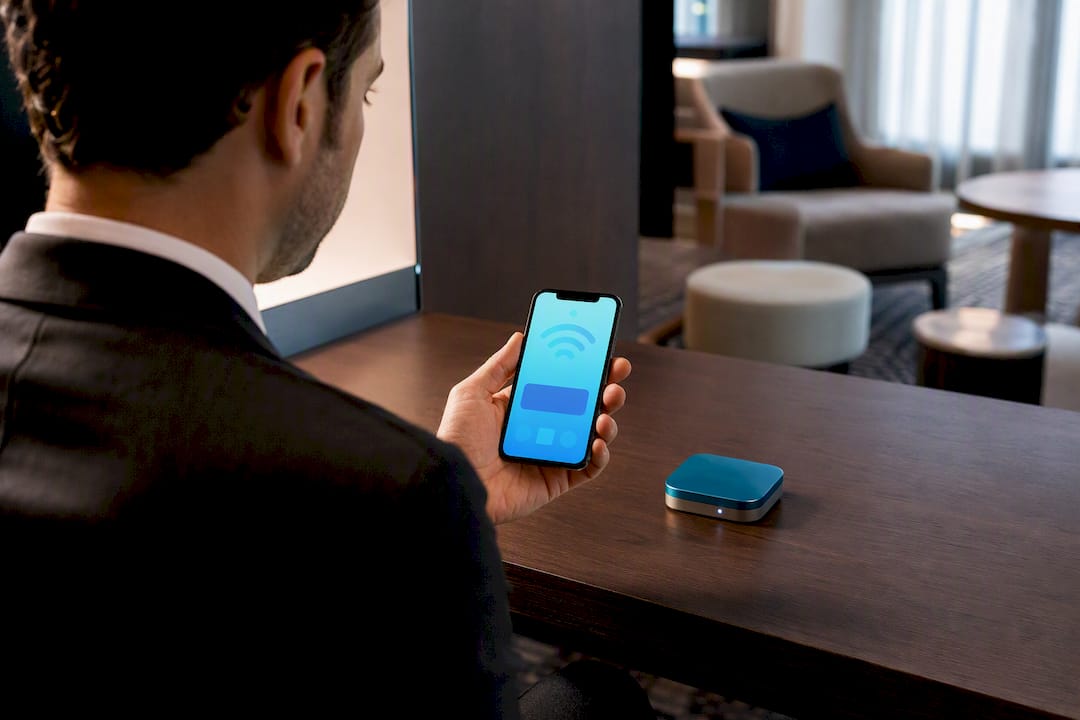
Run a speed test through any free app and look for at least 10 Mbps down and 3 Mbps up for one-on-one video calls; group calls or screen sharing benefit from 25 Mbps down and 5 Mbps up. If the hotel's published speeds don't match what you measure, that's your cue to ask for a room change or request access to a wired connection.
Fallbacks matter because hotel Wi-Fi fails at the worst moments:
- Ask if the room has an ethernet port; older business hotels often do, and a wired connection beats shared Wi-Fi every time.
- Use your phone's mobile hotspot as backup, but check your carrier's data limits before relying on it for video.
- A portable Wi-Fi device or local SIM is worth the cost on international trips where hotel bandwidth is unpredictable.
- A nearby coworking space day pass is a reliable last resort when the hotel network simply can't handle a high-stakes call.
Security matters just as much as speed. Hotel networks are shared, often poorly segmented, and a common target for basic snooping. Use a VPN for anything involving client data, and if you travel frequently, a small personal travel router that creates your own private network off the hotel's connection is worth the $40 to $60 investment.
If connectivity fails 30 minutes before an important call, don't wait it out. Call the front desk immediately, ask for the IT or engineering contact, and simultaneously start your mobile hotspot as backup so you're never caught with zero options.
Which Hotel Loyalty Perks Actually Matter for Business Travelers
Elite status sounds like a vanity metric until you're standing in a lobby at 11 p.m. with a canceled flight and a room that's guaranteed instead of "sold out." Perks that affect daily operations matter more than aspirational extras like spa credits or resort activities.
The perks worth chasing:
- Guaranteed room availability, which matters most when you book close to a busy date and can't afford to be walked to another property.
- Late checkout, which turns a rushed morning meeting into a normal one.
- Lounge access, which gives you a quiet place to work and eat without leaving the building between meetings.
- Room upgrades, which sometimes mean a suite with an actual desk instead of a cramped standard room.
Concentrating your nights in one loyalty program versus spreading them across brands depends on where you actually travel. If your business trips repeatedly land in the same three or four cities, one program with strong footprint in those specific markets will get you to mid-tier status faster than splitting nights across three programs and staying perpetually at the bottom tier of each.
A few tactics accelerate status faster than nights alone: co-branded credit cards that grant automatic elite tiers, targeted promotions that offer bonus nights or points multipliers during slower travel seasons, and partner credits from airline or car rental programs that count toward hotel status thresholds. Compare the trade-off honestly: a brand with broader nationwide footprint but thinner perks, against a smaller chain with excellent status benefits but gaps in the cities you actually visit. For guidance on weighing direct loyalty programs against third-party booking, match the program to your real travel pattern, not the one with the flashiest sign-up bonus.
Returning to the same property repeatedly in a city you visit often has its own payoff. Staff who recognize you tend to move faster on upgrade requests and respond quicker to special asks, according to hotel industry guidance on repeat-guest relationships.
Protecting Sleep and Energy on the Road
Sleep quality on the road determines whether you're sharp in a 9 a.m. meeting or running on fumes. Hotel-specific habits make a measurable difference, starting with the basics: confirm blackout curtains actually block light (some "blackout" curtains have gaps at the edges), set the thermostat to a cool and comfortable level conducive to better rest, and limit alcohol at dinner since it disrupts deep sleep even when it feels relaxing in the moment.
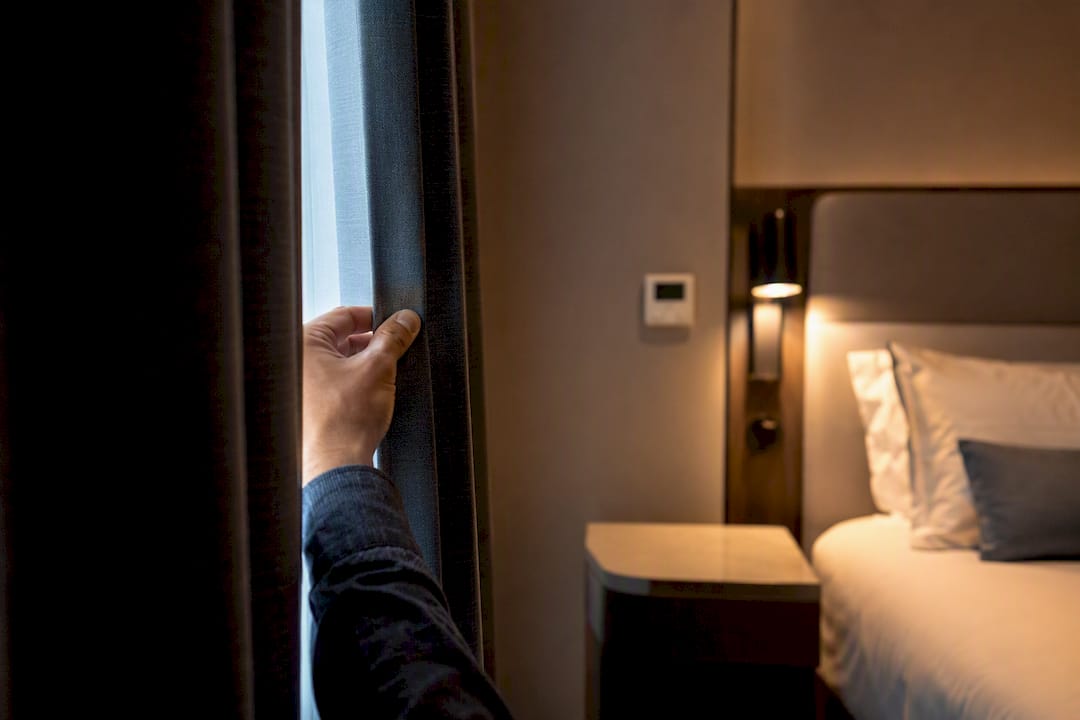
Natural light does real work for your mood and alertness. Exposure to daylight measurably improves mood and increases happiness, so open the curtains first thing in the morning and take at least one work call or coffee break near a window instead of staying in artificial light all day.
For jet lag, start adjusting before you fly: shift your sleep and meal timing by an hour or two toward the destination time zone for two or three days pre-departure. On arrival, get outside in daylight as soon as possible, even for a short walk, since light exposure is the strongest lever for resetting your internal clock.
- Hydrate deliberately. Cabin air and hotel HVAC systems both dry you out, so carry a refillable bottle and aim to drink water on a schedule, not just when thirsty.
- Fit in a 15 to 20 minute micro-workout using the room itself. Bodyweight exercises like squats, push-ups, and lunges need no equipment and reset energy between back-to-back meetings.
- Eat a real breakfast with protein rather than skipping it or grabbing only coffee. Blood sugar crashes mid-morning hit harder when you're already sleep-deprived from travel.
How to Manage Hotel Expenses and Avoid Hidden Fees
Expense reporting eats time you don't have, and hidden fees quietly inflate your "great rate" into something much less impressive by checkout.
- Photograph or screenshot the folio every night, not just at checkout. Hotels sometimes add charges mid-stay (extra room service, a missed late checkout fee) that are easier to dispute in real time than three days later.
- Check for resort fees, parking charges, Wi-Fi upcharges, and city or occupancy taxes before you book, not after. A published $189 rate can land closer to $230 once mandatory fees are added, and that gap is the actual number your company reimburses.
- Request an itemized folio at checkout, specifically one that separates room charges, taxes, and incidentals line by line, since many finance departments require this exact breakdown for reimbursement.
- Ask for a tax invoice if your company or country requires one for expense compliance, particularly for international stays where VAT documentation differs from a standard receipt.
- Use a receipt-capture app to photograph and categorize expenses the same day. Waiting until you're home to sort a week of paper receipts is how legitimate expenses get lost or misreported.
Total cost after fees, not the headline nightly rate, is the number that should drive your comparison between two properties.
What to Do When Something Goes Wrong at Your Hotel
Problems happen. The traveler who fixes them fast is the one who has a script ready instead of improvising while frustrated.
- Wi-Fi failure before a call: Call the front desk and ask specifically for the engineering or IT contact, not just the front desk agent, since they can often reset the access point directly. Simultaneously switch to your mobile hotspot so the call happens regardless.
- Noisy room: Call down immediately and say plainly, "I need a quieter room, ideally away from the elevator or street side," rather than just complaining about the noise. Specific requests get specific solutions.
- Poor desk setup: Ask if a different room type has a proper desk, or request a desk chair be brought up from an unoccupied room.
- Transfer failure: If a promised shuttle doesn't show, ask the front desk to book a taxi or rideshare and request it be added to your folio rather than paying out of pocket and fighting for reimbursement later.
Pro Tip: Frame every escalation around the business impact, not just the inconvenience. "I have a client call in 20 minutes and need this resolved" gets faster action than "the Wi-Fi isn't working."
When a problem genuinely disrupted your stay, it's reasonable to ask for remediation: a partial refund, a complimentary night on a future stay, or an upgrade for the remainder of your trip. Ask calmly and specifically rather than demanding compensation broadly.
The Pre-Booking and Pre-Check-In Checklist
Run through this in order, before you hit "book":
- Confirm the commute or transfer time from the hotel to your meeting location or the airport.
- Check the cancellation policy and how many hours before arrival it applies.
- Verify Wi-Fi speed claims, ideally with a written confirmation from the property.
- Confirm a desk or workspace exists in the room category you're booking, not just in photos of a suite you're not paying for.
- Check breakfast and lounge hours against your actual meeting schedule.
- Confirm the transfer plan: shuttle schedule, taxi availability, or rideshare access at your arrival time.
- Calculate the total cost including resort fees, parking, and taxes, not just the nightly rate.
Send the hotel a short message covering Wi-Fi speed, desk confirmation, and transfer/shuttle timing, and get the reply in writing before you finalize.
Pack light but deliberately: a compact power strip, universal adapter, portable Wi-Fi hotspot or local SIM, earplugs, a refillable water bottle, and any prescription medications in carry-on, never checked luggage.
Handling Special Requests: Dietary Needs, Late Check-In, and Early Check-Out
Special requests get handled well when you make them early and specifically, not as an afterthought at the front desk.
For dietary needs, email the property 48 to 72 hours ahead if breakfast or room service matters to your stay. Mention the specific restriction (gluten-free, vegan, allergy-related) rather than a vague preference, since kitchens can prep in advance but can't improvise safely on short notice.
Late check-in deserves a heads-up call, especially if you're arriving after 11 p.m. Confirm the front desk will be staffed and that your reservation won't be released as a no-show. Many hotels auto-cancel unguaranteed reservations by a set cutoff time unless you've flagged a late arrival.
Early check-out is usually simple, but if you need a folio emailed immediately upon leaving rather than waiting for the standard batch process, say so at check-in, not at 5 a.m. when you're rushing to a flight. Front desk staff can flag your account to prioritize that request overnight.
Reducing Travel Fatigue During Multi-Day Business Trips
Fatigue compounds across a trip. What feels manageable on night one becomes a real problem by night three if you don't build in recovery.
Hydration is the simplest lever and the most skipped. Cabin pressure and dry hotel air both pull moisture out of you faster than normal, so keep a bottle filled and drink on a schedule rather than waiting to feel thirsty, which is often too late to catch up before a long meeting day.
For jet lag on longer trips, anchor your schedule to local time immediately on arrival, even if it means pushing through tiredness for the first afternoon. Get outside during daylight hours; that light exposure resets your circadian rhythm faster than staying in a dim hotel room "resting."
Choose amenities that actually support recovery over amenities that just look nice in the listing. A hotel with a 24-hour gym matters more than one with a rooftop bar if your only free time is a 6 a.a.m. slot before back-to-back meetings. A hotel with strong blackout curtains matters more than one with a scenic view if you're chasing three time zones' worth of sleep debt.
Using Hotel Facilities to Stay on Routine
The gym, business center, and breakfast service exist for exactly the traveler juggling meetings and sleep debt, but only if you use them deliberately instead of skipping them out of fatigue.
Check gym hours before you book if fitness is part of your routine; some business hotels close the fitness center by 10 p.m. or open it only at 6 a.m., which matters if your schedule is unusual. A 20-minute session, even bodyweight only, does more for alertness than an extra 20 minutes of scrolling in bed.
Business centers matter less than they used to, since most travelers carry their own laptops, but they're still useful as backup for printing boarding passes, contracts, or presentation materials when the hotel's printer beats hunting for a copy shop.
Breakfast timing should match your meeting schedule, not the other way around. If breakfast service starts at 7 a.m. but your first meeting is at 7:30, that's a problem worth solving before you book by asking about grab-and-go options or room service availability.
Getting Around: Transit Access and Hotel Shuttles
Location decides most of your daily friction, and it's worth checking transit access before booking rather than discovering it after arrival.
For city-center stays, confirm walking distance to a subway or major bus line, since a hotel that's technically "downtown" but a 25-minute walk from transit defeats the purpose. For airport hotels, verify shuttle frequency and hours; some run every 15 minutes around the clock, while others operate on a limited schedule that won't match a 5 a.m. departure.
Fixed-rate airport transfers are worth booking in advance for early or late flights when shuttle schedules don't align. Reliable, pre-booked transfers also protect your productivity by removing the uncertainty of finding transportation at odd hours, letting you use transit time for prep instead of logistics stress.
If you fly internationally on a regular basis, enrolling in Global Entry cuts customs wait time meaningfully, and domestic flyers benefit from TSA PreCheck for the same reason at security. Both pair well with hotel choices near transit hubs, since the time saved at the airport only helps if your hotel-to-airport commute is equally efficient.
The HeyVacay Approach to Business-Ready Hotel Booking
HeyVacay was built around a simple frustration: too much of business travel booking involves guessing whether a listed hotel actually has usable Wi-Fi or a real desk until you're already checked in. The platform's AI matching surfaces hotels against the specific criteria that matter for work trips, and transparent pricing means the rate you see includes what you'll actually pay, without a resort fee surprise buried in the fine print.
A practical workflow: set filters for your trip dates and city, prioritize listings with desk and workspace details called out, and check published lounge or breakfast hours against your meeting schedule. Once you've shortlisted two or three options, send the same short written confirmation request covered earlier, Wi-Fi speed, desk confirmation, transfer plan, before locking in the booking.
Try running your next trip through this filter before booking anywhere else.
— HeyVacay
Book Smarter for Your Next Business Trip
Finding a business-ready hotel usually means digging through a dozen listings, cross-checking amenities, and still guessing at the total price until checkout. HeyVacay flips that: AI-driven search surfaces the same caliber of hotel at a lower rate, with pricing that's transparent from the first search, no resort fee sprung on you at folio time.
Head to the HeyVacay hotels page and filter by your trip dates and city to see business-ready rooms alongside their real, all-in price. Booking flexibility stays intact, since refundable options are flagged clearly rather than buried in fine print, so you're never locked into a rate that doesn't fit a shifting itinerary. Run your next city-center or conference stay through it before you book anywhere else.
Sources
For readers who want to go deeper on any of the tactics above, these sources informed the checklist framework and wellbeing guidance in this piece:
- Business Travel Hotel Guide 2026 | Hotels for Kings
- Hoteling
- Business Hotel Checklist | Deep Arrival
- Being in natural light improves mood, increases happiness — UCLA Health