

For most U.S. travelers, the sweet spot is 8–14 days before check-in. According to the 2026 Hotel Price Index, last-minute bookers saved an average of roughly 23% compared to travelers who locked in rates four or more months out. That is not a small margin. But it comes with real conditions.
The verdict breaks down like this:
- Book early if your dates are fixed, you need a specific room type, or you are traveling during peak season, a major event, or a holiday week.
- Wait until 8–14 days out if you are flexible, traveling to a large city with abundant hotel supply, and can accept some availability risk.
- Best of both worlds: Book a refundable rate now to hold your spot, set a price alert, and rebook if a lower rate appears closer to arrival. This hybrid approach works in nearly every scenario.
23% average savings for last-minute hotel bookers vs. travelers who booked 4+ months out — Hotels.com 2026 Hotel Price Index
Key Takeaways
The 8–14 day booking window delivers the most consistent hotel savings for flexible U.S. travelers, but fixed dates, peak seasons, and specific room needs shift the right call toward booking early.
| Point | Details |
|---|---|
| Sweet spot for savings | Book 8–14 days out for average savings of roughly 23% vs. booking 4+ months ahead. |
| Hybrid approach works best | Book a refundable rate early, set a price alert, and rebook if the price drops before arrival. |
| Sunday check-ins save money | Sunday arrivals average about 15% less than Friday or Saturday check-ins. |
| Fixed dates mean book early | Families, event travelers, and resort-goers should book at least 4–6 weeks out. |
| HeyVacay for both strategies | HeyVacay's transparent pricing and price alerts support early booking and last-minute deal hunting. |
Table of Contents
- What factors actually determine whether you should book early or wait?
- What does the data actually show about booking windows?
- Who should book early and who should generally wait?
- Tactics to get the best price whether you book early or late
- A quick checklist to decide: book now or wait?
- Red flags that turn a smart timing strategy into a costly mistake
- HeyVacay makes the hybrid booking strategy easy
- Sources
What factors actually determine whether you should book early or wait?
The last-minute vs early booking decision is not one-size-fits-all. Several variables shift the math significantly.
Destination and inventory size matter more than most travelers realize. A major city like New York, Chicago, or Los Angeles has hundreds of hotels competing for the same guests. That supply pressure creates genuine last-minute discounts. A small resort town in the Smoky Mountains or a boutique property in Napa Valley has maybe a dozen options. When those fill up, they fill up.
Season and local events can eliminate last-minute options entirely. A conference that books out 15,000 hotel rooms, a major music festival, or a college graduation weekend will push rates up and inventory down weeks in advance. Booking windows vary significantly by segment and location, and a single average lead time masks the real differences that affect both price and availability.
Your own constraints are the deciding factor:
- Fixed travel dates (school schedules, work commitments) remove flexibility and push you toward early booking.
- Specific room needs, such as a suite, an ADA-accessible room, or a connecting room for a family, narrow inventory fast.
- Group travel of five or more rooms almost always requires early coordination to secure group hotel rates.
- Loyalty status and member pricing can change the calculus. Some hotel loyalty programs offer member-only rates that beat last-minute OTA prices.
Cancellation policy is underrated as a factor. A refundable rate booked early costs you nothing if plans change. A nonrefundable rate booked in a panic the week before travel locks you in whether or not the trip happens.
Pro Tip: Always check the hotel's direct website before finalizing on an OTA. Direct rates are often slightly lower, and direct bookings frequently include free cancellation when OTA rates do not.
What does the data actually show about booking windows?
But the full picture is more nuanced. Sunday check-ins tend to run about 15% cheaper than Friday or Saturday arrivals, and January is typically the least expensive month to travel in the U.S.
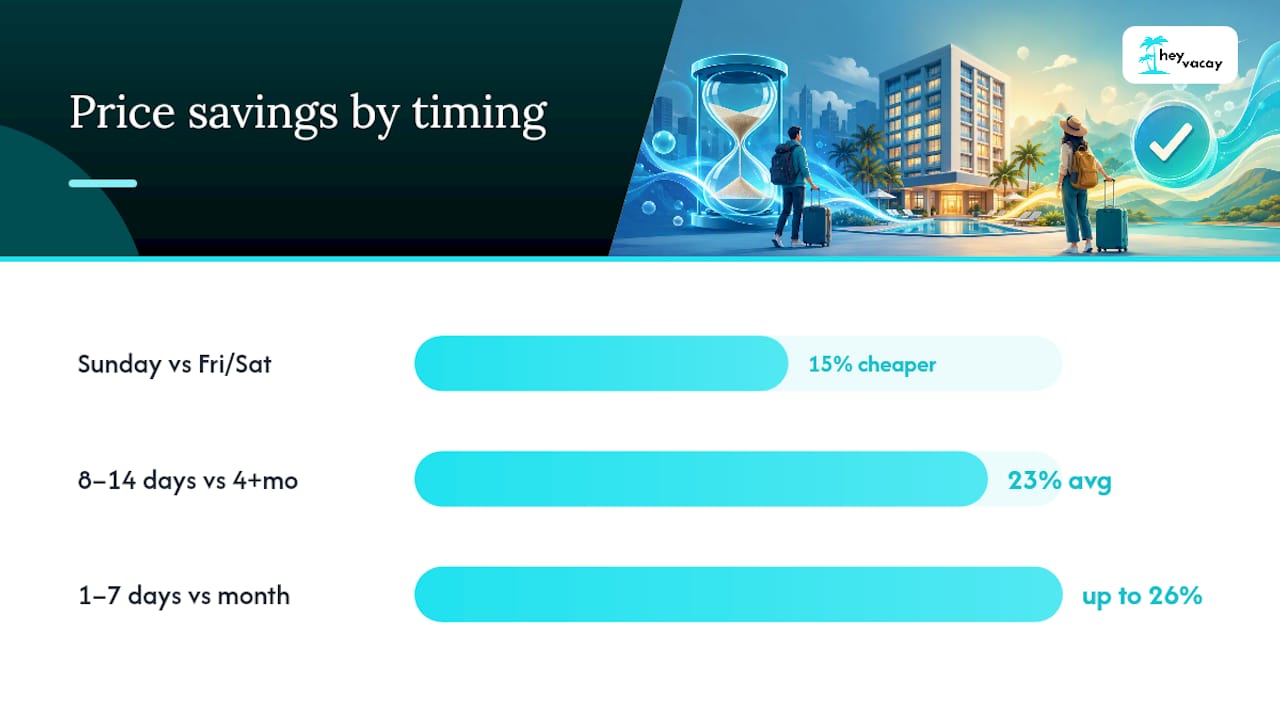
KAYAK data cited by Rate Ranger shows booking within one week of a stay can save up to roughly 26% versus booking a month out, but those savings concentrate in large markets during off-peak windows. In constrained markets or during events, the same last-minute window produces higher prices, not lower ones.
Price curves tend to follow an arch shape: rates often peak around two weeks before check-in, then soften again in the final days as hotels try to fill remaining rooms. RoomPriceGenie's lead-time banding maps this out clearly for the industry, and travelers can use the same framework to time their search.
| Booking window | General price direction | Notes |
|---|---|---|
| 90+ days out | Often elevated or flat | Early-bird discounts available at select properties |
| 15–90 days out | Moderate, stable | Good for peak-season and resort travel |
| 15–30 days out | Rising toward peak | Rates often climbing; act if dates are fixed |
| 8–14 days out | Sweet spot for savings | Average 23% savings vs. 4+ months out |
| 1–7 days out | Variable, often drops | Works in large cities; risky in small markets |
| Same-day | Unpredictable | Deep discounts possible; limited selection |
The 8–14 day window is where last-minute savings are most consistent — Hotels.com 2026 Hotel Price Index
Who should book early and who should generally wait?
Book early if you are:
- A family with school-year constraints and fixed departure dates.
- Attending a wedding, conference, or major event where room blocks fill weeks out. For event-related stays, staying onsite often requires booking months ahead. Learn more.
- Traveling to a resort destination during peak season (summer beach towns, ski resorts in February).
- A luxury traveler who needs a specific property or suite category. Five-star hotels tend to have flatter price curves, meaning last-minute discounts are smaller and availability is tighter.
Consider waiting if you are:
- A solo traveler or couple with flexible dates and no hard commitments.
- Visiting a major U.S. city during a standard business week.
- A business traveler whose schedule shifts frequently and who needs refundable options anyway.
- An experienced deal hunter comfortable monitoring prices and acting quickly.
Two quick scenarios:
The Chicago city break: A couple with a flexible long weekend in October has real options. Chicago has hundreds of hotels, and off-peak weekday rates often drop in the 8–14 day window. Waiting makes sense here, especially with a price alert set.

The Outer Banks summer rental: A family of five targeting the last week of July has almost no flexibility. Inventory in small coastal markets disappears months out. Waiting is a gamble that usually loses. Accommodation timing shapes the entire trip experience, and for constrained markets, early booking is simply the safer call.

Tactics to get the best price whether you book early or late
The hybrid approach is the most reliable strategy for most travelers: book a refundable rate now, set a price alert, and rebook if a lower rate appears in the 8–14 day window.
How to execute the hybrid approach:
- Book a fully refundable rate as soon as your dates are confirmed.
- Set a price alert on the same property through an OTA or a dynamic pricing monitoring tool.
- Check prices again at 14 days out. If the rate has dropped meaningfully, cancel the original booking and rebook at the lower rate.
- Confirm the cancellation deadline before rebooking. Never cancel until the new reservation is confirmed.
Channel-specific tips:
- Hotel direct sites often have the lowest base rates and the most flexible cancellation terms. Check here first.
- OTAs become more aggressive with discounts as arrival approaches. Mobile-only rates on apps like Hotels.com or Expedia can undercut desktop prices.
- Member pricing through loyalty programs (Marriott Bonvoy, Hilton Honors, Hyatt World of Hyatt) frequently beats public OTA rates, especially in the 8–14 day window.
Timing tactics that move the needle:
- Sunday check-ins average about 15% less than weekend arrivals.
- Weekday stays in business-heavy cities tend to be cheaper than weekends.
- Searching with flexible dates (plus or minus two days) can reveal rate gaps that a fixed-date search misses.
Pro Tip: *If your first-choice neighborhood is expensive last-minute, search one neighborhood over.
A quick checklist to decide: book now or wait?
Answer these questions in order. The first "yes" tells you what to do.
- Are your dates completely fixed? Yes → book now, refundable if possible.
- Is there a major event, conference, or festival at your destination? Yes → book now, at least 30 days out.
- Do you need a specific room type (suite, connecting rooms, ADA room)? Yes → book now.
- Are you traveling during peak season (summer beach, ski season, spring break, major holidays)? Yes → book at least 4–6 weeks out.
- Can you accept a nonrefundable rate? No → always book refundable, regardless of timing.
- All answers no? Wait until the 8–14 day window and monitor prices.
Decision deadlines at a glance:
- Same-day: Only viable in large cities with abundant supply and low occupancy.
- 1–7 days out: Works in major markets off-peak; risky everywhere else.
- 8–14 days out: The data-backed sweet spot for most flexible travelers.
- 15–90 days out: Right window for peak-season, resort, and event travel.
- 90+ days out: Necessary for weddings, major events, and holiday travel.
If you have answered "no" to all five checklist questions, the 8–14 day window is your target — the window where last-minute savings are most consistent and inventory is still adequate in most markets.
Red flags that turn a smart timing strategy into a costly mistake
Red flags for waiting too long:
- A major local event is on the calendar and you have not checked hotel inventory yet.
- You need an ADA-accessible room or a specific bed configuration. These are the first room types to sell out.
- You are traveling during school holiday weeks (Thanksgiving, spring break, Christmas). Last-minute rates in these windows are rarely discounted.
- Your destination is a small market with fewer than 20 hotels. Supply constraints make last-minute savings unlikely.
Red flags for booking early without flexibility:
- You locked in a nonrefundable rate three months out and your plans are not fully confirmed.
- You booked early at a high rate without checking whether a refundable option was available at a similar price.
The market-training problem is worth understanding briefly. When hotels repeatedly offer steep last-minute discounts, they condition travelers to wait. This erodes early-booking demand and creates a cycle that hurts rate integrity over time. Properly balanced early-booker and last-minute promotions serve different segments without cannibalizing each other. As a traveler, this means the deepest last-minute discounts tend to appear at properties that are genuinely undersold, not at hotels with strong demand.
The HeyVacay take on timing and trade-offs
The data points to a clear conclusion: the 8–14 day window is where most flexible U.S. travelers find the best combination of price and availability. But the real insight is that the choice between last-minute and early booking is a false binary. The hybrid approach, booking refundable early and monitoring for drops, removes most of the risk from both strategies. HeyVacay's transparent pricing and price alert tools are built specifically for this: you see the real rate upfront, set an alert, and act when the number moves. No hidden fees, no guessing whether the price you see is the price you pay.
HeyVacay makes the hybrid booking strategy easy
Knowing the 8–14 day sweet spot is one thing. Having the tools to act on it is another. HeyVacay gives travelers transparent, no-hidden-fee pricing across luxury and budget hotels, AI-assisted price monitoring, and member discounts that often beat standard OTA rates.

Whether you are locking in a refundable rate early for a family trip or hunting a last-minute deal for a flexible city break, HeyVacay surfaces the real price immediately. Set a price alert, monitor the drop, and rebook in a few taps when the rate falls. For last-minute hotel deals and the apps that surface them fastest, HeyVacay is built to move as quickly as the market does. Search hotels on HeyVacay and see what the 8–14 day window looks like for your next trip.
Sources
- 2026 Hotel Price Index: How Americans are shopping smarter this summer
- Turns out that last-minute travel bookings are saving Americans a lot of money
- Hotel Booking Window and Lead Time: A 2026 Revenue Guide
- Last-Minute Hotel Deals: When They Save You Money (and When They Don't) | Rate Ranger
- Hotel Pricing by Booking Behavior | RoomPriceGenie