

Third-party hotel booking is worth it when you want price discovery, flexible comparison shopping, or a last-minute deal, and it's a weaker choice when you're chasing loyalty perks, guaranteed upgrades, or the flexibility that comes from a direct relationship with the hotel. The single most important move, regardless of which route you pick, is to verify the total price and cancellation terms before you pay and save your confirmation the moment you get it.
Here's what to do the moment you book through a third party:
- Verify the total price and cancellation policy. Confirm taxes, resort fees, and refund windows before you enter your card number, not after.
- Save your confirmation and vendor contact info. Screenshot it, email it to yourself, and keep the vendor's customer service number handy.
- Call the hotel 24 to 48 hours before arrival. This single call catches most reservation mix-ups before they become check-in disasters.
One caution worth carrying with you: third-party inventory is sometimes treated as wholesale allocation, which can mean lower priority for upgrades or room requests when a hotel is near capacity.
Key Takeaways
Third-party hotel booking rewards travelers who prioritize price and flexibility, but it shifts more responsibility onto you to verify terms the hotel would otherwise confirm directly.
| Point | Details |
|---|---|
| Verify before you pay | Confirm total price, cancellation window, and supplier of record before entering payment details. |
| Call the hotel ahead | Confirm your reservation shows up in the hotel's system 24 to 48 hours before arrival. |
| Loyalty perks often don't transfer | Book direct if points, status, or upgrades matter more than saving a few dollars. |
| Document everything | Save confirmations, screenshots, and hotel correspondence in case you need a refund or chargeback. |
| HeyVacay offers transparent pricing | HeyVacay uses AI-driven search and no-hidden-fee pricing to simplify comparison without sacrificing clarity. |
Table of Contents
- What Does Third Party Hotel Booking Actually Mean?
- OTAs, Aggregators, and Metasearch Engines: What's the Difference?
- Is Booking Through a Third Party Site Actually a Good Idea?
- Why Do Third-Party Hotel Prices Look Different Everywhere You Look?
- How Do Hotels Actually Treat Third-Party Reservations?
- What Should You Check Before You Book Through a Third Party?
- What Do You Do if Your Reservation Falls Through?
- Should You Book Direct or Through a Third Party for Your Trip?
- What Do Travel Industry Experts Say About OTAs vs. Direct Booking?
- How Do Third-Party Bookings Affect Customer Service When Something Breaks?
- How Reliable Are Reviews and Ratings on Third-Party Booking Sites?
- How Do You Protect Your Data and Privacy When Booking Online?
- Where HeyVacay Fits Into Your Booking Decision
- Frequently Asked Questions
- Sources
What Does Third Party Hotel Booking Actually Mean?
A third-party hotel booking is any reservation made through a company that isn't the hotel itself. That includes online travel agencies (OTAs), aggregators, and metasearch engines. The hotel still holds your room, but the entity that took your payment and confirmed your dates sits between you and the property.
This distinction matters more than most travelers realize, because three different parties can be involved in a single booking: the payer (you), the reservation holder (the third-party platform), and the hotel's own property management system (PMS), which is the internal database staff actually check at the front desk. When those three don't sync properly, that's when problems start.
Two common flows illustrate how this plays out:
- Prepaid third-party booking: You pay the platform in full at checkout, the platform pays the hotel a negotiated rate, and you show up with a confirmation number that the hotel needs to match against its own system.
- Pay-at-hotel booking via a third-party listing: The platform reserves the room and passes your card details to the hotel, but the hotel charges you directly at check-in or checkout, giving you more control if plans change.
Both are legitimate. The prepaid version usually locks in a lower rate; the pay-at-hotel version usually gives you more flexibility.
OTAs, Aggregators, and Metasearch Engines: What's the Difference?
Not every third-party site works the same way, and knowing which type you're using tells you what to expect if something goes wrong.
- OTAs sell hotel inventory directly, meaning they've negotiated rates with the property and process your payment themselves. Price transparency is usually solid, but customer support can mean navigating a call center rather than the hotel's own staff.
- Aggregators bundle or repackage inventory from multiple sources, sometimes combining flights, cars, and rooms into one deal. They can surface lower bundled prices, but the resolution path when something breaks is often longer since you're a step further removed from the hotel.
- Metasearch engines don't sell anything themselves. They compare prices across sellers and send you to whichever site is offering the room, similar to how Google Travel consolidates results from many sources into one view. That makes them excellent for price discovery, but you still end up buying from a separate OTA or the hotel directly.
Pro Tip: The travel booking industry has consolidated heavily over the past decade, meaning the OTA, the aggregator, and the metasearch engine you're comparing prices across sometimes trace back to the same parent company. Rate parity clauses can make prices look identical across "different" sites for exactly that reason, so don't assume more tabs open means more real competition.
Is Booking Through a Third Party Site Actually a Good Idea?
The honest answer is: it depends what you're optimizing for. Price and speed favor third parties. Control and loyalty perks favor booking direct.
What third-party booking does well:
- Makes price discovery fast, since you can scan dozens of rates in one search instead of visiting hotel websites one by one
- Aggregates guest reviews from thousands of stays in one place, which is genuinely useful for vetting an unfamiliar property
- Surfaces last-minute deals when hotels dump unsold inventory at a discount
- Bundles flights, cars, and rooms for travelers assembling a full trip
Where it tends to fall short:
- Hotels frequently give weaker recognition to third-party guests, meaning less flexibility on requests like early check-in
- Loyalty program points and status perks are often reduced or unavailable entirely on third-party bookings
- Cancellations and refunds route through the platform's policy, not the hotel's, which can mean longer waits and stricter rules
- The advertised price sometimes hides resort fees or service charges that only appear at final checkout
If you're a flexible, budget-conscious traveler booking a last-minute stay or comparison-shopping across a dozen properties, the benefits usually outweigh the risks. If you're a loyalty program member chasing a suite upgrade, or a family with specific accessibility or room-configuration needs, calling the hotel directly almost always serves you better. Business travelers on complex multi-city itineraries often land in the middle, using integrated booking platforms that combine discovery with more direct hotel communication.
Why Do Third-Party Hotel Prices Look Different Everywhere You Look?
Hotels pay OTAs a commission that typically runs between a low to moderate percentage per booking. That commission gets baked into how hotels set their rates across every channel, which is part of why booking direct sometimes unlocks a price match or a small perk the hotel can't offer through a third party.
By the numbers: Commissions in the 15 to 25 percent range mean a hotel effectively nets significantly less on a third-party booking than on a direct one, which is exactly why many properties push perks like free breakfast or late checkout to guests who book through their own website.
The same room can show three different prices across three different sites, and it's rarely a mistake. Rate parity agreements are supposed to keep prices consistent, but limited-time promotions, loyalty discounts, and bundled packages all create legitimate price variance. A site aggregating rates from hundreds of sources will often surface a temporary discount that a competing platform hasn't matched yet.
Before you pay, run through this short checklist:
- Confirm the total price including taxes and resort fees, not just the headline rate
- Read the cancellation window and note the exact date and time it expires
- Identify the supplier of record, meaning whichever company will actually process your refund if you need one
Skipping that last step is how travelers end up arguing with the wrong company when a cancellation goes sideways.
How Do Hotels Actually Treat Third-Party Reservations?
Hotels don't treat every reservation equally, and it's worth knowing where you stand before you arrive with a full house at the property.
- Direct bookings are usually honored first when a hotel is overbooked or short on rooms, since the hotel controls that relationship end to end.
- Third-party allocations are sometimes managed as wholesale inventory, a block of rooms sold in bulk to the platform rather than tracked as individual guest relationships.
- In rare but real cases, guests get downgraded or "walked" (relocated to a different property entirely) when a hotel oversells, and third-party guests are statistically more likely to be the ones affected.
Loyalty status often doesn't transfer either. Book a stay through an OTA and your points, free-night credits, and elite-tier perks may not apply at all, even at a hotel where you're normally a recognized regular.
Pro Tip: Always carry three things when you check in on a third-party reservation: your confirmation email, the hotel's direct phone number, and a written record of any special requests you made. If a dispute happens at the front desk, having documentation in hand cuts your resolution time dramatically compared to trying to explain your situation from memory.
The root cause of most check-in friction is a reconciliation gap between the third-party platform and the hotel's PMS, the internal system front desk staff rely on. When that data doesn't sync cleanly, your reservation can look "missing" even though you paid in full weeks ago.
What Should You Check Before You Book Through a Third Party?
Run through this sequence every time, and you'll avoid the vast majority of third-party booking headaches:
- Read the cancellation policy in full, including the exact time zone the deadline uses. A "24 hours before arrival" cutoff means nothing if you don't know which time zone it's measured in.
- Identify the supplier of record. This is the company legally responsible for your refund, and it's not always the site you booked through.
- Save your confirmation immediately. Screenshot it, forward the email to a second address, and note the confirmation number somewhere you'll actually find it while traveling.
- Call the hotel 24 to 48 hours before arrival to confirm the reservation shows up in their system. This is the single highest-leverage step you can take.
- Book with a credit card that offers travel protection. Many cards include purchase protection or dispute assistance that a debit card simply doesn't.
If you want to know whether the platform is actually pushing your details to the hotel's PMS in real time, ask directly, either through the site's chat support or by calling the hotel and reading them your confirmation number. If they don't see it, that's your early warning to escalate before you're standing at the front desk with luggage.
Pro Tip: Keep every booking-related email in one folder and screenshot your payment confirmation the moment it processes. If a chargeback becomes necessary later, card issuers respond fastest to disputes backed by a clear paper trail rather than a verbal account of what happened.
What Do You Do if Your Reservation Falls Through?
Reservations occasionally fail even when you did everything right. Here's the order of operations that gets you resolved fastest:
- Document the situation on the spot. Ask the hotel to confirm, in writing if possible, that your reservation isn't in their system or that they're relocating you elsewhere.
- Contact the third-party vendor immediately for rebooking or a refund. Have your confirmation number ready and ask specifically for a case or ticket number.
- Contact your card issuer for a chargeback if the vendor won't resolve it within a reasonable window, typically a few business days.
- Escalate to consumer protection resources if you've exhausted the vendor and your bank hasn't resolved the dispute.
Collect evidence as you go: confirmation emails, photos of the front desk situation, any receipts from an alternate hotel you had to book, and a copy of the hotel's own statement about what happened.
Pro Tip: Chargebacks succeed more often when you present a clean timeline: booking confirmation, proof you showed up, the hotel's denial, and your out-of-pocket costs from finding alternate lodging. Card issuers are far more responsive to an organized dispute packet than a frustrated phone call with no documentation attached.
Should You Book Direct or Through a Third Party for Your Trip?
Match your booking method to what actually matters for your specific trip:
- Loyalty program members chasing points or elite perks should book direct. Third-party reservations routinely exclude status recognition entirely.
- Simple price-shopping for a single stay favors third-party platforms, where comparison is fast and last-minute discounts are common.
- Complex, multi-destination business trips often benefit from integrated booking platforms that combine itinerary management with hotel search in one place.
- Families with special requests (accessible rooms, connecting doors, crib setups) do better calling the hotel directly, where requests get logged in the actual PMS rather than passed along secondhand.
A rule of thumb worth memorizing: book direct when you need control, book third-party when you need options.
What Do Travel Industry Experts Say About OTAs vs. Direct Booking?
Industry analysts consistently note that hotels favor direct bookings because they reduce commission costs and give staff more control over guest communication from the moment of booking through checkout, while third-party platforms remain unmatched for price transparency and inventory discovery across dozens of properties at once.
That trade-off shows up in the data, too. Editorial testing like Frommer's annual roundup of the best and worst hotel booking sites consistently finds meaningful gaps between platforms that resolve problems quickly and those that leave travelers stuck in support queues. Reading a roundup like that before committing to an unfamiliar site is one of the simplest trust checks available.
Pro Tip: Transparent, AI-assisted search tools can narrow the gap between price discovery and protection by surfacing supplier information and cancellation terms right alongside the rate, instead of burying them in fine print you only find after you've paid.
How Do Third-Party Bookings Affect Customer Service When Something Breaks?
When a stay goes smoothly, it rarely matters who you booked through. When it doesn't, the gap becomes obvious fast.

A hotel's front desk staff can often resolve a direct-booking issue on the spot, since they have full visibility into your reservation, your history, and your requests. A third-party booking adds a layer: staff may need to contact the platform to confirm details, verify payment status, or get authorization for a change, and that back-and-forth can take hours instead of minutes.
This is where the reconciliation gap between platforms and hotel systems matters most. If the third party never pushed your reservation cleanly into the hotel's PMS, the front desk is working blind, which is precisely why calling ahead to confirm your reservation exists in their system is worth the two minutes it takes.
Refund timing follows the same pattern. A direct cancellation is usually processed by the hotel immediately. A third-party cancellation often routes through the platform's own policy and processing timeline, which can add days to your refund even when the hotel itself approved the change right away. If you're booking somewhere remote or during a high-demand period, that extra layer of communication is worth factoring into your decision, not an afterthought you deal with only if something breaks.
How Reliable Are Reviews and Ratings on Third-Party Booking Sites?
Aggregated reviews are one of the strongest arguments in favor of third-party platforms. Seeing a few thousand recent guest ratings in one place tells you more about a property's actual condition than any glossy marketing photo ever will.
That said, review systems aren't uniform across platforms. Some sites verify that a reviewer actually stayed at the property before posting, which filters out fake or incentivized reviews. Others allow open submissions with far less verification, meaning a suspiciously perfect five-star average deserves a second look rather than blind trust.
A few habits make review reading more useful:
- Sort by recent stays first. A hotel's condition three years ago tells you little about what you'll find this week.
- Read the three-star reviews, not just the five-star and one-star extremes. They tend to be the most balanced and specific.
- Cross-reference across two platforms if a property looks unusually good or unusually bad on just one site, since review pools rarely overlap completely.
Editorial roundups add another layer of credibility here. When a publication like Frommer's tests booking sites directly and reports which ones consistently deliver accurate listings versus which ones generate recurring complaints, that's a different kind of signal than crowd-sourced star ratings, and it's worth weighing both together rather than relying on either alone.
How Do You Protect Your Data and Privacy When Booking Online?
Every third-party booking hands over personal and payment information to a company that isn't the hotel, which makes basic data hygiene worth a few extra minutes.

Start with the payment method itself. A credit card with fraud protection and dispute rights is safer than a debit card tied directly to your bank account, since a compromised debit card gives someone direct access to your funds while a credit card dispute simply pauses a charge.
Look for a secure checkout before entering any payment details. A padlock icon in the browser bar and a URL starting with "https" indicate encrypted data transmission, and their absence is a real warning sign, not a minor inconvenience.
Read the platform's privacy policy for one specific detail: whether they sell or share your data with third-party marketers. Many do, and opting out where possible cuts down on the flood of follow-up promotional emails and reduces the number of companies holding your travel history.
Finally, avoid booking sensitive travel details over public Wi-Fi without a VPN, especially when entering card numbers. Airport and hotel lobby networks are common targets for data interception, and a few minutes of caution here beats untangling a fraud claim later.
One Booking Choice That Changed How I Think About Third-Party Rates
A few seasons back, our team booked an off-season luxury stay through a third-party rate that beat the hotel's own site by a wide margin. We didn't just trust the confirmation. We called the hotel directly two days out and confirmed the reservation, the room type, and a late-checkout request in writing. That single call turned a good price into a stress-free stay.
The lesson stuck: a third-party rate is a starting point, not a finish line. Confirm your special requests directly with the hotel after booking, every time, regardless of which platform you used.
Where HeyVacay Fits Into Your Booking Decision
Most third-party sites make you choose between a good price and a clear picture of what you're actually paying for. HeyVacay is built to close that gap: it uses AI-driven search to surface the same luxury and budget hotels you'd find elsewhere, but at transparent prices with no hidden fees tacked on at checkout.
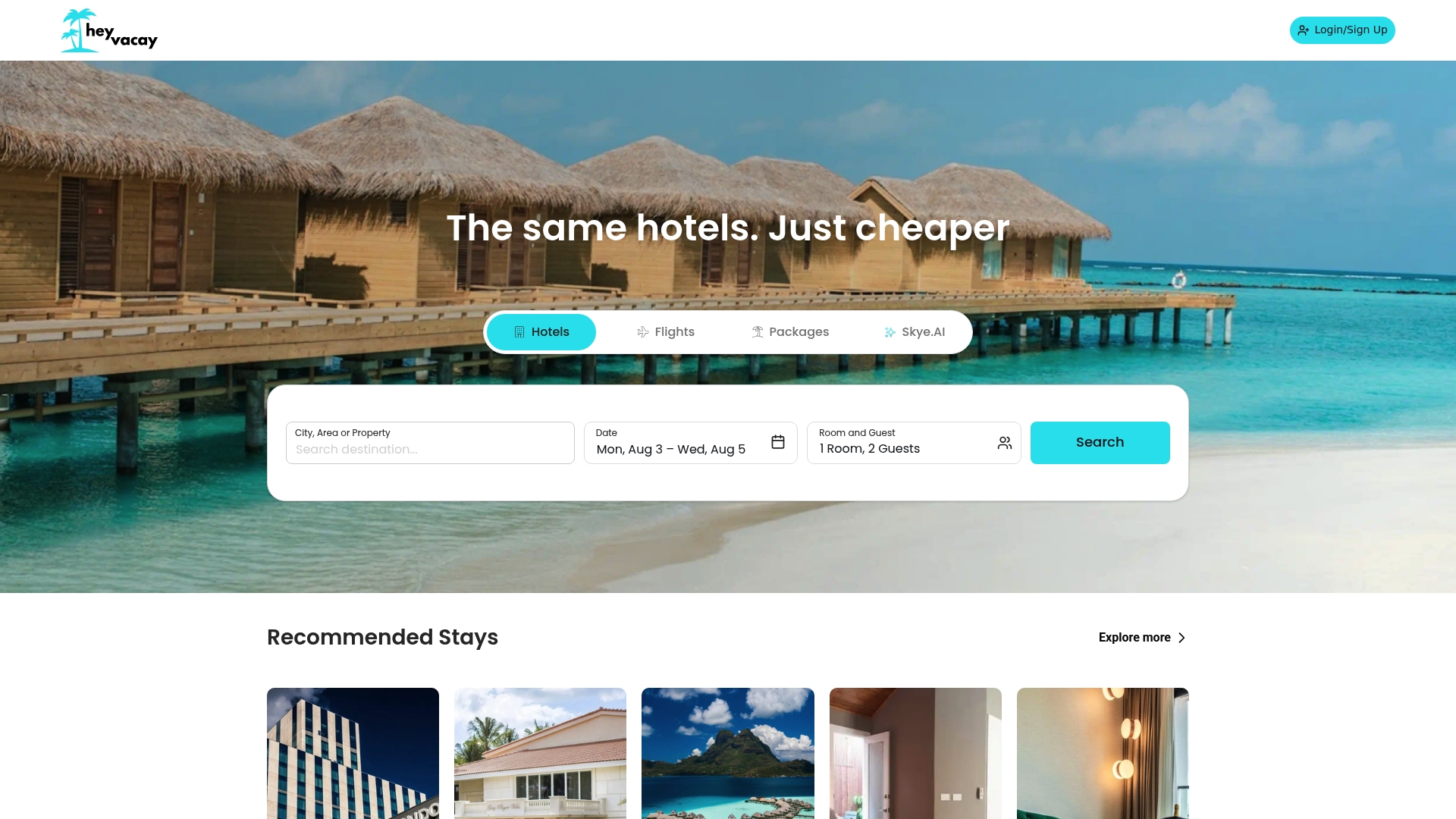
That matters because so many of the risks covered in this guide, rate confusion, buried resort fees, unclear cancellation terms, come down to pricing that isn't upfront from the start. HeyVacay shows the total cost and the terms clearly, so you're not reverse-engineering the real price the way you often have to on a generic OTA. It won't replace calling the hotel to confirm your reservation or checking cancellation terms before you pay, and you should still do both. But if you want fast, honest comparison shopping without the fine-print guessing game, start comparing hotel prices on HeyVacay before you book your next stay.
Frequently Asked Questions
Is third party hotel booking safe? It's generally safe when you verify the supplier of record, read the cancellation policy, and confirm your reservation with the hotel before arrival. Most problems come from skipping that confirmation step, not from the platforms themselves being untrustworthy.
Why is a hotel cheaper on a third-party site than on the hotel's own website? Third-party platforms sometimes access wholesale or bulk rates, run limited-time promotions, or bundle a room with a flight or car rental, all of which can undercut the hotel's standard direct rate.
Will I lose hotel loyalty points if I book through a third party? Usually, yes. Most loyalty programs only credit points and status perks for bookings made directly through the hotel or its official app or website.
What should I do if my third-party reservation isn't showing up at check-in? Show your confirmation email and number to the front desk, and if they can't locate it, call the third-party vendor immediately while you're still at the property to resolve it in real time.
Can I get a refund if I cancel a third-party hotel booking? It depends on the rate type. Refundable bookings typically follow the cancellation window listed at checkout, while prepaid discounted rates are often non-refundable, so always confirm the terms before you pay.
Sources
- Direct bookings vs third-party reservations (Mews blog)
- The Best and Worst Hotel Booking Sites for 2026 (Frommer's)