

If you stay in hotels fewer than 10 nights a year, booking sites usually save you more money. If you cross 15 to 20 nights a year with the same chain, direct booking through a loyalty program almost always wins, once you count the perks. That's the short version. A 2025 industry analysis from Which? found member-only rates now beat third-party pricing on a large share of bookings, but the math still shifts depending on your travel pattern.
Here's what actually moves the needle:
- Per-night price often favors OTAs for one-off trips, loyalty for repeat stays.
- Perks value (breakfast, waived fees, upgrades) can swing $30 to $80 a night in your favor with status.
- Flexibility varies by rate type, not by channel. Read the fine print either way.
- Redemption value differs wildly between programs, from roughly 0.5 to 1.5 cents per point.
- Tools like HeyVacay and sites like ThePointsGuy both track these gaps so you don't have to guess.
Key Takeaways
Direct booking through a hotel loyalty program tends to beat booking sites once perks and status are counted, but occasional travelers usually save more through OTAs.
| Point | Details |
|---|---|
| Match channel to frequency | Book direct past roughly 15 nights a year with one brand; use OTAs for occasional trips. |
| Elite status takes volume | Top-tier status usually requires 60 to 70 nights a year; mid-tier often needs 25 to 40. |
| Price gaps are real | Identical rooms can differ by up to 40% across channels, so check both before booking. |
| OTAs strip elite perks | Suite upgrades, lounge access, and free breakfast rarely apply to third-party bookings. |
| Compare before you commit | HeyVacay's AI search shows transparent, side-by-side pricing across channels for the same room. |
Table of Contents
- How Do Hotel Loyalty Programs Work?
- What Do Booking Sites Actually Offer?
- Which Books Cheaper: Loyalty Rates or OTA Deals?
- When Should You Book Direct With a Loyalty Program?
- Should You Join Multiple Programs or Concentrate Stays?
- How to Combine OTAs and Loyalty for the Best Price
- Quick Checklist: Loyalty or Booking Site?
- How HeyVacay Helps You Compare Both Channels
- Sources
How Do Hotel Loyalty Programs Work?
Hotel loyalty programs reward you two ways: for how much you spend, or for how many nights you stay. Hilton Honors and Marriott Bonvoy weight earnings toward dollars spent, while World of Hyatt leans more on qualifying nights. Points typically translate to something between 0.5 and 1.5 cents each in redemption value, and World of Hyatt tends to run higher than average on a per-point basis, even though its portfolio is smaller than Marriott's or IHG's.
The perks are where members actually feel the difference:
- Member-only rates, often 5 to 10% below the public price
- Free Wi-Fi and waived resort fees
- Complimentary breakfast at mid-tier status and above
- Room upgrades and late checkout, subject to availability
Elite status usually isn't cheap to earn. Top-tier status at programs like Marriott Bonvoy or Hilton Honors typically demands 60 to 70 qualifying nights a year, while mid-tier status often lands between 25 and 40 nights. If that sounds unreachable, a co-branded credit card or a fast-track promotion can shortcut you into mid-tier perks without the travel volume.
What Do Booking Sites Actually Offer?
Booking.com and Hotels.com compete on price, not points. Their advantage is aggregation: thousands of properties, opaque last-minute deals, and flash sales that hotel chains rarely run themselves. Portal loyalty tiers, like Booking.com's Genius program or Hotels.com's OneKey rewards, hand out instant discounts and perks without asking you to hit a night threshold first.
What you get from OTAs:
- Immediate percentage discounts once you unlock a tier, no waiting required
- Flexible search across brands, neighborhoods, and price points in one screen
- Bundling with flights and rental cars for a lower combined price
- Fast comparison shopping when you don't care which hotel brand you stay at
The catch: book through an OTA and you typically forfeit elite recognition. Hotels rarely honor suite upgrades, lounge access, or guaranteed breakfast for third-party reservations, even if you hold top-tier status with that chain. The front desk sees an OTA booking code, not your loyalty number.
Which Books Cheaper: Loyalty Rates or OTA Deals?
The honest answer is: it depends on the night, the market, and how badly the OTA wants to move inventory that week. Real-world price tracking has found identical rooms differing by up to 40% across booking channels, which is reason enough to check both before you commit. Separate research puts typical portal savings in the 15 to 25% range versus the public direct rate, especially off-peak.
| Dimension | Hotel loyalty (direct) | Booking sites (OTA) |
|---|---|---|
| Typical price | Member rate often 5 to 10% below rack rate | Can undercut direct by 15 to 25% off-peak |
| Member perks | Wi-Fi, breakfast, waived fees | Portal-tier instant discounts, bundles |
| Elite status value | Full recognition, upgrades possible | Rarely honored |
| Cancellation | Set by hotel brand, usually consistent | Set by OTA, varies by rate type |
| Points/redemption | 0.5 to 1.5 cents per point | Portal cash-back or credits, no elite path |
| Privacy | Shared with one hotel group | Shared across a broader ad network |
| Convenience | One app, one brand's inventory | Cross-brand search in one place |
Run the numbers on two travelers. A couple booking two nights in a city they visit once a year will likely find the OTA cheaper. But someone hitting 25 nights a year with one chain earns free breakfast and upgrades worth $50 to $70 a night in perks alone, on top of member rates.
The traveler who wins is rarely the one chasing the lowest sticker price. It's the one who knows which channel actually reflects their travel pattern.
For occasional stays, price rules. For frequent stays with one brand, the perks stack up faster than most people expect.
When Should You Book Direct With a Loyalty Program?
Book direct when your annual pattern with a specific chain starts to look like a habit, not a one-off. A few rules of thumb:
- If you'll hit 15+ nights a year with one brand, direct booking usually pays for itself in perks alone.
- If breakfast, lounge access, or a lounge-adjacent upgrade matters for this specific trip, book direct. OTAs strip that access almost every time.
- If you're traveling somewhere your loyalty chain has heavy coverage (say, Hyatt in a market where it dominates), status recognition gets you more than a discount would.
- Run the math: if the direct rate premium is under $15 a night and perks are worth $40 or more, direct wins outright.
Business travelers hitting three or four cities a month almost never lose by going direct.
Should You Join Multiple Programs or Concentrate Stays?
Joining several hotel loyalty programs costs nothing, and it widens your coverage across brands you don't always control when traveling for work. The tradeoff: spreading your nights thin across IHG Rewards, Accor Live Limitless, and Hilton Honors can prevent you from ever reaching a status tier that actually pays off.
Concentrating stays makes sense once you're within striking distance of a mid-tier threshold, typically 25 to 40 nights. Below that, diversifying protects you from being stuck with an unusable pile of points in a program you rarely use.
- Track balances quarterly so points don't expire unused.
- Avoid opening a fifth loyalty account for a one-time stay.
Pro Tip: If you travel 10 to 20 nights a year, pick one chain that covers your most frequent destinations and route as many bookings through it as you can. That's usually enough to hit mid-tier status without obsessing over every stay.
How to Combine OTAs and Loyalty for the Best Price
You don't have to choose one channel forever. Run this sequence on every trip:
- Search OTAs first to establish a market-rate baseline for the dates and property you want.
- Check the hotel's direct member rate for the same room. Many brands guarantee it will match or beat public OTA pricing.
- If the OTA price is lower, screenshot it and ask the hotel to price-match. Many hotels will honor a lower third-party rate to win the direct booking and the loyalty relationship that comes with it.
- Factor in perks. A $20 premium for booking direct often pays for itself with free breakfast and a waived resort fee.
Use a meta-search tool and test rates in an incognito browser window, since dynamic pricing can shift the number you see based on your search history.
Pro Tip: If the OTA discount is under $15 a night, book direct and keep the loyalty perks. If it's $30 or more, take the OTA deal and skip the status game for that stay.
Quick Checklist: Loyalty or Booking Site?
- Trip length under 3 nights, one-off destination? Check OTAs first.
- Breakfast or upgrade worth $40+/night to you? Book direct.
- Direct rate premium under $15/night? Book direct.
- Need flexible, free cancellation? Compare both, rate type matters more than channel.
- Booking flights and a hotel together? OTAs bundle better.
A note from HeyVacay's own testing
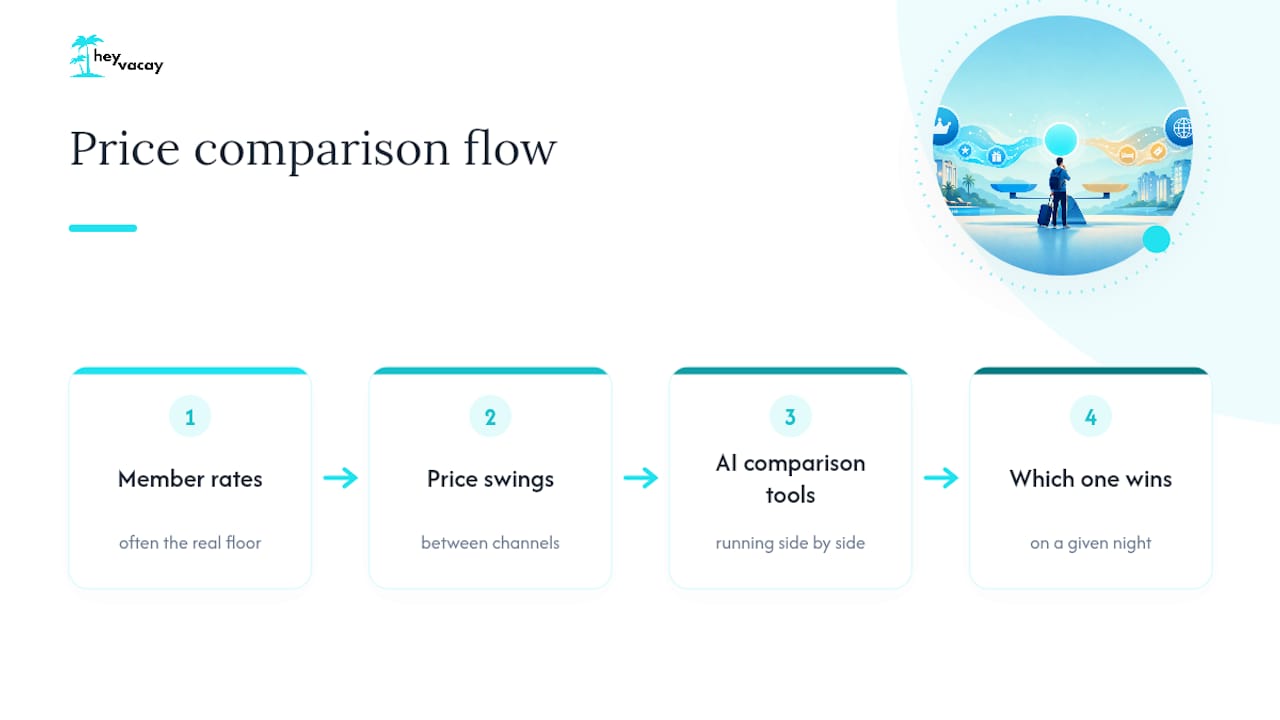
Price swings between channels surprised us more than expected. Member rates are often the real floor, not a marketing gimmick, and running both channels side by side with AI comparison tools is the only way to know which one wins on a given night.
How HeyVacay Helps You Compare Both Channels
Rather than betting on one channel, HeyVacay searches across pricing sources with AI and shows you the true cost, including fees that some booking sites bury until checkout. You get transparent pricing on the same rooms you'd find through a loyalty portal or an OTA, without needing five browser tabs open to compare them yourself. If you're weighing a two-night city trip against a longer stay where perks might matter more, running a search through HeyVacay shows you where the real savings sit before you commit. For deeper reading on finding the lowest verified prices, HeyVacay's guide to best cheap hotel sites is a solid next stop. Start a search on HeyVacay for your next trip's dates and compare the total cost side by side.
Sources
- Best hotel loyalty programs — The Points Guy
- Why hotel loyalty schemes are now the cheapest way to book — Which?
- Hotel booking channels comparison 2026 — Travel Arbitrage
- Should you book hotels direct or through an OTA? — SmarterTravel