

For most U.S. leisure travelers, the best time to book hotels is roughly 14–21 days before check-in for domestic trips, and 1–3 months out for international travel. That's the window where price and availability tend to align most favorably, based on aggregated booking-data analyses across major OTAs and industry trackers.
One headline finding worth knowing: some OTA analyses have recorded double-digit percent savings for travelers who booked within a week of arrival during certain summer windows. That's real money, but it comes with real risk.
Quick decision checklist:
- Book now if your dates are fixed, you need a specific property or room type, or you're traveling during a holiday, festival, or peak season.
- Wait and monitor if your dates are flexible, you're booking a domestic trip more than 30 days out, and you're comfortable with a refundable backup.
- Book immediately if you're targeting a popular resort, a major-event destination, or any stay that falls within 60–90 days of a predictable demand spike.
This guidance draws on published industry analyses, hotel-tech research, and HeyVacay's own AI-driven rate modeling across U.S. hotel markets. The recommendation suits most leisure travelers; business travelers and group bookings follow different patterns covered below.
Key Takeaways
The best time to book a hotel for most U.S. leisure travelers is 14–21 days before check-in for domestic trips, and 1–3 months out for international travel, with earlier booking required for peak seasons and major events.
| Point | Details |
|---|---|
| Domestic sweet spot | Book 14–21 days before check-in for the best balance of price and availability. |
| International lead time | Book 1–3 months out; coordinate with flight timing and use refundable rates. |
| Peak seasons and events | Book 2–6 months out for holidays, festivals, and major events to avoid sellouts. |
| Stay day over booking day | Shifting your check-in day (e.g., Sunday vs. Friday) can save 10–20% in many markets. |
| HeyVacay monitoring | Use HeyVacay's watchlists and price-drop alerts to rebook at lower rates after your initial booking. |
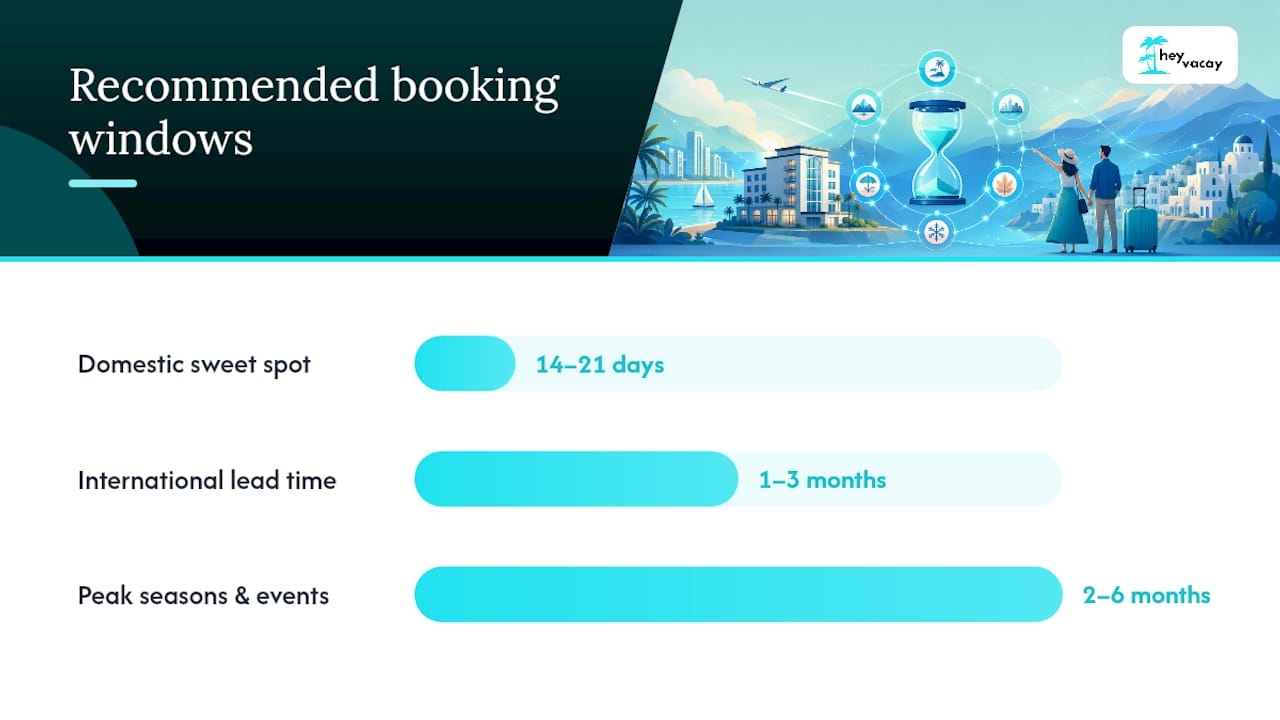
Table of Contents
- What the data actually shows about hotel booking windows
- Which days and months give you the cheapest hotel rates?
- How the right booking window changes by trip type
- When you should always book early: peak seasons and major events
- How to find last-minute hotel deals without getting burned
- How HeyVacay's AI models the variables that matter
- Book now or wait? A quick decision checklist
- HeyVacay's take on applying these rules in real bookings
- Smarter hotel rates start with the right tools
- Sources
What the data actually shows about hotel booking windows
The evidence on optimal hotel booking timing is consistent in one direction and messy in the details. Here's what the aggregated data actually says.
The domestic sweet spot is real. RateRanger's booking-data analysis identifies 15–21 days before check-in as a common lowest-rate period for U.S. domestic stays. Hotels in this window are trying to fill remaining inventory without slashing prices to last-minute desperation levels. You get the benefit of availability plus a rate that hasn't been bid up by early demand.
International trips need more lead time. For most international destinations, booking 1–3 months out tends to produce better rates than either very early or very late booking. Supply is tighter, flight coordination matters, and popular properties fill faster.
Last-minute savings are real, but conditional. Travel + Leisure's analysis found that booking within a week of arrival sometimes produced savings of 24–35% versus earlier booking in summer windows. The catch: this pattern holds in markets with abundant supply and doesn't apply to sold-out destinations or peak weekends.
Stat to remember: Shifting your stay day, not just your booking day, can save 10–20% in many U.S. markets, according to OTA-sourced analyses.
| Source | Suggested booking window | Headline savings noted |
|---|---|---|
| RateRanger (domestic) | 15–21 days before check-in | Lowest average rate period |
| Travel + Leisure (OTA data) | Within 1 week (select markets) | 24–35% vs. earlier booking |
| AAA travel guidance | 1–3 months (international) | Availability + rate alignment |
| SiteMinder (industry analysis) | No single window; varies by market | Destination-dependent |
A word on methodology: these figures come from aggregate OTA datasets, which means they reflect averages across thousands of properties and markets. Your specific destination, travel dates, and property type will shift the numbers. Treat these as directional signals, not guarantees.
Pro Tip: Set a price alert the moment you identify your hotel. Rates move constantly, and knowing the baseline makes it easier to recognize a real drop when it appears.
Which days and months give you the cheapest hotel rates?
The short answer: where you stay matters more than when you book, and Sunday arrivals tend to be cheapest for U.S. leisure travelers.
Stay day beats booking day
SiteMinder's hotel-industry analysis confirms that Sunday check-ins are typically cheaper for leisure markets, while city and business-oriented hotels show different patterns, often pricing midweek stays lower because corporate demand drops on weekends. If you're booking a city hotel for a weekend getaway, you may actually find Friday night pricier than Tuesday.

Shifting your arrival by one day can produce savings comparable to weeks of price monitoring. That's the lever most travelers ignore.
Best months and off-season timing
- January and February are the cheapest months for most U.S. beach and warm-weather destinations (excluding ski resorts, which peak in winter).
- September and October offer the best shoulder-season value for city travel, particularly in major metros like New York, Chicago, and San Francisco, where summer conference demand has cleared.
- November (excluding Thanksgiving week) is consistently underpriced for domestic leisure travel.
- March and April work well for budget-conscious travelers targeting the South and Southwest before spring-break crowds arrive.
Summer (June–August) and the December holiday window are the two periods where waiting almost never pays off. Rates climb and availability shrinks as the dates approach.
Pro Tip: If your trip has any date flexibility at all, run a flexible-date search before locking in. Moving a Friday check-in to Sunday, or a Saturday departure to Monday, can cut your nightly rate noticeably without changing much about the trip itself.
How the right booking window changes by trip type
The 14–21 day domestic rule is a useful default, but it breaks down fast once you factor in trip type, property class, and group size.
Domestic leisure vs. international
For a standard domestic weekend trip to a mid-size city or regional destination, the 15–21 day window holds up well. Hotels in these markets carry enough inventory that last-minute availability is rarely a problem, and rates tend to dip as check-in approaches.
International trips are a different calculation. AAA's travel guidance recommends coordinating hotel and flight booking together, using flexible and refundable rates when itineraries are complex. For international stays, booking 1–3 months out reduces the risk of both rate spikes and sold-out properties, especially in markets with limited English-language inventory.
City/business hotels vs. resorts
Business hotels in major metros follow corporate demand patterns. Weekday rates are often higher than weekend rates because business travelers fill rooms Monday through Thursday. If you're visiting a city for leisure, booking a Thursday check-in and leaving Sunday can actually cost less than a Friday-to-Sunday stay.
Resort properties work the opposite way. Weekend and peak-season demand drives rates up, and popular resorts at beach or mountain destinations can sell out weeks or months in advance; exploring some of the best Halkidiki destinations can inspire your multi-destination planning for seaside resorts. For a summer beach resort or a ski property during peak season, the 14–21 day window is too late.
How hotel class affects lead time
- Budget and midscale properties carry more inventory and tend to have more last-minute availability. The 14–21 day window often works, and same-day deals are more common.
- Upscale and upper-upscale hotels fill faster during peak periods. Booking 3–6 weeks out is safer.
- Luxury properties with limited room counts can sell out months in advance for popular dates. If you have a specific luxury hotel in mind, book early and use a refundable rate so you can rebook if the price drops.
For group hotel bookings, add at least 30–60 days to whatever lead time you'd use for a solo trip. Group blocks require coordination, and hotels often release unsold group inventory close to the date, but you can't count on it.
Pro Tip: If you've already booked nonrefundable flights, lock in a refundable hotel rate immediately. You've already taken on the availability risk with the flight; don't double it with a nonrefundable room.
When you should always book early: peak seasons and major events
Some situations make the 14–21 day rule irrelevant. When demand is predictable and high, early booking isn't just smart, it's the only real option.
- Summer beach destinations (June–August): Book 2–3 months out. Coastal properties in popular markets like Miami, the Outer Banks, or the Jersey Shore fill fast, and rates climb steadily as summer approaches.
- Major holidays (July 4th, Labor Day, Thanksgiving, Christmas/New Year's): Book 3–4 months out for popular destinations. These windows are the most predictable demand spikes in the U.S. hotel calendar.
- Large festivals and events (SXSW, Mardi Gras, major music festivals): Book 4–6 months out, sometimes earlier. Hotel inventory near major festivals is genuinely limited, and rates can triple or quadruple compared to non-event weeks.
- Conferences and conventions: Book as soon as the conference hotel block opens, typically 3–6 months before the event. Conference-adjacent hotels fill quickly, and the overflow market gets expensive fast.
- Major sports events (Super Bowl, Final Four, college football rivalry weekends): Book the moment the venue is announced. These are the most extreme demand events in the U.S. hotel market.
- Ski resorts during peak winter weeks (Christmas, Presidents' Day, spring break): Book 2–3 months out. Ski destinations have limited room supply and predictable demand spikes.
Refundable vs. nonrefundable for peak windows: book a refundable rate first to secure availability, then monitor for price drops. If the rate falls, rebook at the lower price. If it doesn't, you're already covered. RateRanger's analysis supports this approach, noting that booking early and monitoring for drops is a lower-risk strategy than waiting for last-minute inventory.
Example: You're planning a July 4th weekend at a coastal resort in the Carolinas. By June, you're choosing between whatever's left and paying a premium for it. Booking in April with a refundable rate gives you the room you want at a rate you can still improve on.

Pro Tip: For peak-event travel, treat availability as the primary constraint, not price. A room at a higher rate beats no room at all.
How to find last-minute hotel deals without getting burned
Last-minute hotel deals are real. Travel + Leisure's data shows that same-day and very-late bookings can produce the deepest discounts in markets with abundant supply, because hotels prefer some revenue to an empty room. The risk is that this only works when supply exceeds demand, which is exactly when you don't need a deal.
Here's how to pursue last-minute savings without ending up stranded:
- Use flexible-date searches to identify which nights in your window are cheapest. A one-day shift can produce a meaningful rate difference.
- Check mobile apps and app-exclusive rates. Many OTAs offer app-only pricing that doesn't appear on desktop searches.
- Look for same-day booking apps that specialize in distressed inventory. These work best in large cities with high hotel density.
- Set price alerts on your target property as soon as you identify it. Monitoring a rate from 30 days out tells you whether the trend is up or down.
- Use loyalty program rates. Member rates at major hotel chains are often 5–10% below public rates and sometimes include free cancellation that public rates don't.
Risk management steps:
- Always have a backup property identified before you go last-minute.
- Use refundable rates whenever possible, even if they're slightly higher.
- Know the cancellation window before you book, not after.
- Avoid last-minute booking for peak weekends, holidays, or any destination with a major event in progress.
The most effective approach for last-minute hotel deals is a hybrid: book a refundable rate now to secure availability, then monitor for drops. If the rate falls before your cancellation deadline, rebook at the lower price. You capture the discount without gambling on availability.
Pro Tip: The "book refundable now, monitor, rebook" method works best when you set a specific target rate before you start watching. Without a target, you'll keep waiting for a drop that may never come.
How HeyVacay's AI models the variables that matter
Industry experts are clear that no single booking window works for every traveler. Pricing is dynamic and depends on occupancy curves, cancellation flows, local events, and rate parity signals that shift daily. A rule that worked last summer may not hold this year for the same destination.
HeyVacay's AI tracks these variables continuously across U.S. hotel markets, surfacing rate patterns that manual monitoring would miss. The platform monitors:
- Occupancy curves: how fast a property is filling relative to its historical pace for that date.
- Cancellation flows: when rooms re-enter inventory, which often creates short-lived rate dips.
- Local event calendars: conferences, festivals, and sporting events that drive demand spikes.
- Rate parity signals: when a property's rate on one channel diverges from its rate on another.
The practical result is that HeyVacay can flag when a rate is likely to rise (book now) or when it has room to fall (wait and monitor), rather than applying a fixed rule that ignores the specific property and date.
HeyVacay also offers transparent pricing with no hidden fees, so the rate you see is the rate you pay. That matters when you're comparing a "cheaper" rate on another platform that adds resort fees or service charges at checkout.
Pro Tip: Use HeyVacay's watchlist feature to monitor a specific property from the moment you identify it. You'll see the rate trend over time, which is more useful than any single snapshot.
For a deeper look at how dynamic hotel pricing works and why timing matters, HeyVacay's guide covers the mechanics behind revenue management systems.
Book now or wait? A quick decision checklist
The core trade-off is simple: booking early secures availability but may leave money on the table; waiting risks selling out or paying a premium when supply tightens. Here's how to decide.
Book now if:
- Your dates are fixed and non-negotiable.
- You're traveling during a peak period, holiday, or major event.
- You need a specific property or room type with limited inventory.
- Your trip is international and involves coordinated flights.
- You're booking for a group of four or more.
- The rate is already at or below the historical average for that property and date.
Wait and monitor if:
- Your dates are flexible by at least two to three days.
- You're booking a domestic trip more than 30 days out with no event pressure.
- The destination has abundant hotel supply and no major events scheduled.
- You already have a refundable booking in place as a backup.
A nonrefundable rate that saves $30 is not worth the risk if there's any chance your plans change.
On group bookings: add 30–60 days to your normal lead time and ask about group block rates directly with the property. OTA rates for groups are rarely the best option.
Combine a refundable booking with price monitoring. Book the room you want at today's rate, set an alert, and rebook if the price drops before your cancellation deadline. This approach captures most of the upside of waiting without the availability risk.
HeyVacay's take on applying these rules in real bookings
The rules in this article are solid starting points, but the travelers who consistently pay less aren't the ones who memorized the 14–21 day window. They're the ones who monitor actively and rebook when the rate drops.
HeyVacay has seen this play out repeatedly: a traveler books a refundable rate 25 days out, sets a watchlist alert, and catches a rate drop 10 days later when a block of rooms re-enters inventory after a cancellation wave. They rebook at the lower rate, cancel the original, and end up paying less than if they'd waited for the "right" moment to book in the first place.
The monitoring-and-rebook approach works because hotel pricing isn't a one-way escalator. Rates move up and down based on occupancy, cancellations, and competitive pressure. The traveler who books once and forgets misses those drops. HeyVacay's watchlist and price-drop alerts are built specifically to catch them.
Smarter hotel rates start with the right tools
Knowing when to book is only half the equation. The other half is having a platform that tracks the variables for you so you don't have to refresh a browser tab every morning.
HeyVacay gives travelers a concrete edge on timing:
- AI-powered price monitoring that tracks occupancy curves, cancellation flows, and rate parity signals across U.S. hotel markets.
- Watchlists and price-drop alerts so you know the moment a rate falls on your target property.
- Multi-destination search for travelers comparing rates across several cities or resort areas before committing.
- Transparent pricing with no hidden fees, so the rate you see is what you pay.
Whether you're locking in a summer beach resort two months out or hunting a last-minute city deal this weekend, HeyVacay's AI does the monitoring work so you can book with confidence. Search hotels on HeyVacay and see what the rate trend looks like for your dates before you commit.
Sources
The findings in this article draw on the following published analyses and travel guidance resources. Each covers a different angle of hotel booking timing, and combining multiple sources with active price monitoring produces better results than any single rule.
- Best Time to Book the Hotel in 2026 | Rate Ranger
- Maximize Savings: Best Time to Book a Hotel Room
- The cheapest day to book a hotel — SiteMinder
- Travel smarter with the best time to book flights and hotels — AAA
No single source covers every market and every traveler type. Use these as directional benchmarks, then monitor your specific property's rate trend to make the final call.