

The rule is simpler than it sounds, but it splits in two directions. Business hotels, the ones near office parks, convention centers, and downtown financial districts, tend to get cheaper on weekends when corporate travelers go home. Leisure hotels, the ones near beaches, theme parks, and casino strips, tend to get cheaper midweek when families and vacationers clear out. There's no single "cheapest day" that applies everywhere, which is exactly why so many travelers overpay.
A few data signals are worth checking before you book anything:
- Hotels.com's 2026 Hotel Price Index found Sunday is often the cheapest U.S. check-in night, roughly 15% below Friday.
- Hopper's research points to Tuesday through Thursday as the sweet spot in many leisure-heavy markets.
- HotelTonight data reported by Travel + Leisure showed Sunday bookings running about 16% cheaper than Friday or Saturday on that last-minute platform.
Pro Tip: Before you trust any general rule, pull up the same room at the same hotel for both a Sunday check-in and a Friday check-in. That five-minute comparison beats any blog post, including this one.
Key Takeaways
Check-in day, not booking day, is the strongest predictor of hotel price, and business hotels get cheaper on weekends while leisure hotels get cheaper midweek.
| Point | Details |
|---|---|
| Pattern depends on hotel type | Business hotels often drop 15% to 24% on weekends; leisure hotels can drop 40% to 50% midweek in resort markets. |
| Check-in day beats booking day | Industry data ties price more consistently to the night you stay than the day you reserve. |
| Compare total stay cost | Pull a seven-day rate window and total the full stay, including fees, before choosing dates. |
| Watch for local events | Conventions, festivals, and holidays can override the usual weekday-weekend pattern. |
| Use a flexible-date search | Platforms like HeyVacay let you compare nightly rates across a date range for the same room and policy. |
Table of Contents
- Why Weekend Vs Weekday Hotel Prices Diverge
- What the Hotel Pricing Data Actually Shows
- Is This Hotel Priced Like a Business Property or a Leisure One?
- How to Compare Weekend and Weekday Hotel Rates for Your Trip
- The Booking-Day Myth vs the Check-In-Day Reality
- Reading Industry Data Without Getting Confused
- What Travelers Get Wrong About Cheap Check-In Days
- Book the Cheaper Date Without the Guesswork
- Frequently Asked Questions
- Sources
Why Weekend Vs Weekday Hotel Prices Diverge
Hotel pricing follows demand, and demand follows two very different traveler calendars. Business travel clusters Monday through Thursday. Conferences run midweek, sales calls happen on weekdays, and corporate travel departments book flights that get people home before Saturday. That pattern pushes weekday rates up in cities built around offices and convention centers, then lets prices sag once the business crowd clears out for the weekend.
Leisure travel runs the opposite direction. Families take long weekends, couples book Friday through Sunday getaways, and resort destinations fill up exactly when downtown business hotels empty out. STR performance data shows weekend average daily rates running roughly 15% to 20% higher than weekday rates at the national level, though that aggregate hides massive market-by-market swings.
Revenue management adds another layer. Hotels don't just raise or lower one nightly rate. They apply:
- Length-of-stay rules that require a minimum two- or three-night stay to unlock a discounted rate.
- Rate fences that price a refundable room differently from a prepaid, nonrefundable one for the same night.
- Group and event blocks that can quietly wipe out cheap inventory even when the public calendar looks wide open.
That's why the advertised nightly rate and the total price of your stay aren't always telling the same story.
What the Hotel Pricing Data Actually Shows
The numbers back up the split, and they're bigger than most travelers expect. RateRanger's sample of U.S. hotels found Sunday check-ins averaging $166 against $205 for Friday check-ins at the same properties, a difference of roughly 24%. That's not a rounding error. That's the cost of an extra dinner out.

A separate analysis by UponArriving, built on 2,800 data points, found Saturday the most expensive night and Sunday the cheapest, with an average weekly price swing of around $83 per property.
Where this plays out depends heavily on the market:
- New York City and other business-heavy metros: weekend rates often drop as corporate demand disappears, sometimes the cheapest nights of the week.
- Las Vegas and resort or casino markets: the pattern flips hard. Midweek rooms can run 40% to 50% cheaper than the same room on a Friday or Saturday, since Vegas runs on weekend leisure demand, not weekday business travel.
- Beach resorts and family destinations: midweek troughs are common outside of summer peak and holiday windows, when family travel schedules shift the whole curve.
Hotels.com's 2026 HPI data and Hopper's independent 2025 findings aren't in conflict here. Hotels.com flags Sunday as the national low point; Hopper's numbers lean toward Tuesday through Thursday in many leisure markets. Both are describing the same underlying split from different angles.
Is This Hotel Priced Like a Business Property or a Leisure One?
Before you can apply any pricing rule, you need to know which pattern your hotel follows. A quick checklist handles most of it:
- Location: downtown, near a convention center, or close to a business airport terminal points to a business pattern. Beachfront, near a theme park, or inside a casino resort points to leisure.
- Guest mix: check the property's own marketing. Suites, work desks, and "meetings and events" pages signal corporate demand. Family suites, pool bars, and all-inclusive packages signal leisure travelers.
- Booking calendar: open the hotel's own rate calendar for the next four weeks. If Friday and Saturday nights are consistently pricier, you're looking at a leisure-driven property. If they're cheaper, it's business-driven.
- Group and event pages: a hotel that promotes conference space and corporate rates usually empties out on weekends.
Pro Tip: Check the hotel's calendar for local festivals, marathons, or conventions before locking in a "cheap" midweek date. A single citywide event can flip the entire pattern for a few days, even in a normally predictable market.
How to Compare Weekend and Weekday Hotel Rates for Your Trip
Comparing rates properly takes about ten minutes and saves real money. Here's the method:
- Lock the specifics. Pick the exact property, room type, and cancellation policy you want. Comparing a refundable suite against a prepaid standard room isn't a fair test.
- Pull a seven-day window. Check nightly rates for every date surrounding your preferred travel window, not just your two candidate nights.
- Total the stay, not the night. A cheaper nightly rate paired with a mandatory two-night minimum can cost more than a pricier single-night rate.
- Factor in fees. Resort fees, parking, and taxes vary by night and by rate type, and they can erase a nightly discount fast.
Say a three-night stay runs $205 a night from Friday through Sunday, or $166 a night from Sunday through Tuesday. Shifting the check-in by just 48 hours saves $117 across the stay, even before fees. That's the kind of gap a flat "weekends cost more" assumption misses entirely, because hotels often run four to six distinct price brackets across a single week.
- Set up price alerts for your target dates.
- Use a flexible-date search instead of fixed check-in and check-out dates.
- Recheck rates a few days before travel. Same-day pricing can move sharply in either direction depending on how full the hotel is.
The Booking-Day Myth vs the Check-In-Day Reality
A lot of advice online treats "best day to book" and "best day to check in" as the same question. They're not. SiteMinder's industry analysis makes the distinction clear: check-in day patterns, like the Sunday trough, are far more consistent predictors of price than whatever day you happen to click "reserve."
Booking-day data is messier. HotelTonight's last-minute figures showed Sunday bookings and same-day bookings both delivering strong discounts on that platform, but that's a same-day, last-minute signal, not a universal booking rule that applies across every site and hotel.
- Don't chase a "magic booking day." Chase a flexible check-in date instead.
- Same-day deals through apps like HotelTonight can work, but they're a gamble tied to unsold inventory, not a guarantee.
- Always compare total stay cost across a few check-in options rather than obsessing over when you hit "book."
Pro Tip: If your dates are fixed and non-negotiable, stop trying to time the booking day. Put your energy into comparing properties and rate types instead, where the bigger savings actually live.
Reading Industry Data Without Getting Confused
When Hotels.com, Hopper, and STR seem to disagree, they're usually measuring different slices of the same market. National HPI and STR performance data are best for spotting broad seasonal and market-level trends. Last-minute platforms like HotelTonight are useful only for same-day or next-day bookings, not for planning three months out.
The practical approach: treat national datasets as a starting hypothesis, then confirm it against the actual property's own calendar. If Hotels.com says Sunday is generally cheapest but your specific casino resort in Las Vegas shows midweek nights running far lower, trust the property's real calendar over the national average.
- Use HPI-style national data to form your initial guess about a market.
- Use STR-style occupancy patterns to understand the business vs leisure split at a city level.
- Override both with the specific hotel's own rate calendar for your exact dates, since events and seasonality can flip the "expected" pattern without warning.
What Travelers Get Wrong About Cheap Check-In Days
The conventional advice, "book on a Sunday and you'll save money," isn't wrong so much as incomplete. It borrows a real pattern from certain markets and applies it everywhere, which is how travelers end up paying business-hotel prices on what should have been a cheap weekend leisure trip, or missing a genuine midweek discount at a beach resort because they assumed weekends always cost more.
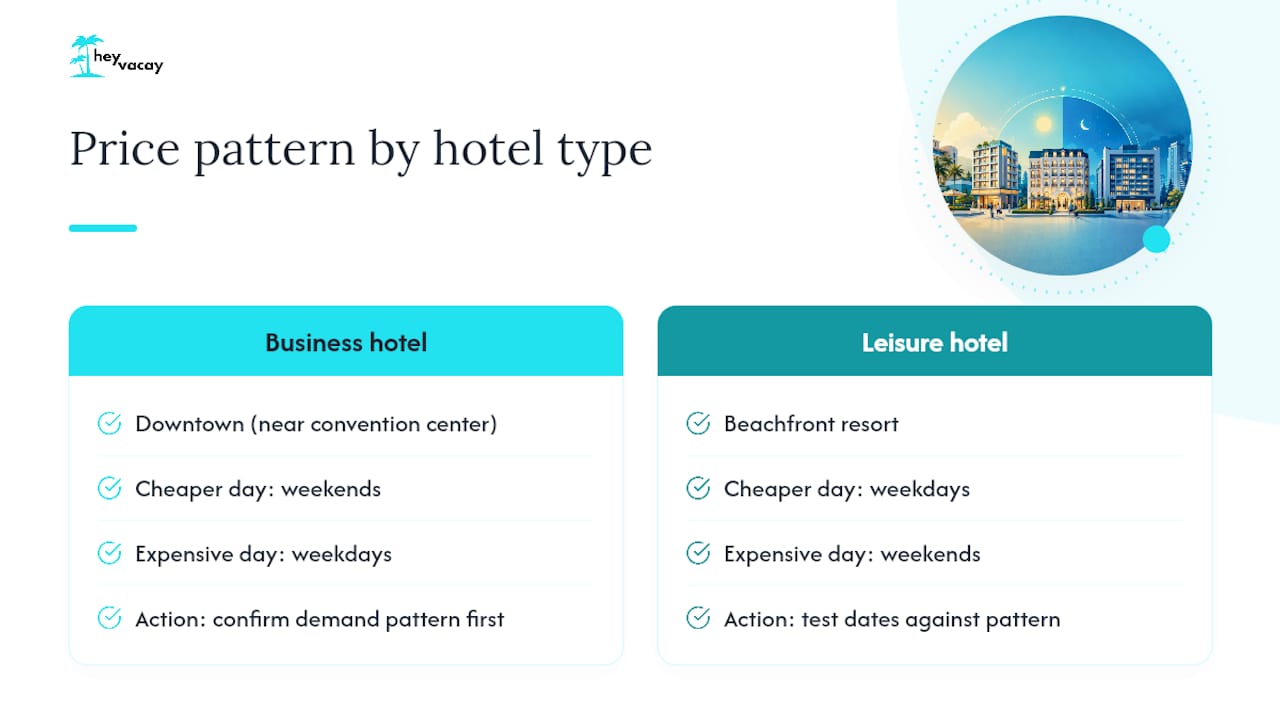
What the data actually supports is a diagnostic habit, not a fixed rule. Look at what kind of hotel you're booking before you look at what day it is. A downtown hotel three blocks from a convention center and a beachfront resort in the same state can have completely opposite pricing calendars in the same week.
The biggest thing readers should prioritize first isn't finding the "right" day. It's confirming which demand pattern their specific hotel follows, then testing dates against that pattern instead of a generic rule pulled from a national average. Once you know whether you're dealing with a business property or a leisure one, the rest of the comparison takes minutes.
Book the Cheaper Date Without the Guesswork
Comparing seven days of rates across multiple sites by hand is exactly the kind of task that eats an evening and still leaves you unsure you found the best price. HeyVacay's AI-driven search does that comparison for you, pulling the same room and cancellation terms across flexible dates so you can see the real gap between a Sunday check-in and a Friday one, side by side, with no hidden fees tacked on afterward.

That matters most for exactly the trips this article covers: a business trip where shifting your arrival by a day could save you real money, or a weekend getaway where midweek turns out to be the better deal. Instead of manually checking a hotel's calendar across a seven-day window, search flexible dates on HeyVacay and let the platform surface the cheapest night for your exact room and stay length before you commit.
Frequently Asked Questions
Are weekday hotel rates always cheaper than weekend rates?
No. Business-focused hotels in downtown or convention areas tend to be cheaper on weekends, while leisure-focused hotels near beaches, theme parks, or casinos tend to be cheaper midweek, usually Sunday through Thursday.
What is the cheapest day to check into a hotel?
It depends on the property. Hotels.com's 2026 HPI data points to Sunday as the cheapest national check-in day, while Hopper's research favors Tuesday through Thursday in many leisure markets. Check your specific hotel's calendar to confirm which applies.
Does the day I book matter more than the day I check in?
Check-in day matters more for the final price in most cases. Booking-day trends, like the same-day discounts reported on HotelTonight, are platform-specific and don't override the underlying demand pattern tied to your actual stay dates.
How much can I save by shifting my check-in date?
Your actual savings depend on the property and market.
Do events or holidays change the usual pricing pattern?
Yes. Conventions, festivals, and holiday weekends can push rates up on nights that are normally cheap, so always check the exact dates against local event calendars before assuming a standard pattern applies.
Sources
- The Cheapest Day of the Week to Book a Hotel, According to New Data
- What day of the week is it cheaper to book a hotel? | SiteMinder
- Weekend vs. Weekday Hotel Rates: The Cheapest Night to Book | Rate Ranger
- Weekday Vs Weekend Hotel Prices In The USA (2026) | Cost Difference
- Are Hotels Cheaper During the Week or Weekend? - UponArriving