

Yes, but with a catch: AI can research, shortlist, and increasingly complete hotel bookings, though most tools still stop just short of the payment step. Search agents already compare live rates across neighborhoods, filter by amenities you'd never think to specify, and rank options with a stated reason for each pick. Booking, the actual transaction, is where the technology splits into two camps.
Here's what's real right now:
- Immediate today: natural-language search, curated shortlists, real-time price comparisons, and automated fare/rate alerts.
- Usually still needs you: final payment authorization, identity verification, and a confirm-before-charge step, even on agents that support end-to-end booking.
- Emerging fast: in-agent checkout, where the AI completes the reservation without redirecting you to a separate site.
HeyVacay sits inside this shift directly. It uses AI to surface the same caliber of hotel at a lower rate, then hands you a transparent price with no hidden fees tacked on at checkout.
TL;DR:
- Most AI hotel booking tools still require manual payment authorization and do not complete transactions within the chat interface.
- Reliable systems recheck live room availability just before booking to prevent issues with rate changes or availability gaps.
- AI tools that only perform searches without integrated booking capabilities are common, with full transaction features still emerging.
- Multi-destination, group, and last-minute trips benefit most from AI, saving hours and avoiding missed deals caused by manual searching.
- Trustworthy booking platforms show transparent prices, perform live rate checks before purchase, and route payments through secure tokenized connectors.
Table of Contents
- How AI Hotel Booking Actually Works
- Types of AI Hotel Agents and What Each One Actually Does
- When AI Finds You a Genuinely Better Deal
- What AI Booking Means for Hotels and Hospitality Teams
- How to Use AI to Find a Cheaper Hotel: A Step-by-Step Checklist
- Staying Safe: Verification, Privacy, and Payment Checks
- Where We Think AI Booking Still Falls Short, and Where It Delivers
- Book Hotels Smarter, Cheaper, Faster With HeyVacay
- Key Takeaways
- Sources
How AI Hotel Booking Actually Works
AI hotel booking starts with a conversation, not a search box. Instead of typing "hotels in Lisbon," you tell the system something closer to how you'd describe your trip to a friend: quiet neighborhood, walking distance to the water, flexible on dates but not on a rooftop pool. The model weighs those preferences against thousands of listings and produces a shortlist ranked by fit, not just price.
That's the easy part. The harder part is making sure the price it shows you is the price you'll actually pay.
Here's the sequence most reliable systems follow, according to technical patterns documented in open-source booking projects like tourmind-com/Hotel-Booking-AI:
- Discovery — the AI parses your intent and pulls candidate hotels from aggregated inventory.
- Rate query — it checks pricing across the shortlist through a middleware layer connected to hotel or OTA APIs.
- Availability recheck — right before booking, it queries the specific room type again, because rates and inventory shift by the minute.
- User confirmation — you approve the exact room, dates, and total.
- Payment handoff — the transaction routes through a tokenized payment connector.
- Booking creation — the system generates a confirmation and receipt from the partner's own API.
Skip step three, and you get the most common complaint about AI travel tools: a room that was "available" a minute ago suddenly isn't, or the price jumps between search and checkout. That's not a bug specific to one app. It's a structural risk anytime an agent shows cached results instead of forcing a live recheck.
Industry guides on AI travel agent workflows describe this same pattern: agents retrieve live rates, then hand travelers into a confirmed booking process only once availability is reverified. Some platforms complete the whole thing inside the chat interface. Others, especially ones without direct payment integrations, redirect you to a standard checkout page on the hotel or OTA site. Neither approach is inherently worse. The redirect model just means a human (you) does the final click.
Pro Tip: If an AI tool shows you a price without a "checking live availability" step or a timestamp, ask it directly to recheck before you commit. A trustworthy agent will do this instantly and show you the updated number.
Types of AI Hotel Agents and What Each One Actually Does
Not every tool that markets itself as an "AI hotel finder" does the same job. Three categories have emerged, and knowing which one you're using changes what you should expect.
- Search-only assistants find and rank hotels but stop there, sending you to book elsewhere. Most general-purpose AI chatbots fall here unless they've added a booking partner.
- Agentic booking assistants can search, recheck rates, and complete a reservation inside the same conversation, using payment connectors and booking APIs behind the scenes.
- Integrated booking platforms combine AI-driven search with a full transaction layer: inventory access, pricing engines, and payment processing built as one product rather than bolted together.
The technical backbone matters more than the interface. A search-only tool can look identical to an agentic one until you try to actually pay. The difference comes down to whether the platform has inventory API access, a matching engine that can reconcile listings across sources, and a payment connector that can complete a transaction without kicking you out to another site.
Product announcements are pushing all three categories forward quickly. Perplexity's move to add a hotel search agent built on partnerships with Tripadvisor and Selfbook shows how fast a search-only tool can pick up booking capability once it partners with the right infrastructure. Once one major agent demonstrates hand-off-to-booking, competitors tend to follow within months, not years.
For travelers, the practical takeaway is simple: ask what happens after you pick a hotel. If the answer involves leaving the chat window, you're using a search-only tool no matter how sophisticated its recommendations sound.
When AI Finds You a Genuinely Better Deal
AI earns its keep in the specific situations where manual search falls apart. A single hotel search across one city, one date range, one traveler? A human can do that fine. A four-city trip with different group sizes at each stop, shifting dates, and a budget ceiling that has to hold across all of it? That's where an AI agent starts saving real time and real money.
- Multi-destination trips, where comparing 15 hotels across five cities by hand takes hours an AI compresses into seconds.
- Group bookings, where block-rate thresholds and room-type mixes are easy to miss without software checking every combination.
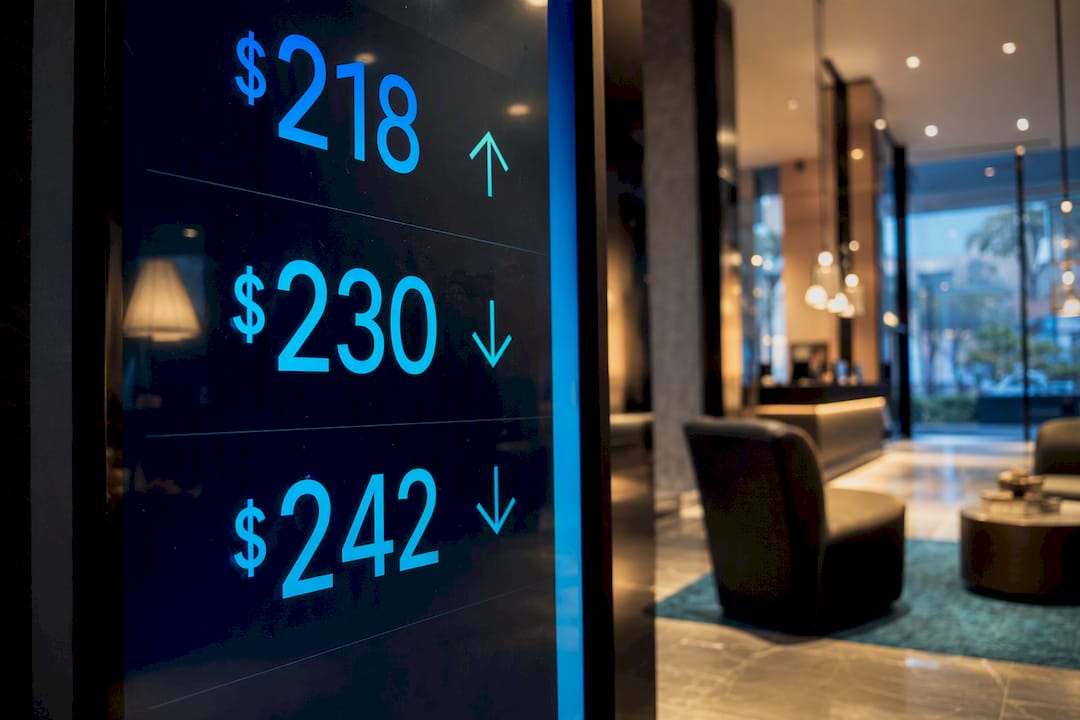
- Last-minute constraints, where dynamic pricing shifts hourly and a human refreshing a browser tab simply can't keep pace.
- Neighborhood-specific searches, where you care about proximity to a conference venue or a specific beach, not just the city center.
The last point matters more than it sounds. AI search tools that factor in neighborhood context and explain why they picked a specific property, rather than just ranking by star rating, tend to produce shortlists travelers actually book from, according to product analysis from Stardrift's AI hotel search. A rationale attached to each result, "closer to your dinner reservation than the higher-rated option two miles out", beats a bare list every time.
Timing tactics compound the effect. Booking mid-week, watching for dynamic pricing dips, and letting an AI flag rate drops automatically can shift a nightly rate by a meaningful margin, a pattern HeyVacay's own research on dynamic pricing in hotels breaks down in more detail.
What AI Booking Means for Hotels and Hospitality Teams
The shift toward AI-driven discovery isn't just a traveler-side story. It's rewriting how hotels acquire guests and staff their front desks.
Direct bookings stand to benefit most. When an AI agent can complete a reservation without routing through a third-party OTA, hotels keep more of the margin they'd otherwise hand over in commission. That's part of why chains are investing so aggressively in their own AI infrastructure rather than waiting for aggregators to build it for them.
- Hilton has run numerous AI experiments across its portfolio, reporting measurable shifts in booking conversion and adjusting owner fee structures in response, according to Skift's coverage of Hilton's AI rollout.
- Guest-facing chatbots are absorbing a growing share of routine questions, freeing front-desk staff for issues that actually need a human.
- Integration costs are real. Connecting an AI layer to legacy property management systems isn't a weekend project, and smaller independent hotels often lack the technical resources larger chains have.
- Rate parity risk grows when AI agents pull pricing from multiple channels simultaneously; a hotel that lets its direct rate drift out of sync with OTA listings can end up undercutting itself.
The pattern across these rollouts isn't uniform success. It's a trade: faster service and higher conversion in exchange for upfront integration work and constant rate monitoring across every channel an AI agent might query.
How to Use AI to Find a Cheaper Hotel: A Step-by-Step Checklist
Getting a genuinely lower rate out of an AI hotel finder isn't about typing "cheap hotels near me." It's about giving the system constraints specific enough that it can actually optimize against them.
- Set a hard price ceiling and a neighborhood, not just a city. "Under $180 a night, within a 10-minute walk of the convention center" gives the AI something to filter against instead of guessing your intent.
- List nonstandard amenities upfront. Rooftop pool, late checkout, pet-friendly, whatever actually matters, because generic searches default to star rating and price alone.
- Ask for the live rate check before you commit. A good agent will recheck availability on your chosen room type the moment before payment, not rely on the number it showed you five minutes earlier.
- Test flexible dates. Ask the AI to compare your target dates against a three-day window; mid-week stays frequently undercut weekend rates by a wide margin.
- Run group and single-room searches separately. Group-rate thresholds kick in at different guest counts depending on the property, and group booking strategies can unlock rates a single-room search never surfaces.
- Confirm the cancellation policy before paying, not after. Ask the AI to state it explicitly rather than assuming it matches the hotel's general policy.
- Check the final total, not the nightly rate. Taxes and resort fees can turn a "cheap" find into an average one once they're added at checkout.
Pro Tip: Before you pay, ask the AI to show you a direct comparison between the price it found and the rate listed on the hotel's own website. If the numbers don't match, that's your cue to dig deeper before booking.
Staying Safe: Verification, Privacy, and Payment Checks
The same speed that makes AI hotel booking useful also creates room for mistakes. Two failure modes show up most often: hallucinated availability, where the AI describes a room that isn't actually bookable, and stale rates, where the price shown hasn't been rechecked against the live system.
Force a live check every time. Ask directly: "Confirm this rate against current availability before I pay." Any agent worth using can do this instantly.
Payment safety comes down to recognizing a proper handoff. A trustworthy booking flow routes payment through a tokenized connector, systems like Stripe or similar partner APIs, and returns a receipt generated by the actual booking partner, not just a confirmation screen inside the chat window. If a booking flow asks for your full card number directly in a chat interface rather than a secure payment form, stop and verify before proceeding.
On privacy, most agents request travel dates, budget range, and loyalty program details to personalize results. That's normal. What's worth questioning is any request for information unrelated to the booking itself, like full passport details before you've even chosen a hotel.
Red flags worth pausing on:
- A redirect to an unfamiliar domain right before payment.
- No visible cancellation policy attached to the booking summary.
- Hotel details (address, room type) that don't match what you searched for.
A helpful outside explainer on this topic, Wild Foodz's breakdown of digital reservations, covers what travelers should verify before trusting any automated booking system with their payment details.
Where We Think AI Booking Still Falls Short, and Where It Delivers
Most coverage of AI hotel booking treats speed as the whole story. It isn't. The real value shows up when an agent explains why it picked a property, not just that it fits your budget. A shortlist without reasoning is just a filtered list, dressed up.
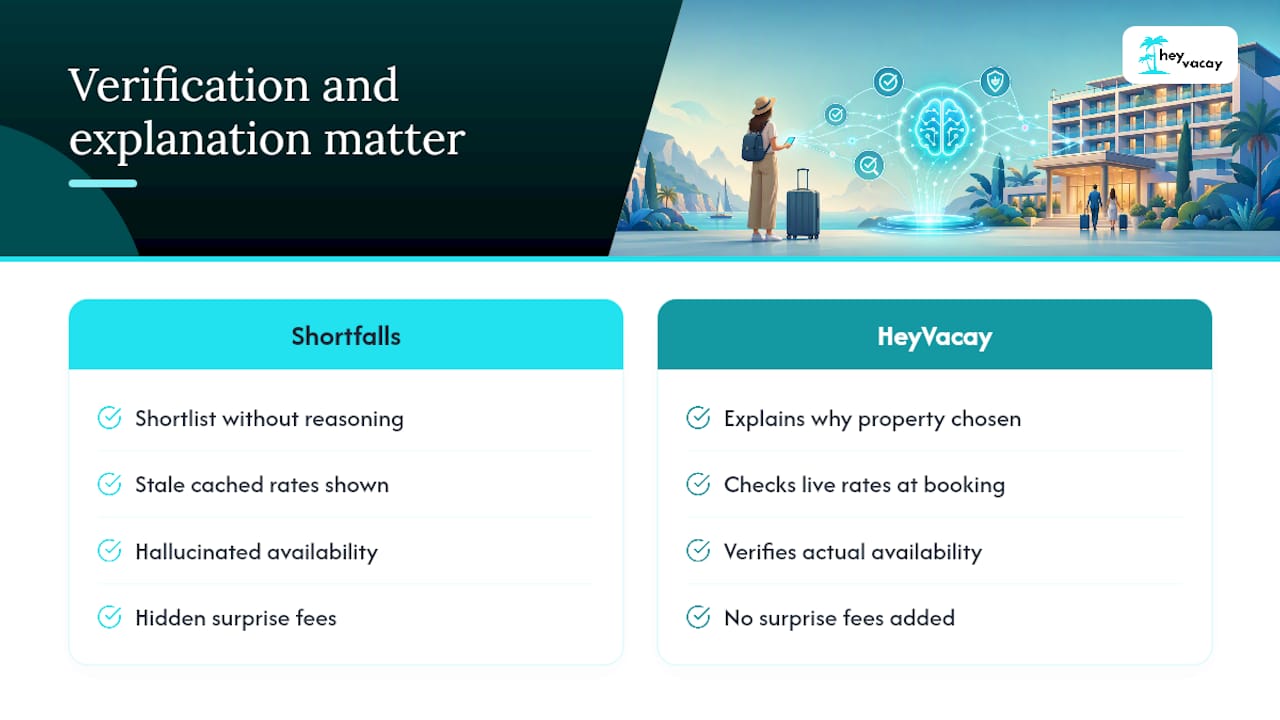
We built HeyVacay around the part of this process most tools skip: showing the same luxury inventory at a lower rate with pricing you can actually trust before you click confirm. That means checking live rates immediately before booking, not relying on a cached number from an earlier search and never tacking on fees the traveler didn't see coming.
The industry's verification gap, hallucinated availability, stale rates, unclear cancellation terms, isn't a minor annoyance. It's the reason some travelers still don't trust AI with a real transaction. Solving that isn't optional if this category wants to earn broader adoption.
— HeyVacay
Book Hotels Smarter, Cheaper, Faster With HeyVacay
HeyVacay is built for exactly the gap this article just walked through: AI that searches well but leaves you guessing on price, or worse, surprises you with fees at checkout. HeyVacay's AI curates the same luxury and budget hotel options you'd find elsewhere, then shows a transparent, all-in rate with nothing hidden behind a "resort fee" line at the end.
When you search on HeyVacay, the platform runs live pricing checks against current inventory before presenting your shortlist, so the number you see is the number you pay. Multi-destination trips, group stays, last-minute finds, the search logic adapts to all of them without forcing you to run separate queries for each. Start a search on HeyVacay's booking platform and compare your current shortlist against what it surfaces. The difference in transparency usually shows up in the first few results.
Key Takeaways
AI hotel booking works best when it combines live rate rechecking, transparent pricing, and a clear human confirmation step before payment.
| Point | Details |
|---|---|
| Search vs. booking gap | Most AI tools can find hotels instantly, but completing payment still often needs your explicit confirmation. |
| Recheck before paying | Always ask the AI to reverify live availability and pricing right before checkout, not rely on the initial search result. |
| Best use cases | Multi-destination trips, group bookings, and last-minute searches show the biggest time and cost savings. |
| Verify payment handoffs | Look for tokenized payment connectors and partner-generated receipts before trusting a booking as final. |
| HeyVacay's approach | HeyVacay pairs AI-curated hotel shortlists with transparent, no-hidden-fee pricing and live rate checks before booking. |
Sources
- Perplexity AI introduces new hotel search agent
- Hilton’s 41 AI experiments and new fee cuts for hotel owners
- AI Travel Agents & Hotel Bookings Guide
- tourmind-com/Hotel-Booking-AI (GitHub)
- AI Hotel Search — Find Hotels with Stardrift