
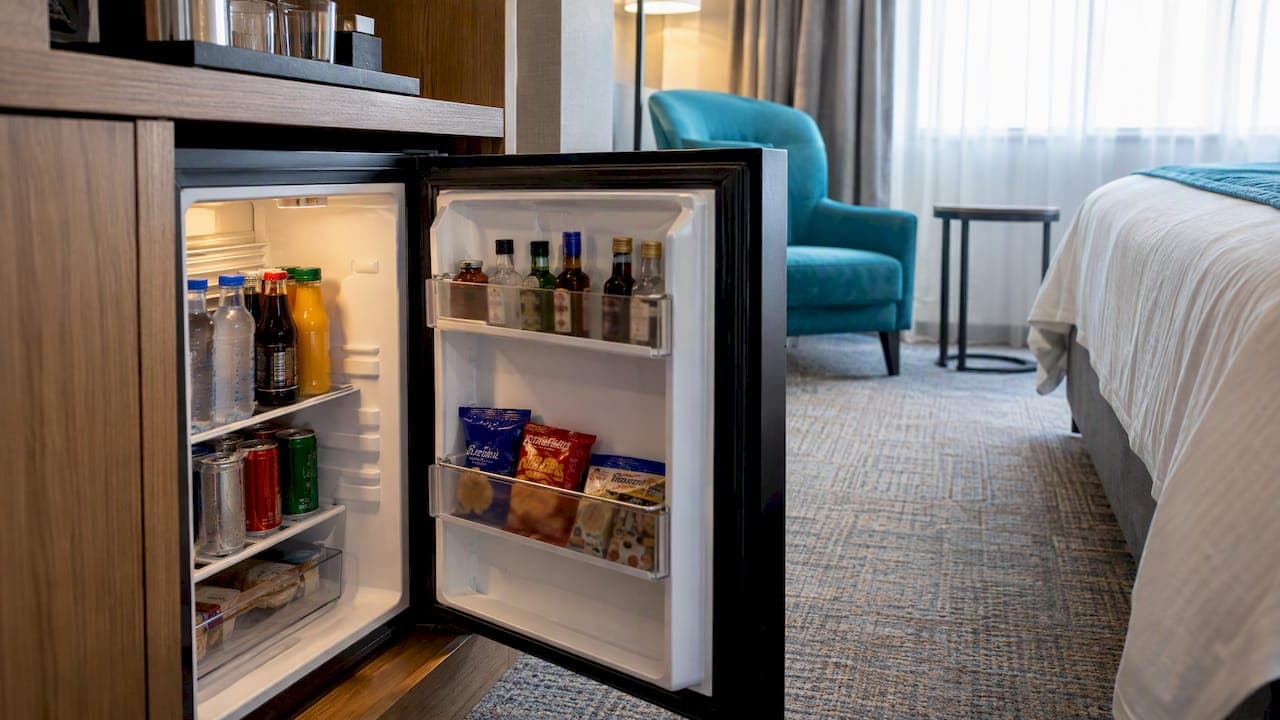
Most hotel minibars are not free, and many now charge you the moment you lift an item, whether or not you drink it. Prices run far above store prices, and some hotels add restocking or fridge fees on top. You can avoid nearly all of it with a few habits at check-in and a careful look at your bill before you leave.
This guide explains what sets off a minibar charge, what hotels typically charge, how to keep your own food and medication cold without paying extra, and what to do if a charge on your bill is wrong.
TL;DR
- Sensor-equipped minibars can bill you when you pick up an item, even if you put it back. Some Las Vegas Strip hotels charge if an item is out for more than 45 seconds.
- A can of a non-alcoholic drink commonly costs US$6 to US$10 from a minibar.
- Need the fridge for insulin or baby milk? Ask the hotel to empty it before you arrive, and confirm any fee in advance.
- Check your folio before checkout and raise any wrong charge right away. If the hotel will not fix it, go to the brand's corporate customer service or your card issuer.
Table of Contents
- What a hotel minibar is, and what is in it
- What actually triggers a minibar charge
- How much hotels charge
- How the charge reaches your bill
- How to avoid minibar charges: a checklist
- If you need the fridge for medication or baby milk
- Alternatives to using the minibar
- What to do if a minibar charge is wrong
- Why minibar charges are part of a bigger pricing picture
- Our perspective
- Find the room, then keep the total low
- FAQ
- Sources
What a hotel minibar is, and what is in it
A minibar is a small refrigerator in your room, stocked with drinks and snacks you pay for if you use them. Typical stock includes bottled water, juice, soft drinks, beer, wine, small bottles of spirits, candy, cookies, crackers and nuts. Some hotels add gourmet, healthy, organic or local products to the mix.
Not every room has one. Some hotels leave the refrigerator empty and point guests to a lobby market or vending area instead. If you are unsure, ask at booking or at check-in, because the answer changes how you should handle the fridge.
One more point matters for budgeting: minibar items are priced for convenience, not value. The hotel is covering the cost of stocking, tracking and restocking a tiny store inside your room. That is why a single bottle of water can cost several times what it does at a pharmacy two blocks away.

What actually triggers a minibar charge
Many travelers assume you only pay for what you consume. That used to be closer to the truth. Today, how you are charged depends on the type of minibar in your room.
Manual minibars
In the classic setup, housekeeping or an attendant checks the stock, or you fill in a slip. Guests are charged for goods consumed at checkout. If you open a snack and leave it, expect to see it on your bill.
Sensor and automated minibars
Newer units use infrared or other automated methods. They detect that an item has been removed and can charge your credit card right away, even if you never consume it. Travel reporting confirms how little it takes: picking up an item and putting it back can trigger the sensors, and jostling items while you add your own food can also incur a charge.
The timing rules vary by property. In Las Vegas, a 2019 report found that most minibars on the Strip charge guests when an item is removed for longer than 45 seconds, even if it goes back. The same report's headline put the cost of using one at up to $75. Caesars explained that personal use of the minibar created waste and extra labor to restock, which is the reasoning behind such fees.
Fees that have nothing to do with items
Some charges are about the fridge itself, not what is inside:
- Restocking fees. If you call ahead and ask staff to empty the minibar before you arrive, some hotels charge a restocking fee.
- Daily fridge fees. Some properties will provide an empty refrigerator on request but charge a daily rental fee.
- Extra fridge fees. If you need a second fridge, some hotels charge extra.
These fees rarely appear in the nightly rate you see when you search. They show up at the desk or on the folio, which is why asking early matters. Our guide to questions to ask at check-in to prevent incidental charges covers the wider set of fees worth clarifying on arrival.
How much hotels charge
There is no standard price list, but the pattern is consistent: minibar pricing is significantly higher than retail prices, because you are paying for convenience and the hotel's overhead. A can of a non-alcoholic beverage commonly runs US$6 to US$10.
Here is a simple way to think about the real cost of one grab:
| Scenario | What you expect | What can happen |
|---|---|---|
| You lift a soda, read the label, put it back | No charge | Charged on a sensor minibar if it stays out past the hotel's time limit |
| You drink a bottled water | A small fee | A markup of several times the store price, often in the US$6 to US$10 range for non-alcoholic drinks |
| You move items to fit your own groceries | No charge | Sensors may register removal and bill each item |
| You ask staff to empty the fridge before arrival | A courtesy | Possible restocking or fridge fee, depending on the property |
Alcohol tends to be priced higher still. Hotel Management reported that water was the best-selling minibar item in the products it discussed and vodka the leading alcoholic one, so those are the lines you will most often see on a bill.
Also watch the surrounding lines. A minibar item can arrive with a service charge or tax added on top. Our explainer on the hotel service charge and how to spot it shows where these add-ons hide.
How the charge reaches your bill
There are two routes. In the traditional route, items are tallied and added to your folio, and you see them at checkout. In the automated route, the sensor tells the hotel billing system to post the charge, sometimes straight to the card on file. Either way, the line usually appears as a short description such as "minibar" or "mini bar F&B" with a date and amount.

There is a reason hotels moved to sensors. Before they were installed, operating minibars cost more than they earned because of the workforce needed to maintain them. Knowing that explains the strictness: the hotel is trying to make an expensive service pay for itself, and your accidental pick-up is a cost it wants to recover.
How to avoid minibar charges: a checklist
The steps below take about two minutes in total and cover most situations.
- Read the in-room card or sign first. Signage can be vague, so look for words like "sensor," "restocking" or "removal." If it is unclear, call the front desk before touching anything.
- Treat every item as sold the second you lift it. On a sensor unit, do not pick things up to read labels or compare. Look from the shelf.
- Do not store your own food among the hotel's items. Moving bottles around to make space is a common way to trigger a charge.
- Ask about the fridge at check-in. Find out if it is a sensor minibar, whether there is a time limit and whether the hotel can give you an empty fridge.
- Take a photo of the minibar when you arrive. A quick shot of the contents and the shelf gives you a record if the bill later shows something you never touched.
- Buy your drinks elsewhere. A nearby store, or the hotel's lobby market if it has one, will cost much less.
- Review the folio the night before checkout. Most hotels offer an itemized bill on request or by app, so you can catch errors while you are still on site.
If you need the fridge for medication or baby milk
This is the case where a minibar problem is not just about money. If you need to keep insulin or baby milk cold, do not squeeze them in beside sensor-tracked bottles and hope for the best. The practical route is to ask for the minibar to be emptied before arrival, and to ask whether another fridge is available and what it costs.
Some hotels will provide an empty refrigerator at no charge, others bill a daily fee, so get the answer in writing, by email or in the booking notes, before you travel. If the hotel quotes a fee for medical storage, say what the fridge is for when you ask. For questions about how to store a specific medication, your pharmacist or the prescribing doctor is the right person to ask, not the hotel.
Alternatives to using the minibar
The minibar is not the only way to get a late-night drink or breakfast in the room. The hotel industry has been moving toward lobby markets and on-demand delivery, which some operators see as friendlier to guests than a high-markup in-room fridge. If you want to see how food delivery fits into hospitality, it is worth a look, since delivery and takeaway can replace most minibar habits.
Some easy swaps:
- Buy water and snacks on arrival from a nearby grocery store or pharmacy.
- Use the lobby market, if the hotel has one.
- Order delivery for late meals instead of using in-room snacks.
- Choose a rate that includes breakfast if you usually buy food in the morning. Our comparison of breakfast rate vs room only shows when each makes sense.
If you want to think about which hotel perks actually pay for themselves, our list of hotel amenities worth paying for walks through the trade-offs.
What to do if a minibar charge is wrong
Check the bill before you leave, because it is much easier to fix an error at the desk than from home. Review your bill carefully and raise anything questionable right away; waiting means phone calls and follow-ups with the property later, and some travelers ended up needing a card dispute.
A workable order of steps:
- Ask the front desk to remove the charge. Be specific: the date, the item, the amount and why it is wrong, such as "I never opened the minibar" or "the item was already missing when I arrived."
- Show your evidence. Your arrival photo, the in-room sign and any emails about fridge arrangements all help.
- Escalate to the brand. If the property does not resolve a valid billing error, you can go to the hotel brand's corporate customer service.
- Dispute with your card issuer. As a last step, you can file a formal chargeback. Keep copies of every message and your itemized folio.
Keep your tone calm and factual. Front-desk staff can usually reverse a sensor error in seconds when you have a clear case.
Why minibar charges are part of a bigger pricing picture
A minibar fee is one of several small costs that sit outside the room rate. Resort fees, service charges and no-show penalties work the same way: invisible when you compare prices, obvious on the bill. If you want to understand how the headline price is built in the first place, read our pieces on dynamic pricing in hotels and what a rack rate really means. If you may arrive late or change plans, the hotel no-show policy is worth knowing too.
Our perspective
We think the cheapest hotel stay is the one where nothing on the final bill surprises you. A minibar charge is a small example of a big problem: the price you compare is not always the price you pay.
That is why we built HeyVacay around clear pricing with no hidden fees. Our approach is to use AI to search hotel options and present the same kind of hotels at lower rates, so the money you save on the room is not handed back at the minibar. We also believe in flexible cancellation and real human support, because when a charge looks wrong, you should be able to talk to a person.
Our advice is simple: pick the room first, then protect the total. Ask about the fridge, skip the sensor-tracked snacks, and check the folio before checkout.
HeyVacay
Find the room, then keep the total low
Minibar fees are easy to dodge once you know the rules. The bigger savings usually come from the room rate itself. HeyVacay searches hotels across destinations and is designed to show you lower rates for the same kind of stays, with transparent pricing and no hidden fees.
Ready to compare? Search hotels on HeyVacay and see what your next stay could cost.
FAQ
Are hotel minibars free?
Usually not. Most hotels charge when you move or remove an item, often at inflated prices. Some all-inclusive resorts stock the minibar as part of the rate, so check what your booking includes before you assume either way.
Can I be charged if I only pick something up and put it back?
Yes, on some sensor minibars. Picking up an item and returning it can trigger the sensors, and some Las Vegas Strip hotels bill after about 45 seconds. Ask the front desk about the policy at check-in, and avoid handling items you do not plan to buy.
Can I ask the hotel to empty the minibar?
Yes, and it is the best option if you need the fridge for insulin or baby milk. Ask before arrival. Some hotels do it free, while others charge a restocking or daily fridge fee, so confirm the cost first.
What if I find a minibar charge I did not make?
Raise it with the front desk right away, with your photo or messages as evidence. If the hotel does not resolve it, contact the brand's corporate customer service, then your credit card issuer about a chargeback.
Sources
- Hotel minibars: The products to offer customers
- Minibar menu an exact science, Hotel Management
- What will you find in your hotel minibar? Hotel Management
- Minibar, Wikipedia
- Hidden Hotel Fees to Watch Out For, SmarterTravel
- Using a Las Vegas Strip hotel minibar can cost up to $75, Las Vegas Review-Journal
- Check your hotel bill for incorrect charges, The Points Guy
- Ask a Travel Nerd: How Do I Dispute Hotel Minibar Charges?
- Overly punishing fee travellers need to watch out for
- Mini bars in your hotel room, Timeshare Users Group
- The death of the hotel minibar, The Washington Post
- The Role of Food Delivery in Hospitality: 2026 Guide