

The best way to "get cashback" on a hotel room in 2026 isn't a rebate at all. It's an AI-powered platform that finds the discounted upfront rate before you pay, so there's no money to claw back later. HeyVacay does exactly that: transparent pricing, no hidden fees, and student discounts up to 40% off stacked on top of already-lower rates.
TL;DR:
- AI-driven platforms find and display the lowest upfront hotel rates in real-time by scanning multiple sources and matching identical rooms and cancellation policies.
- Upfront discounts eliminate the uncertainty and delays associated with cashback rebates by showing the final price, including taxes and fees, before payment.
- Using flexible dates, specific queries, and verifying total costs can significantly improve the chances of securing the lowest available rate.
- Transparency checks should include confirming that the final price matches the search rate and that all additional fees, taxes, and cancellation details are clear upfront.
- Combining student, corporate, or seasonal discounts with the AI-found rate can further reduce total costs, provided they are properly stacked and verified.
Table of Contents
- How Do AI-Driven Discounted Hotel Bookings Actually Work?
- Why Upfront AI Discounts Beat Traditional Hotel Cashback Programs
- How Do You Book a Hotel at the Lowest Upfront Price?
- What Should You Check for Pricing Transparency Before You Pay?
- What Special Discounts Can You Combine With AI-Sourced Rates?
- Is It Safe to Book Hotels Through an AI Platform?
- Do Cashback Hotel Offers Have Blackout Dates or Chain Exclusions?
- Does Your Payment Method Affect Hotel Discount Eligibility?
- How Does This Compare to Coupon Codes and Discount Sites?
- How Do You Stack Discounts for Maximum Savings?
- Why We Built HeyVacay Around Transparent Pricing
- Ready to Find a Lower Upfront Hotel Price?
- Sources
How Do AI-Driven Discounted Hotel Bookings Actually Work?
Forget the old cashback model where you pay full price and wait weeks for a rebate to land in your account. AI-driven booking platforms flip the order of operations: they find the discount before you check out, not after.
Here's the mechanism. AI systems scan hotel inventory across dozens of channels simultaneously, matching identical rooms, rate types, and cancellation policies against each other. When real-time price matching tools spot a lower rate for the same room somewhere else, they can update the displayed price automatically or flag the better option instantly, instead of you refreshing five tabs at midnight.
This matters more than it sounds like it should. Hotel pricing has always moved based on occupancy, demand signals, and how close you are to the check-in date. What's changed is the speed at which AI can react to those shifts. According to Revfine's analysis of AI in hotel distribution, AI compresses reaction times in revenue management to the point where price mistakes and rate-parity gaps become visible almost immediately, which pushes hotels toward more consistent, value-based pricing rather than opaque rate games.
HeyVacay builds its search around this same logic, surfacing dynamic pricing insights so travelers see the discounted upfront number without digging through fine print. A few things happen behind the scenes when you search:
- The platform pulls live rates across multiple sources for the exact room type and dates you want.
- It cross-checks cancellation terms so a "cheaper" rate isn't secretly less flexible.
- It filters out rates that look lower but exclude taxes or fees shown later.
Statistic to know: Agentic AI systems can now search, evaluate, and book hotels within a single conversation, a shift that's actively rewriting how the entire discovery-to-booking funnel works in 2026.
Why Upfront AI Discounts Beat Traditional Hotel Cashback Programs
Cashback programs ask you to trust a process you can't see. You pay the full rate, submit a claim or wait for automatic tracking, then hope the rebate posts before you forget you're owed money. AI-sourced upfront discounts skip that entire waiting game.
The practical differences show up in three places:
- Timing. You see the lower price before you pay, not weeks after your trip when the credit finally clears.
- Certainty. Cashback offers often carry eligibility exclusions, minimum spend thresholds, or blackout windows that only surface after you've already booked. An upfront discount has no such asterisk.
- Disputes. When platforms display explicit final-price components instead of a teaser rate plus fine print, travelers file fewer complaints and trust the direct booking channel more.
There's also a psychological cost to rebate hunting that rarely gets mentioned. Tracking which card you used, whether the merchant category coded correctly, and whether the claim window has closed takes real mental effort. An AI travel app that shows the discounted total at checkout removes that entire administrative layer. You know what you're paying the moment you see the price, which is the whole point.
How Do You Book a Hotel at the Lowest Upfront Price?
Getting the best AI-sourced rate isn't about luck. It's about giving the search engine enough to work with and verifying what it hands back. Follow this sequence:
- Search with flexible dates first. Run a scan across a 3 to 5 day window instead of one fixed date. Rates can swing meaningfully night to night even at the same property.
- Use specific, natural-language queries. "Beachfront hotel with free cancellation under $150" gets better matches than a bare city name.
- Verify room equivalence before comparing prices. A "discounted" rate on a smaller room or a non-refundable rate isn't actually cheaper if it doesn't match what you need.
- Check the all-in total, not the nightly teaser rate. Taxes and fees should already be reflected, not added as a surprise at checkout.
- Set a price-watch alert if your dates are flexible. Dynamic pricing means today's rate isn't necessarily tomorrow's, and tracking price movement can save you real money on a delayed booking.
- Lock the rate when cancellation terms are generous. If you can cancel free of charge, there's little downside to booking early and rebooking later if the price drops further.
- Pick a low-fee payment method. Currency conversion fees and card surcharges can quietly erase a discount you worked to find.
Timing carries real weight here too. Booking a weekend stay close to but not directly on the date you first see a discount often gives dynamic pricing room to shift in your favor, especially for city hotels with midweek business demand that drops off by Thursday.
Pro Tip: If a rate looks unusually low, check the cancellation policy before anything else. A steep discount tied to a non-refundable, non-changeable rate is a different product than a flexible booking, even if the room looks identical.
What Should You Check for Pricing Transparency Before You Pay?
A discounted upfront rate only counts as a discount if nothing gets added later. Before you enter payment details, run through this checklist against the confirmation screen:
- Base nightly rate. Confirm it matches what you saw in the search results, not a higher number that appeared after you clicked in.
- Taxes and government fees. These should be itemized, not folded into a vague "additional charges" line.
- Resort or city fees. Common in leisure destinations and frequently omitted from the headline price on less transparent sites.
- Service and booking fees. Ask whether the platform charges its own fee on top of the hotel's rate.
- Cleaning fees and optional add-ons. Parking, breakfast, and early check-in should be listed separately, not bundled invisibly into the total.
- Cancellation and change penalties. A cheap rate with a harsh change fee can end up costing more than a slightly higher, fully flexible one.
Cancellation terms deserve particular attention because they change the effective price of a room, not just the headline number. A rate that's $20 cheaper but non-refundable is a worse deal than a flexible rate if your travel plans have any chance of shifting. The simplest test of a platform's honesty: does the price on the search results page match the price on the final confirmation, dollar for dollar? If it does, you're looking at genuine transparency instead of a bait rate.
What Special Discounts Can You Combine With AI-Sourced Rates?
Beyond the base discount an AI search surfaces, a few targeted programs can push the price down further.
- Student discounts. HeyVacay offers savings up to 40% for verified students, which stacks on top of the platform's already discounted upfront rates rather than replacing them.
- Corporate rates without a company account. Some AI platforms extend negotiated-style corporate pricing to independent travelers and freelancers who'd otherwise need an employer contract to access those rates.
- Seasonal or loyalty-free promotions. These don't require signing up for a points program or hitting a spending threshold to qualify.
The stacking rules matter here. Student and corporate-style discounts generally apply on top of the AI-found base rate, since they're eligibility-based rather than a competing rate type. What they typically can't combine with is another promotional code targeting the exact same rate category. Always check the final total before assuming two discounts added together.
Is It Safe to Book Hotels Through an AI Platform?
AI is genuinely good at narrowing down and pricing options. Where travelers still want a human in the loop is the actual payment step. [Amadeus found that 74% of U.S. travelers](https://www.morningstar.com/news/business-wire/20260803712850/new-amadeus-study-while-3-in-4-us-travelers-use-ai-for-travel-planning-trust-must-grow-when-it-comes-to-bookings) have used AI for trip planning, but trust drops when it comes to letting AI complete a booking without oversight. That's a reasonable instinct, and it's worth confirming before you commit to any platform.
- Confirm live chat or phone support exists, not just an automated bot loop.
- Look for a written, dated cancellation and refund policy, not a vague "contact us" promise.
- Check that room descriptions specify bed type, view, and square footage, not generic marketing copy.
- Walk away from any listing missing a clear fee breakdown before checkout.
Pro Tip: Before trusting any AI hotel booking tool, test its support response time with a simple pre-booking question. A slow or absent reply now predicts a worse experience if you need help after you've paid.
Do Cashback Hotel Offers Have Blackout Dates or Chain Exclusions?
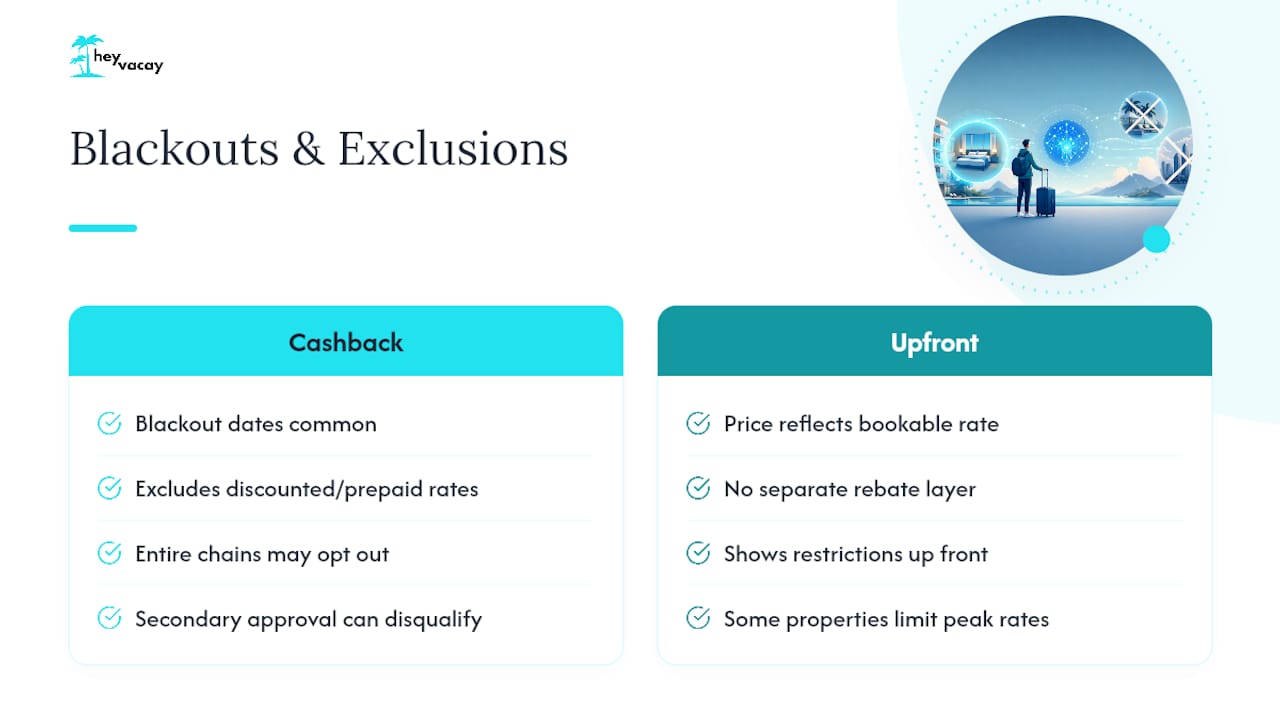
Traditional post-booking rebate programs are notorious for fine print that only surfaces after you've already paid. Blackout dates around major holidays, exclusions on already-discounted or prepaid rates, and entire hotel chains opted out of a given cashback network are standard features of that model, not the exception.
The upfront-discount approach sidesteps most of this because there's no separate rebate layer sitting on top of the booking. The price you see already reflects what's available for that property, on that date, for that room type. There's no secondary approval process that can later disqualify your stay for a reason buried in a terms-and-conditions page.
That doesn't mean every rate is guaranteed to be the absolute floor. Some properties restrict their lowest rates during peak periods, protect inventory during citywide events, or exclude certain room categories from discount eligibility. The difference is transparency: an AI platform showing you the actual bookable rate for your dates tells you the real number immediately, rather than dangling a rebate percentage that might evaporate once you try to claim it. If a rate looks restricted, a transparent platform will show that clearly rather than let you discover it after the fact.
Does Your Payment Method Affect Hotel Discount Eligibility?
Traditional cashback structures often depend heavily on which credit card or digital wallet you use, since card networks and portal partnerships determine whether a purchase even qualifies for a rebate. Miss the right card, and the "discount" you thought you earned simply doesn't register.
Upfront AI-sourced pricing doesn't carry that dependency in the same way. The discount is baked into the rate itself, not contingent on a specific card network's cashback partnership. That said, payment method still affects your final cost through a different channel: fees.
Foreign transaction fees, currency conversion markups, and card-specific surcharges can all eat into savings you've already secured through a lower rate. A card with no foreign transaction fee, or a digital wallet that settles in your home currency without a conversion markup, preserves more of the discount than a card that quietly adds 3% at settlement. Before booking internationally, check your card's foreign transaction fee schedule, not just its rewards structure. The right rate paired with the wrong payment method can still cost you more than expected.
How Does This Compare to Coupon Codes and Discount Sites?
Third-party coupon codes and discount aggregator sites work on a hit-or-miss model. You copy a code, hope it applies to your dates and room type, and often find out at checkout that it's expired, restricted to specific properties, or simply doesn't stack with the rate you found.
AI-sourced discounts work differently because the discount is embedded in the search result itself rather than bolted on afterward. There's no code to hunt for, no expiration date to track, and no guessing whether a promo applies to your specific booking. The rate displayed is the rate available, filtered by real-time inventory and pricing rather than a static coupon that hasn't been updated in weeks.
Coupon sites also tend to lag behind actual hotel pricing. A code advertising 15% off means little if the base rate it applies to is already higher than what a dynamic-pricing search would surface without any code at all. The comparison that matters isn't "discount percentage on paper" versus "discount percentage on paper." It's the actual dollar total at checkout, and that's where live AI comparison consistently has an edge over a coupon that was accurate the day someone posted it.
How Do You Stack Discounts for Maximum Savings?
Getting the lowest possible total usually means layering a few things rather than relying on one big discount.
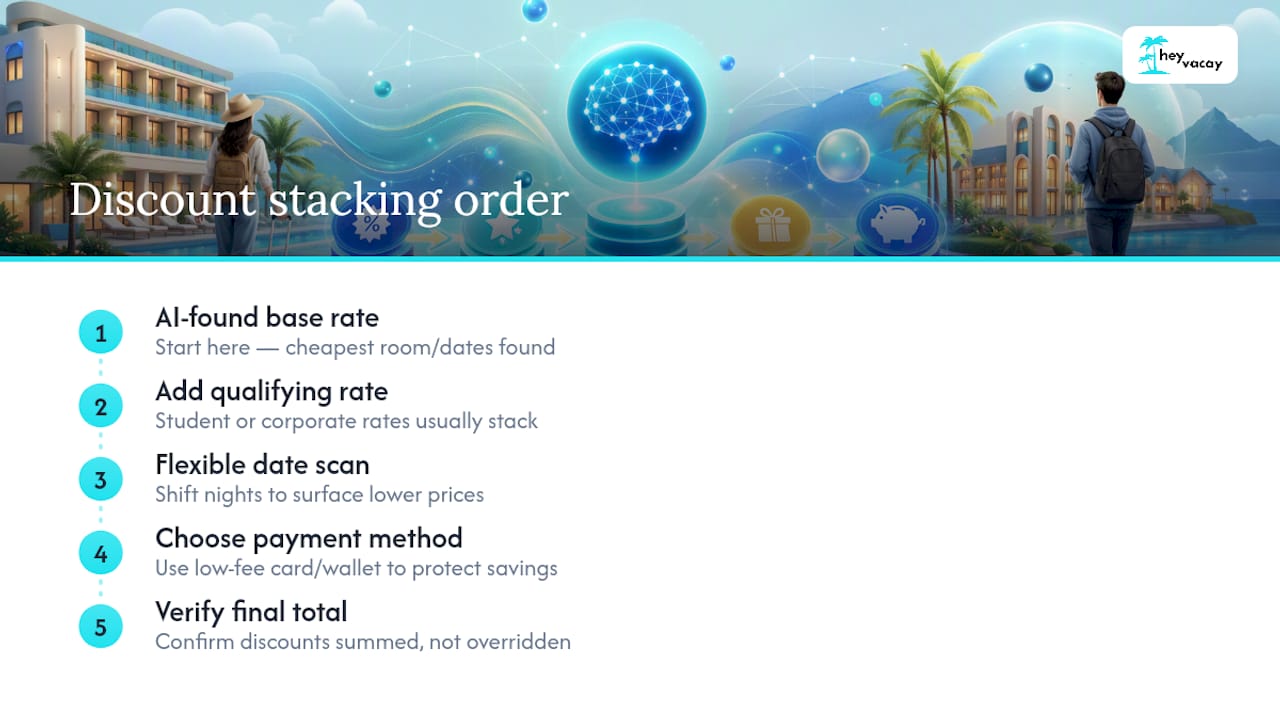
Start with the AI-found base rate, since that's already accounting for the cheapest available option across the room type and dates you searched. From there, check whether you qualify for a student or corporate-style rate, since those typically apply on top of the base price rather than replacing it. Flexible date scanning adds another layer: shifting a stay by even one night can surface a meaningfully different price on the same room.
Payment method is the final lever. Choosing a low-fee card or digital wallet protects the savings you've already stacked instead of losing a percentage of it to conversion charges. What doesn't typically stack: two promotional codes aimed at the same rate category, or a discount rate combined with a separate loyalty-program rate on the identical booking. Check the final total before assuming multiple discounts have layered correctly. If the number matches what you'd expect after adding each discount individually, the stack worked. If it doesn't, one of the offers likely overrode the other rather than combining with it.
Why We Built HeyVacay Around Transparent Pricing
We started HeyVacay because hotel pricing had become a trust problem, not just a cost problem. Travelers deserve to see the real, discounted rate upfront, without hunting for a rebate afterward.
— HeyVacay
Ready to Find a Lower Upfront Hotel Price?
You've seen how AI-sourced discounts work, what to check for hidden fees, and which special rates to stack. The next move is putting that into practice instead of falling back on a rebate you'll have to chase down later.
Start a search on HeyVacay with your dates and destination, and the platform runs its price comparison across sources immediately, surfacing the discounted upfront rate with taxes and fees already included rather than added as a surprise at checkout. If you're a student, apply your verification during checkout to unlock the additional discount on top of the base rate. Enable a price alert if your dates are flexible, and you'll see if the rate drops further before you commit. Every total shown is the total you pay, which is the entire point of skipping cashback in the first place.
Sources
- How AI-Powered Real-Time Price Matching Is Transforming Hotel and Airfare Bookings
- How AI Is Reshaping Hotel Pricing And Distribution Strategy | Revfine
- How Agentic AI Is Rewriting the Hotel Booking Experience in 2026 | VE3 Blog