
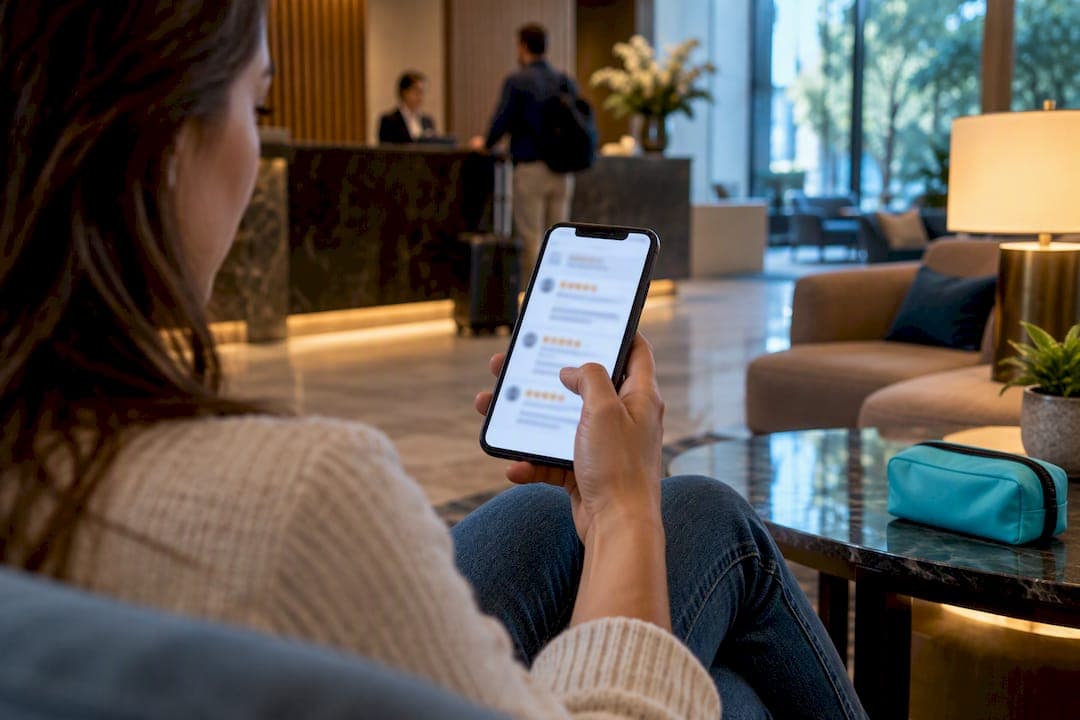
Yes, fake hotel reviews exist at scale, but you can avoid most of the damage by checking a few specific signals instead of trusting a star rating alone. TripAdvisor's own removal numbers show the scope of the problem, and a new FTC rule now makes buying or selling fake reviews a legal risk for the people writing them. Your best move: check the rating distribution, read the mid-range reviews, and cross-reference before you book.
TL;DR:
- Fake hotel reviews often come from new accounts, feature generic praise, and include stock photos or no verified booking markers.
- Review platforms use automated filters, behavioral signals, and manual checks, but fraudsters adapt using VPNs, review farms, and AI-generated text.
- Comparing ratings across multiple sites, reading mid-range reviews, and checking reviewer history can help identify manipulated feedback before booking.
- In 2024, TripAdvisor removed 2.7 million fraudulent reviews, with legislative action now making the sale or purchase of fake reviews a legal offense.
- Transparent booking platforms that show clear prices and details reduce reliance on review legitimacy, helping travelers make better-informed decisions.
Table of Contents
- Top red flags to spot fake hotel reviews
- How platforms detect fake reviews and why some still get through
- Cross-checks travelers can run before booking
- Platform stats and the new FTC rule on fake reviews
- Examples and phrases that often signal a fake review
- Action checklist: what to do before you book
- Who benefits from fake hotel reviews and why they exist
- How fake reviews affect travelers and hotel businesses
- What happens legally to people caught posting fake reviews
- HeyVacay's perspective on review reliability and transparent booking
- How HeyVacay can help you book with more confidence
- Sources
- FAQ
Top red flags to spot fake hotel reviews
Fake reviews tend to share a handful of tells you can catch in under a minute. The language is often the first giveaway: generic praise like "amazing stay, highly recommend" with no specific room number, staff name, or detail about the neighborhood reads like marketing copy because it often is.
Watch for these patterns together, since any single one alone can be innocent:
- Reviewer profile: a brand-new account with only one review, or a username and location that do not match the property's typical guest base.
- Timing clusters: a burst of five-star reviews posted within days of each other, often after a slow stretch.
- Photos: bright, staged, brochure-style images with no candid or imperfect traveler shots.
- Missing verification: no "verified stay" or "confirmed booking" marker on a platform that normally offers one.
- Absolute language: words like "perfect," "flawless," or "best hotel ever" repeated across multiple reviews for the same property.
None of these alone proves fakery. A guest can legitimately love a hotel and gush about it. The pattern matters more than any one review.
Pro Tip: If a hotel's five-star reviews all sound like they were written by the same person, they probably were.
How platforms detect fake reviews and why some still get through
Review platforms lean on a mix of automated filters, behavioral signals, and human moderators. Submission timing, IP addresses, device fingerprints, and account history all feed into models that flag suspicious activity before a review ever goes public, alongside manual checks for edge cases.
Fraudsters adapt just as fast. Common evasion tactics include:
- VPNs and rotating IPs to disguise where a review is actually coming from.
- Review farms where paid workers post reviews for multiple properties on a schedule.
- Recycled or AI-generated text rewritten slightly to dodge duplicate-content filters.
- Insider reviews from employees or owners posing as guests.
There is a nuance worth understanding here: when a platform reports catching more fakes, that often reflects better detection, not necessarily a worse problem. TripAdvisor has attributed part of its 2024 numbers to stronger AI-based screening rather than a sudden spike in fraud attempts. "Verified stay" badges also have limits: they confirm a booking happened, not that the review itself is honest.
Cross-checks travelers can run before booking
A few minutes of comparison work catches most manipulation attempts. Run through these steps in order:
- Compare ratings across two or three platforms. A hotel rated 4.7 on one site and 3.2 on another is a red flag worth investigating.
- Read three mid-range reviews (2 to 4 stars). These tend to carry the most specific, least manipulated detail.
- Check reviewer histories. A profile with one review, posted the same week as a dozen similar ones, is suspicious.
- Search a distinctive phrase from the review in quotes. If it appears word for word on other listings, it is likely copied or templated.
- Look for outside mentions. A quick check of social media or independent travel blogs can confirm or contradict what the reviews claim.
Pro Tip: Skip the 1-star and 5-star extremes first and start with the middle. That's usually where the honest detail lives.
Rating distributions that differ sharply between sites often point to a campaign targeting just one platform, since most manipulation efforts focus their effort where it is cheapest to buy visibility.
Platform stats and the new FTC rule on fake reviews
TripAdvisor removed roughly 2.7 million fraudulent review submissions in 2024, about 8% of everything submitted that year. "Review boosting," where an account or operator pushes artificially positive reviews for a property, accounted for 54% of the detected fraud, with fake member accounts and paid reviews making up smaller shares. That figure describes what one platform caught, not the total volume of fake reviews across the internet, and stronger detection tools can make the numbers look larger even when underlying fraud attempts hold steady.

Regulation has caught up with the problem. The FTC's final rule took effect on October 21, 2024, prohibiting the sale or purchase of fake consumer reviews and allowing civil penalties against anyone who knowingly violates it. The Federal Register notes the rule also covers repurposing someone else's review as if it were new and certain forms of review suppression. Platform moderation and government enforcement work as two separate layers: one catches fakes after they are posted, the other makes creating them in the first place a legal liability.
Examples and phrases that often signal a fake review
A templated fake often reads something like this:
Compare that to an authentic review with real detail: "Room 412 had a slow AC unit but the front desk swapped us to 418 within twenty minutes. Breakfast buffet ran out of hot food by 9:15am on a Saturday." The second version names specifics a bot or paid writer would not bother inventing.
Other tells to watch for:
- Phrases like "exceeded my expectations" or "hidden gem" repeated across unrelated hotels.
- Reviewer avatars that look like stock photos or default icons.
- Identical paragraphs appearing under different names on different listings, a sign of copy reuse across a review farm's client list.
Action checklist: what to do before you book
Run through this sequence before you commit to a reservation:
- Check the rating distribution, not just the average, across two or three platforms.
- Read a handful of mid-range reviews for specific, checkable detail.
- Scan reviewer histories for single-review accounts or suspicious timing clusters.
- Confirm "verified stay" or booking-confirmation markers where the platform offers them.
- Search for independent coverage, a travel blog post, a social media mention, or a forum thread about the property.
- Walk away or call the hotel directly if three or more red flags stack up on the same listing.
Pro Tip: When in doubt, book through a channel that shows you the full price breakdown upfront. It removes some of the guesswork that fake reviews are designed to exploit.
For a deeper look at related scams, see how hotel booking scams and reservation hijacks actually work, since fake reviews are often just one piece of a larger deception.
Who benefits from fake hotel reviews and why they exist
Fake reviews are rarely random. Independent hotels and small property owners have the strongest incentive to manipulate their standing because a handful of fabricated five-star reviews can meaningfully shift their visibility on a booking platform, while large chains have less to gain relative to the risk. Research from the NBER working paper on promotional reviewing found that hotels with smaller, independent ownership show different review distributions across platforms, a pattern consistent with targeted promotional reviewing rather than organic guest feedback.
Competitors also have a motive to work in reverse: posting fake negative reviews about a rival property to drag down its ranking. Third-party marketing agencies and review brokers profit by selling packages of fake reviews to any property willing to pay, which is exactly the transaction the FTC rule now targets directly. The common thread is visibility. On platforms where ranking determines bookings, a small nudge in review volume or sentiment can translate into real revenue, and that incentive does not disappear just because detection improves.

How fake reviews affect travelers and hotel businesses
For travelers, the cost is a bad booking: a room that does not match its photos, a location farther from the attractions than advertised, or amenities that turned out to be aspirational. Beyond the individual disappointment, fake reviews erode the basic usefulness of the review system itself, making travelers second-guess even honest feedback.
For hotels, the damage cuts both ways. A property that plays it straight can lose bookings to a competitor padding its numbers with fabricated praise, and a hotel targeted by fake negative reviews can see its ranking and revenue drop through no fault of its own. Honest small businesses end up competing against manipulated numbers they had no part in creating, and rebuilding a damaged reputation after a fake-review attack takes far longer than the attack itself.
What happens legally to people caught posting fake reviews
The FTC's rule gives regulators real teeth. Anyone who knowingly writes, buys, or sells a fake review, or who repurposes someone else's review to pass it off as new, can face civil penalties under the final rule that took effect on October 21, 2024. The Federal Register's Statement of Basis and Purpose spells out that this covers not just individuals posting fakes but also the businesses and brokers who commission them.
That marks a shift from a purely platform-side problem, where the worst outcome was a removed review or a suspended account, to one with direct legal exposure. A hotel that pays a marketing firm for fake reviews can now be held liable alongside the firm doing the posting, and platforms are expected to cooperate with enforcement rather than treat fraud purely as an internal moderation issue.
HeyVacay's perspective on review reliability and transparent booking
Review manipulation thrives in the gap between what a listing promises and what a traveler can actually verify before paying. The most reliable fix is not a smarter detection algorithm. It is giving travelers more of the underlying information upfront, so a handful of fake reviews cannot single-handedly swing a booking decision.
That's the thinking behind pairing AI-assisted hotel search with transparent pricing: the fewer blind spots a traveler has to fill in with review speculation, the less power a fake review has over their decision. If you spot a review that looks manufactured, report it to the platform directly. Detection systems improve when travelers flag what the algorithms miss, and no single review, real or fake, should be the deciding factor in a big purchase like a hotel stay.
— HeyVacay
How HeyVacay can help you book with more confidence
Fake reviews carry less weight when the price and details in front of you are already clear. The platform uses AI to search luxury and budget hotels alike and surface rates without hidden fees, so you are comparing real prices instead of guessing whether a glowing review was worth what it cost the property to buy.
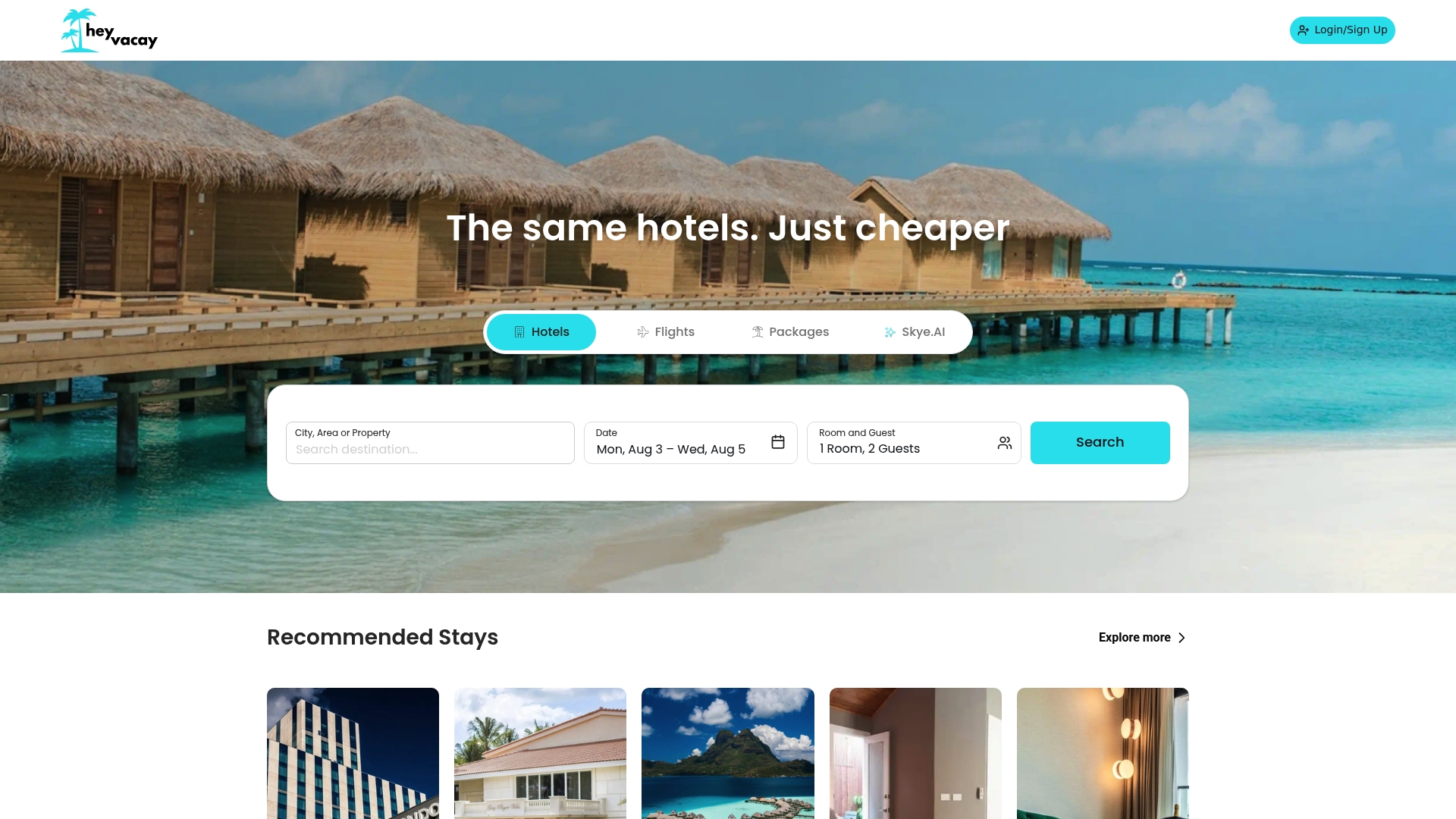
That transparency does not replace your own checks, but it removes one layer of uncertainty: you know what you are paying and what you are getting before a single review enters the decision. Search hotels on HeyVacay and see the same properties at clearer prices, or visit the help and support page if you have questions about how a listing or booking works.
Sources
This article draws on the FTC's Consumer Reviews and Testimonials Rule, the Federal Register's published rule text, and PhocusWire's reporting on TripAdvisor's 2024 fraud data. For a broader look at publisher trust in travel content, see this affiliate link audit research.
- Tripadvisor found 2.7M fraudulent reviews in 2024, report says
- The Consumer Reviews and Testimonials Rule: Questions and Answers | Federal Trade Commission
- Trade Regulation Rule on the Use of Consumer Reviews and Testimonials (Federal Register)
FAQ
How can you tell if hotel reviews are fake?
Look for generic praise with no specific detail, brand-new reviewer accounts, a burst of five-star reviews posted close together, and stock-style photos with no candid shots. Cross-checking the same hotel's ratings across two or three platforms and reading mid-range reviews for specifics catches most fakes.
What is the 2-4 star rule for hotel reviews?
There is no official "15-5 rule" recognized by hospitality regulators or major platforms; travel writers commonly recommend focusing on 2 to 4 star reviews instead, since they tend to include more specific, less manipulated detail than the 1-star or 5-star extremes.
Can you give examples of fake hotel reviews?
A typical fake reads like generic marketing copy: "Amazing hotel, amazing staff, best stay ever!!!" with no room number, date, or specific complaint. An authentic review usually names something concrete, like a slow air conditioner or a specific breakfast issue, that a paid or bot-written review rarely bothers to invent.
Is it illegal to post fake hotel reviews?
Yes, under the FTC's final rule effective October 21, 2024, knowingly writing, buying, or selling fake reviews can carry civil penalties in the United States. The rule also covers businesses and brokers that commission fake reviews, not just the individuals who post them.