
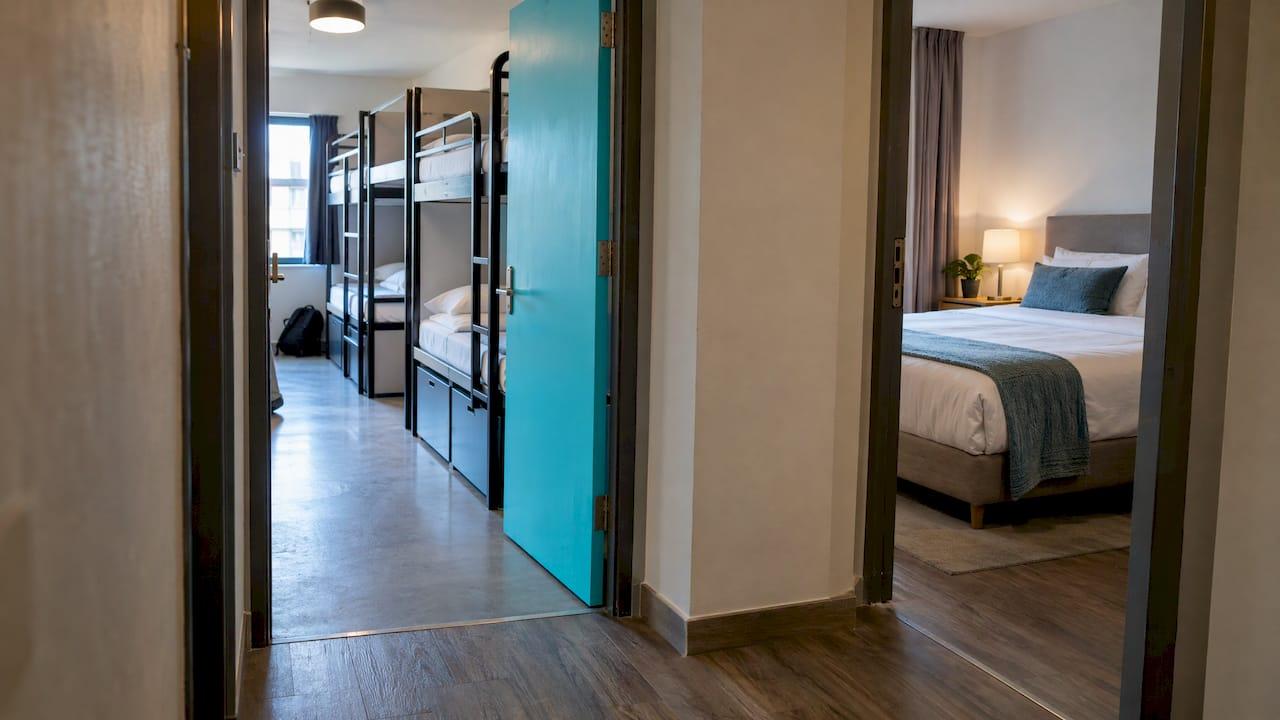
A hostel sells you a bed in a shared room. A hotel sells you a private room with its own door and bathroom. That one difference drives almost everything else: the price, the privacy, the noise, the social scene and how safe your things feel. For couples, families, business travelers and anyone who wants to sleep well and arrive rested, a hotel is the better default, and a good hotel rate is often closer to a hostel price than you would expect once you split it per person.
Below you will find the real differences, a way to compare the true cost for your group size, and a short guide to who should book what.
TL;DR
- Hostels charge per bed in a shared dorm. Hotels charge per room, with a private bathroom and a lock that is only yours.
- A hostel dorm bed is cheaper on paper, but for two or more people the gap often shrinks or disappears once you compare one room against several beds.
- Hotels suit couples, families, light sleepers, business trips and short stays. Hostels suit solo travelers who want to meet people on long, low-budget trips.
- Compare the final price including taxes and extras for your dates, not the headline nightly figure.
- Finding a discounted hotel rate is the simplest way to get privacy and comfort without paying full price.
Table of Contents
- What actually separates a hostel from a hotel
- Price: why hostels look cheaper and when they are not
- Compare the final price, not the first price
- Privacy, sleep and comfort
- Safety and your belongings
- Atmosphere: social versus restful
- Who should book what
- How to get hotel comfort for less
- Book the hotel for less with HeyVacay
- Our view: privacy is worth protecting
- FAQ
- Sources
What actually separates a hostel from a hotel
The words sound similar, but the products are different. Official definitions make this clear. Tourism Northern Ireland, the region's tourism authority, defines a hotel as an establishment with at least 15 double bedrooms, all ensuite, able to serve meals and clean your room daily. It describes a hostel as budget accommodation in shared rooms or dormitories, with a common kitchen and lounge. Rules vary by country, but the pattern holds worldwide.
In practice, this is what you get:
| Hostel | Hotel | |
|---|---|---|
| What you pay for | A bed | A room |
| Sleeping space | Shared dorm, or a basic private room | Private room |
| Bathroom | Usually shared in a dorm | Usually in your room |
| Atmosphere | Social, casual, sometimes noisy | Quiet, structured, private |
| Shared spaces | Kitchen, lounge, events | Lobby, restaurant, sometimes gym or pool |
| Housekeeping | Limited | Typically daily |
| Belongings | Locker, often with your own lock | In-room safe at many properties |
The distinction between pricing the bed and pricing the room is the key to everything that follows. It explains why a hostel looks cheap for one person and why that advantage fades quickly for a pair or a family.
Price: why hostels look cheaper and when they are not
Hostels earn their money by fitting many guests into one room, so each guest pays less. Hotels sell the whole room once. That is the honest reason for the gap, and it is why a dorm bed in a big city can cost a fraction of a hotel room.
Real traveler examples show how wide the spread is. A solo traveler writing for Business Insider reported paying under $15 a night for a last-minute hostel in Costa Rica and about $40 a night in Rotterdam. Prices like that are real, but they depend on the city, the season and how early you book. Hostel beds in expensive capitals in summer can cost far more than that.
Two things narrow the gap:
- Group size. The more people sharing, the less a private room costs per head. The New York Times notes that more beds in a dorm means lower rates but only by a few dollars a night, so a bigger dorm is not a big saving.
- Private hostel rooms. Lonely Planet says some hostels offer private rooms whose costs and amenities can compare to hotel rooms, though sometimes without the same level of cleanliness. Once you pay for a private room in a hostel, you are in hotel pricing territory, often with a shared bathroom.
A simple per-person check
Here is an illustration with round numbers, not a quote. Say a dorm bed costs $40 a night and a private hotel room costs $110.
- One traveler: the bed is $40, the room is $110. The hostel saves $70.
- Two travelers: two beds are $80, the room is $110 split two ways, so $55 each. The difference is $30 for the pair, and you get a private bathroom and a door that locks.
- Four travelers: four beds are $160. A family room or two rooms at $110 each is $220 total. Dorm beds for a family with children are often not realistic anyway, because many hostels set age limits on shared dorms.
The arithmetic changes with each trip, which is why the right comparison is always the total for your group on your dates, not the number on the search results page. Our guide to working out hotel price per person walks through how to do it, and how per-person pricing works explains why a hotel's advertised rate can shift when you add a second or third guest.
Compare the final price, not the first price
Before you decide, line up the full cost of each option:
- Taxes and fees. Some listings show prices before taxes. Our explainer on taxes included versus excluded shows what hotel prices really include so you are comparing like with like.
- Extras. In a hostel, linens, towels, a locker lock or breakfast can be separate charges. In a hotel, resort or facility fees can apply at some properties.
- Breakfast and kitchen. A hostel guest kitchen can save money on meals. Business Insider's solo traveler called the shared kitchen a real standout compared with hotels, where you buy breakfast at the property or nearby. A hotel breakfast included in the rate can close part of that gap.
- Location and transport. A cheaper bed far from the center can cost you more in daily fares and time. A well-placed hotel can save both.
- Cancellation terms. Flexible cancellation matters when plans change. Check it before you pay, whichever kind of stay you book.
The point is to compare the same things on both sides. A $40 bed plus linen, a lock, breakfast and a train ride is not a $40 night.
Privacy, sleep and comfort
Privacy is where hotels win most clearly. In a dorm you share the room with strangers who arrive and leave at different hours. Lonely Planet notes that most hostel dorms have four, six or eight beds, with co-ed or women-only options. Even in a four-bed dorm, someone is likely to come in late or get up early.
In a hotel, your room is yours. You control the light, the temperature and the schedule. You can take a call, spread out your work, put children to bed at a set time, or simply sleep in.
This matters most in these situations:
- Business trips. You need a quiet desk and a full night's sleep before a meeting.
- Family trips. Children need a routine, a bathroom close by and a door that closes.
- Couples. A private room and bathroom are the whole point of a romantic getaway.
- Light sleepers. Earplugs help in a dorm, but they do not replace a closed door.
- Short stays. On a one- or two-night trip, a bad night wastes a large share of the trip.
Some travelers who like hostels say earbuds and an eye mask make dorms manageable. That is a fair tip for those who choose a dorm, but it also shows what you are working around.
Safety and your belongings
Safety is a common worry, and it deserves a clear answer. Most modern hostels and hotels take basic precautions. The New York Times reports that most hostels include a locker, lock their doors at night and require a key, card or code to enter the building and the room, much like a hotel.
The practical differences come from the setup:
- In a hotel, only you and the people you invite have the key to your room. Many rooms have an in-room safe, and the front desk is usually staffed.
- In a dorm, other guests share your room, so valuables belong in a locker. Many hostels expect you to bring your own padlock.
Whichever you choose, keep your passport, cash and electronics locked away when you are out, and keep a copy of your documents on your phone.
If you travel alone and want a hotel for the added privacy, our guide to the first 10 minutes to secure solo female hotel safety covers the checks worth doing as soon as you enter the room. If you are planning a family trip, our family hotel booking tips show how to choose rooms that fit everyone.
Atmosphere: social versus restful
This is the real strength of hostels. Common kitchens and lounges put travelers in the same space, and conversations happen without effort. If your main goal is to meet people on a solo trip, that is a genuine advantage.

Hotels offer a different kind of experience: calm, service and predictability. You get daily housekeeping, a front desk to help with directions or a late check-in, and often a restaurant, gym or pool. For most travelers on a short vacation, that is exactly the rest they came for.
If you are a social traveler who still wants a private room, the middle ground is a hotel with a lively lobby bar or rooftop, or a hostel private room. Be realistic about the second option: the bathroom may be shared, the bed may be a bunk and the walls are thin.
Who should book what
Use your group and trip length to decide.
| Traveler | Better fit | Why |
|---|---|---|
| Business traveler | Hotel | Quiet, reliable sleep, desk space, predictable service |
| Family with children | Hotel | Private bathroom, room for everyone, set routine |
| Couple on a getaway | Hotel | Privacy and comfort are the point of the trip |
| Light sleeper | Hotel | A closed door and no strangers in the room |
| Short city break | Hotel | A good night's sleep protects a short trip |
| Solo backpacker on a long trip | Hostel dorm | Lowest cost per night, easy to meet people |
| Frequent traveler comparing rates | Hotel, compared per person | The gap is smaller than it looks once you divide the room |
For families and larger groups, the family trip planning guide covers which kind of stay suits different group sizes and trip lengths, and our guides to aparthotels versus hotels and family suite hotels show how to get more space for the same money. If you still want to look at hostels as part of a longer solo route, our overview of hostel booking options covers what to look for.
How to get hotel comfort for less
If the hostel appeals to you mainly because of the price, you can often get a hotel's privacy at a lower cost than you think:
- Divide by the number of people. A $120 room for two is $60 each, and the room includes a bathroom and a lock.
- Compare the full price. Include taxes, fees and breakfast on both sides.
- Book flexible rates when your plans might change, so a better price later does not cost you.
- Look beyond the center. A hotel a short transit ride from the main sights is often much cheaper and just as comfortable.
- Check several destinations and dates. Moving a trip by a day or two can change the nightly rate noticeably.
- Use a platform built to find lower hotel rates. That is where we come in.
Book the hotel for less with HeyVacay
HeyVacay is a hotel booking platform that uses AI to search for the same hotels at lower rates than you will often see elsewhere. We show clear pricing with no hidden fees, so the figure you compare is the figure you pay. You can search multiple destinations, compare options for your type of trip and book with flexible cancellation and real human support if something changes.
If you were weighing a hostel to save money, start by searching for your dates at HeyVacay and compare the total per person. For help with a booking, our help and support page is the place to go.
Our view: privacy is worth protecting
We built HeyVacay around a simple observation: most people choose a hostel because of the price, not because they prefer sharing a room. When the price of a hotel drops, the choice gets easier.
That is what we work on. Our platform uses AI and wholesale inventory to present the same hotels at lower rates, and our claim is that the price you see is the price you pay, with no hidden fees. For a couple, a family or a business traveler, that means a private room, your own bathroom and a proper night's sleep without paying the rate you would find on a typical booking site.
We also think the comparison should be honest. Look at the total for your group, not the lowest number on the page. Divide the room by the number of guests. Check the taxes. Then choose the stay that fits your trip. In our experience of what travelers want, that is a hotel more often than the headline prices suggest, and we want it to be affordable.
HeyVacay
FAQ
Are hostels and hotels the same?
No. A hostel rents beds, usually in shared dorms with a common kitchen and lounge. A hotel rents private rooms, typically with an ensuite bathroom and daily housekeeping. The official definition in places like Northern Ireland reflects this split between shared and private accommodation.
Why are hostels cheaper than hotels?
Hostels fit several guests into one room and charge each one separately, so each person pays less. They also offer fewer services, such as limited housekeeping and no room service. The saving is largest for one traveler and shrinks as your group grows.
What are the disadvantages of hostels?
The main trade-offs are less privacy, shared bathrooms in dorms and noise from other guests coming and going. You also need a lock for your locker at many properties. These are the reasons couples, families, business travelers and light sleepers usually book a hotel instead.
Is a hostel private room the same as a hotel room?
Not quite. A private room in a hostel gives you a door that locks, but the bathroom is often shared and soundproofing is basic. Lonely Planet notes the price and amenities can be similar to a hotel room, so compare the total before you book.
How do I compare the real cost of a hostel and a hotel?
Add up the final price for your whole group on your dates, including taxes, linen, lockers, breakfast and transport. For two people, compare two dorm beds with one double room. Then divide the hotel total by the number of guests.
Sources
- What are the different accommodation categories? Tourism Northern Ireland
- Why Hostels Are My Preferred Option, Business Insider
- Travel Longer, Cheaper and Better: Hostels for Beginners, The New York Times
- A guide to staying in hostels, Lonely Planet