

Yes, most major hotel brands run a price-match program, usually called a "best rate guarantee." Book directly through the hotel's own site, app, or phone line, then file a claim within the chain's window, typically 24 hours after booking, and match the exact same room type, dates, and cancellation terms. Get it right and you'll usually walk away with the lower rate plus a bonus, often a percentage discount or a number of loyalty points. Get any detail wrong and the claim gets denied, which happens more often than travelers expect.
TL;DR:
- Most hotel chains require booking directly through their official channels and file claims within 24 hours to qualify for price matching and bonuses.
- Eligibility depends on rates being publicly viewable, instant bookability, and matching room type, dates, and cancellation policies; many discounts like membership or group rates are excluded.
- Proof for claims must include screenshots of the lower rate, booking confirmation, and must be filed quickly, ideally within the same day to prevent rates from changing or disappearing.
- Common claim rejections happen due to mismatched cancellation policies, rate disappearance, or if the competing rate is a package, group, or member rate rather than a standard public rate.
- Prioritizing larger bookings and verifying lower rates before booking can save time and increase success chances, especially through phone verification when rates are unstable online.
Table of Contents
- How Hotel Price Match Policies Actually Work
- What Counts (and What Gets Excluded)
- What to Save and When to File Your Claim
- Why Claims Get Denied
- What You Actually Get If a Claim Is Approved
- Is Filing a Price Match Claim Worth Your Time?
- Why We Built HeyVacay Around This Exact Problem
- Skip the Claim Paperwork and Book the Better Rate First
- Sources
- FAQ
How Hotel Price Match Policies Actually Work
The mechanics are nearly identical across brands, even though the fine print differs. Here's the sequence a typical claim follows from booking to payout:
- Book direct. You have to reserve through the hotel's official website, app, or a phone reservation. A booking made through a third-party travel site usually disqualifies you before you even find a lower rate.
- Find the lower rate. It has to be publicly viewable and instantly bookable, not hidden behind a login or a membership wall.
- File the claim. Most chains want this done through an online form, though some, like Hilton, let you call in for same-day verification.
- Wait for review. The chain checks the competing rate itself rather than taking your word for it, which is why a rate that vanishes before review gets you nowhere.
One claim per reservation is standard, and if you've booked several consecutive nights, that's typically treated as a single stay rather than several separate claims.
What Counts (and What Gets Excluded)
Eligibility rules read almost the same from one chain to the next, but the exclusions are where most travelers trip up.
- The competing rate must be publicly viewable and bookable right now, not something you saw yesterday.
- Opaque booking sites and auction-style rates (where you don't know the hotel name until after purchase) never qualify.
- Membership-only rates, negotiated corporate rates, group blocks, vacation packages, and wholesaler pricing are excluded almost universally.
- The room type, dates, occupancy, and cancellation policy all need to match, not just the nightly price.
- Some brands apply a minimum gap before a claim is worth filing. Hyatt, for instance, requires the competing rate to be at least $1 or 3% lower, adjusted for currency, before it counts.
- Taxes, resort fees, and currency conversion can shift what actually gets compared, and some brands carve out exclusions by property or region, so the policy page for your specific hotel matters more than the general brand page.
What to Save and When to File Your Claim
Treat this like assembling evidence for a small claims case, because that's essentially what it is.
- Screenshot the competing rate the moment you find it. Include the date, the full price breakdown with taxes and fees, and the cancellation terms.
- Save your own booking confirmation with the confirmation number and the channel you booked through.
- Match device and channel type where possible. If the lower rate showed up on a mobile app, a desktop screenshot of a different rate display can weaken your claim.
- File fast. Most programs, including Marriott's, want the claim within 24 hours of booking, and some, like Wyndham, also require it at least 48 hours before check-in.
- Call instead of clicking, when the rate looks unstable. Phone verification lets an agent confirm the competing price in real time before it disappears.
Pro Tip: Grab your screenshot the second you see the lower rate. Prices on comparison sites shift by the hour, and a rate that's gone by the time the hotel checks it is treated as if it never existed.
Why Claims Get Denied
A mismatched cancellation policy is the single most common reason a claim fails, even when the dollar amount is genuinely lower. If the competing rate is nonrefundable and yours is fully refundable, or vice versa, that's not the same rate in the hotel's eyes, no matter how close the price looks.
Other frequent denial triggers:
- The competing rate disappears or changes before the hotel's team verifies it, which is why acting fast or calling in matters.
- The room name or category doesn't line up exactly, especially with country-specific versions of the same online travel site.
- Screenshots are cropped, edited, or missing the full rate breakdown.
- The "lower" rate turns out to be a package, a member rate, or a group rate in disguise.
Independent comparisons of major chain policies consistently point to the same pattern: cancellation-term mismatches and rates that vanish before verification account for the bulk of rejected claims, regardless of which brand you're dealing with.
What You Actually Get If a Claim Is Approved
Payouts fall into a few predictable buckets, and they're not identical across brands.
- A matched rate plus a percentage discount. Marriott's guarantee, for example, pairs the lower rate with an additional 25% off.
- A matched rate plus loyalty points. Hyatt offers a choice between 20% off or 5,000 World of Hyatt points, while Wyndham's program leans points-first.
- A future-stay coupon, which some brands use instead of an immediate rate adjustment.
The bonus almost always applies to the room rate itself, not resort fees, incidentals, or taxes. The points equivalent only wins if you value those points above roughly 3 cents each, which is a reasonable ballpark for most hotel loyalty currencies.
Is Filing a Price Match Claim Worth Your Time?
Not every mismatched rate is worth chasing. Use this to decide fast:
- Prioritize bigger bookings. A 25% bonus on a $600, three-night stay is worth the ten minutes it takes to file. The same bonus on a $70 night barely covers your coffee.
- Skip it if the lower rate is hard to prove. Membership-gated prices, rates buried behind a login, or opaque bundles rarely hold up under review.
- Call ahead if you can. Some chains let you verify a competing rate by phone before you even book, which sidesteps the whole disappearing-rate problem entirely.
Below that, you're spending more energy than the refund is worth.
Why We Built HeyVacay Around This Exact Problem
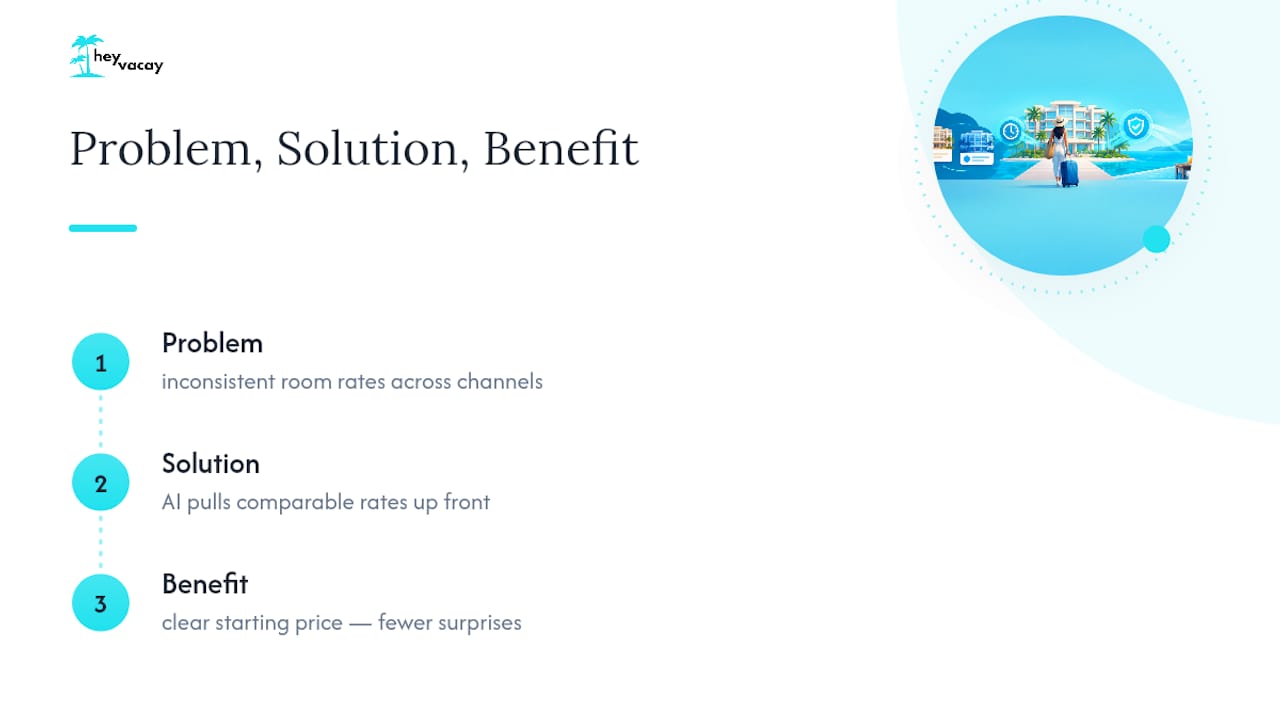
Price match policies exist because room rates are genuinely inconsistent across channels, and most travelers don't have time to hunt down five versions of the same room before deciding where to book. An AI-driven search can pull comparable rates for the same property and room type up front, so you're seeing a fair price before you book instead of discovering a better one afterward and scrambling to file a claim.
Transparent pricing with no hidden fees also matters here in a very specific way: hidden resort fees and last-minute add-ons are exactly the kind of thing that make two "identical" rates hard to compare, which can lead to price match claims being denied. A clearer starting price means fewer surprises to chase down later.
— HeyVacay
Skip the Claim Paperwork and Book the Better Rate First
There's a simpler way to avoid the whole price-match scramble: find the lower rate before you book instead of hunting for proof after. An AI search compares hotel rooms across sources up front, with transparent pricing and no hidden fees stacked on at checkout.
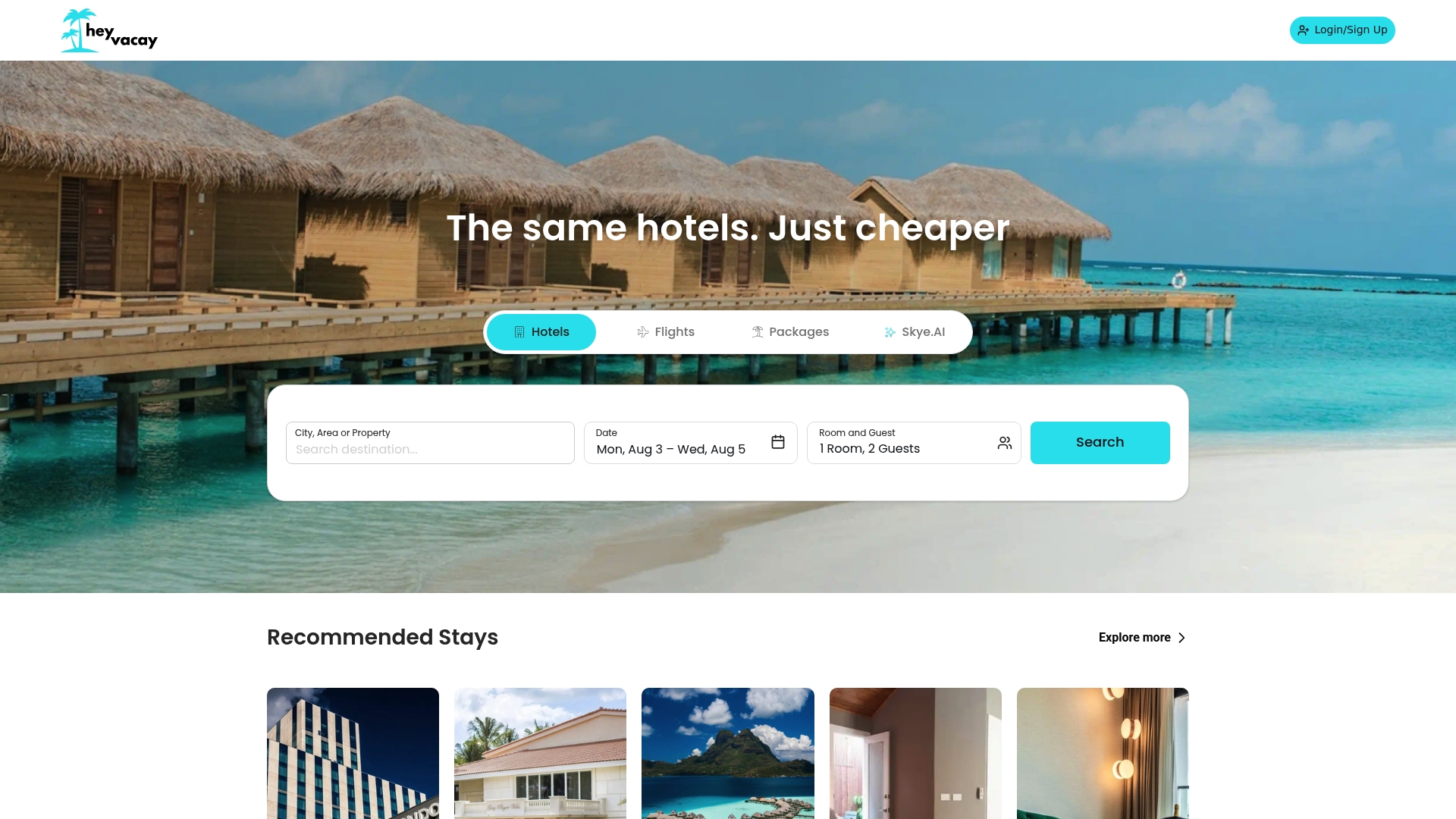
That means less time screenshotting competing rates and more time actually planning the trip. If you're deciding between a few properties for an upcoming stay, start your search on HeyVacay's hotel booking page and compare rates directly, or visit the help and support page if you have questions about a specific booking before you commit.
Sources
- Hilton's Price Match Guarantee
- Marriott | Our best rate. Guaranteed
- Hyatt Book with Confidence price guarantee (explainer)
- Do Hotels Price Match? Marriott, Hilton, IHG, Hyatt, and Wyndham Best Rate Guarantees Compared
- Wyndham secure the best rate guarantee
FAQ
Do Hotels Actually Price Match?
Yes. Most major chains, including Hilton, Marriott, Hyatt, and Wyndham, run a best rate guarantee that matches a lower publicly bookable rate for the identical room and dates when you book direct. Approval typically comes with a bonus on top of the match, like a percentage discount or loyalty points.
What Is the 15/5 Rule in Hotels?
There's no universal "15/5 rule" across the hotel industry.
What Happens if the Price of My Hotel Stay Drops After Booking?
A price drop after booking doesn't refund you automatically. You need to file a best rate guarantee claim, usually within 24 hours of your original booking, matching the new lower rate to the same room type, dates, and cancellation terms as your reservation.
Will Calling the Hotel Get You a Better Rate?
Sometimes, and it can also help your price-match claim specifically. Hilton allows phone verification for same-day claims, which lets an agent confirm a competing rate in real time before it disappears online, something a web form alone can't do.
How Many Price Match Claims Can I File Per Booking?
Generally one claim per reservation, and multiple consecutive nights at the same property are usually treated as a single stay rather than separate claims. Filing multiple claims against one booking typically won't get you multiple payouts.