

Yes, hotel prices drop regularly, but not on command. The pattern depends on unsold rooms, sudden demand, and how close you are to check-in. For domestic trips, the sweet spot for savings usually sits between 8 and 14 days out, with the final week often delivering the steepest cuts. The safest way to play it: book a refundable rate now, then watch for a better price and rebook if one shows up.
TL;DR:
- Booking domestic hotels 8 to 14 days before arrival generally offers the best balance between cost savings and availability, with discounts increasing significantly in the final week.
- Most hotel price drops happen within a narrow window between 7 and 21 days before check-in, driven by revenue management adjustments based on actual bookings versus forecasts.
- Moving your check-in day from Friday to Sunday or traveling during shoulder seasons can reduce rates more effectively than closely tracking booking dates.
- About 40% of reservations see a price decrease after booking, with average savings near $60, making refundable bookings with monitoring the most effective strategy.
- External factors like local events, economic conditions, and regional demand fluctuations significantly influence price volatility and timing opportunities.
Table of Contents
- Hotel Price Patterns at a Glance
- When Do Hotel Prices Actually Drop?
- Does Your Check-In Day or the Season Change the Price?
- How Do You Actually Capture a Price Drop?
- What Tools Help You Monitor Hotel Price Drops?
- Do Booking Channels and Loyalty Programs Affect Price Drops?
- How Do Occupancy Forecasts Drive Price Swings?
- Are Last-Minute Deals and Flash Sales Worth Chasing?
- Do Economic Conditions and Travel Restrictions Move Hotel Prices?
- Our Take on Timing the Hotel Market
- Ready to Put This Strategy to Work?
- Sources
- FAQ
Hotel Price Patterns at a Glance
Hotel pricing isn't random. It follows two competing forces: hotels dropping rates to fill rooms that would otherwise sit empty, and rates spiking when demand suddenly outpaces supply.
- Rooms that go unsold as check-in nears tend to get discounted rather than left vacant.
- Conventions, festivals, and local events can spike prices overnight, even a night or two before arrival.
- Booking domestic hotels 8 to 14 days ahead can save a significant percentage compared to booking four months out (https://www.independent.co.uk/us/money/hotel-reservations-best-day-to-book-discount-b2998606.html), and waiting until the final week can push savings to a notable percentage for many domestic trips.
- About 40% of tracked reservations see a price drop after booking, with average savings near $60.
Your two best immediate moves: turn on price alerts for your dates, and book refundable whenever you plan to keep watching the rate.
When Do Hotel Prices Actually Drop?
The data points to a fairly narrow window. Domestic hotel bookings made 8 to 14 days before arrival tend to run cheaper than bookings made months in advance, and the final week before check-in often brings the biggest discounts of the entire booking cycle. That's not a coincidence. It's how hotel revenue management works.
The three-week window matters most. Revenue managers make their largest short-range pricing adjustments in the roughly three weeks before check-in, which is exactly why rates swing the hardest during that stretch, not months earlier.
Hotels forecast occupancy the same way airlines forecast seat demand. Early on, a property might hold rooms back at higher rates, betting on business travelers or last-minute leisure demand. As the date approaches and actual bookings come in below forecast, the system adjusts, often aggressively, to avoid an empty room that earns nothing.
That volatility isn't uniform across every market. A downtown business hotel that's slow on weekends behaves differently from a beach resort during spring break. Luxury properties tend to hold prices longer because they rely less on last-minute fill-rate panic, while economy chains often discount faster once occupancy forecasts slip.
A few things worth tracking:
- Business-heavy hotels usually loosen prices on weekends when corporate travelers disappear.
- Leisure destinations tighten instead of loosen around holidays and school breaks.
- Destination-specific softness matters: some markets, including several popular 2026 summer spots, have simply seen more inventory than demand this year.
As a rule of thumb, don't bother rebooking for a small dip. Anything smaller usually isn't worth the hassle of canceling and rebooking.
Does Your Check-In Day or the Season Change the Price?
Shifting your dates by a day or two often saves more than obsessing over the exact moment you book. Check-in day matters more than most travelers realize: staying Sunday night instead of Friday night can save around 15% in many markets, since business hotels empty out on weekends and need to fill rooms fast.
Season plays an even bigger role. January and February tend to run softer in a lot of markets simply because fewer people travel, and hotels compete harder for the bookings that do come in.
- Move a weekend trip to Sunday through Wednesday and you're likely paying less per night for the same hotel.
- Traveling in a destination's shoulder season, right before or after peak months, usually beats chasing a last-minute deal during peak weeks.
- A citywide convention or major event nearby can flip the whole equation, pushing rates up even a week out.
- When you stay often matters more than when you book, so check whether shifting your trip by a few days unlocks better rates before fixating on the countdown clock.
If your dates are flexible, this is the highest-leverage move available. A single-night shift, say, checking in Sunday instead of Saturday, can beat weeks of price-alert monitoring. Read more on this in our breakdown of weekend versus weekday hotel rates.
How Do You Actually Capture a Price Drop?
Here's the practical playbook, step by step:
- Book refundable first. Lock in a fully refundable rate as soon as your dates are set. This protects your reservation while leaving the door open to a cheaper rate later.
- Set alerts and check the 7 to 21 day window closely. Most meaningful movement happens in this stretch, per Rate Ranger's tracking data. Inside the final week, check daily.
- Compare the new price against your threshold. Only bother rebooking if the drop clears roughly 10% or $15 a night. Smaller shifts aren't worth the friction.
- Cancel and rebook before the deadline. Confirm the cancellation window on your existing reservation, then cancel and immediately rebook at the lower rate. Never let the new booking lapse before canceling the old one.
- Weigh the last-minute gamble carefully. Waiting until 48 to 72 hours before arrival can unlock steep discounts on unsold inventory, but you risk losing your preferred room type, running into a sold-out property, or forfeiting loyalty points tied to advance rates.
Pro Tip: Always check your cancellation deadline before you start hunting for a lower rate. A refundable rate that expires two days before check-in is useless if you're planning to monitor prices through the final week.
Our guide on hotel cancellation policies walks through exactly what to check before you cancel and rebook.
What Tools Help You Monitor Hotel Price Drops?
Manual monitoring works, but it's tedious. Setting a daily reminder to check five hotel sites for two weeks straight isn't realistic for most travelers, which is why alert-based tools and automated monitors have become the default approach for anyone serious about catching a drop.
- OTA-based alerts notify you when a tracked property's price moves, though coverage varies by site.
- Third-party rate trackers monitor prices across multiple sources and flag changes automatically.
- Platform-integrated monitoring checks rates continuously in the background, catching short-lived dips a person checking once a day would likely miss.
Automation doesn't change the underlying pricing mechanics. It just watches faster and reacts sooner, which matters most in that volatile week before check-in when rates can shift more than once a day.
This platform approaches this with transparent pricing and no hidden fees, paired with real human support if you need help sorting out a cancellation deadline or a rebooking question. That said, automation has real limits: it can't override a hotel's cancellation window, it can't guarantee availability of your original room type, and it works within whatever channel you booked through. If you booked through a specific loyalty program, cancel-and-rebook rules tied to that program still apply.
Do Booking Channels and Loyalty Programs Affect Price Drops?
Where you book shapes whether you can actually catch a drop. A rate booked directly through a hotel is often easier to cancel and rebook than a third-party package rate bundled with other perks, since packaged rates sometimes carry stricter, non-refundable terms in exchange for a lower headline price.
Loyalty programs complicate the math further. A member rate might already sit below the public rate, which narrows the gap you're chasing when you monitor for drops. But member rates typically follow the same cancellation flexibility as the standard refundable rate at that property, so the ability to cancel and rebook usually isn't affected by loyalty status itself.
Points-based bookings deserve separate consideration. If you paid with loyalty points instead of cash, tracking a "price drop" gets murkier, since award pricing sometimes moves on a different schedule than cash rates and doesn't always respond to the same 7 to 21 day volatility. Canceling a points booking to rebook at a lower points price is possible with many programs, but the process and deadlines differ from a standard cash refund.
The practical takeaway: check the specific cancellation terms of the channel and rate type you booked, not just the general rule that refundable rates can be canceled. A rate that looks refundable in the confirmation email can still carry channel-specific restrictions that limit your ability to act on a lower price later. This is exactly the kind of detail that's easy to skip and expensive to discover after the fact.
How Do Occupancy Forecasts Drive Price Swings?
Every price change traces back to a hotel's occupancy forecast. Properties build pricing models based on projected demand for a given date, then adjust rates as actual bookings come in above or below that projection.
When bookings lag the forecast, the system typically lowers rates to stimulate demand and avoid empty rooms, which is the mechanism behind most of the drops travelers see in that 7 to 21 day window. When bookings run ahead of forecast, especially with a convention, sporting event, or holiday weekend layered on top, rates climb instead, sometimes sharply, in the days leading up to the date.
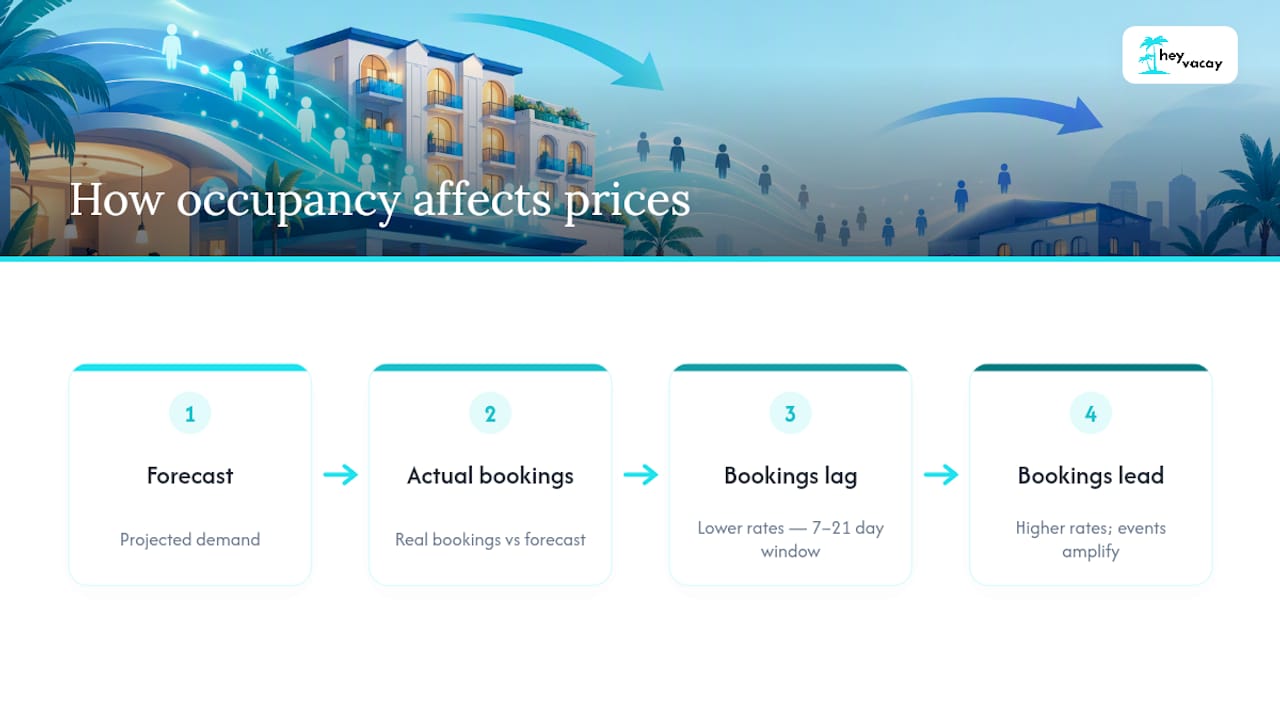
This is why the same hotel can behave completely differently across two weekends a month apart. A quiet weekend with no local events might see the property slash rates 10 days out to chase occupancy. A weekend with a major event nearby might do the opposite, tightening availability and raising rates as the date approaches because the hotel now expects to sell out anyway.
Understanding this mechanism changes how you interpret a price you see today. A rate that looks high a month out isn't necessarily fixed. It reflects a forecast that can still shift in either direction as real booking data comes in. Our explainer on dynamic pricing at hotels breaks down exactly how these forecasting models translate into the rate changes you see on a booking page.
Are Last-Minute Deals and Flash Sales Worth Chasing?
Last-minute deals exist because unsold inventory on the night before check-in is worth almost nothing to a hotel once the date passes. A room that doesn't sell tonight can't be sold retroactively tomorrow, which creates real pressure to discount rather than eat the loss entirely.
That pressure is strongest in the final 48 to 72 hours before arrival, particularly for properties running below their occupancy forecast. Flash sales, whether run by the hotel directly or pushed through a booking platform, tend to cluster in this window for the same reason.
The catch is availability. Last-minute deals often apply to whatever room type is left, not necessarily the one you'd have chosen with more lead time. A property running a flash sale on its remaining rooms might only have accessible rooms, rooms with obstructed views, or smaller room categories left by the time the discount appears.

There's also a timing risk that cuts the other way: waiting for a last-minute deal that never materializes. If a destination is trending toward a sellout, whether from a local event, a holiday weekend, or simple seasonal demand, prices can just as easily rise in that final week instead of falling. Our data-backed comparison of last-minute versus early booking walks through which scenarios favor waiting and which ones punish it.
Do Economic Conditions and Travel Restrictions Move Hotel Prices?
Hotel pricing doesn't exist in a vacuum. Broader economic conditions, currency shifts, fuel costs affecting travel volume, and regional travel advisories all filter into how aggressively a hotel needs to discount to fill rooms.
When travel demand softens across a region, whether from economic uncertainty or a drop in international visitors, hotels typically respond by widening their discounts and extending the booking window in which cuts start to appear. This is part of what's driving the market-specific softness reporters have flagged in several popular summer destinations in 2026, where oversupply relative to demand has pushed rates down noticeably compared to prior years.
Travel restrictions or advisories work similarly but faster. A sudden dip in visitor confidence to a specific region, whether from a health concern, a safety advisory, or a natural event, tends to produce sharper, quicker price drops than a slow economic trend, since the demand shock hits all at once rather than building gradually.
None of this means every softening market guarantees you a deal. It means the odds shift in your favor. A destination facing genuine oversupply gives you more room to negotiate through timing and monitoring than a destination running near capacity, where even a soft economy won't be enough to move prices much.
Our Take on Timing the Hotel Market
Book refundable, then watch the 7 to 21 day window instead of gambling on a single magic date. That's the whole strategy stripped down. HeyVacay builds around this because transparent pricing and straightforward support matter more than a flashy countdown timer. If you want a low-friction way to run this playbook without babysitting five browser tabs, that's exactly the gap we built to fill.
— HeyVacay
Ready to Put This Strategy to Work?
Most booking sites bury their pricing logic behind confusing fees and rate types that make it hard to tell whether a "deal" is actually a deal. The platform skips that entirely: clear pricing with no hidden fees, so the rate you see reflects what you'll actually pay when you book.

That transparency matters most when you're running the exact playbook this article lays out. If you're planning to book refundable now and watch for a drop later, you need a platform where the price you compare against is real, not padded with fees that appear at checkout. This site's hotel search is built for that kind of comparison shopping, with properties similar to those found on larger sites, often at lower rates. If you hit a snag figuring out cancellation terms or need a hand setting up your monitoring routine, the help and support page connects you with real support, not a chatbot loop. Start by searching your dates, book refundable, and check back inside that 7 to 21 day window.
Sources
- The day of the week when last-minute hotel booking prices are slashed by 40 percent | The Independent
- Do Hotel Prices Drop After You Book? Here's the Data | Rate Ranger
- When is the best time to book a hotel? | Travel + Leisure
- Hotel prices are falling in these popular summer destinations | Forbes
FAQ
Do hotel prices ever go down closer to the date?
Yes, prices often drop as check-in approaches, especially in the final week before arrival. Roughly 40% of tracked reservations see a price decrease after the initial booking, with average savings around $60.
Do hotels reduce prices last minute?
Often, yes, particularly for unsold rooms in the 48 to 72 hours before check-in, since an empty room earns nothing once the date passes. Availability is limited to whatever room types remain, so the discount doesn't always come with your first-choice room.
What is the cheapest month to book a hotel?
This varies by destination, but January and February tend to run softer in many markets due to lower overall travel demand. Shoulder-season months just outside a destination's peak also tend to beat peak-season pricing significantly.
What is the cheapest day to book a hotel?
The check-in day matters more than the booking day: Sunday night check-ins run about 15% cheaper than Friday night check-ins in many markets. For the booking window itself, 8 to 14 days before arrival tends to produce the best domestic rates outside of last-minute deals.