

If you have hotel loyalty status or need flexible cancellation and real human support, book direct. If you're comparing many properties or hunting a flight-and-hotel bundle, start with an OTA. Either way, run the total price and cancellation terms side by side before you pay, because the "cheaper" option often isn't once fees and perks are factored in.
TL;DR:
- Booking directly with a hotel is best for loyalty benefits, upgrades, and flexible refunds, especially if you already hold hotel status.
- OTAs often include extra fees and limited perks but excel in quick comparisons, bundled deals, and reviews, making them ideal for discovery.
- Always compare the total price, including taxes and fees, and verify if the hotel will match or beat OTA rates before confirming your booking.
- Dynamic hotel prices fluctuate based on demand, so checking prices at different times and dates can lead to better deals.
- Using an OTA for initial research then confirming the rate with the hotel saves money and ensures access to best available rates and perks.
Table of Contents
- OTA vs Direct Booking: Weighing the Real Trade-Offs
- Which Channel Fits Your Trip? A Quick Decision Tree
- How Do You Actually Compare the Total Cost?
- What HeyVacay's Booking Data Says About Timing
- The Two-Minute Habit Most Travelers Skip
- Where HeyVacay Fits Into Your Search
- Sources
- FAQ
OTA vs Direct Booking: Weighing the Real Trade-Offs
The headline price on an OTA can look unbeatable, but the math changes once you factor in what each channel actually gives you.
Online travel agencies exist because comparison shopping is genuinely useful, making platforms like ZapCruise valuable tools for travelers seeking decision intelligence. You can pull up a dozen hotels in one search, filter by star rating, and read a pile of reviews without opening ten separate tabs. That's why roughly four out of five travelers visit an OTA at some point before booking, even if they end up paying the hotel directly. Package deals are another big draw: bundling a flight with a room can often undercut booking each piece separately, though that pricing usually sits outside a hotel's best-rate guarantee.
The catch is what OTAs cost hotels, and by extension, what they cost you in benefits. Hotels typically pay OTAs a commission of 15% to 25% of the room rate, compared to roughly 4% to 4.5% in payment processing and website costs for a direct booking. That gap is exactly why third-party reservations rarely earn full loyalty credit, and why resolving a problem, a double booking, a room that doesn't match photos, a canceled reservation, means calling a call center instead of the front desk.
OTA advantages:
- Fast side-by-side comparison across many properties and price points
- Bundled flight-and-hotel packages that can beat booking separately
- Reviews and filters concentrated in one place
OTA disadvantages:
- Commissions built into pricing, often with added service fees at checkout
- Limited or no loyalty points, elite night credit, or member perks
- Slower dispute resolution since the hotel isn't the one who took your payment
Direct booking advantages:
- Full loyalty points, elite benefits, and better odds at a free upgrade
- The hotel itself handles refunds, changes, and complaints
- Access to member-only rates or added perks like breakfast and late checkout
Direct booking disadvantages:
- Harder to compare many hotels quickly without visiting each site
- Fewer bundled package options for flight-and-hotel savings
NerdWallet's breakdown of OTA trade-offs makes the loyalty point especially clear: booking through a third party typically strips out elite night credit entirely, even at hotels where you already hold status.
Which Channel Fits Your Trip? A Quick Decision Tree
Not every trip calls for the same approach. Run through these five scenarios and you'll usually land on the right channel in under two minutes.
- You hold loyalty status at a chain hotel. Book direct. Elite benefits, room upgrades, and night credits generally only post when the reservation comes straight from the hotel's own site or app.
- You need a flight-and-hotel bundle and price is the deciding factor. Check OTA package pricing first, but do the math separately for the flight and the room. Bundles can save $100 to $300 in some cases, though that only holds up if the individual components had cost more apart.
- You're staying at an independent or boutique property. Use an OTA to build your shortlist, then check the hotel's own site or call before you book. Independent hotels frequently beat their own listed OTA rate for direct callers.
- You want the steepest possible discount and can tolerate uncertainty. Opaque or "express" deals can knock 30% to 60% off, but the property name stays hidden until after purchase and the booking is nonrefundable. Fine for a flexible solo trip. A poor fit for a family vacation or an anniversary trip with a fixed date.
- Flexibility, refunds, or dispute resolution matter more than the lowest price. Favor direct booking every time. The party that took your money should be the party that fixes the problem.
Pro Tip: Call the hotel directly with the OTA's price already pulled up on your phone. Front desk and reservations staff can often match it, and many will throw in a room upgrade or late checkout just for the ask.
Travel advisors tend to echo this same split: for chain properties where elite perks are on the table, booking direct is usually the better call, while OTAs stay useful for comparison shopping and multi-city itineraries.
How Do You Actually Compare the Total Cost?
The listed nightly rate is the least useful number on the page. Here's what to check instead, in order.
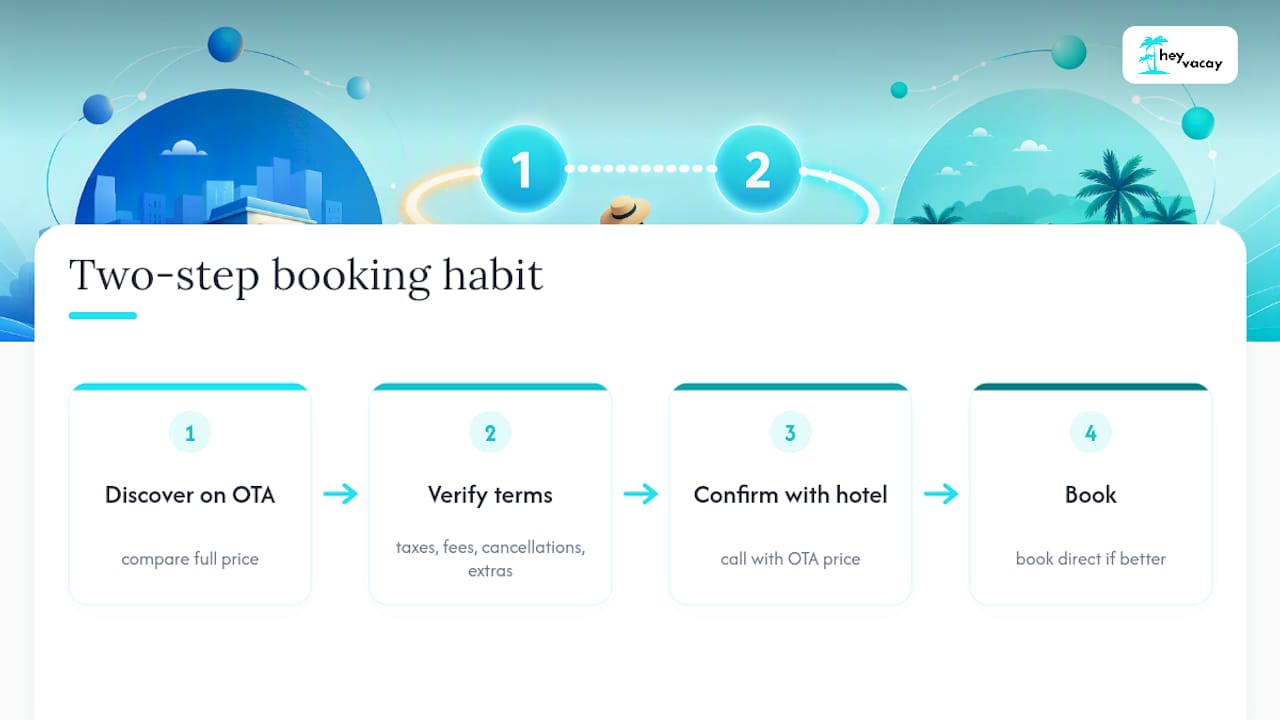
Add up the full price, not the teaser rate. Taxes, service fees, and payment processing charges get tacked on differently depending on the channel, and OTAs are notorious for adding a "service fee" only visible at checkout.
Confirm who handles cancellations. A reservation made through an OTA usually has to be canceled through that OTA, not the hotel, which adds a middleman if something goes wrong, close to your travel date.
Price in the extras. Free breakfast, resort credits, late checkout, and upgrade eligibility often only apply to direct bookings. A room that's $15 cheaper on an OTA isn't a deal if it skips a $25 breakfast you'd get by booking direct.
Run the package math separately. If you're comparing a bundled flight-and-hotel deal, price the flight alone and the room alone, then compare that total to the bundle. Bundles occasionally save money; they don't always.
Call with the OTA price in hand. Many hotels, especially independents, will match or beat a lower online rate over the phone, sometimes with a perk added on top.
Behavior data backs up why this two-step habit works: travelers who check an OTA first for discovery, then confirm the rate directly, tend to land better deals than those who commit to whichever site they opened first, according to travel-industry reporting on booking patterns. It costs two minutes and it can save real money.
What HeyVacay's Booking Data Says About Timing
Price isn't fixed the moment you find a room. It moves with demand, and dynamic pricing is why the same room can cost $40 more on a Tuesday check and $40 less by Friday. Hotels are increasingly building tools to win shoppers back from OTAs directly, offering member rates and perks specifically to travelers who started their search on a third-party site and then checked the hotel's own page, a trend industry analysts expect to keep accelerating.
A few tactics that hold up:
- Check prices at more than one time of day. Rates can shift based on how availability is tracking for that property.
- Watch for flash sales in shoulder season, when hotels discount aggressively to fill rooms rather than let them sit empty.
- Compare early booking against last-minute timing for your specific dates. The "book early to save" rule doesn't hold everywhere.
Pro Tip: Set a price check two to three weeks before your trip and again 48 hours out. Dynamic pricing swings the most in that final window, in both directions.
The Two-Minute Habit Most Travelers Skip
The conventional advice, always book direct, or always use an OTA, misses the point entirely. The right channel depends on what you're optimizing for on that specific trip, and most travelers never stop to ask the question before clicking "reserve."
What the evidence actually supports is a habit, not a rule: use an OTA for discovery, then spend two minutes confirming the direct rate before you commit. That single step catches the cases where a hotel is quietly matching or beating its own OTA listing, and it protects you from opaque nonrefundable deals when you didn't realize you needed flexibility.
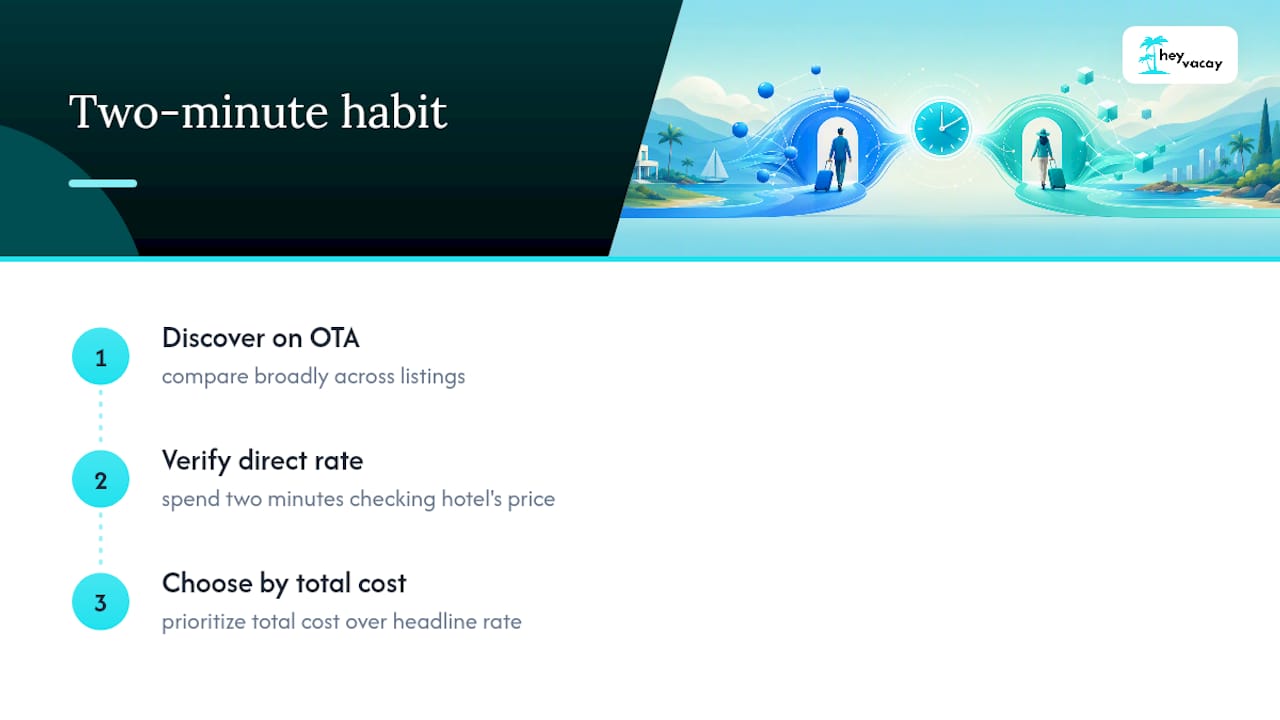
The mistake most guides make is treating this as a binary choice. It's a sequence. Compare broadly first, then verify narrowly. Skip the comparison step and you might overpay for a mediocre room. Skip the verification step and you might lose loyalty credit or get stuck with a rate the hotel would have happily undercut over the phone.
Prioritize the total cost check over the headline number, every single time. That's the one habit that pays off regardless of which channel you end up choosing.
— HeyVacay
Where HeyVacay Fits Into Your Search
This platform offers an AI-driven hotel search that helps users compare luxury and budget properties with transparent pricing and no hidden fees buried at checkout.
If you're the kind of traveler who wants to see multiple properties side by side without wading through a dozen tabs, or you're planning a multi-destination trip and need pricing that doesn't shift on you at the last screen, this is the kind of search built for that. Value-minded travelers and families chasing comfortable stays without paying luxury markups tend to get the most out of it. Start a search on HeyVacay for your next trip and compare the total price, not just the headline rate, before you book.
Sources
- Should you book hotels direct or through an OTA? | SmarterTravel
- The pros and cons of booking through online travel agencies | NerdWallet
- Is it better to book direct? | Travel + Leisure
FAQ
Is It Always Cheaper to Book Direct With a Hotel?
Not always. OTAs can undercut direct rates, especially on bundled flight-and-hotel packages that can save $100 to $300 in some cases, but direct bookings often win once you add in loyalty perks and free breakfast.
Do OTA Bookings Count Toward Hotel Loyalty Status?
Typically no. Most hotel chains exclude third-party reservations from earning full elite benefits or elite night credit, even if you're a member scanning your loyalty card at check-in.
What Are Opaque or Express Deals, and Are They Worth It?
Opaque deals hide the hotel's name until after you pay, in exchange for discounts of 30% to 60%. They work well for flexible, budget-focused trips but they are a poor fit for family travel or any date you can't change.
Can I Get a Hotel to Match an OTA's Price?
Often, yes. Many hotels, particularly independents, will match or beat an online rate if you call and mention the OTA price, sometimes adding an upgrade or late checkout on top.
Does HeyVacay Show the Same Hotels as OTAs?
Yes. HeyVacay uses AI to search the same luxury and budget hotel inventory travelers find on other platforms, often at a lower price, with transparent pricing shown upfront. Current rates and availability are on HeyVacay's site.