

A resort fee is a mandatory per-night charge hotels add on top of the advertised room rate, usually covering things like Wi-Fi, pool access, or a fitness room. It's not optional and it's not a tax. It raises your real nightly cost, often well beyond what you saw in your search results, so the only real defense is checking the total price before you hit "book."
TL;DR:
- Resort fees are mandatory, per-night charges that increase the total cost by $30 to $45 on average, often hidden until late in the booking process.
- These fees typically cover amenities like Wi-Fi, pool access, and fitness facilities, regardless of whether you use them.
- The FTC requires that total prices including resort fees be clearly disclosed before payment, but compliance varies among booking platforms.
- Travelers can reduce or waive resort fees by booking with points, using elite status, choosing no-fee properties, or requesting waivers at check-in.
- Always verify the total price on the final checkout page and consider direct hotel communication to avoid unwelcome surprise charges.
Table of Contents
- Resort Fees Explained: Names, Mechanics, and What They're Not
- What Resort Fees Cover and What They Typically Cost
- Why Hotels Charge Resort Fees in the First Place
- What the FTC's Junk Fees Rule Actually Requires
- How to Confirm a Hotel's Resort Fee Before You Book
- How to Avoid, Reduce, or Get Resort Fees Waived
- What to Do If You're Charged a Resort Fee Anyway
- Why Transparent Pricing Tools Matter More Than Willpower
- Book With the Total Price Up Front, Not a Guessing Game
- Sources
- FAQ
Resort Fees Explained: Names, Mechanics, and What They're Not
Hotels rarely call it a "resort fee" on the bill. You'll see it listed as a destination fee, amenity fee, facility fee, urban fee, or resort charge, depending on the property and the city. The name changes, the mechanics don't: it's billed per room, per night, and it's mandatory regardless of whether you use anything it supposedly covers.
That distinction matters when you're trying to figure out what you're actually paying for. Government occupancy taxes and sales taxes are set by law and appear on every hotel bill in that jurisdiction. A resort fee is not, and it varies from one property to the next, even on the same street. Optional charges, like a $15 breakfast buffet or valet parking you chose to use, are different again. Those are add-ons you opted into. A resort fee is baked in from the moment you book, whether you asked for any of it or not.
Here's how that typically plays out in a booking flow:
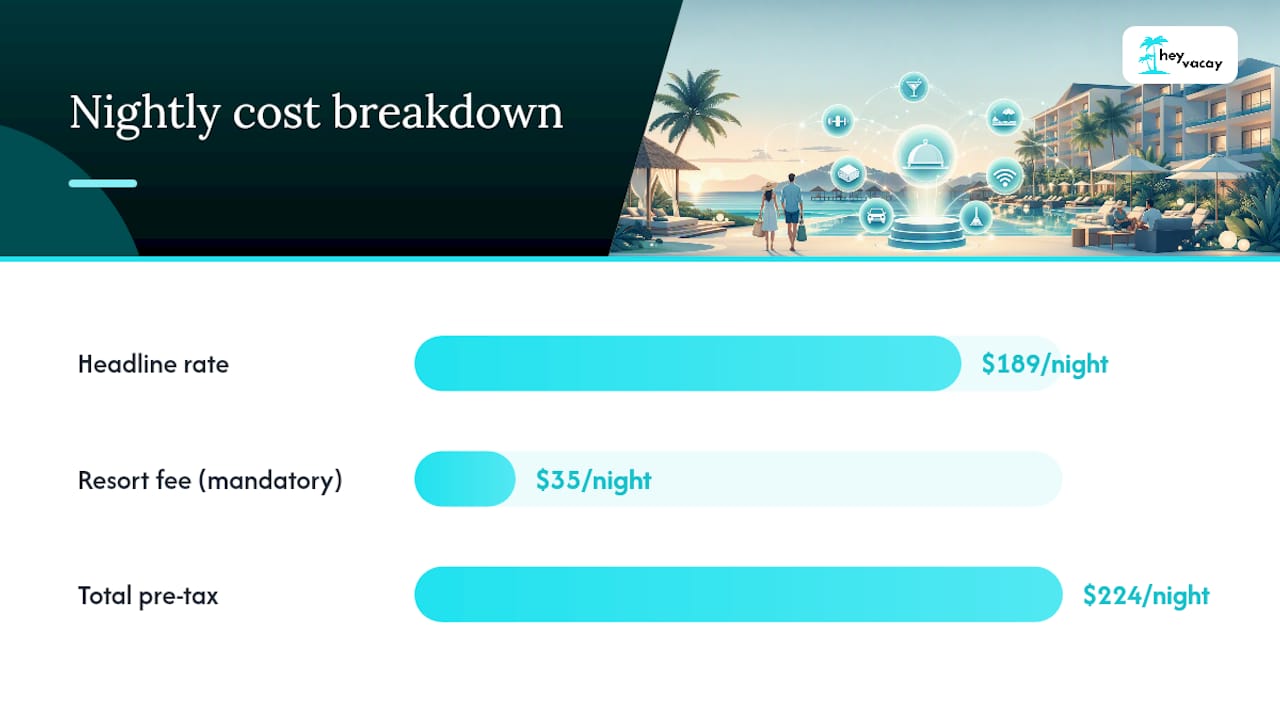
- You search and see a room listed at $189 a night.
- On the rate details or checkout page, a line appears: "Resort fee: $35/night, mandatory."
- Your real cost per night jumps to $224 before taxes are even added.
The FTC's economic analysis of hotel resort fees confirms this pattern: these are per-room, per-night charges frequently disclosed separately from the headline rate, covering items like internet access, parking, and club access.
What Resort Fees Cover and What They Typically Cost
Most resort fees bundle a predictable set of amenities, whether or not you'll use a single one of them. Expect some combination of:
- In-room and lobby Wi-Fi
- Pool and hot tub access
- Fitness center or gym entry
- Airport or local shuttle service
- Bottled water, coffee, or a daily newspaper
- Local and toll-free phone calls
- Sometimes, parking (though parking is often billed separately on top)
Reported averages put U.S. resort fees somewhere between roughly $30 and $45 per night, though that range swings widely by market. A budget hotel might skip the fee entirely. A beachfront resort in a high-demand market can push past $50 a night.
The math adds up fast. A single night at $40 in resort fees is annoying but survivable. Stretch that across a five-night vacation and you've added $200 to your bill, on top of taxes, before you've bought a single drink by the pool.
Some markets are outliers worth flagging specifically: Las Vegas and parts of Florida have a reputation for stacking resort fees on properties where the "amenities" amount to a gym you'll never enter and Wi-Fi you'd get free at a roadside motel. Journalists covering hidden hotel fees consistently point out that these charges surface late in the booking process, often after you've already picked your room and started entering payment details.
Why Hotels Charge Resort Fees in the First Place
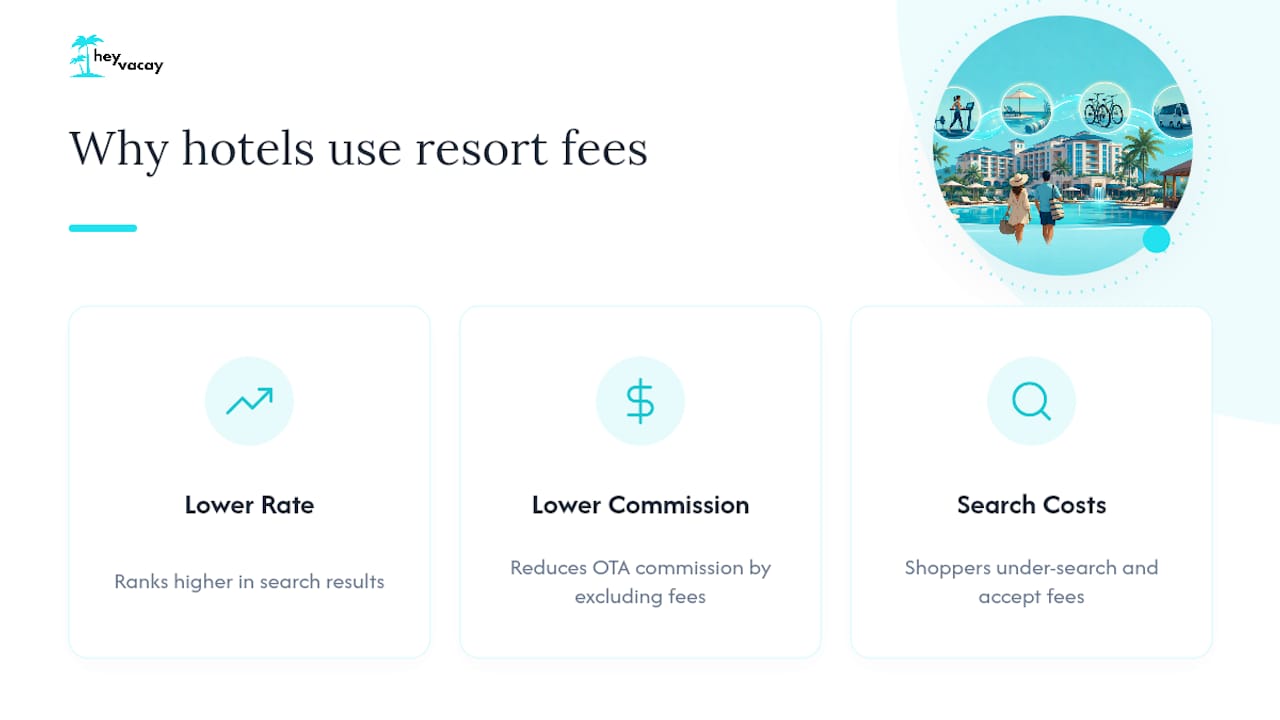
Hotels charge resort fees because splitting the price works in their favor, not because bundled Wi-Fi genuinely costs $40 a night to provide. Economists call this drip pricing or partitioned pricing: showing a lower headline rate up front and adding mandatory charges later in the process.
The tactic pays off in a few concrete ways. A lower advertised rate ranks higher and looks more competitive in search results and price-comparison tools. Splitting off a fee can also reduce the commission a hotel owes an online travel agency, since some fees are calculated outside the commissionable room rate. And because the fee gets disclosed after a shopper has already invested time comparing options, many travelers simply accept it rather than start their search over.
The FTC's own economic analysis frames this as a search-cost problem: when mandatory fees are shown separately from the advertised price, shoppers under-search and consistently underestimate the total cost they'll actually pay.
That's the core of the transparency problem: it's not that resort fees are secret. It's that comparing two hotels honestly requires you to do math the booking site should be doing for you.
What the FTC's Junk Fees Rule Actually Requires
The FTC finalized a rule in late 2024 requiring short-term lodging businesses to display the total price, including mandatory fees, prominently and before you agree to pay. It also requires clear disclosure of what any mandatory fee is for, who charges it, and how much it costs.
Here's what that rule does and doesn't do:
- It requires the total price to be shown prominently, not buried in fine print or a separate tab.
- It requires disclosure of a fee's nature, purpose, and amount before checkout.
- It does not ban resort fees outright. Hotels can still charge them.
- It applies to U.S. short-term lodging bookings; if you're booking internationally, check that country's own consumer-protection rules, since disclosure requirements differ from state to state and country to country.
Reporting from CNBC on resort fee disclosure notes that while the rule has improved upfront disclosure on many platforms, compliance and enforcement still vary. Some booking sites show the all-in total clearly at every step. Others still make you click into a rate breakdown to find it. The rule changed the law. It hasn't fully changed the browsing experience yet.
How to Confirm a Hotel's Resort Fee Before You Book
Never take the headline rate at face value. Run through this checklist before you enter payment information:
- Look for a "total price" or "price includes" toggle on the search results page, not just the room listing.
- Open the rate details or cancellation policy section, where mandatory fees are frequently disclosed even when they're absent from the headline price.
- Check the hotel's own website directly. Independent hotel sites sometimes list resort fees more clearly than third-party booking platforms do, since they're required to show that fee upfront under the FTC's disclosure rule.
- Multiply the nightly fee by your total nights and add it to the room rate. That's your real comparison number against any other property.
- If the fee still isn't clear, call the hotel directly and ask for the amount in writing, or screenshot the booking page in case the number changes later.
Pro Tip: Search results can display different totals depending on the device or browser you're using, especially if location or cookie data changes what a site shows you. Check the final total on the actual checkout page, not just the search results, right before you pay.
How to Avoid, Reduce, or Get Resort Fees Waived
You won't dodge every resort fee, but you've got more leverage than most travelers realize. A few tactics work more often than others.
- Book with points or miles. Award bookings through hotel loyalty programs frequently waive resort fees entirely, since the fee is tied to cash rate structures many programs don't apply to award stays.
- Use elite loyalty status. Some hotel brands waive resort fees for top-tier elite members as a stated benefit, so check your program's terms before you book.
- Pay with a card that issues travel credits. Certain travel credit cards apply statement credits toward hotel fees, effectively offsetting what you're charged even if the fee itself isn't removed.
- Book through channels that show all-in pricing. Comparing the total price rather than the headline rate up front means you're choosing hotels that are cheaper overall, fee included, instead of just cheaper-looking.
- Choose a no-resort-fee property. Plenty of hotels, especially outside major resort destinations, don't charge one at all. A quick search for "no resort fee hotels" in your destination often turns up solid options.
- Try asking, politely, at check-in. Travel + Leisure's reporting on resort fee tactics notes some guests get fees reduced or waived by simply requesting it, particularly at properties with lower occupancy.
Pro Tip: If a fee is genuinely unavoidable, ask the front desk for a written list of everything it covers at check-in. Many guests never touch half the bundled perks, but knowing exactly what's included means you can at least use the gym pass or grab the bottled water you already paid for.
Negotiation works best when a specific amenity is unavailable, like a "pool access" fee at a property with a closed pool for the season, or when the fee wasn't disclosed at the price you were originally shown. It rarely works if you simply don't like the fee on principle. Know which fight is worth having before you start it.
What to Do If You're Charged a Resort Fee Anyway
If a resort fee shows up that wasn't disclosed clearly during booking, don't just eat the charge. Work through these steps in order:
- Ask the front desk first. Point to your original booking confirmation or a screenshot showing the rate you agreed to, and ask them to explain or remove the discrepancy.
- Escalate to the booking platform. If you booked through a third-party site, its customer service can often intervene directly with the property, especially if the fee wasn't shown at checkout.
- File a credit card dispute. If the hotel won't budge and the fee wasn't properly disclosed, a chargeback through your card issuer is a legitimate option, particularly with documentation in hand.
- File a complaint with the FTC or your state Attorney General. Undisclosed mandatory fees are exactly what the Junk Fees Rule targets, and regulators do track these complaints.
Small claims court is a real, if slow, last resort for larger disputed amounts if the hotel and your card issuer both refuse to act.
Why Transparent Pricing Tools Matter More Than Willpower
Reading fine print on every booking site isn't a sustainable strategy, and it shouldn't have to be. HeyVacay was built around the idea that the price you see in search results should already reflect what you'll actually pay, fees included, rather than requiring you to reverse-engineer the real total from a rate breakdown page.
Our take: the FTC's disclosure rule is a meaningful step, but it puts the burden of comparison back on the traveler once the total is technically visible somewhere on the page. Tools that surface the all-in price at the search stage, not the checkout stage, do more real work than any single tip on this list. If you want a deeper look at how AI-driven search handles this, our guide on transparent hotel pricing walks through the specifics.
— HeyVacay
Book With the Total Price Up Front, Not a Guessing Game
This platform is built to show the total price for a stay, not just a headline rate that grows once you reach checkout. Instead of comparing room rates across five tabs and doing fee math by hand, the service offers a search that surfaces the all-in cost for hotels, often at a lower price.

That matters most in exactly the situations this article covers: resort towns, urban hotels with facility fees, and properties where the advertised rate and the real cost rarely match. Before your next trip, run your destination through how to book a weekend stay and get the best deal and check the total price view against what you'd see on a standard booking site. If a fee or policy question comes up mid-booking, HeyVacay's support team can walk you through it before you pay, not after.
Sources
- Economic analysis of hotel resort fees — FTC
- Resort fees must be disclosed: What to do if you're charged one — CNBC
- Hidden hotel fees — Newsweek
FAQ
Can you refuse to pay resort fees?
You generally can't refuse a mandatory fee that was properly disclosed before you booked, since it's part of the contracted rate. If it wasn't disclosed clearly, you have grounds to dispute it with the hotel, your card issuer, or the booking platform.
Are resort fees a rip-off?
Many travelers and consumer advocates think so, since fees often cover amenities you'd expect included in the rate, like Wi-Fi. The FTC's own analysis backs that criticism up, finding that separating fees from the advertised price makes it harder for shoppers to compare prices accurately.
How can I avoid paying resort fees?
Book with loyalty points, use elite status waivers, choose a hotel without a resort fee, or use a booking channel that displays the total price upfront so you can compare true costs before committing.
Why am I getting charged a resort fee?
Hotels charge resort fees to cover bundled amenities like Wi-Fi, pool access, or shuttle service, and to keep their advertised nightly rate looking lower in search results and price comparisons.