

An adults-only hotel is a property that enforces a minimum guest age across its rooms, pools, and dining areas, typically 16, 18, or 21 depending on the property and destination. The label is set by the hotel itself, not by any travel industry authority. It guarantees an age floor, nothing more. It does not automatically mean the resort is couples-only, romantic, or geared toward nightlife.
TL;DR:
- Some adults-only hotels set the minimum age at 16, 18, or 21, but these thresholds vary by region and property type without legal mandates.
- The adults-only label primarily enables operational flexibility, such as later dining hours, quieter spaces, and adult-specific programming, not necessarily romance or exclusivity.
- Enforcement occurs at check-in through ID checks, with some properties offering partial or seasonal adults-only sections, which can cause confusion for travelers.
- Confirm the exact age policy directly with the hotel before booking by reading the policy page, checking booking terms, and contacting the property if needed.
- The atmosphere and amenities differ substantially based on marketing focus, with some targeting wellness, romance, or nightlife, even among properties with similar age cutoffs.
Table of Contents
- What "Adults Only Hotels Meaning" Actually Covers in Practice
- Typical Age Cutoffs and How They Vary by Region
- What to Expect: Atmosphere, Amenities, and Programming
- How Hotels Enforce the Age Rule, and Where Exceptions Creep In
- Pre-Booking Checklist: What to Confirm Before You Reserve
- Adults-Only vs. Couples-Only vs. Adult-Oriented vs. Lifestyle Resorts
- HeyVacay's Take on Verifying Adults-Only Listings Before You Book
- Book Your Adults-Only Stay With a Clear Policy in Hand
- Sources
- FAQ
What "Adults Only Hotels Meaning" Actually Covers in Practice
Hotels do not adopt an adults-only policy just to sound exclusive. It changes how the building runs. Once a property drops the minimum age requirement into its terms, it can rework everything from pool hours to menu design without worrying about child safety codes or family logistics.
Think of it as a permission slip the hotel writes for itself. A resort with no children on the property does not need lifeguard-staffed splash zones, kid-friendly buffet stations, or noise limits tuned for nap schedules. It can push dinner service later, add a cigar lounge next to the main pool, or turn the space that would have been a kids' club into a second spa wing. That is the real answer to "what does adults-only hotel mean": it is a policy that unlocks operational choices, not a personality trait some resorts happen to have.
The shift is measurable, not just cosmetic. Adults-only positioning lets a hotel reconfigure service rhythms and acoustic design, meaning quieter public areas, later checkout enforcement on quiet floors, and catering schedules built around adult dining habits rather than early kids' meals. None of that is required by law. It is a business decision a property makes because its target guest wants it.
Why pick one cutoff over another? Positioning drives it more than anything else. A boutique property chasing honeymooners and anniversary trips often leans toward 18+ or 21+ to signal a romantic, low-noise environment. A larger resort chain that wants to capture families with older teenagers, plus couples, might set the bar at 16+ instead, wide enough to include mature kids while still filtering out toddlers and splash pads.
That distinction matters if you are booking with a specific trip in mind. A 16+ property and a 21+ property can look nearly identical in a listing photo. One might be full of graduation trips and college friend groups. The other might be almost entirely couples in their thirties and forties. The age cutoff is your first clue about which crowd you are actually walking into.
Typical Age Cutoffs and How They Vary by Region
There is no single global standard for adults-only minimum ages, and that is the part travelers trip over most often. Regional habits vary enough that assuming one number across every destination will get you a wrong booking sooner or later.
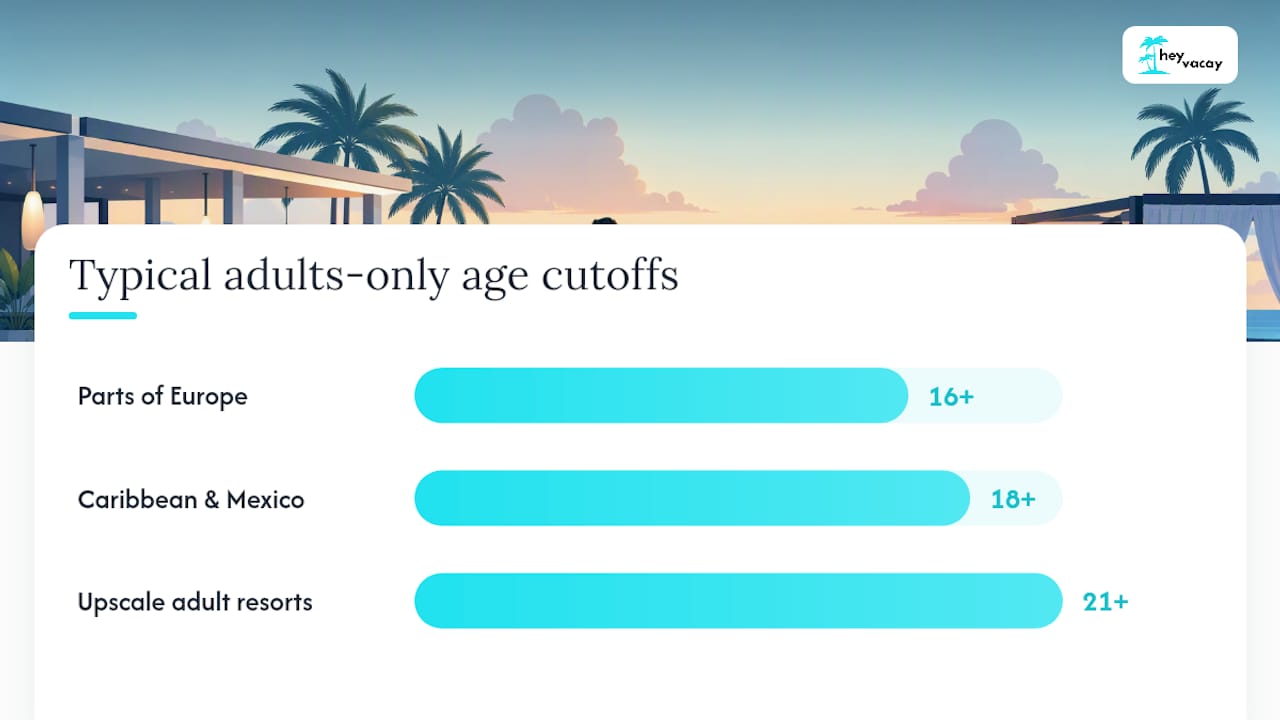
In parts of Europe, 16+ shows up frequently as the adults-only threshold. Many properties in Spain, Greece, and along the Mediterranean use it because 16+ is common in that region while still functioning as a genuine adults-only experience for most travelers. Caribbean and Mexican resorts skew differently. Many all-inclusive properties in Cancun, Punta Cana, and Jamaica set the line at 18+, and some upscale, adult-focused resorts push it to 21+ to lean harder into a party or honeymoon identity.
Hotel chains complicate this further because a single brand might run some properties as family resorts and others, sometimes just down the beach, as adults-only with a completely different minimum age. Some chains set that threshold between 16 and 18 depending on the specific property, which means the brand name on the sign tells you almost nothing on its own.
Most of these cutoffs come from marketing and guest-experience positioning rather than any legal requirement. A government does not mandate that a resort be 18+. The hotel decides that age creates the atmosphere it wants to sell.
So how do you actually confirm the number for a property you are eyeing? Three checks, in order:
- Read the hotel's own policy page, not a third-party listing site, since aggregators sometimes carry outdated age rules.
- Check the booking terms and conditions during checkout, where the minimum age is usually spelled out per room or per reservation.
- Call or message the front desk directly if the listing and the policy page disagree, and ask for the answer in writing.
What to Expect: Atmosphere, Amenities, and Programming
Walk into most adults-only properties and the first thing you notice is what is missing: no kids splashing in the shallow end, no character breakfast, no arcade noise bleeding into the lobby. What replaces it depends heavily on which flavor of adults-only you booked.
Pools and public spaces tend to be quieter by design, sometimes with swim-up bars replacing splash pads and adult-focused music replacing family programming. Wellness and spa access often gets more square footage and longer hours, since the property is not splitting that space with a kids' club. Entertainment shifts toward evening cocktail hours, live music, and sometimes casino nights instead of pool games and mascot appearances. Adults-only resorts commonly build their identity around tranquility, privacy, and adult-oriented programming like curated wellness retreats and romantic dinner setups rather than kids' clubs and splash zones.
Dining changes too, and it is one of the more noticeable shifts if you have stayed at a family resort before. Expect later dinner service, à la carte options replacing some buffet lines, and cocktail-forward bar menus. Some properties build entire trips around combining lodging with a serious food and drink program, which is a different pitch than the standard all-you-can-eat family buffet model.

Here is where the variance really shows up: not every adults-only resort wants the same guest. Some are built for wellness travelers who want yoga at sunrise and an early bedtime. Others are aimed at social nightlife, with DJ pool parties and late bars. A third group leans hard into romance, marketing almost exclusively to couples. The label "adults-only" tells you kids are not present. It does not tell you which of those three experiences you are booking, since marketing language matters more than the age cutoff itself once you get past the basic definition.
Pro Tip: Scroll past the hero photos on a resort's website and look at the actual excursion and entertainment calendar for the week you're traveling. A property that lists "silent disco" and "mixology class" every night is telling you something different than one that lists "sunrise meditation" and "spa hour."
How Hotels Enforce the Age Rule, and Where Exceptions Creep In
Enforcement usually happens at check-in, not before. Front desk staff check ID for every guest listed on a reservation, and a booking with an underage guest attached can get flagged, modified, or in rarer cases, walked to a different property entirely. The contract terms you agree to at booking are what give the hotel legal footing to do that.
That said, "adults-only" is not always as absolute as the label implies. A few common exceptions catch travelers off guard.
Some resorts run partial adults-only models, where one wing, tower, or section of the property enforces the age minimum while the rest of the resort welcomes families. Others use seasonal adults-only periods, meaning the property is family-friendly most of the year but flips to adults-only during a specific stretch, often a shoulder season when family travel demand drops. Properties operating this way are not misleading you exactly, but the label needs a second look, since some adults-only branding applies to a wing or specific dates rather than the whole property year round. A smaller number of properties also sell day passes that briefly open adult-only pool decks or lounges to outside visitors, which can temporarily shift the crowd you are paying to avoid.
If your booking confirmation, the resort's website, and a third-party listing all say different things about the age policy, do not just hope it works out. Cancel and rebook directly if you are within a refund window, contact the property through its official channel, and ask for written confirmation of the exact age rule for your reservation dates. Save that message. It is your evidence if the front desk tries to enforce something different when you arrive.
Pre-Booking Checklist: What to Confirm Before You Reserve
A few minutes of checking before you pay saves you from arriving to a resort that does not match what you pictured. Work through this in order:
- Confirm the minimum age and how it applies. Some properties enforce the rule per guest, others per room, and a few only require the primary booker to meet the age minimum while a younger companion can still stay. That distinction changes who can legally book the room.
- Read the fine print on exceptions. Look specifically for day-pass language, seasonal family weeks, or wing-specific policies buried in the terms and conditions. Travel guides consistently flag that the label alone is not standardized, so the actual policy text matters more than the marketing badge.
- Scan recent guest reviews, not just the top five. Reviews from the last few months tell you whether enforcement is strict or loose, and whether the atmosphere matches wellness, romance, or nightlife branding.
- Check what is included versus what costs extra. Spa access, premium dining, and certain pool areas at adults-only resorts sometimes carry upcharges that a standard all-inclusive rate does not cover.
- Cross-reference amenity lists against photos. A telling signal here: the presence or absence of kids' facilities in the amenity list, plus recent guest photos, tends to reveal the real guest profile more reliably than the marketing copy does.
Pro Tip: Screenshot the policy page the day you book. Hotels update their websites, and having a timestamped copy of what the age rule said when you paid gives you real leverage if the property tries to enforce something different later.
Adults-Only vs. Couples-Only vs. Adult-Oriented vs. Lifestyle Resorts
These four labels get used almost interchangeably in casual travel talk, but they signal different things, and mixing them up is how travelers end up somewhere they did not expect.
Adults-only means only one thing for certain: a minimum age applies. Nothing about romance, exclusivity, or nightlife is guaranteed by that word alone.
Couples-only is a narrower claim. These properties restrict bookings to two-person reservations, often specifically romantic pairs, and sometimes will not accept groups of friends or solo travelers at all. A couples-only resort is almost always adults-only too, but the reverse is not true. Plenty of adults-only properties happily book groups of four friends or a solo traveler.
Adult-oriented is a softer, more marketing-driven term, generally used to describe properties that lean into a mature vibe (quiet pools, upscale bars, curated wellness) without a hard minimum age policy backing it up. It is a tone, not a rule.
Lifestyle resorts is industry shorthand for a specific niche: clothing-optional or swinger-friendly properties, almost always adults-only by necessity but a completely different category from a standard romantic or wellness resort. This is the one distinction worth being direct about, because the confusion causes real booking mistakes: standard adults-only hotels are not clothing-optional and are not built around a sexual theme. If a property falls into the lifestyle category, it will say so explicitly, usually with clear branding and disclaimers, not by accident.
The fastest way to sort a listing into the right bucket is to check its amenity list against its photos. A resort vs. hotel comparison helps clarify service model differences too, since a boutique adults-only hotel and a sprawling adults-only resort deliver very different pacing even at the same age cutoff.
HeyVacay's Take on Verifying Adults-Only Listings Before You Book
The biggest risk with adults-only bookings is not the concept. It is the mismatch between what a listing implies and what the property's actual policy page says. Aggregator sites lag behind hotel updates more often than people expect, and a resort's age minimum can change between seasons without every listing catching up.
Our approach at HeyVacay leans on AI-assisted search and transparent pricing to help travelers compare adults-only properties without guessing at hidden terms. Before you pay, screen the policy page directly, message support with your exact travel dates if anything looks inconsistent, and keep a saved copy of whatever confirmation you get in writing. Our help and support resources exist specifically for that kind of pre-booking check, and it is worth using them rather than assuming a listing's badge tells the whole story.
— HeyVacay
Book Your Adults-Only Stay With a Clear Policy in Hand
You now know the label can mean five different things depending on the hotel, so the real advantage is booking somewhere that shows you the actual policy instead of a vague badge. Some platforms pair AI-assisted search with transparent pricing, meaning no hidden resort fees stacked on after you have already picked a room, and no guessing about what "adults-only" covers at the property you are eyeing.

Search HeyVacay for adults-only properties in your destination, open the listing's policy details before you commit, and reach out through HeyVacay's support page if the age minimum or amenity access is not spelled out clearly. If you are also weighing a family trip alongside a couples getaway, our breakdown of hotel room types worth checking before you book is a useful companion read. Start your search at HeyVacay and lock in a rate with the policy details already in front of you, not buried in a confirmation email after the fact.
Sources
- What is an Adults Only hotel: a real guide to how it works - Hoteles Viva
- What Does an Adults-Only Hotel Mean? | Catalonia Hotels & Resorts
- Adults-Only Resorts Explained: Peace, Privacy, and Why They’re Booming in 2025
FAQ
What Happens at an Adults-Only Hotel?
Guests get a property where every reserved room and public space enforces a minimum age, typically 16, 18, or 21, which usually means quieter pools, later dining, and adult-focused entertainment instead of kids' programming.
What Is the Point of an Adults-Only Hotel?
The main draw is a calmer, more consistent atmosphere for travelers without children, whether that means romance, wellness, or social nightlife, plus operational perks like later meal service and expanded spa access that family resorts rarely offer.
Why Do People Book Adults-Only Resorts?
Most travelers choose them for predictability: no surprise splash-pad noise, no early family dinner rush, and programming built around adult schedules rather than nap times and children’s clubs.
What Actually Goes On at Adults-Only Resorts?
Expect pool decks with swim-up bars instead of splash zones, evening entertainment like live music or cocktail hours, and dining that leans toward a la carte or curated menus rather than family buffets; the specific mix depends on whether the property markets itself as romantic, wellness-focused, or social.
Does Adults-Only Mean the Same Thing as Couples-Only?
No. Adults-only guarantees an age minimum, while couples-only additionally restricts bookings to two-person romantic reservations, and plenty of adults-only properties still welcome groups of friends or solo travelers.