

For most beach-resort trips and family vacations, all-inclusive is the smarter financial move; for city breaks, short stays, and independent travelers, room-only usually wins on cost and freedom. The reason comes down to how you actually spend your days. A step-by-step framework below lets you run the math on your own trip instead of guessing.
TL;DR:
- All-inclusive usually offers better value for long stays, families, and travelers who drink frequently, especially when staying at large beach resorts.
- Room-only tends to be more cost-effective for short city trips, spontaneous bookings, and travelers who plan to dine and explore off property most days.
- Both options frequently exclude extras such as premium alcohol, spa treatments, or transfer fees, which can significantly impact the total cost if not carefully checked.
- Comparing total trip costs requires including all mandatory fees, taxes, and realistic food and drink expenses, not just nightly rates.
- Booking through platforms that show full, inclusive rates helps avoid hidden fees and ensures accurate cost comparisons before finalizing travel plans.
Table of Contents
- All Inclusive vs Room Only: What Each Term Actually Means
- When Does All-Inclusive Usually Win?
- When Does Room-Only Usually Win?
- What's Not Included, and Where Hidden Fees Hide
- How to Compare Total Trip Cost, Step by Step
- Smart Booking Tactics That Actually Save Money
- How HeyVacay Helps You Run This Comparison
- Cancellation and Refund Rules Differ More Than You'd Expect
- Does One Option Travel More Lightly on the Planet?
- Does Your Meal Plan Change How You Experience the Place?
- The Real Tradeoff Nobody Says Out Loud
- Compare Real Trip Totals Before You Book
- Sources
- FAQ
All Inclusive vs Room Only: What Each Term Actually Means
Room-only, sometimes called the European plan, gets you the bed and four walls. Nothing else. Breakfast, drinks, resort activities, and even Wi-Fi often show up as separate charges once you check in.
"All-inclusive" is not one product. Budget all-inclusive resorts typically cover buffet meals, house wine and beer, and basic pool activities, but charge extra for excursions or a la carte dinners. Mid-tier properties add specialty restaurants, better liquor, and non-motorized water sports. Ultra-luxury all-inclusives can bundle gratuities, airport transfers, and premium spirits into the rate, which is why the inclusions vary so dramatically by tier. Reading the fine print on what's excluded matters more than the label on the box.
If you're weighing whether you even want an all-in-one property versus something closer to a standalone hotel, it helps to understand how resorts differ structurally from hotels before comparing meal plans at all.
When Does All-Inclusive Usually Win?
The math favors all-inclusive when you're staying put and eating and drinking a lot while you do it. Four traveler profiles consistently come out ahead:
- Beach resort vacations. When the property itself is the destination, you're not paying for meals you'd skip anyway by exploring elsewhere.
- Long stays (7+ nights). Fixed daily costs get diluted across more nights, and the odds you'll want at least one drink by the pool every day go up.
- Families with kids. Buffets solve the "nobody agrees on dinner" problem, and many resorts include kids' clubs and activities that would otherwise cost extra.
- Travelers who drink regularly on vacation. A couple ordering two cocktails each at dinner plus a bottle of wine can rack up a significant nightly amount in a la carte pricing, an amount that disappears entirely under an all-inclusive rate.
A beach resort couple who eats out and drinks moderately can expect food and drink costs of a moderate daily amount if paying à la carte, according to industry cost comparisons. That's the number all-inclusive pricing is designed to beat.
The traveler-sentiment data backs this up only partway. Skift's 2026 research found 66% of surveyed travelers felt all-inclusive delivered better value, while 34% didn't. That split isn't noise. It reflects real differences in how people vacation. Heavy diners-out and light eaters get very different math from the same resort.
When Does Room-Only Usually Win?
Flip the profile and the math flips with it. Room-only tends to win when your days are unpredictable or short.
- City breaks. You're eating where the day takes you, not where the buffet line is, and street food or a quick café lunch beats resort pricing anyway.
- Short stays (1 to 3 nights). All-inclusive pricing is built around volume. A two-night stay doesn't give you enough meals to absorb the markup.
- Explorers who plan to leave the property most days. Paying for included meals you never eat is the single biggest way all-inclusive wastes money.
- Light eaters and non-drinkers. If your daily food and drink spend is naturally low, you're subsidizing the buffet, not saving on it.
City dining typically runs $50 to $90 per person per day depending on the destination, well below what a beach resort's food and drink allowance would cost you à la carte. Room-only also wins on cancellation flexibility for shorter, spontaneous trips, and it suits couples who'd rather book a curated dinner or a specific romantic experience than eat at the same buffet every night.
What's Not Included, and Where Hidden Fees Hide
The sticker price on either option is rarely the number you pay. Both models exclude things that add up fast if you don't check for them first.
- Confirm what "all-inclusive" excludes. Premium liquor brands, specialty restaurants beyond a set number of visits per stay, spa treatments, motorized water sports, and airport transfers are commonly billed separately even at properties that call themselves all-inclusive.
- Check room-only add-ons before you book. Resort fees, destination fees, or amenity fees in the U.S. typically run $25 to $65 per night and often don't show up until checkout, according to Rate Ranger's cost breakdown. Add local occupancy taxes, breakfast, parking, and airport transfers on top.
- Ask about tipping culture at the destination. Some all-inclusive resorts fold gratuities into the rate; others expect cash tips daily regardless of what you already paid.
- Verify transfer policy in writing. "Free airport transfer" sometimes means shared shuttle only, with private transfer as a paid upgrade.
- Recalculate for kids. Child rates, age cutoffs for kids' clubs, and per-child meal surcharges change the total fast for families.
Skip any of these checks and you can end up paying resort-fee prices on a room-only stay or a la carte prices on a supposedly "all-inclusive" one.
How to Compare Total Trip Cost, Step by Step
Comparing nightly rates side by side is the single biggest mistake travelers make in this decision. The nightly rate is not the trip cost. A repeatable cost-comparison formula fixes that:
- Add up total lodging cost for the exact number of nights, both options.
- Estimate realistic food and drink spend for a room-only stay based on your actual habits, not a diet version of your habits.
- Add mandatory extras: resort fees, taxes, parking, and airport transfers for room-only; specialty dining, premium drinks, and excursions for all-inclusive.
- Subtract the value of anything included that you genuinely would have paid for anyway. Don't count a $200 spa credit you'd never actually book.
- Compare the two final totals, not the two nightly rates.
A quick statistic worth sitting with: Skift's research puts the value split at 66% in favor of all-inclusive and 34% against, among travelers who'd already chosen it. Even people who picked all-inclusive aren't universally convinced it was the better deal, which tells you the decision genuinely depends on your own eating and drinking habits, not on some universal truth about the model.
Here's the math for a couple booking six nights at a beach resort. Assume a room-only room runs $180 a night ($1,080 total) plus a $45 nightly resort fee ($270), plus realistic food and drink spend of $200 a day for both people combined ($1,200). That's a room-only total of $2,550. An all-inclusive at the same property, priced at $340 a night per couple, comes to $2,040 for six nights, with almost nothing left to add beyond tips and the occasional premium cocktail upcharge.
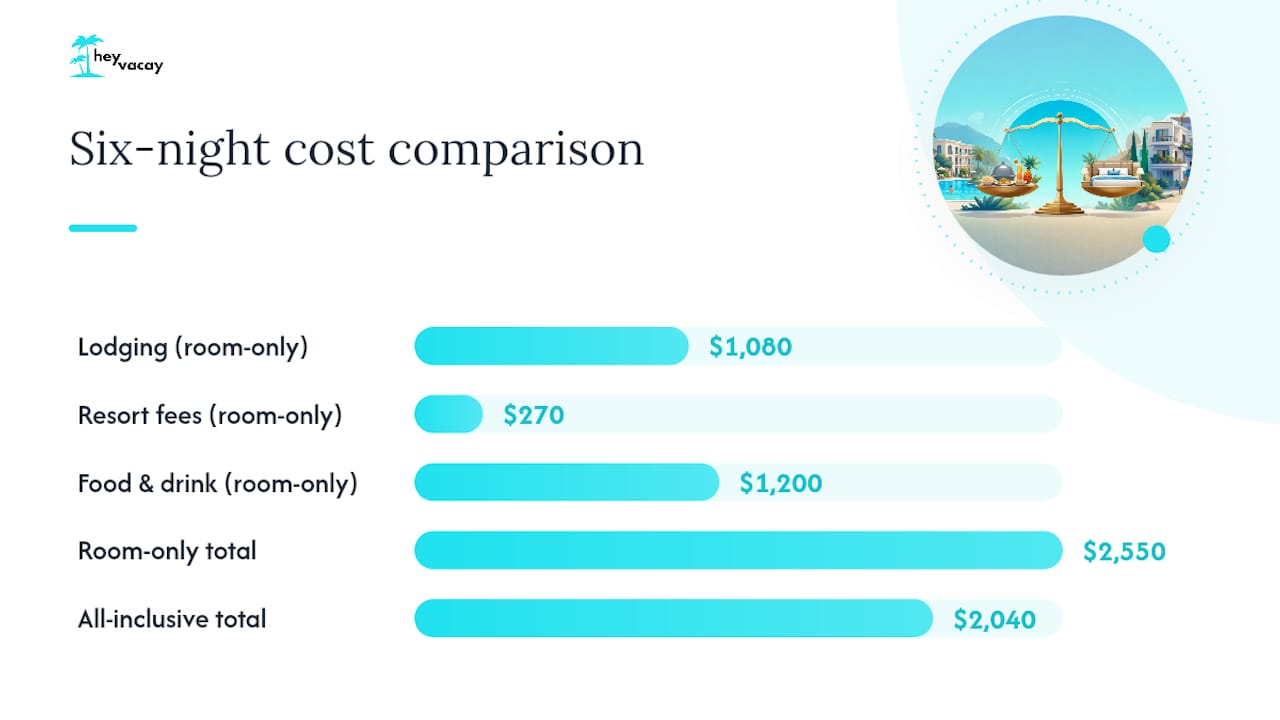
The breakeven shifts fast with two variables: how much you drink and how many days you spend off-property. A couple planning two full days of excursions away from the resort effectively pays for meals twice on those days if they picked all-inclusive, which narrows or erases the savings. Stretch the same trip to ten nights and the fixed food-and-drink costs compound in room-only's disfavor, pushing all-inclusive further ahead. Shrink it to two nights and room-only usually wins outright, since there isn't enough time for the all-inclusive markup to pay for itself.
Smart Booking Tactics That Actually Save Money
Rate type matters more than most travelers realize. Nonrefundable rates make sense only when your dates are locked and you've already run the cost comparison.
Set a price watch on both the room-only rate and at least one all-inclusive package at the same property. Prices on both sides move independently, and a mid-tier all-inclusive sometimes drops below a comparable room-only rate during shoulder season.
Pro Tip: Call or message the property directly and ask what specialty restaurants cost per visit beyond the included allotment. Properties rarely publish this online, and it's often the single biggest swing factor in whether all-inclusive actually pays off.
For families, check occupancy rules before comparing prices. A "kids stay free" policy only helps if your children fit inside the room's stated occupancy limit, and understanding room categories before booking avoids a costly upgrade later. Also confirm the kids' club age cutoff. A five-year-old and a twelve-year-old get very different value from the same resort.
How HeyVacay Helps You Run This Comparison
Running the math above manually means opening a dozen browser tabs and guessing at fees. An AI search pulls full rates, including taxes and mandatory fees, so the number you see is closer to the number you'll actually pay. You can filter by meal plan directly, putting room-only and all-inclusive options for the same property side by side without re-searching.
That transparency matters most exactly where this article's framework depends on accuracy: resort fees, transfer costs, and per-tier inclusions that generic search results tend to bury. For deal-hunting on the all-inclusive side specifically, HeyVacay's guide to budget-friendly all-inclusive packages walks through where the real savings tend to hide. If a booking question comes up mid-search, HeyVacay's help and support resources cover policy details before you commit to a rate.
Cancellation and Refund Rules Differ More Than You'd Expect
All-inclusive packages, especially ones bundled with airfare, tend to carry stricter cancellation windows than standalone room-only bookings. Many all-inclusive rates require cancellation 14 to 30 days out to avoid a penalty, and last-minute changes often forfeit a portion of the package price rather than just one night's stay.
Room-only bookings, particularly through major hotel brands, more often offer free cancellation up to 24 or 48 hours before arrival, even on discounted rates, because the hotel is only risking one room's revenue rather than a bundled meal-plan commitment. That flexibility is part of why room-only suits spontaneous or uncertain travel dates better.
The safest approach either way: read the cancellation terms before comparing prices, not after. A slightly higher all-inclusive rate with a flexible cancellation policy can be worth more than a cheaper nonrefundable one, especially if you're booking more than two months ahead and your plans could still shift.
Does One Option Travel More Lightly on the Planet?
Neither model is inherently greener, but the incentives inside each one point in different directions. All-inclusive resorts often centralize food service, which can reduce per-meal waste through bulk purchasing and buffet-style production, but that same buffet model is also linked to higher food waste when portions go uneaten. Large all-inclusive properties also tend to concentrate water and energy use in resort zones that weren't always built with local ecosystems in mind, particularly in coastal areas.
Room-only stays push spending out into the surrounding town, which usually means a larger share of your trip budget lands with local restaurants, markets, and small businesses instead of a single resort operator. That distributed spending pattern tends to support local economies more directly, though it's not automatically lower impact. It depends entirely on where and how you spend once you leave the hotel.
If sustainability is a real priority for your trip, the more useful question isn't which category you book, but which specific property discloses its water sourcing, waste practices, and labor conditions. Some all-inclusive brands have made real strides on sustainability certifications; some room-only hotels have made none. The meal plan label tells you almost nothing about that.
Does Your Meal Plan Change How You Experience the Place?
All-inclusive resorts are built to keep you on property, and that design has a real social effect. You'll likely meet other guests at the pool bar or buffet, and for solo travelers or families wanting easy, low-effort socializing, that built-in community is a genuine draw. What you're less likely to get is meaningful contact with the destination itself. Staff often work within a resort's script, and outside excursions get sold as add-ons rather than woven into daily life.
Room-only travel puts you in direct contact with the place you're visiting almost by default. You order from a local menu instead of a translated buffet card, you ask a shopkeeper for directions instead of a concierge desk, and you're more likely to eat where locals eat because there's no included alternative pulling you back to the property. That friction is exactly what some travelers are trying to avoid on vacation, and exactly what others are paying for.

Neither approach is more "authentic" by default. A resort employee is still a real local person, and a traveler on a room-only city break can still spend a week never speaking to anyone outside their hotel. The meal plan sets the default path, but how much cultural immersion you actually get still comes down to what you choose to do with your free time.
The Real Tradeoff Nobody Says Out Loud
Most articles frame this choice as all-inclusive versus room-only. The more honest framing is predictability versus control. All-inclusive buys you a fixed number and fewer decisions; room-only buys you the freedom to spend badly or brilliantly, and the responsibility for figuring out which.
I think the industry undersells how much trip length changes the answer. A three-night city hotel and a ten-night beach resort aren't the same decision wearing different clothes. Run the actual numbers for your dates, your appetite, and your drinking habits before you decide, because the 67/34 value split researchers found exists precisely because so many travelers skip that step.
— HeyVacay
Compare Real Trip Totals Before You Book
Most booking sites show you a nightly rate and let you discover the fees at checkout; others pull the full total, room cost, taxes, and mandatory fees, side by side, for both meal-plan types at the same property, which makes comparison faster.

Search a specific destination and date range on HeyVacay, then filter by meal plan to see the all-inclusive and room-only totals for the same hotel stacked against each other. If a resort fee or transfer cost isn't showing up clearly, HeyVacay's help and support team can confirm exactly what's included before you pay. Start with your actual travel dates rather than a rough budget guess. That's where the real number lives.
Sources
- New research: why all-inclusive travel is having a moment | Skift
- All-Inclusive vs. Room-Only Hotels: Which Is Actually the Better Deal? | Rate Ranger
- What Does All-Inclusive Actually Include? The Complete Breakdown for 2026 | All-Inclusive Guide
FAQ
Is It Worth Paying for All-Inclusive?
It's worth it if you're staying at a beach resort for a week or more, drink regularly, or are traveling with a family that eats often. For short city trips or light eaters, room-only usually costs less overall.
What's Not Included in an All-Inclusive Package?
Premium liquor brands, specialty restaurant visits beyond a set number, spa treatments, motorized water sports, and some airport transfers are commonly excluded even at properties marketed as fully all-inclusive.
Is All-Inclusive Pricing Per Room or Per Person?
Most all-inclusive resorts price per person, per night, not per room, so a family of four pays four separate rates rather than one flat room charge. Room-only pricing is almost always per room, regardless of how many people occupy it.
Is It Better to Book All-Inclusive or Room-Only?
Neither is universally better. Skift's research found 66% of surveyed travelers preferred the value of all-inclusive while 34% didn't, and the right call depends on your trip length, destination, and how much you plan to eat and drink off the property.