
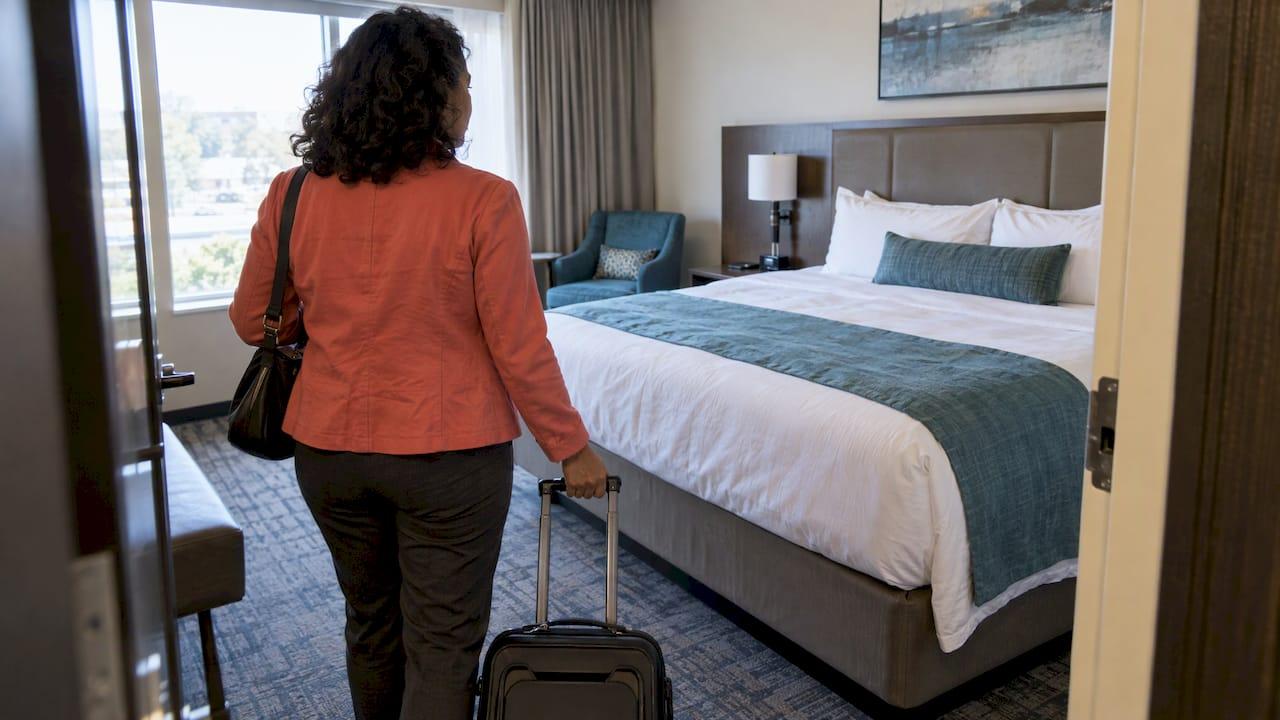
A bed type guarantee means the bed setup is part of the room category you selected and paid for. A bed request is only a note the hotel may try to honor. The wording on your confirmation decides which one you have. Choose a room name that names the beds, such as "King" or "Two Queens", rather than relying on a comment box.
This guide shows how to tell the two apart, why mismatches happen, what to check before you pay and how to ask for a fix at the front desk.
TL;DR
- A guarantee covers what was sold in the room name and description. A special-request box is usually a preference.
- "Double" and "twin" have no industry-wide meaning, so confirm the number and size of beds in writing.
- Hotel chains differ. Some guarantee bed type for certain bookings or members, and some do not.
- If the beds are wrong, stay calm, point to your confirmation, ask for the booked room first and document any alternative.
- Remedies are negotiating options in most cases, and a missing room category is a stronger complaint than an unmet wish.
Table of Contents
- What a bed type guarantee actually means
- Request or guarantee: how to read your confirmation
- Why the bed you booked is sometimes not the bed in the room
- What to check before you book
- How chain policies differ
- If the room has the wrong beds
- Your rights when the room is not as described
- Families and groups: put the beds in writing
- Compare hotels with the room details in view
- FAQ
- Sources
What a bed type guarantee actually means
Hotels do not sell rooms in a generic sense. They sell configurations. According to The Hotel Blueprint, each unit in a reservation system is defined by both its room type and its bedding setup, because both affect who can stay and how many people the room can hold.
That is why a bed type guarantee is really a question of what the hotel put on the product. Travel Fine Print explains that a booked room type is the category you selected and paid for, while a request marked "subject to availability", "request" or "preference" means the hotel may try but has not promised that detail.
Two practical consequences follow:
- If the bed setup is in the room name ("Deluxe King", "Standard Room, 2 Queen Beds"), you bought it.
- If you typed "high floor, king bed please" into a notes field on a room that does not name its beds, you made a wish.
The guarantee usually covers the bed configuration only. Christopher Elliott quotes a hospitality executive on what guarantees often leave out: they tend to apply to the bed layout, not to view, floor height or square footage variations within a category. Expect the bed, not the corner room.
Request or guarantee: how to read your confirmation
Open your confirmation email and look for the exact words next to the room. The same trip can read very differently depending on the phrasing.
| What your confirmation says | What it usually means | What to do |
|---|---|---|
| "Deluxe King Room" | Bed setup is part of the category you bought | Keep the email handy at check-in |
| "Standard Room, 2 Queen Beds" | Bed count and size are named in the product | Same as above |
| "Run of house" or "Guaranteed room, bedding assigned at check-in" | A room is held, bedding is assigned on arrival | Contact the hotel and ask what can be noted |
| "King bed requested" | A request the hotel noted | Ask whether it was confirmed in writing |
| "Double room" or "Twin room" | Ambiguous, may mean room for two or specific beds | Ask the hotel to state the beds |
| Special-requests box only | A hope, not a purchase | Treat it as a preference and follow up |
The dividing line is simple, as 2refund.com puts it: what appears on your confirmation is part of what you bought, and what you typed into the requests box is something the property may or may not have accepted.
The Hotel Blueprint also describes "run of house" rates. These guarantee a room within a category, but the hotel assigns the bedding at check-in based on availability. It is a common source of frustration when someone assumed they had a king and got twin beds.
And the framing you use matters. In the same Elliott piece, a travel business founder says a hotel that hears "preference" treats the room as flexible, while "requirement" creates a different note in the reservation. If you need two beds for medical, mobility or sleeping reasons, say that plainly and ask for the hotel to confirm it.
Why the bed you booked is sometimes not the bed in the room
Most mismatches are logistics, not bad faith. Still, knowing the causes helps you prevent them.
Room assignment happens late. Travel Fine Print notes that the hotel may not know until closer to arrival which rooms are clean, vacant, out of service, occupied longer than expected or needed for other confirmed bookings. A specific physical room is picked then.
Names are not standardized. The Points Guy points out that there is no industry-wide standard for room names, so a "double queen" could mean one queen bed for two people or two queen beds. A reader in that story booked for four people and ended up with fewer beds than expected.
Twin means different things. The Telegraph reported a case where two women in their mid-80s booked a twin room in Tenerife and were given a room with one double bed. The hotel said a twin room was a room for two people. A German court record shows the same ambiguity: the Munich district court noted that the usual definition of a double room is accommodation for two in a double bed or two single beds pushed together.
Convertible rooms. Some hotels run "flexible bedding", where one room converts between king and twin using reconfigurable furniture. According to The Hotel Blueprint, housekeeping has to physically change the room between some stays, which must be scheduled in advance. A note made late may not reach the team in time.

Oversold or out-of-service categories. Travel Fine Print lists these as reasons for a downgrade, along with a booking channel sending different inventory details than the hotel holds.
If you want a refresher on what each size means, our guide to hotel bed sizes explains twin, full, queen and king, and the four axes of hotel room types shows what else to compare besides beds.
What to check before you book
A few minutes before payment prevents most front desk arguments.
- Read the full room name and description, not the photo. Look for the number of beds and their sizes. The strongest clue to what is guaranteed, per Travel Fine Print, is the room name and description on the reservation. Details sold as part of that category, such as bed setup, view or accessibility features, carry more weight than notes in a request box.
- Compare square footage and occupancy. The Points Guy recommends checking pictures, detailed descriptions, bed counts, square footage and amenities, and reading third-party reviews or calling the hotel. This matters most for families and groups.
- Pick the category that names the beds. If two options look alike and only one says "2 Queen Beds", choose that one even if the name is longer.
- Use the request box as a backup, not a plan. Add your preference, then confirm it another way.
- Call or message the hotel after booking. Ask them to confirm your bed configuration against your reservation number, and ask for the reply in writing.
- Screenshot the room page. If the listing changes later, you can show what you saw when you booked.
- Check what the reservation says in the first day or two. Our guide to confirming your hotel reservation walks through what to verify and ask while there is still time to correct it.
If you need an extra sleeping surface instead of a different room, see our guide to rollaway bed policies for fees, room limits and how to ask.
How chain policies differ
Some hotel brands turn the bed type promise into an explicit policy, and others leave it to the property. That is why the same request can succeed at one hotel and fail at the next.
The Points Guy explains that the Marriott Guaranteed Room Type benefit is about not being downgraded or getting a different bed type in the U.S. and Canada. It does not apply if you book on the day you plan to arrive, and it does not cover upgrades. That same article also separates this benefit from upgrade chances: one is about not getting less than you booked, the other is about possibly getting more.
Elliott's reporting describes a broader pattern: getting the room type you selected and paid for has become, at some chains, something tied to loyalty status, and for guests without status the selection can be treated as a request. If you book often, our comparison of hotel loyalty programs versus booking sites helps you decide where a status benefit is worth chasing.
When you book through any third party, the practical rule is the same: the room product name is what travels to the hotel. If the name does not include the beds, the bed is likely handled as a preference.
If the room has the wrong beds
Start at the desk, keep it factual and work through these steps in order.
- Show your confirmation. Point to the exact room name. Do not lead with frustration.
- Ask for the room you booked. Travel Fine Print advises asking first for the booked room, then for an equivalent or better category at no extra cost.
- Ask about a later move. If the issue is only a request, ask whether another room in the same category may open up later in the day, or whether a move is possible.
- Ask for a remedy if only a lower category is left. The usual options are a price difference, hotel credit, points, a fee adjustment or amenities.
- Document any alternative before accepting it. HotelInfo.com suggests verifying reservation details and documenting the alternative, and notes that "King Bed Requested" can carry different implications from a reservation that explicitly confirms a king room.
- Write down names and times. Note who you spoke with, what they offered and what you accepted.
- Follow up in writing after the stay. If the matter is unresolved, send the confirmation, the room you got and the outcome you want to the hotel's guest relations team and to the booking platform.
Travel Fine Print is candid that these remedies are negotiating options, not automatic entitlements, and that a lower category is a stronger complaint than an unmet preference. Knowing that helps you ask for something reasonable and get it.
When the issue is bigger than a bed, such as a missing room category, our upgrade tactics can also help you shape the conversation around moving to a better room instead of a worse one.
Your rights when the room is not as described
Consumer rules differ by country, and a hotel stay abroad may fall under different rules than your home country. Here are examples from the research, each tied to its country.
- New Zealand: the government's consumer site says accommodation providers must provide services with reasonable skill and care, and the facilities listed in the booking must be available. If guarantees are breached, consumers may claim damages that can include the extra cost of alternative accommodation.
- Australia: ABC News, citing the group CHOICE, reported that a room not matching its web description can be a breach of consumer rights. In a major failure, the consumer may cancel and ask for a refund, or keep the booking and negotiate a lower price.
- Spain and the UK (a reported case): in the Tenerife twin room story, the tour operator offered £400 in compensation for the inconvenience.
In the United States, the rules for lodging disputes depend on the state and the booking terms, so start with the hotel and the company you booked through, then use your card issuer's dispute process if needed. Nothing here is legal advice. For a serious dispute, a local consumer protection office or a lawyer in your jurisdiction can tell you what applies.
Families and groups: put the beds in writing
Bed mismatches hurt most when many people share a booking. A family of four that expects two queens and finds one king has a real problem, and a rollaway may not fit. For parties of several rooms, the paperwork carries the weight. Event planners handle this with written terms, and the same logic applies to a family reunion: look at how hotel room block contract clauses spell out what is held and what is not. Our guide to group hotel rates covers when to book and how to save, and the principle is the same: ask for the bed count per room in the confirmation.
A few extra tips for groups:
- Count beds, not rooms. "Two double rooms" can mean different things, as the Munich court record shows.
- Ask for adjoining or nearby rooms if you travel with children, and pick a location that suits your plans using our advice on choosing a hotel room location.
- If arrival is early, read our tips on early check-in. Room assignment tends to be set closer to arrival, so an early heads-up helps the front desk.
Our view: the bed is part of the price
We think a traveler should know what they are buying before they pay. A bed setup is not a decoration. It decides who sleeps where, and a surprise at midnight is a poor way to learn the difference between a request and a guarantee.
That is why we focus on clear pricing with no hidden fees and on showing the room details you need to compare options. Our approach is designed to help you find the same kind of hotels at lower rates, and we want you to be able to read what you are getting just as plainly as you read the total.
We also support flexible cancellation with real human support. If something about your reservation looks unclear, the point is to have a person to ask, not a form to fill in.
Our advice: choose a room name that lists the beds, keep the confirmation, and tell the hotel early if the beds matter to your trip.
HeyVacay
Compare hotels with the room details in view
When you search on HeyVacay, you can compare hotel options across destinations, look at transparent pricing with no hidden fees, and pick the stay that fits your party. Look at the room name before you book, choose the one that names the beds you need, and keep your confirmation.

Ready to compare? Search hotels on HeyVacay and find a room that fits your group.
FAQ
Does a hotel have to give me the bed type I requested?
Not always. A request marked as a preference generally means the hotel may try but has not promised it. A bed type that is part of the room name you booked is much stronger. Ask the hotel to confirm in writing.
Is a bed type guarantee the same as a room guarantee?
No. A guaranteed reservation means the hotel must hold a room in the category you booked. The bed type is only guaranteed when it is part of that category, or when a chain policy covers it. Some chains, such as Marriott in the U.S. and Canada, offer a specific benefit for this.
What should I do if I get one bed instead of two?
Show your confirmation and ask for the room you booked. If it is not available, ask for an equivalent or better room at no extra cost, or a fair adjustment. Document anything you accept.
Does "twin room" always mean two separate beds?
No. Room names are not standardized, and a hotel in a reported Tenerife case treated a twin room as simply a room for two people. Ask the hotel to state the number and size of beds before you arrive.
Sources
- Hotel Room Type vs Request: What Is Actually Guaranteed? (Travel Fine Print)
- Wrong Hotel Room? What to Do If the Room Is Different (Travel Fine Print)
- Bedding Setup Standards in Hotels Explained (The Hotel Blueprint)
- Your hotel room isn't guaranteed. Read the fine print. (Elliott.org)
- Not the room you booked? (2refund.com)
- How I booked 1 bed for 4 people (The Points Guy)
- Everything you need to know about Marriott's guarantees (The Points Guy)
- Does a twin room always mean twin beds? (The Telegraph)
- Amtsgericht München press release on double room bookings
- What to Do If a Hotel Refuses to Honor Your Confirmed Room (HotelInfo.com)
- Accommodation (New Zealand Consumer Protection)
- Your rights when your hotel looks nothing like the ad (ABC News)
- Prevent Surprise Hotel Bills: Contract Clauses Hotel Room Blocks Need