

Platform-based hotel discounts are real, and you don't need a specific credit card to get them. HeyVacay applies AI Upfront Rates and transparent pricing to show you a lower total cost up front, plus student discounts up to 40% for eligible travelers. Expect savings that vary by hotel and date, with the main trade-off being fewer loyalty points than a direct chain booking earns.
TL;DR:
- Platform discounts often stem from lower commission rates and wholesaler reselling, with independent hotels and last-minute deals offering the biggest savings.
- Finding the best rate requires quick comparison across aggregators, hotel sites, and booking platforms, with login and flexible dates often unlocking lower prices.
- Always verify cancellation policies, additional fees, loyalty eligibility, and booking restrictions before finalizing a reservation to ensure savings aren’t offset by hidden costs.
- Most discounts activate automatically or via promo codes and require minimal effort, but restrictions like blackout dates and minimum stays can limit savings.
- For immediate savings and transparency, HeyVacay's AI Upfront Rates show the total price upfront, including taxes and fees, without requiring a credit card or waiting period.
Table of Contents
- How Booking Platforms Create Lower Headline Rates
- How Do You Find and Lock In Platform Discounts?
- What Should You Verify Before You Book?
- HeyVacay Spotlight: Transparent Pricing Without the Guesswork
- How Credit Card Companies Partner With Hotels
- What Types of Hotel Discounts Exist Across the Market?
- How Do You Activate a Hotel Discount Offer?
- Platform Discounts or Card-Linked Perks: Which Saves You More?
- Who Actually Qualifies for These Discounts?
- What Restrictions Should You Watch For?
- When Should You Book Through a Platform Instead of Direct?
- Start Comparing Rates on HeyVacay Right Now
- Sources
How Booking Platforms Create Lower Headline Rates
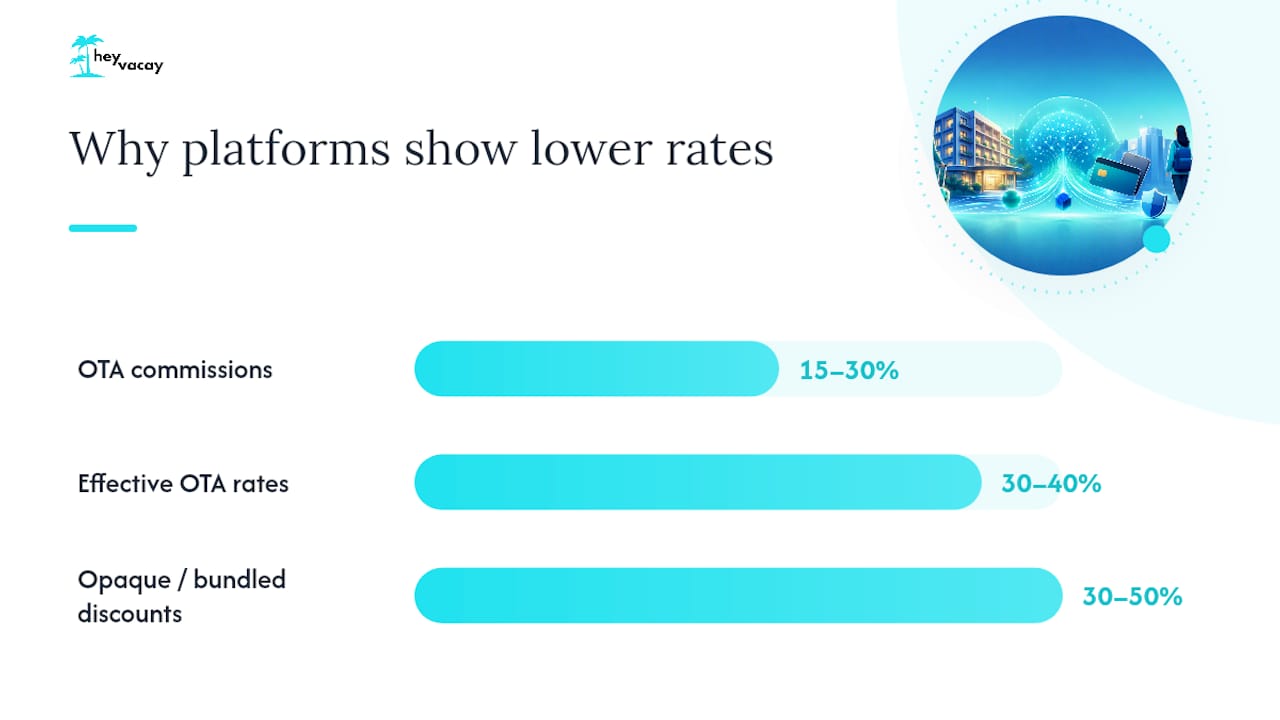
The gap between a platform's sticker price and a hotel's direct rate usually comes down to who takes a cut and how much. Online travel agencies typically collect commissions ranging from 15% to 30% per booking, and effective rates climb toward 30% to 40% once you factor in visibility fees and promotional placement charges hotels pay to rank higher in search results.
That commission structure sounds like it should make platforms more expensive, not less. It works the other way for one reason: competition for your booking is fierce, and some platforms give up part of their own margin to win it. Certain platforms absorb a portion of their commission specifically to fund member discounts, which is why logging into an account before you search can shift the number you see.
The other force at play is the wholesaler, or bed-bank, model. Hotels sell blocks of rooms to wholesalers at a fixed net rate, and those wholesalers resell the inventory through multiple channels at whatever markup they choose. That's why the same room can carry wildly different prices depending on which site you check, even on the same night.
A few patterns show up consistently across booking types:
- Independent hotels and boutique properties tend to show their biggest platform discounts, since they lack a loyalty program to protect.
- Opaque and bundled deals can undercut published rates by 30% to 50% for travelers willing to trade certainty for savings.
- Major chains usually protect their direct rates through price-match guarantees, narrowing the platform advantage.
- Last-minute and off-peak searches surface the deepest wholesaler-driven discounts, since unsold inventory gets pushed through secondary channels fast.
Effective OTA commission rates can reach 30% to 40% when promotional fees are included, according to EHL Insights. That's the ceiling platforms work within to fund the discounts you actually see at checkout.
How Do You Find and Lock In Platform Discounts?
Getting the lowest legitimate rate takes about five minutes of comparison shopping, not luck. Here's the sequence that actually works:
- Set a baseline first. Search a broad aggregator like Google Hotels for your dates to see the general price range before you commit to any single site.
- Log in before you search again. Member rates on platforms are often hidden until you're signed in, and the difference can be the gap between a mediocre deal and a genuinely good one.
- Try flexible dates. Shifting your check-in by even one day can unlock a different pricing tier, especially around weekends.
- Check opaque or express deals. These blind-booking options can cut 30% to 50% off, though you won't know the exact hotel until after you pay.
- Apply any student or platform-specific promo. Codes and toggles for these discounts are usually buried in account settings or a banner you have to click through.
- Confirm the total price before paying. Taxes, resort fees, and service charges can erase a discount that looked great at first glance.
Timing matters almost as much as the search itself. Flash sales cluster around Tuesday and Wednesday releases for many platforms, last-minute opaque deals get better within 24 to 72 hours of check-in as hotels offload unsold rooms, and package discounts (room plus flight or car) tend to beat solo room bookings by a wider margin during shoulder season.
Pro Tip: Run your three-source check, aggregator, hotel direct site, and one platform, in the same browser session using incognito mode. Some sites raise prices slightly if they detect repeat visits to the same listing.
A practical direct-versus-OTA comparison backs this up: checking multiple sources before booking typically takes about five minutes and can save $30 to $60 per stay. That's a strong return for a few extra browser tabs. For a deeper look at why prices shift by the hour, HeyVacay's guide to dynamic pricing patterns breaks down when hotels adjust rates and why.
What Should You Verify Before You Book?
A lower headline price only matters if it survives contact with the fine print. Before you enter payment details, check these four things every time.
- Cancellation terms. Some discounted rates are non-refundable, which is fine for a locked itinerary but risky for anything flexible.
- Separate fees. Resort fees, service charges, and local taxes often get added after the room rate is quoted, sometimes adding 10% to 20% to your total.
- Loyalty eligibility. Many chains exclude third-party bookings from earning points or counting toward elite-tier progress, even when the stay itself qualifies otherwise.
- Upgrade and service priority. Front-desk staff often prioritize direct bookings and loyalty members for room upgrades and late checkout, a soft cost that doesn't show up on any receipt.
None of this means platform bookings are a worse deal, only that the comparison has to include more than the number at the top of the page. Travel + Leisure's reporting on booking channels confirms that third-party platforms tend to win for discovery, packages, and travelers without existing loyalty status, while direct booking pulls ahead for anyone who values points and upgrade priority more than the lowest possible rate.
If you're chasing a specific elite tier or nights credit toward a free stay next year, direct booking might be worth the higher price. If you're comparing loyalty perks against platform savings in more detail, HeyVacay's breakdown of loyalty programs versus booking sites walks through the math for frequent travelers specifically.
HeyVacay Spotlight: Transparent Pricing Without the Guesswork
HeyVacay's core mechanism is called AI Upfront Rates, and it works differently than the cashback model most travelers are used to. Cashback discounts pay you back after your card statement closes, weeks or months after the stay. AI Upfront Rates apply the discount before you pay, so the number you see at checkout is the number you're actually charged. HeyVacay's own comparison of AI Upfront Rates versus cashback lays out the mechanics in more detail.
Three features do most of the heavy lifting:
- Transparent pricing with no hidden fees, so the rate you compare against other sites is the rate you'll pay, taxes and service charges included.
- Student discounts up to 40%, applied automatically once eligibility is verified, no separate card or account required.
- Corporate-style rate access without a company affiliation, which HeyVacay explains in its guide to getting corporate hotel rates without a company.
That combination targets exactly the friction point most booking sites create: a low price that turns out to have $40 in fees attached once you reach checkout.
How Credit Card Companies Partner With Hotels
Credit card issuers negotiate directly with hotel chains and booking platforms to create co-branded offers, statement credits, and points-multiplier promotions tied to specific spending categories. These partnerships work as marketing agreements: the card issuer gets exclusive-sounding perks to advertise, and the hotel chain or platform gets guaranteed volume from cardholders funneled toward their brand.
The arrangement typically involves a portfolio agreement rather than a single deal. A major card network might partner with several hotel chains simultaneously, each offering different perks (free night certificates, elite status, or bonus points) depending on the card tier. These deals get renegotiated periodically, which is why a discount or perk that existed last year can disappear or shrink without much warning.
This matters for context, but it's a separate system from the platform discounts this guide focuses on. A booking platform's discount comes from commission structure and wholesaler pricing, not from a card issuer's marketing budget. You don't need a particular card, a minimum spend, or an annual fee to access an AI-driven rate reduction or a student discount on a platform. That distinction is worth keeping straight, because the two discount types get lumped together constantly in casual conversation, even though they come from entirely different sources and require entirely different actions to unlock.
What Types of Hotel Discounts Exist Across the Market?
Discounts in the broader hotel-booking market generally fall into a handful of categories, and knowing the difference helps you evaluate any offer you come across.
Percentage-based promo codes knock a flat percentage off the room rate, usually applied at checkout on a booking platform or directly on a hotel's website. Cashback and statement credits return a portion of what you spent after the transaction posts, which means you pay full price up front and get compensated later. Elite status perks (room upgrades, late checkout, free breakfast) come from loyalty tier status rather than a discount on the room rate itself, so they add value without lowering the number on your receipt. Package bundles combine a room with a flight, car rental, or activity, and the combined discount often exceeds what you'd get booking each piece separately.
Member-only rates unlock once you create a free account and log in before searching, a pattern most platforms use to reward repeat visitors without requiring any special card or subscription. Opaque deals hide the hotel's identity until after purchase in exchange for a steep discount, typically 30% to 50% off, which suits travelers who care more about price and quality tier than the specific property name.
Understanding these categories helps you spot which type of "discount" any given offer actually is, since marketing language often blurs the line between a genuine price reduction and a perk that just feels valuable.
How Do You Activate a Hotel Discount Offer?
Most legitimate hotel discounts activate one of three ways, and knowing which type you're dealing with saves you from missing out on savings you already qualify for.
Automatic application happens when a platform detects your eligibility (logged-in status, saved student verification, location) and applies the lower rate without any action from you. This is how AI Upfront Rates typically work on HeyVacay: you search, and the discount is already reflected in the number you see.
Promo code entry requires you to find a code, usually through an email newsletter, a partner site, or a promotional banner, and manually type it into a field at checkout. These codes often have expiration dates and blackout restrictions buried in terms you'll need to check separately.
Registration-based activation applies to offers that require you to sign up in advance, sometimes days or weeks before booking, in order to be eligible when you eventually search. Student discount programs frequently work this way: you verify your student status once, and the discount applies to every eligible booking afterward without repeating the process.
The practical takeaway is simple. Before assuming you missed a discount, check whether you were logged in, whether a code needed to be entered, and whether your eligibility (student status, membership tier, region) was verified ahead of time. A surprising number of "missed" discounts are just offers that needed one extra click.
Platform Discounts or Card-Linked Perks: Which Saves You More?
The honest answer depends on what you're optimizing for, but for most price-focused travelers, platform discounts win on speed and simplicity. A platform discount applies instantly, requires no application process, no credit check, and no waiting period. You search, you see the reduced rate, you book. Card-linked perks require holding a specific card, often with an annual fee, and sometimes require registering for a promotion in advance before it applies to your next stay.
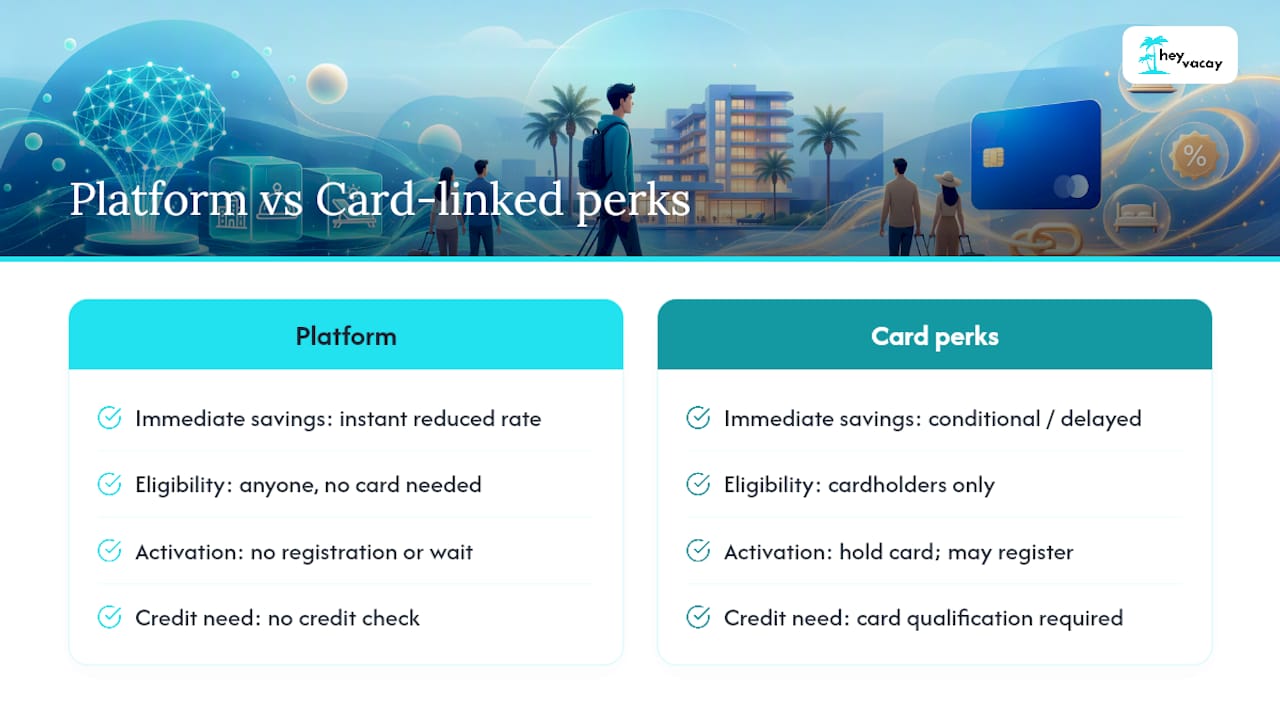
Platform discounts also don't discriminate by credit history. Anyone can search a booking platform and receive a member rate or a student discount, regardless of what's in their wallet. Card-linked perks by definition exclude anyone who doesn't already hold, or can't qualify for, the specific card in question.
Where card-linked perks can pull ahead is long-term value for someone who travels frequently on one hotel brand and accumulates points toward free nights or elite status over years of stays. That's a loyalty play, not a discount play, and it rewards volume and patience rather than solving the immediate problem of one expensive booking coming up next month.
For a single upcoming trip, or for a traveler who books different hotel brands depending on destination, a platform's upfront discount is almost always the faster and more universally accessible route to a lower final price.
Who Actually Qualifies for These Discounts?
Eligibility varies a lot depending on the type of discount and where you're booking from. Student discounts typically require verification through a university email address or a service that confirms enrollment status, and they usually apply regardless of which region you're booking a hotel in. Platform member rates generally require nothing more than creating a free account, no income threshold, no minimum booking history, no regional restriction beyond the hotel's own availability.
Hotel chain loyalty discounts sit at the other end of the spectrum. They're tied to membership tier, and higher discounts or perks unlock only after you've stayed enough nights or spent enough to climb the tier system, which can take months or years depending on how often you travel.
Region matters more for chain-specific promotions than for platform-wide discounts. A hotel brand running a regional promotion in one country might not extend the same offer elsewhere, while a platform's student discount or AI-driven rate reduction typically applies wherever that hotel is bookable through the platform, since it's a function of the platform's own pricing engine rather than a hotel's marketing campaign.
The simplest eligibility check is to look at what the discount requires: an account login usually means broad access, while a specific loyalty tier or regional promo code means narrower access limited to people who already meet that bar.
What Restrictions Should You Watch For?
Every discount has fine print, and the restrictions tend to cluster around a few predictable patterns. Blackout dates exclude major holidays, local events, or peak season from discounted rates, which is worth checking before you assume a discount applies to your exact travel window. Minimum stay requirements sometimes force a two- or three-night booking to unlock the lower per-night rate, which can work against you if you only need one night.
Limited room types show up often with opaque and heavily discounted deals. You might get the advertised price, but only for the smallest or least desirable room category, with upgrades priced separately. Advance booking windows require you to reserve a certain number of days ahead, ruling out last-minute discount hunting for some promotions while rewarding it for others, since the rules vary by offer.
Non-combinability clauses prevent stacking a promo code on top of an already-discounted member rate, so read whether a discount applies to the base rate or the already-reduced price. Cancellation penalties often accompany the deepest discounts. A rate that looks 40% cheaper might carry a strict non-refundable policy, effectively trading flexibility for savings.
None of these restrictions make a discount worthless. They just mean the advertised percentage isn't automatically the final word on what you'll pay or how flexible your booking will be. Read the specific terms attached to your dates and room category before assuming the headline discount applies cleanly to your situation.
When Should You Book Through a Platform Instead of Direct?
Book through HeyVacay or a similar platform when price is your primary concern, when you're a student who qualifies for a verified discount, or when your travel dates are flexible enough to chase the best available rate across multiple properties. Platform searching also makes sense when you're booking an independent hotel without a loyalty program worth protecting.
Book direct when you're chasing elite status progress, when a specific chain's loyalty perks (guaranteed late checkout, room upgrades, free breakfast) matter more to you than a marginal price difference, or when your stay is tied to a rate that only exists through the hotel's own site.
Whichever way you lean, run the three-source check before you commit: an aggregator for a baseline, the hotel's direct site while logged into any loyalty account, and one platform like HeyVacay for the AI-adjusted rate. Five minutes of comparison rarely fails to clarify which option actually wins for your specific dates.
— HeyVacay
Start Comparing Rates on HeyVacay Right Now
HeyVacay is the direct route to a lower hotel price without hunting for promo codes or waiting on a statement credit to post weeks later.
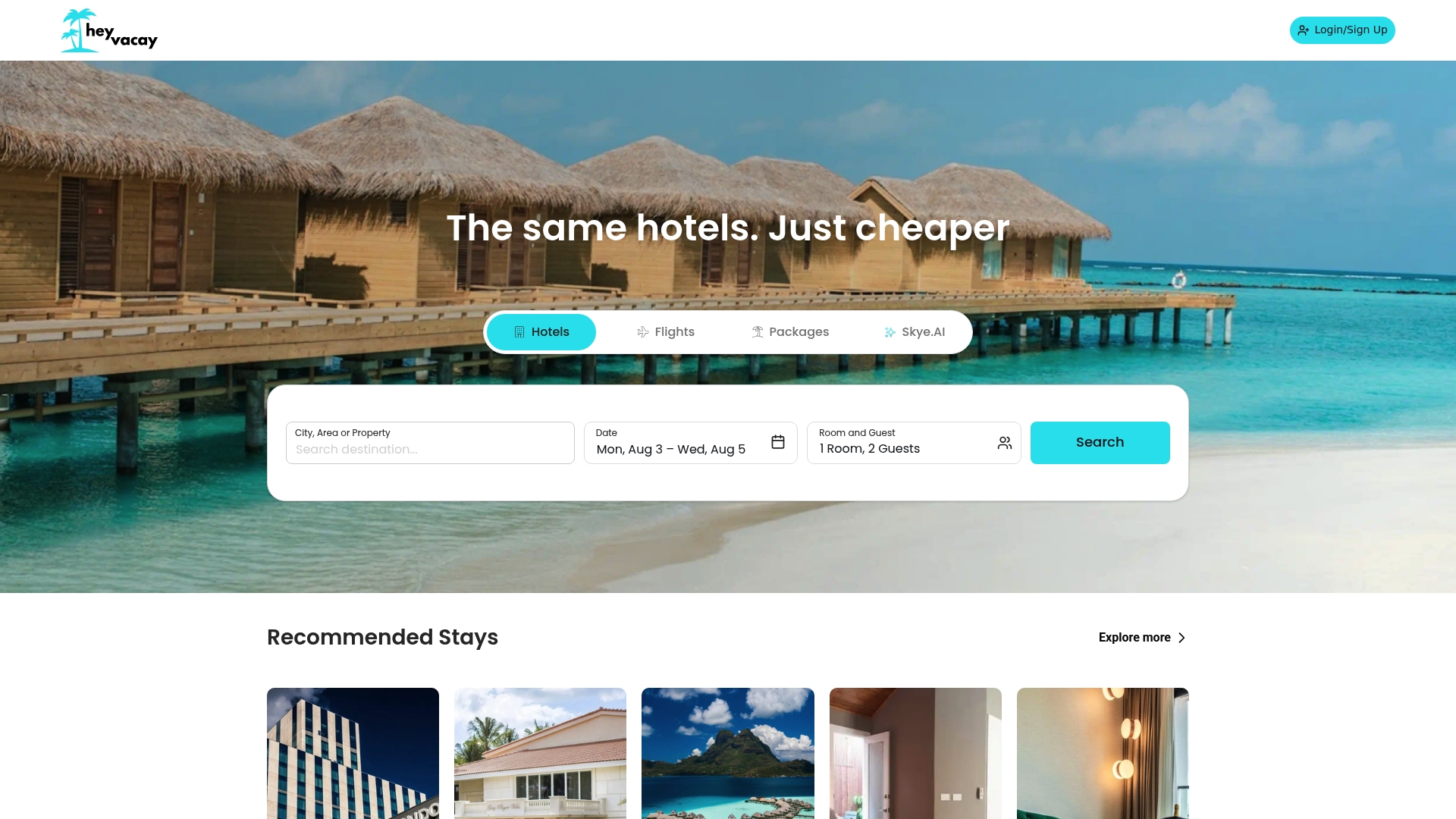
Every rate you see reflects AI Upfront Rates applied before checkout, not after, and the price displayed includes taxes and fees rather than hiding them behind a "see total at checkout" link. There's no card requirement, no annual fee, and no waiting period to qualify for the discount you're looking at. Head to HeyVacay to start your search, and if you run into a question about pricing or a specific booking policy, the help and support page has answers ready before you commit to a reservation.
Sources
For more on OTA commission structures, see EHL Insights. For direct-versus-platform trade-offs, read Travel + Leisure. For a practical multi-channel price check, see SmarterTravel and Wild Foodz's weekend booking tips.
- Hotel OTAs and pricing dynamics — EHL Insights
- Why the same hotel room has different prices online — RateRanger
- Is it better to book direct or through an OTA? — Travel + Leisure