
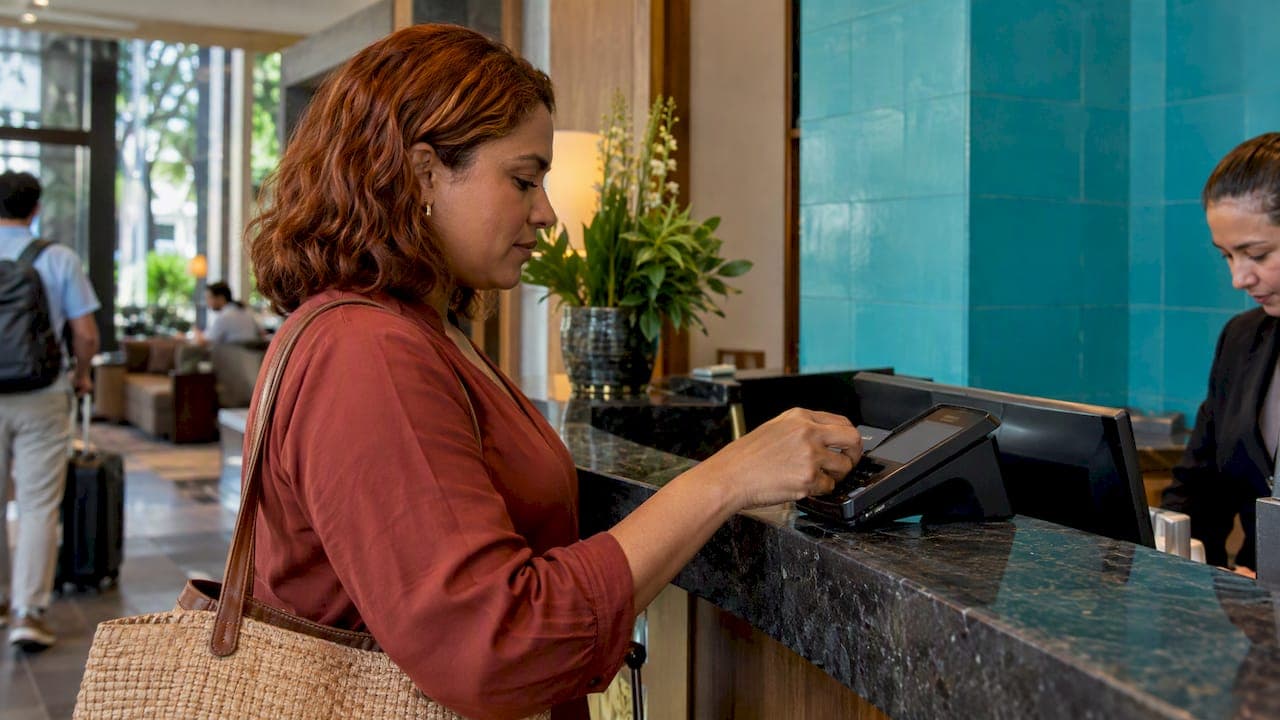
When you book a hotel in another currency, the safest default is to pay in the hotel's local currency and let your card network do the conversion. That is the choice that usually avoids a merchant's markup. Your own card's foreign transaction fee can still apply, so the real task is to know which of three prices you are looking at: the hotel's rate, the conversion rate and the fees on top. This guide walks through each one, so the number you approve at checkout is close to the number that hits your statement.
TL;DR
- If you are offered a choice between the hotel's currency and your home currency, Visa's travel guidance says the local currency may provide a more competitive rate.
- Two costs can stack: your card issuer's foreign transaction fee, typically about 2% to 3%, and a merchant conversion markup if you accept your home currency.
- Prepaid and pay-at-hotel bookings convert at different moments and at different rates, so check which one you are choosing before you confirm.
- Look for taxes, service charges and destination fees that are not in the displayed price, then compare the total, not the headline rate.
- Debit cards work at many hotels, but expect a pre-authorization hold that can tie up your funds for days.
Table of Contents
- Which currency will you actually be charged in?
- Local currency or home currency: which should you pick?
- The fees that can stack on a foreign-currency booking
- Prepaid or pay at the hotel: when does conversion happen?
- Compare the total, not the headline rate
- Debit cards and hotel holds abroad
- Should you exchange cash before you go?
- A checklist before you confirm
- Our perspective on foreign-currency bookings
- Find a clear-priced hotel on HeyVacay
- FAQ
- Sources
Which currency will you actually be charged in?
Three things decide the currency on your statement: how the booking site displays prices, whether you prepay or pay at the property, and what the payment terminal offers at check-out.
A booking site may show prices in dollars because that is the currency it detects for you. That display price is not always what the hotel charges. Some properties price in their local currency and the site converts for your convenience. Others require a specific currency. Hotel terms vary, and some hotels' own terms spell this out. One aparthotel group, for example, states in its terms and conditions that amounts shown in a customer's currency on a booking confirmation are indicative and become final only once full payment is made. In plain words: a converted figure on a confirmation page may move until the money is actually taken.
So the answer to the first question is: read the payment step carefully. Look for wording such as charged in, billed in or you will pay the hotel in. If the page shows two currencies, find out which one is the charge and which one is just an estimate.
Can the exchange rate change before you pay?
Yes, unless the charge is already made. Exchange rates move every day. If you are paying later, at the hotel or on a date after booking, the final amount in dollars depends on the rate that applies when the charge is processed. If you prepay, the conversion is typically settled when you pay, and later rate moves no longer matter for that charge.
That is why a nightly rate of, say, 150 euros is not a fixed dollar amount until payment happens. Treat any dollar figure shown before payment as an estimate.
Local currency or home currency: which should you pick?
When a hotel's card terminal or checkout page asks whether you want to pay in euros or in dollars, the local currency is usually the better answer. Several sources agree on the reasoning.
Visa's travel guidance says that when a cardholder is offered a choice abroad, selecting the local currency may provide a more competitive exchange rate than selecting the home currency. It adds that fees may apply depending on your issuing bank, so the advice is about the conversion rate, not about eliminating every cost.
American Express makes the same point in its guide on paying in local or home currency: when you are given the option, consumers should generally select the hotel's local currency to avoid the often unfavorable rates and service fees applied by the merchant's conversion provider.
Why the home-currency option looks friendly but costs more
Paying in dollars feels safer because you see a familiar number. That is the sales pitch of dynamic currency conversion, or DCC. The merchant converts the bill into your card's currency at the point of sale, using a rate set by a foreign exchange dealer.
The Hong Kong Monetary Authority explains that the conversion is handled by the merchant, the acquiring bank and an overseas foreign exchange dealer rather than by your card-issuing bank, and that the dealer uses the prevailing rate plus a markup. The same page puts that markup at 1.5% to 4%, and sometimes 5% or more for less common currencies. That figure comes from a Hong Kong regulator, so treat it as a typical range rather than a guarantee for every terminal in every country.
When you pay in the local currency instead, the conversion happens on the card side. Wise explains that in this case the card provider or network handles it, while accepting home-currency conversion lets the DCC provider set the rate. It also notes that local-currency payment can still trigger your card's own foreign transaction fee.

What the rules say about your right to choose
You are not meant to be tricked into DCC. Visa states that merchants must be transparent about DCC, including the exchange rate used and any additional fees, and that the cardholder must actively choose to accept or decline the conversion. Visa's cross-border payments documentation adds that the disclosures must be made when the offer is made and before the cardholder chooses, and that the receipt must repeat them if the conversion is accepted.
Practically, that gives you three habits:
- Never let a cashier press the button for you. Ask which currency is being charged.
- If the terminal shows an exchange rate and a fee, that is a DCC offer. Decline it and ask to pay in the local currency.
- Check the receipt. If it shows your home currency and a markup you did not agree to, ask the hotel front desk to correct it before you leave.
The fees that can stack on a foreign-currency booking
A foreign-currency booking can carry up to three separate layers of cost. Seeing them in a line makes it easier to find what you can control.
| Cost layer | Who charges it | Typical size | Can you avoid it? |
|---|---|---|---|
| Card foreign transaction fee | Your card issuer | About 2% to 3% per transaction, varies by card | Yes, by choosing a card that does not charge one |
| DCC markup | Merchant's conversion provider | 1.5% to 4%, sometimes 5% or more | Yes, by declining conversion and paying in local currency |
| Hotel taxes and service charges | Hotel or local authority | Varies by place | No, but you can plan for it |
The card fee range comes from American Express, which says issuers typically charge about 2% to 3% per transaction, though this varies by card or issuer. The same guide gives an example: on a $1,000 hotel bill, hidden conversion costs could add up to $60.
The figure varies by country and issuer. A card guide from a bank in South Korea, for instance, warns its cardholders of roughly 3% to 8% in extra charges when paying abroad in Korean won through DCC. That is specific to that issuer and country, but it shows how wide the range can get.
A worked example
Say your hotel bill is 1,000 euros and the market rate works out to a certain number of dollars. You have three options:
- Pay in euros on a card with no foreign transaction fee. You pay roughly the market rate with no markup.
- Pay in euros on a card with a 3% fee. You pay the market rate plus 3%, about $30 on every $1,000.
- Accept dollars at the terminal and use a card with a 3% fee. Depending on the terminal, you could pay a 1.5% to 4% DCC markup on top, and in some cases the card fee may still apply. The difference over option one can be $45 to $70 on a $1,000 bill.
The last scenario is the one that can be avoided in one tap. It is the reason we say to look at the currency line before you approve.
Don't forget gift cards and other payment tools
If you plan to fund part of the trip with a prepaid or gift product, read its terms first, because issuer fees may apply separately when you pay a hotel in a foreign currency. This overview of travel gift card fees is a useful starting point for what to look for before you rely on one.
Prepaid or pay at the hotel: when does conversion happen?
The timing of the charge changes who converts the money and when.
Prepaid (pay now). You pay when you book. The charge is made in the currency the booking page states, and the amount is fixed from that moment. If the page charges in dollars, the platform has already converted, and you should check that the displayed rate is fair. If it charges in the hotel's currency, your card handles the conversion.

Pay at the hotel. You are charged at check-out, in whatever currency the hotel uses, at the rate in force that day. You carry the exchange rate risk until then, and you face the DCC question at the terminal. You also see any extras added to the bill during your stay.
Neither is always cheaper. Prepaying can lock the price and protect you from a weaker dollar. Paying later can keep your cash free and sometimes offers more flexible cancellation. We go deeper on this trade-off in Pay Now vs Pay at Hotel, including what to check about cancellation terms before you choose.
A rule of thumb: if you expect the dollar to weaken or the rate is already good, prepaying in the hotel's currency can make sense. If your plans may change, a pay-later rate with free cancellation can be worth more than any exchange rate gain.
Compare the total, not the headline rate
Two hotels in different countries can show the same nightly price in different currencies and end up far apart on the final bill. Before you confirm, build a simple total.
- Start with the nightly rate in the currency you will be charged.
- Add taxes and service charges if they are not included. In some markets hotels display a base rate and add taxes and service on top at the property. Our guide to the hotel service charge explains how to spot it.
- Add destination or resort fees, which are often collected at check-in rather than online. See what a hotel destination fee is and how to avoid surprises.
- Add your card's foreign transaction fee, if there is one.
- Convert at today's market rate as a baseline, then compare with what the checkout shows.
The final number is your real price. If two options are within a percent or two of each other after this exercise, the cancellation terms and location should break the tie.
Prices on the same room can also change by date and demand. If your dates are flexible, flexible dates hotel search can reveal cheaper nights, and dynamic pricing in hotels explains why the same room costs more on some days.
Debit cards and hotel holds abroad
Most hotels accept debit cards, but a debit card behaves differently from a credit card at check-in. Citi's hotel guidance says hotels commonly place pre-authorization holds on debit cards for incidentals or a security deposit. The hold temporarily reduces the funds available in your account and can stay for several days, or more than a week, depending on the hotel and the bank.
Abroad, that matters for two reasons. The hold may be placed in the hotel's currency, so the amount in dollars can shift while it sits there. And if the hold eats into a small balance, your other spending on the trip can be declined.
What to do:
- Ask at check-in how large the hold is and when it is released.
- Keep enough available balance to cover the hold plus your normal spending.
- Consider a credit card for the deposit, where a hold does not reduce your cash.
- Read our guides on hotel deposit policies and clearing a hotel credit card hold for the questions to ask.
Should you exchange cash before you go?
For the hotel bill itself, usually not. Visa says there is no need to be weighed down by cash abroad, and that using a Visa card abroad may be better value than buying currency at an airport bureau de change, according to its Visa Abroad page. A UK digital bank makes a similar point, noting that paying in local currency often avoids extra markups, but that you should still check your own card provider's rates and fees (Monzo).
Cash still has a role: tips, small purchases, taxis and the few properties that prefer it. If a hotel asks you to settle in cash, confirm the deposit and ID rules first, using our guide to paying cash at a hotel. Withdrawals at an ATM are subject to the same choice: decline the machine's offer to convert to dollars and take local currency.
A checklist before you confirm
Use this list at the booking page and again at check-out.
- Find the line that states the currency you will be charged in.
- Decide whether you are prepaying or paying at the property.
- Check whether taxes, service charges and destination fees are included.
- Check your card's foreign transaction fee, and use a card without one when you can.
- At the terminal, choose the hotel's local currency.
- Read the receipt for currency, rate and any added fee.
- Review the final folio. Our list of questions to ask at check-in helps prevent surprise incidental charges.
- Compare the charge on your statement with your estimate within a few days, and dispute anything that does not match what you agreed to.
Perspective
Our perspective on foreign-currency bookings
Most travelers do not lose money on the room. They lose it in the small decisions around the room: an unclear currency line, a terminal that converts for you, a fee that shows up only on the receipt. We built HeyVacay around the idea that the price you see should be the price you understand.
That is why we focus on transparent pricing with no hidden fees, and why we use AI and wholesale inventory to look for the same quality of hotel at a lower rate. A good rate only helps if you know what you are paying, in which currency, and when. We believe the travelers who save the most are the ones who compare the full total before they commit.
Our advice is simple. Choose a rate with clear terms, prefer flexible cancellation when your plans might change, pay in the local currency when you are asked, and keep your receipts. Real human support should be there if something on a bill does not look right.
HeyVacay
Find a clear-priced hotel on HeyVacay
If you are comparing hotels abroad, start with a search where the price and the terms are easy to read. HeyVacay is built to show you hotel options at lower rates, with clear pricing and no hidden fees, across multiple destinations and for different kinds of trips, from a family vacation to a business stay.

Try a search for your next trip on HeyVacay hotels and compare the total before you decide.
FAQ
Is it better to pay a hotel in local currency or in dollars?
Usually local currency. When a hotel terminal or checkout page offers both, Visa says the local currency may give a more competitive exchange rate. Your card issuer may still charge its own foreign transaction fee, so check your card's terms.
Will I pay a foreign transaction fee if I book a hotel abroad?
It depends on your card and on how the charge is processed. Issuers that charge a fee typically take about 2% to 3% per transaction, according to American Express. Some cards charge none, so check your card agreement before you travel.
Can I book a hotel abroad with a debit card?
Often yes, but plan for a hold. Hotels commonly place pre-authorization holds on debit cards, and the hold can last several days or longer, reducing the funds you can spend. Ask the hotel for the amount and the release timing, or use a credit card for the deposit.
Should I buy foreign currency before I travel?
For most hotel payments, a card used in the local currency is simpler and may be better value than buying currency at an airport exchange desk. Carry a modest amount of cash for small expenses. Check your own bank's rates and fees before deciding.
Can the price change after I book?
It can if you pay later and the exchange rate moves before check-out. A prepaid booking is charged when you pay, so that rate is settled. Some confirmations show converted amounts that are only indicative until payment is complete, so read the wording near the price.
Sources
- Visa Abroad, Travel with Visa
- Should You Pay in Local or Home Currency When Traveling, American Express
- Hong Kong Monetary Authority, Hong Kong Dollars or Foreign Currency
- What is dynamic currency conversion, Wise
- Dynamic Currency Conversion Explained, Visa
- Optimize Your Cross-Border Ecommerce Payment Acceptance, Visa
- Staycity Aparthotels Terms and Conditions
- KB Kookmin Card overseas use guide
- Can You Book a Hotel Room with a Debit Card, Citi
- Should I pay in local currency or pounds, Monzo
- Travel gift card fees