

Yes, most hotels place a hold or collect a deposit, and it happens even when you already paid for the room in full. For more details on how these digital holds guarantee your reservation, see explaining digital reservations. A hold is a temporary block on your funds, not a withdrawal, while a charge actually takes the money. Before you arrive, call or check your confirmation for the exact amount, and use a credit card instead of a debit card whenever the hotel allows it.
TL;DR:
- Hotels typically hold $50 to $200 for incidentals at budget to mid-range properties, with upscale hotels often requiring $200 to $500 or more.
- Pre-authorizations are temporary holds that lower your available credit or funds but do not withdraw money, and they usually clear faster on credit cards than on debit cards.
- Using a debit card for incidentals can deplete your checking account and cause potential overdraft issues, especially if the hold extends beyond your planned stay.
- The release of deposits can take from three to ten business days, with credit card holds clearing faster than debit or international card holds.
- Confirm the exact hold amount and policy in writing before check-in to avoid surprises, and contact the hotel directly if you notice incorrect charges after departure.
Table of Contents
- Understanding Hotel Deposit Policies: What the Different Types Mean
- Pre-Authorization vs. an Actual Charge: Why Your Card Type Matters
- How Much Do Hotels Typically Hold for a Deposit?
- When Do Hotels Release Deposits, and How Do You Dispute a Problem?
- A Pre-Arrival Checklist That Prevents Deposit Headaches
- What Consumer Protections Apply to Hotel Deposits?
- How Hotel Deposit Policies Change From Country to Country
- Does Hotel Loyalty Status Reduce or Waive Deposits?
- HeyVacay's Take: Clarity Beats Guesswork Every Time
- Book With Confidence Through HeyVacay
- Sources
- FAQ
Understanding Hotel Deposit Policies: What the Different Types Mean
Hotel deposit policies cover more ground than a single flat fee. When you see "deposit" on a confirmation email, it could mean several different things depending on the property and when you booked.
- Security deposit or incidental hold: A temporary authorization, usually taken at check-in, meant to cover minibar charges, room service, or property damage.
- Advance or booking deposit: A portion of the room cost collected at the time of booking, often nonrefundable past a certain cancellation window.
- Damage or breakage deposit: More common at vacation rentals and resorts with pools, kitchens, or shared equipment, and it's usually a hold rather than an outright charge.
- Early or late check-in/checkout deposit: A smaller hold some properties add when you request hours outside the standard window.
Hotel deposits secure the reservation itself and protect the property against cancellations, no-shows, and unpaid incidentals. Front desks often phrase this loosely, like "we'll place a hold for incidentals" or "a deposit is required at check-in," without specifying which type applies. That vagueness is exactly why asking directly, before you show up, saves you from a surprise at the front desk.
Pre-Authorization vs. an Actual Charge: Why Your Card Type Matters
A pre-authorization is not a charge. It's a temporary block that lowers your available credit or checking balance without actually moving money out of your account, and it disappears once the hotel releases it or converts it into a real charge.
The card you hand over changes everything about how that process feels. Credit card holds typically clear faster than debit holds, with release windows running anywhere from 24 hours to seven business days, longer for cards issued outside the country where you're staying. Debit holds, by contrast, physically remove that money from what's available in your checking account until the bank lifts the hold, which can strain your budget if you're traveling on a tight margin.
- Credit card: The hold reduces your credit limit, not your cash. Disputes are simpler because you're arguing with the card issuer, not draining your own money.
- Debit card: The hold locks up real cash sitting in your account. Some hotels refuse debit cards for incidentals entirely because of how often this causes overdrafts.
- Virtual or prepaid cards: Many properties won't accept these for the incidental hold, even if you paid for the room itself with one, since there's no reliable way to place a hold against a balance that could be spent elsewhere.
Complications also show up when you pay for the room with one card and want to use a different card for incidentals. Not every hotel property management system supports splitting payment methods this way, so ask before you assume it's an option.
Pro Tip: If you're traveling with both a credit and a debit card, hand over the credit card for the incidental hold, even if you're paying the room balance with debit. It keeps your checking account untouched during your stay.
How Much Do Hotels Typically Hold for a Deposit?
Deposit amounts swing widely, but there's a rough pattern by property type. Budget hotels tend to hold $50 to $100, mid-range properties commonly land between $100 and $200, and upscale or luxury hotels can hold $200 to $500 or more per stay. Resorts and casino hotels sometimes exceed that, especially where gaming credit or extensive amenities are involved.
Several factors push that number higher:
- Suites and premium room categories often carry larger holds than standard rooms.
- Group bookings and long stays multiply the hold, since more nights mean more potential incidentals.
- On-site minibar and dining service availability increases what the hotel wants covered.
- Pet fees sometimes get folded into the incidental hold rather than charged separately.
- Local market conditions and seasonality can push holds up during high-demand periods when properties see more risk of unpaid extras.
Treat every one of these ranges as a starting point, not a guarantee. The only number that matters is the one your specific property quotes, so check the hotel's own FAQ page or confirmation email rather than assuming a nationwide standard applies.
When Do Hotels Release Deposits, and How Do You Dispute a Problem?
Release timing depends heavily on your bank and your card type. Deposit and refund windows commonly fall between three and ten business days, though credit card holds often clear on the faster end of that range while debit holds and international cards tend to stretch longer. Weekends and holidays add delay too, since banks don't process releases on non-business days.
The hotel's side of this moves in a predictable order:
- Room inspection at checkout. Staff check for damage, missing items, or unpaid minibar and room service charges.
- Release or conversion. If everything checks out, the hotel releases the hold. If not, the pre-authorization gets converted into an actual charge, and refunds on charged deposits commonly take five to ten business days to reach your account.
- Bank processing. Your bank or card issuer then has to process that release or refund on their own schedule, which is the part hotels can't control.
If you spot a charge that looks wrong, work the problem in this order:
- Ask the hotel for written confirmation that the hold was released, including a reference number.
- Call your bank or card issuer with that reference number. Most holds resolve at this stage once the bank sees the hotel's release confirmation.
- If a captured charge is genuinely incorrect and the hotel won't correct it, escalate a formal dispute with your card issuer, who can investigate and reverse it if warranted.
A Pre-Arrival Checklist That Prevents Deposit Headaches
The single most useful thing you can do before checking in is ask two questions: What's the exact hold amount, and is it charged per night or per stay? That distinction changes the total blocked amount dramatically, since a $100 per-night hold on a five-night stay ties up far more of your available funds than a flat $100 for the whole trip.
- Confirm whether the property accepts credit, debit, or both for the incidental hold.
- If you must use debit, ask your own bank how long it typically takes them to release hotel holds.
- Request that the front desk disable room charging privileges or physically remove the minibar if you're worried about accidental charges.
- Get the hold amount and release policy in writing, even a screenshot of a text or email, before you hand over your card.
- Keep your checkout receipt or folio until the hold clears on your statement.
Pro Tip: If a hold is blocking a purchase elsewhere, like a rental car deposit or a flight change fee, call the hotel first and ask for a release reference number before you contact your bank. Banks move faster when you can hand them that reference instead of asking them to chase it down themselves.
You may also want a quick refresher on how reservation confirmations should look before you arrive, since a legitimate hold notice should never ask you to wire money or share a card number outside the hotel's official system.
What Consumer Protections Apply to Hotel Deposits?
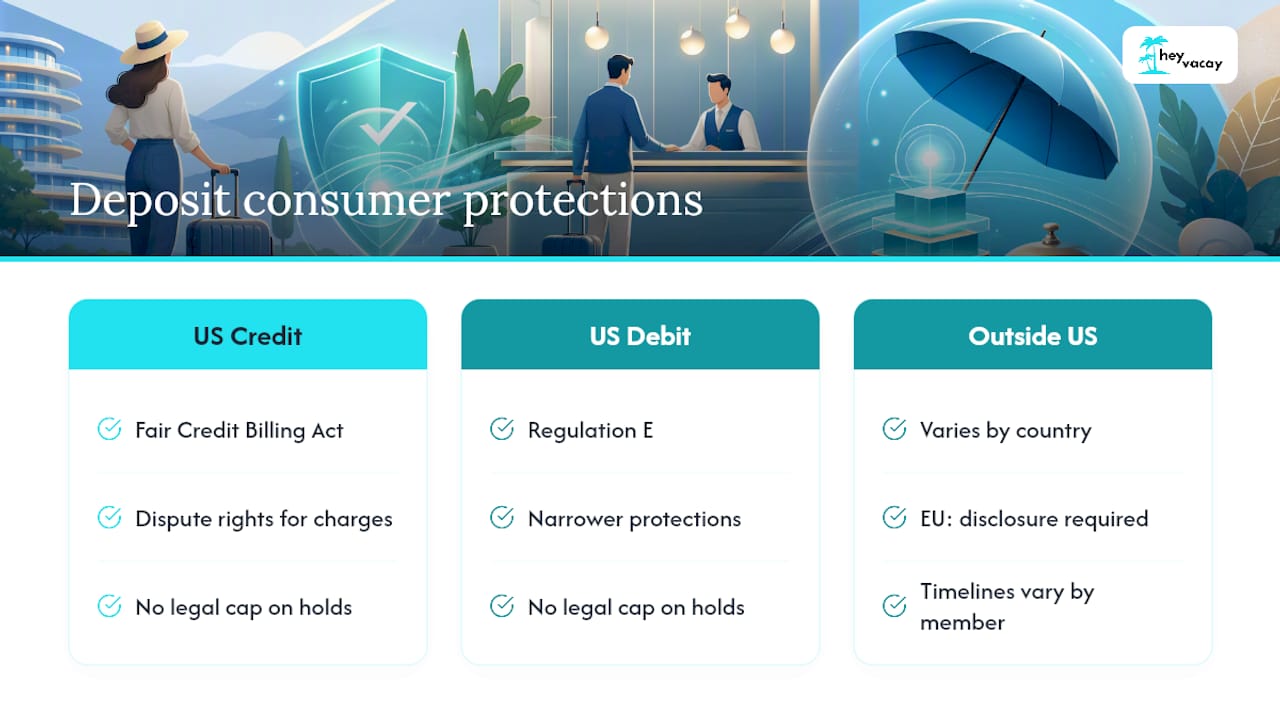
Hotel deposit rules aren't governed by one universal law. Consumer protection around deposits and holds is generally handled through banking regulations, not hospitality-specific statutes, which means your recourse usually runs through your card issuer rather than a hotel regulator.
In the United States, credit card holders have dispute rights under the Fair Credit Billing Act for charges they believe are inaccurate, including deposits that were never properly released. Debit card holders have narrower protections under Regulation E, which is one more reason credit cards are the safer choice for incidental holds. Neither law caps how much a hotel can hold or how long a pre-authorization can sit on your account, so the practical protection comes from disputing promptly rather than any hard legal ceiling.
Outside the US, consumer protection frameworks vary by country, and some jurisdictions place tighter limits on how long a merchant can hold funds before releasing or capturing them. European Union consumer rules generally require clear disclosure of any deposit or hold terms before a booking is confirmed, though enforcement and exact timelines differ by member state.
None of this replaces reading the specific hotel's cancellation and deposit terms, since those terms function as the contract you agreed to at booking. Reviewing a property's cancellation policy alongside its deposit terms gives you the clearest picture of what you can actually dispute versus what you agreed to accept.
How Hotel Deposit Policies Change From Country to Country
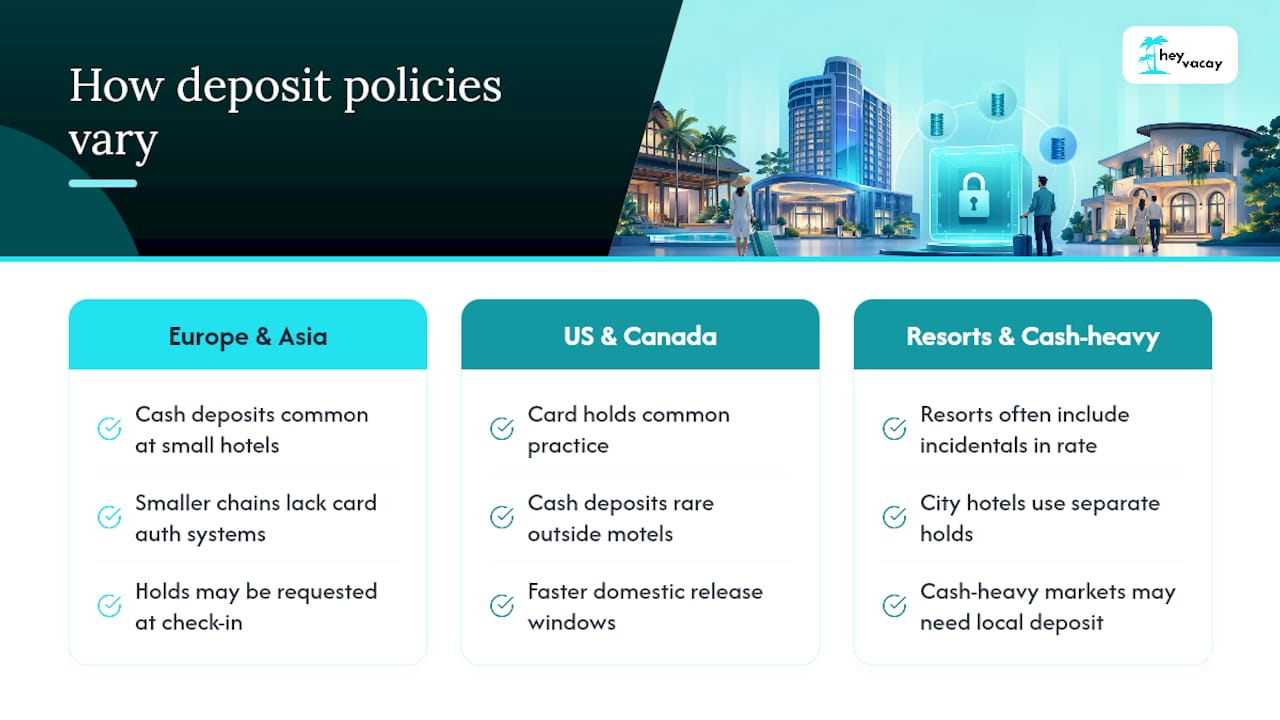
A deposit policy that feels standard in one country can feel aggressive in another. Hotels in parts of Europe and Asia sometimes request cash deposits at check-in, particularly at smaller independent properties that don't run the same card authorization systems larger chains use. That's less common in the US and Canada, where card holds have mostly replaced cash deposits outside of budget motels.
Currency and international card processing add another layer. A hold placed in a foreign currency can shift slightly in your home currency by the time it releases, thanks to exchange rate movement between authorization and settlement. International cards also tend to sit in the slower end of release windows, since cross-border processing adds extra steps most domestic transactions skip entirely.
Local business norms matter too. Resort destinations that lean heavily on all-inclusive packages often build incidental coverage into the room rate itself, reducing or eliminating the separate hold you'd see at a standalone city hotel. Meanwhile, properties in cash-heavy tourism markets may ask for a security deposit in local currency even if you paid the room rate in dollars or euros through an online platform.
The safest approach when traveling internationally is the same one that works domestically: read the property's own FAQ or contact them directly, since assuming your home country's norms apply abroad is one of the most common ways travelers get caught off guard by an unexpected hold.
Does Hotel Loyalty Status Reduce or Waive Deposits?
Loyalty program membership can soften deposit requirements, but it rarely eliminates them entirely. Many chain loyalty programs waive the incidental hold for members at higher tiers, treating that as a status perk alongside room upgrades and late checkout. Lower tiers and general members typically still face the standard hold, regardless of how long they've been enrolled in the program.
Corporate or negotiated rate bookings sometimes carry similar waivers, since properties trust repeat business accounts more than an anonymous walk-in reservation. That trust doesn't automatically extend to damage or breakage deposits, though. Even elite loyalty members can still face a hold if a property considers the room type, length of stay, or local risk factors high enough to warrant one.
None of this is guaranteed across every brand or property, since franchise-operated hotels within the same loyalty program don't always apply deposit waivers identically. If deposit-free treatment matters to your trip, confirm it directly with the specific property rather than assuming your status tier automatically applies everywhere in the chain.
HeyVacay's Take: Clarity Beats Guesswork Every Time
Deposit confusion almost always traces back to one root cause: travelers find out the rules after they've already committed to a booking. HeyVacay's approach leans toward surfacing policy details, pricing, and terms upfront on the HeyVacay platform, so you're not decoding vague front-desk language on arrival day.
We think the industry habit of burying deposit terms in fine print does travelers a disservice, especially when a $200 hold on a debit card can quietly wreck a vacation budget. Our own educational resources on cancellation policies and late checkout fees exist for the same reason: the more you know before you book, the less likely a hold catches you off guard. Our practical advice stays consistent regardless of where you book: confirm the hold amount in writing, and hang onto that confirmation until the charge clears off your statement.
— HeyVacay
Book With Confidence Through HeyVacay
Deposit surprises usually come from unclear pricing, not from hotels acting in bad faith. Some platforms are built around transparent rates with no hidden fees, so what you see during your search is what you're actually agreeing to pay for the room.

When you're comparing listings on HeyVacay, check the property details and confirmation notes for any mention of deposits or incidental holds before you lock in your dates. If a policy detail isn't clear, or you've already booked and have a question about a charge on your confirmation, the HeyVacay support page is the fastest way to get a straight answer. Start your next search on your preferred booking platform and book knowing the price you see is the price you'll pay for the room itself, with no guessing about what else might get held.
Sources
For deeper reading on hold mechanics and timelines, the Mews deposit and security hold guide breaks down deposit types in detail, while AllHotelsWeb's explainer on incidental holds covers why prepaid bookings still carry holds. For a real-world example of how a property states its own terms, the Westgate Hotel FAQ shows exactly how deposit language appears in practice. Property-specific rules always take precedence over general guidance, so confirm details directly with your hotel when it matters.
- Hotel Deposit & Security Hold Policy Guide | Mews
- Here's what happens when you use a debit card for a hotel deposit - AOL
FAQ
Do all hotels charge a deposit or hold?
Not every property does, but holds for incidentals are common across most hotel categories, even when the room itself is fully prepaid.
What's the difference between a deposit and a pre-authorization?
A pre-authorization is a temporary hold that blocks funds without withdrawing them, while a deposit or charge actually moves money and requires a refund to reverse.
Will my debit card work for a hotel deposit?
Many hotels accept debit cards, but the hold removes real cash from your checking account until released, and some properties refuse debit for incidentals entirely.
How long does it take to get a hotel deposit back?
Credit card holds often release within one to seven business days, while debit holds and international cards can take longer, sometimes up to ten business days.
Does HeyVacay show deposit information before I book?
HeyVacay presents transparent pricing and policy details on its listings so you can review deposit and hold notes before completing a reservation.