
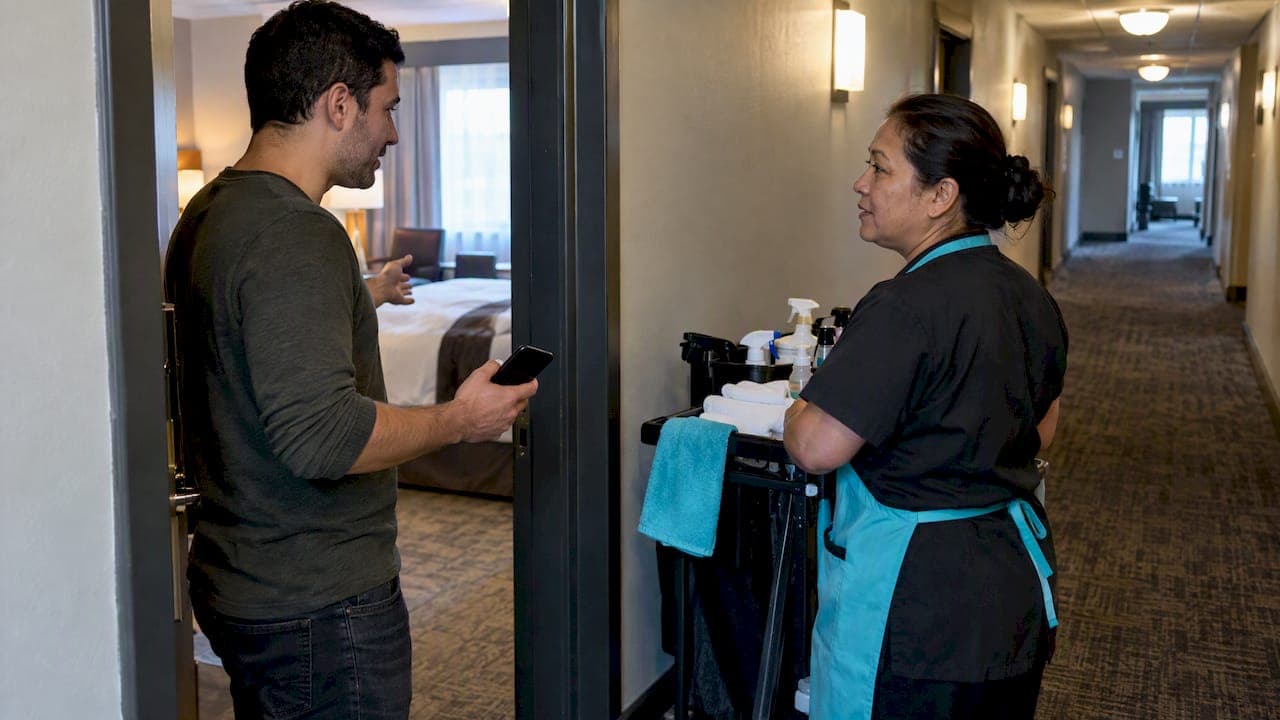
Housekeeping on request means a guest or resident asks for cleaning services on their own schedule instead of accepting a preset daily visit, and the fastest way to get it is usually a note on your reservation or a message through the hotel's app or front desk before you arrive. Most properties can accommodate a specific time window if you give them enough notice and the right details.
TL;DR:
- Hotels typically require several hours' notice for requests beyond standard refreshes, and same-day deep cleans are not always guaranteed during full occupancy.
- Adding detailed instructions, preferred timing windows, and scope of service early through digital forms or at check-in improves the chances of fulfillment.
- Clear communication of allergies or safety concerns, such as fragrance-free products or pest issues, helps staff source the appropriate solutions without delays.
- Last-minute requests or services outside normal hours may incur extra charges, so confirming fees beforehand prevents surprise bills.
- Choosing properties with transparent housekeeping policies and flexible options can reduce guesswork and improve your experience.
Table of Contents
- What Housekeeping on Request Covers in Hotels vs. Homes
- How to Request Housekeeping: Step-by-Step Options
- Housekeeping Request Form and AI-Agent Template: Fields to Collect
- Custom Requests and Safety: Allergens, Chemicals, and Pest Notes
- What Hotels and Hosts Typically Expect
- Practical Tips to Improve Fulfillment Rates
- When to Choose On-Request vs. Daily Housekeeping
- Find Stays With Clear Housekeeping Policies
- FAQ
- Sources
What Housekeeping on Request Covers in Hotels vs. Homes
The scope of "on request" service depends heavily on where you are staying. In hotels, housekeeping departments typically handle room refreshes, linen changes, trash pickup, and public-area cleaning as part of their standard operating procedures, with deep cleans usually reserved for stays longer than a few nights or handled separately from daily service, according to hospitality operations training. In residential settings, the term covers a wider range, from a single deep clean before guests arrive to recurring biweekly visits, and whether you book a professional service or handle it yourself.
Typical distinctions include:
- Hotel room refresh: quick tidy, trash removal, and towel replacement without full linen changes.
- Hotel deep clean: full linen change, bathroom scrub, and vacuuming, often requested separately from daily service.
- Residential one-off clean: a single scheduled visit, common before or after a trip.
- Residential recurring clean: a set cadence (weekly or biweekly) that can still be paused or adjusted on request.
Hotels may decline same-day deep cleans during full occupancy or short staffing, so flexibility on timing helps.
How to Request Housekeeping: Step-by-Step Options
Some request methods work better than others, mostly because they reach the right staff member faster and leave less room for a message to get lost.
- Add a note to your reservation before arrival. Most booking platforms let you include a free-text comment, and specifying your date, time window, and scope gets the request into the property's system before you even check in.
- Message the property directly pre-arrival. If the booking site does not offer a notes field, a short email or app message to the front desk a day or two before arrival works nearly as well.
- Use the hotel's app or digital form if available. Many properties now offer in-app requests that route straight to housekeeping without needing a phone call.
- Ask at the front desk during check-in. This confirms any earlier digital request and lets staff flag it for the right shift.
- Call the front desk or housekeeping extension directly. This is the most reliable fallback when other channels are slow, but it is also the most time-consuming for both sides.
Whichever method you use, include your reservation number, room number, a preferred date and time window, the exact scope (refresh vs. deep clean vs. linen only), and whether housekeeping has permission to enter while you are out. Guests who specify preferences early or reconfirm at check-in tend to see requests honored more consistently, since staff can plan around occupancy and shift schedules, as noted in hospitality reporting on room preference requests.
If you would rather minimize contact entirely, written notes through a booking form or app message reduce the back-and-forth of a phone call and still give housekeeping everything they need.
Pro Tip: Always give a window ("between 1 and 3 PM") rather than an exact time; it is far easier for housekeeping to hit a range than a single minute.
Housekeeping Request Form and AI-Agent Template: Fields to Collect
A short, predictable form or chat flow captures everything housekeeping teams need without forcing you to write a paragraph. Essential fields include:
- Guest name and reservation or room number.
- Preferred date and time window for the visit.
- Service scope (refresh, full clean, linen only, or deep clean).
- Special instructions (allergies, product preferences, areas to skip).
- Contact method for confirmation and permission to enter while away.
Optional fields worth adding: product preferences (fragrance-free, eco-certified), pets in the room, whether the request is one-off or recurring, and payment confirmation if a fee applies.
For AI chat agents or booking bots, a simple prompt skeleton works well: "Collect guest name, room number, requested date and time window, service scope, and any special instructions, then confirm entry permission before submitting." This mirrors the same fields a paper form would use, just delivered conversationally, which helps guests who would rather type a quick message than fill out a multi-field document.
Capturing guest name, room number, and requested action at the time of the request is a documented best practice in hospitality training, since incomplete records are a common cause of missed or delayed service according to lodging operations coursework.
Custom Requests and Safety: Allergens, Chemicals, and Pest Notes
If you have allergies or sensitivities, say so specifically: naming "fragrance-free detergent" or "no bleach-based cleaners" gives housekeeping something concrete to work from, rather than a general note about sensitivity.
A few safety points worth knowing before you ask for something nonstandard:
- Hotels are responsible for maintaining sanitary conditions and generally follow set procedures for chemical handling and storage.
- WHO guidance on household pesticides recommends that nonprofessionals avoid applying certain pesticides themselves, since improper use carries health risks.
- If you notice a pest issue, ask property management to arrange professional pest control rather than requesting a spray or treating it yourself.
- Fragrance-free and hypoallergenic requests are reasonable to ask for, but confirm availability since not every property stocks alternative products.
Flagging a safety concern clearly and early gives staff time to source the right product or bring in a specialist instead of improvising.
What Hotels and Hosts Typically Expect
Properties generally work within set notice windows and service hours, so understanding those constraints helps you time your request realistically.
- Most hotels prefer at least a few hours' notice for anything beyond a standard refresh, and same-day deep cleans are not always guaranteed.
- Extra fees can apply for last-minute requests, additional linen changes, or services outside standard hours, so confirming the charge before the visit avoids surprises; our guide to hotel cancellation policies covers related guest-controlled service terms worth checking.
- Full occupancy or short staffing can limit how quickly a request gets fulfilled, and staff may offer an alternative time slot rather than declining outright.
- Reconfirming your request at check-in, even after submitting it digitally, helps make sure it reaches the shift actually working your stay.
Practical Tips to Improve Fulfillment Rates
A few small habits make requests far more likely to land. Confirm your note at check-in even if you already submitted it online, and always give a time window instead of a fixed minute. Keep the wording short and polite, and mention your reservation number if you are messaging digitally so staff can match it to your room instantly.
Pro Tip: Flexibility on timing matters more than the wording of the request itself; a guest who offers a two-hour window usually gets served faster than one who insists on an exact time.

When to Choose On-Request vs. Daily Housekeeping
On-request service fits travelers who value privacy, want to control costs, or are only in a room briefly between activities. Daily service suits longer stays or guests who want consistent turnover without having to think about it. Many travelers land on a hybrid: skip daily cleaning mid-trip, then request a full refresh before checkout. The right choice depends less on the property and more on how much you actually want strangers in your space while you're out.
— HeyVacay
Find Stays With Clear Housekeeping Policies
Before you even get to the request stage, the property you book matters. Some listings spell out housekeeping frequency, fees, and flexibility up front, which saves you a round of guesswork later. We built our hotel search to surface those details alongside pricing, so you can compare options that list amenities clearly before committing to a stay.
A quick look at listed amenities, like the kind our guide to hotel amenities worth paying for breaks down, can tell you a lot about how flexible a property's service will actually be. This is a starting point for comparing stays, not a substitute for contacting the property directly once you have questions specific to your dates.
- Browse listings and compare housekeeping-related amenities on our hotel search.
- Confirm specific policy questions with the property or through our help and support page.
FAQ
What are the two types of requests in housekeeping?
Housekeeping requests generally fall into routine requests, like a standard refresh or linen change, and special requests, like a deep clean, product substitution, or a one-time schedule change. Hotels typically have standard procedures for the first type and more flexible, case-by-case handling for the second, according to lodging operations training.
What is a professional way to say housekeeping on request?
"On-demand housekeeping" or "scheduled housekeeping service" are both common, professional phrasings used in hospitality and property management. Either works well in a reservation note or when messaging front desk staff.
What are some basic rules for requesting housekeeping?
Give clear details (room number, date, time window, and scope), submit the request as early as possible, and confirm it again at check-in. Hotels are more likely to honor specific, early requests than vague or last-minute ones, as reporting on room preference requests suggests.
What housekeeping skills matter most for getting a request fulfilled well?
From the guest side, clarity, specificity, and timing matter most: a clear scope, a realistic time window, and early notice. From the property side, good record keeping and communication between shifts are what actually turn a request into a completed task.
Will hotels charge extra for housekeeping requested outside normal hours?
Some properties do charge for last-minute or outside-hours service, so it's worth confirming the fee before the visit rather than assuming it's included. Checking the property's listed policies or asking the front desk directly avoids surprises on your bill.
Sources
- Fundamentals in lodging operations by Yap et al. (2019)
- Guidance on management of household pesticides (WHO)
- Here's how to nab the quietest hotel room on your next trip (Reader's Digest)