

Monthly hotel rates are discounted prices for stays of roughly 28 nights or more, and in the US they run from about $900 a month at a budget chain to $4,500 or more at an upscale brand. The headline nightly price is only the starting point. The real number depends on the hotel tier, the season, the taxes and fees, and whether the property publishes a long-stay rate at all. At HeyVacay we compare hotel prices for you and show clear pricing with no hidden fees, so you can see what a long stay costs before you commit.
TL;DR
- Discounts for long stays usually begin at 28 nights. Monthly pricing is typically built as a discounted weekly rate first, then a deeper rate for the full month.
- US monthly ranges for 2026: roughly $900 to $1,500 at budget extended-stay chains, $1,800 to $2,800 mid-range, $2,200 to $3,500 residence-style, and $2,400 to $4,200 at full-service hotels.
- Do not multiply the nightly rate by 30. Compare the standard rate and the long-stay rate for the same property and the same dates.
- Get a written quote that covers the room rate, taxes, fees, deposit, payment schedule and extension terms.
- Many US jurisdictions stop charging occupancy tax after about 30 consecutive nights, but the rules differ by place.
Table of Contents
- How monthly hotel rates work
- What a month in a hotel costs in the US
- Why 30 times the nightly rate is the wrong math
- Total cost: the formula for a monthly budget
- Occupancy tax and the 30-day mark
- Getting the rate in writing
- Ways to bring the monthly price down
- Where HeyVacay fits in a long stay
- Our perspective
- FAQ
- Sources
How monthly hotel rates work
A monthly rate is a hotel's price for a guest who stays long enough to be treated differently from a one-night traveler. Hotels like long stays because they fill rooms for weeks with little turnover, so they trade a lower nightly price for certainty.
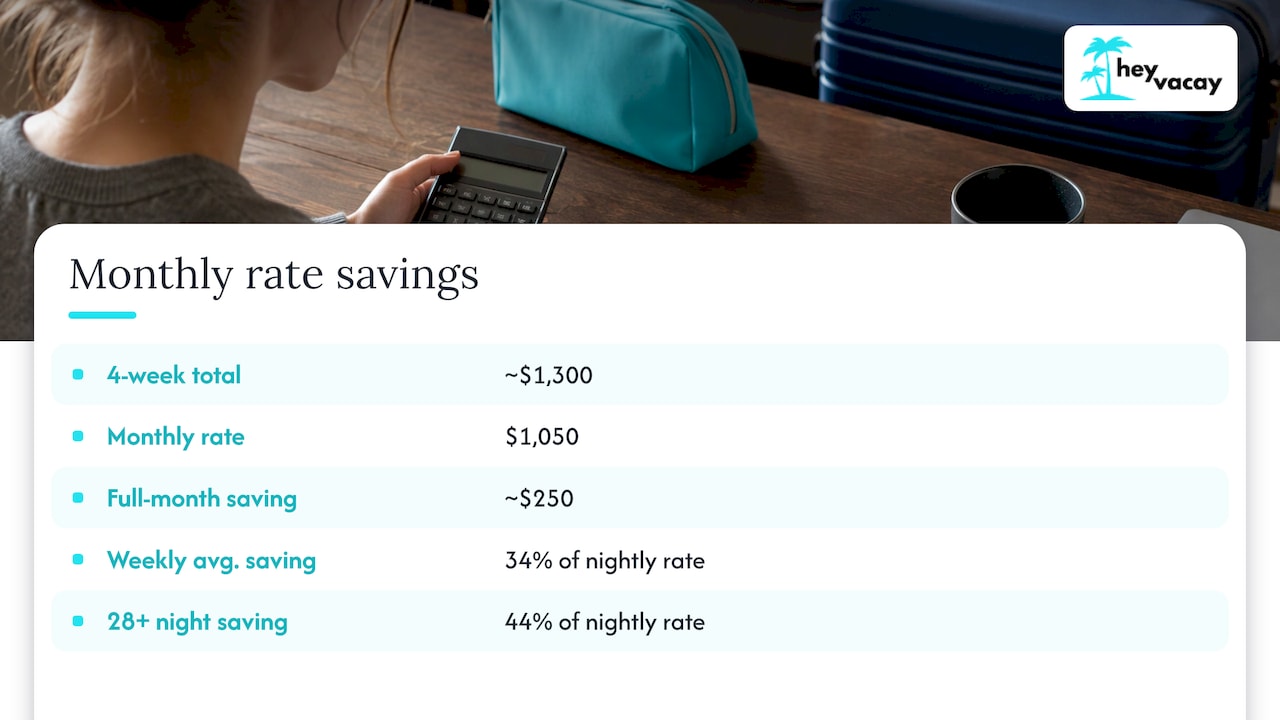
In the US, monthly pricing is usually built as a discounted weekly rate first, then a deeper monthly rate for stays of 28 or more nights. One extended-stay chain's July 2026 example shows a $325 weekly rate, about $1,300 over four weeks, against a $1,050 monthly rate. That is a saving of roughly $250 for staying the full month. The same chain says its average saving on the nightly rate is 34% for weekly stays and 44% for 28 or more nights.
Standard hotels, the kind without kitchens and long-stay branding, work differently. The same source, citing a 2026 travel study, reports that they typically take 20% to 40% off the nightly rate for 28 or more nights, and up to 50% in low season. The monthly rate is rarely published online, so it often has to be requested.
The pattern holds outside the US too. A 2026 study of Japanese extended-stay chains found that plans for 30 or more nights were a median 20% below the standard plan, weekly plans 15% below, and plans for two or more nights 10% below. The bigger your commitment, the bigger the discount, but the exact figure varies by property.
What a month in a hotel costs in the US
Published 2026 ranges for the US, by hotel tier, give a realistic frame. These are ranges from one 2026 tier table, not quotes, and your price will move with city and dates.
| Hotel tier | Typical monthly rate (2026) |
|---|---|
| Budget extended-stay chains | $900 to $1,500 |
| Mid-range extended-stay | $1,800 to $2,800 |
| Residence-style suites | $2,200 to $3,500 |
| Full-service standard hotels on monthly rates | $2,400 to $4,200 |
| Upscale major-brand properties | $4,500 to $8,000+ |
Source for every row: Northquire's 2026 extended-stay tier table.
The jump between tiers tells you what you are paying for. Budget properties typically offer a room with a small kitchen and weekly housekeeping. Residence-style suites add more space and a fuller kitchen. Full-service and upscale hotels add the lobby, restaurant, gym and staffing that come with a full hotel.

A broader industry range quoted for 2026 is $300 to $800 a week or $1,200 to $3,000 a month, depending on destination, dates, suite type and length of stay. If a number looks far outside the range for your city, that is worth a second look at what is and is not included.
Who each tier suits
- Budget travelers: The budget chains give the lowest monthly total. Weekly housekeeping and a kitchenette cover most needs for a month on the road.
- Business travelers: Mid-range and residence-style suites work well for project stays because they offer space to work and cook. Corporate rates can improve the price further.
- Families: Two-room suites cost more per month, but a kitchen and separate sleeping space often matter more than the lobby.
- Couples: For a romantic month somewhere warm, the full-service tier gives you the hotel experience at a monthly rate rather than a nightly one.
- Frequent travelers: If you repeat the same city, the monthly or weekly structure is worth learning, since you can compare it against stacked nightly stays.
Why 30 times the nightly rate is the wrong math
The nightly price on a booking page tells you little about a month. It is the price for a single night under flexible conditions, and the monthly rate follows its own logic. Our own guide on nightly versus total price walks through why the total is the only number worth comparing. For a long stay, that matters even more, because fees and taxes are multiplied across many nights.
Season shifts the picture sharply. A personal account of living in hotels reports off-season monthly rooms for roughly $600 in Turkey and $1,500 in Dubai, with the same rooms costing far more in peak season. Treat such figures as a reminder that your dates matter as much as your destination. Our guide to flexible-date hotel search shows how shifting a start date by a few days can change the total, and dynamic pricing explains why the same room has different prices on different days.
The cleanest comparison is simple. For the same property and the same stay dates, compare the standard plan against the long-stay plan. A 2026 Japanese study uses exactly that method, and it also notes that listed prices differ from what guests finally pay as booking timing and availability change. Make the comparison on the day you book, not a week earlier.
Total cost: the formula for a monthly budget
The room rate is only part of the bill. A useful monthly hotel budget formula is: the discounted stay total, including mandatory hotel fees, plus applicable government taxes, plus optional extras such as parking, pets, laundry, housekeeping and other services.
Here is a worked example with made-up round numbers to show the method:
- Monthly room rate: $2,000
- Mandatory resort or facility fee: $300 for the month
- Taxes: depends on the place, see below
- Parking: $20 a night for 30 nights is $600
- Total before tax: $2,900, which is about $97 a night rather than the $67 the room rate alone suggests
Parking is the line that surprises people most. Our guide to hotel parking fees covers how to spot them and what to do about them, which pays off when a daily charge runs for 30 nights. Breakfast is another variable: see breakfast rate versus room only to judge whether a bundled rate wins over a month. And for the full picture of what is shown, taxes included versus excluded explains what a displayed price really covers.
Is a monthly hotel cheaper than renting?
Sometimes, and the answer depends on what a lease would add. A rental normally adds a deposit, utilities, internet, furniture and cleaning. A hotel monthly rate often bundles most of these. A hotel also asks for no lease, so you can leave when your plans change, which matters for a work assignment, a relocation search or a long winter escape.
The hotel wins most clearly when your stay is short of a year, when you do not own furniture in that city, and when you book outside peak season. Add up your own utility, internet and furnishing costs for a like-for-like comparison.
Occupancy tax and the 30-day mark
Many US states and cities stop charging occupancy tax once a guest passes a set length of stay, commonly around 30 consecutive days. The guest is then treated as a resident rather than a transient. Day counts and rules vary by jurisdiction, and some properties apply the exemption automatically while others require a form.
This can change your total by double digits in percentage terms, so it deserves a question in writing. Rules on how long you can stay before your status changes differ widely by place, so ask the hotel when the exemption starts, whether you need to file anything, and whether any tax already paid is refundable.
Getting the rate in writing
A monthly rate is not always the cheaper one. Some properties use a formal long-stay agreement, while others offer only a discount code or a different cancellation policy. Request a written quote that covers these items, as recommended in a 2026 guide to extended-stay savings:
- Room rate and the exact dates it covers
- Taxes and mandatory fees
- Deposit and when it is released
- Payment schedule: upfront for the month or in instalments
- Housekeeping, kitchen and laundry equipment, and what each costs
- Parking and transport costs
- Cancellation and stay-change terms, including any early-departure penalty
- The extension rate, and whether the rate is guaranteed for the full period or subject to availability after the first term
That last item is the one people miss. If you plan to stay six weeks, ask what week five and six cost. If your plans change midstay, our guide to extending a hotel stay shows how adding nights works.
Ways to bring the monthly price down
- Start at 28 nights or more. Discounts typically begin at that point, so a 26-night stay can cost more per night than a 28-night one.
- Book low season. Standard hotels may go up to 50% off the nightly rate in slow months.
- Check in midweek. Midweek check-ins can help you secure better terms.
- Pay the full month upfront when the hotel offers a better rate for it, and you are comfortable with the cancellation terms.
- Ask about corporate or group rates. If you travel for work or with a larger party, see our guide to group hotel rates.
- Book at the right moment. Our data-backed booking timing rules show when prices tend to be lowest.
- Look at amenities that save money. A kitchen and laundry can cut a month's spending, as explained in nine hotel amenities worth paying for.
Where HeyVacay fits in a long stay
We built HeyVacay for travelers who want the same hotels at lower prices. We use AI and wholesale inventory to present hotel options at reduced rates, with clear pricing and no hidden fees. You can search several destinations at once, which helps when you are choosing between cities for a long stay. Our reservations come with flexible cancellation and real human support, so you have someone to talk to if plans shift.
Start your search on HeyVacay's hotel search, enter your dates, and compare the totals. If you have a question about a booking, our help and support page is where to go.
Our perspective
A long hotel stay is a purchase, not a long version of a short one. The nightly price on a screen is a number designed to be compared quickly, and over 30 nights every extra line on the bill is multiplied.
That is why we focus on transparency. We believe a traveler should see a price that means what it says, with no hidden fees waiting at checkout. Our approach is to use AI and wholesale inventory to bring luxury and budget hotels to travelers at lower rates than they would find on the major booking sites.
For a month away, we think the best habit is to compare totals for the same dates, ask what is included, and keep flexibility on your side. Flexible cancellation and a human to talk to are part of how we design the experience, because long trips are the ones where plans are most likely to move.
HeyVacay
FAQ
Are hotels cheaper if you stay a month?
Usually, yes. Discounts typically start at 28 nights, and standard hotels commonly take 20% to 40% off the nightly rate, while extended-stay brands build in weekly and monthly pricing. The size of the saving varies by property and season, so compare the standard and long-stay prices for the same dates.
Can I book a hotel for months at a time?
Yes. Extended-stay properties are built for it, and many standard hotels will agree to a monthly rate on request. Ask for a written quote that states the dates, taxes, fees, deposit and what happens if you extend beyond the first term.
Is it cheaper to live in a hotel than to rent?
It can be, particularly outside peak season and for stays shorter than a year. A monthly hotel rate often bundles furniture, cleaning and utilities that a rental charges separately. Add up those costs for a fair comparison, and include parking and other fees.
Do I pay occupancy tax on a monthly stay?
It depends on the state or city. Many jurisdictions stop charging occupancy tax after about 30 consecutive days, and some properties apply that automatically while others need a form. Ask the hotel in writing how tax is handled for your dates.
Sources
- Extended-Stay Hotel Monthly Rates by Tier (Northquire, 2026)
- Monthly Hotels in Japan: No Lease, 20% Off at 30 Nights (HotelBank, August 2026)
- Monthly Hotel Stay Cost in the USA (GetCostidea, 2026)
- How to Save on Extended-Stay Hotels (Privilege.live, 2026)
- Understanding visas, how long you can stay, and how to extend your stay (Qbic Travel)