

The quickest way to save on business hotels is to run one search on a metasearch tool like Google Hotels, then check the same property's direct site for a signed-in member rate, book refundable, and set a price alert. This single habit, done in under five minutes, catches most of the overpayment that happens when travelers book the first rate they see. Add midweek or shoulder-season timing and you're stacking savings on top of savings.
TL;DR:
- Comparing metasearch rates with the hotel's direct member rate often reveals discounts that prevent overpayment.
- Setting a refundable rate and then tracking for a 10% or more drop can secure additional savings by canceling and rebooking.
- Combining midweek stays, shoulder-season timing, cashback, and loyalty benefits can cut hotel costs by up to 50 percent.
- Contacting independent hotels directly during off-peak hours and asking for stay or long-term discounts can yield extra savings.
- Using corporate, group, or travel agency rates, along with free perks like breakfast and parking, further reduces overall trip expenses.
Table of Contents
- How to Save on Business Hotels: High-Impact Tactics You Can Use Right Now
- Five-Minute Booking Checklist to Avoid Overpaying
- How to Stack Savings and What Kind of Impact to Expect
- Negotiate With Independent Hotels and Long-Stay Strategies
- Leverage Corporate or Negotiated Business Rates if Eligible
- Use Group Booking Discounts if Traveling With Colleagues
- Utilize Business Travel Agencies or Corporate Travel Programs
- Check for Perks That Save Money: Breakfast, Parking, and Wi-Fi
- Use Credit Cards and Travel Rewards Built for Business Bookings
- HeyVacay was created to help automate the process of comparing metasearch rates, member pricing, and refundable options that travelers often do manually. This AI-assisted search aims to provide transparent pricing without hidden fees, so users can see the final price upfront.
- Book Smarter With HeyVacay's AI-Assisted Hotel Search
- Sources
How to Save on Business Hotels: High-Impact Tactics You Can Use Right Now
Most business travelers overpay for one reason: they book the first price they see instead of comparing it against two or three others that take almost no extra time to check.
Start with a metasearch tool. Google Hotels aggregates rates across booking platforms and hotel direct pages, which makes it the fastest way to see the full price landscape for a property before you commit to anything. Once you know the lowest public rate, sign into the hotel's own loyalty program and check its member pricing.
Here's what actually moves the needle:
- Compare metasearch against the hotel's direct site. The direct site often unlocks a member rate the aggregator can't show you.
- Join loyalty programs before you search, not after. Signing up takes two minutes and the discount applies immediately.
- Book refundable, then set a price alert. If the rate drops, cancel and rebook. This tactic alone has paid off on roughly one in four hotel bookings.
- Shift your dates when the schedule allows it. Midweek and shoulder-season stays can swing rates 15 to 50%.
- Stack a cashback or credit-card travel portal on top of the member rate. Small percentages add up across a year of trips.
- Use last-minute apps sparingly. They're great for flexible single-night stays but risky when you need a specific brand or location for a meeting.
Sign-up alerts matter more than people think. Platform sales, including Black Friday and late-summer flash promotions, can knock 25 to 40% off select properties for a limited window, and you'll miss them entirely if you're not subscribed.
Pro Tip: Set your price alert for the exact room type and dates you booked, not just the property. Rate drops on a different room category won't trigger a useful rebooking opportunity.
Last-minute opaque deals deserve a caveat. They work when you don't care which specific hotel you land in and your schedule has slack. They don't work well the night before a 9 a.m. client meeting when you need a confirmed, named property.
Five-Minute Booking Checklist to Avoid Overpaying
Run this sequence every time you book, and you'll rarely leave money on the table.
- Search the property on Google Hotels or another metasearch tool to establish the lowest publicly available rate.
- Open the hotel's direct website and sign in to your loyalty account to check the member-only rate against what you just found.
- Glance at one OTA as a cross-check. One extra tab, not five. If the direct rate already beats it, stop there.
- Book the refundable rate if you're comfortable with the price, then immediately set a price alert for that same room type and dates.
- Watch for a meaningful drop. If the rate falls by 10% or more before your free-cancellation deadline, cancel and rebook at the lower price.
For flight-plus-hotel trips, bundle only when the combined price beats booking each piece separately, and only when your return date is fixed. If your meeting schedule might shift, book the hotel and flight separately so you can change one without forfeiting the other.
Pro Tip: Screenshot the refundable rate and cancellation deadline the moment you book. Hotels sometimes tighten cancellation windows closer to the stay date, and you want proof of your original terms.
This checklist takes less time than ordering lunch, and a two-step habit of metasearch-then-direct-site catches most avoidable overpayment before it happens.
How to Stack Savings and What Kind of Impact to Expect
Layering tactics beats relying on any single one. Add midweek or shoulder-season timing on top of that and the combined effect can reach 30 to 50% savings compared to booking the first available rate on default dates.
Credit-card travel portals and cashback portals add another layer. Neither move is dramatic on its own, but they cost nothing extra to use.
Here's the math on a $150-a-night hotel:
- Member rate + direct booking: save roughly $7.50 to $22.50 per night.
- Add midweek or shoulder-season timing: total savings climb toward $45 to $75 per night.
- Add a cashback portal or rewards card: shave off another dollar or two per night, or bank points toward a future stay.
Over a dozen trips a year, that's the difference between paying full freight and covering an extra flight home to see your family.
Decide your priority based on your travel pattern. If you fly the same route to the same city every month, concentrate loyalty with one chain. If your trips are one-off and your dates are flexible, skip loyalty-building and hunt for the best price each time instead.
Negotiate With Independent Hotels and Long-Stay Strategies
Independent hotels don't pay the 15 to 25% commission that online travel agencies charge, and many will pass part of that savings to guests who book direct, especially during slow periods or for multi-night stays.
Call or email the property directly and ask plainly: "Do you offer a discounted rate for direct bookings, or any rate flexibility for a three-night stay?" Front-desk managers have more pricing authority than most travelers assume, particularly midweek or during shoulder season when occupancy is soft.
- Call during off-peak hours, mid-morning or mid-afternoon, when the front desk isn't juggling check-ins.
- Mention the length of your stay upfront. Three-plus nights gives the property a reason to say yes.
- Ask about added perks, not just price. Free breakfast or a room upgrade sometimes come easier than a rate cut.
Pro Tip: If the front desk can't authorize a discount, ask to speak with the general manager or revenue manager. That's usually where the actual pricing flexibility lives.
Leverage Corporate or Negotiated Business Rates if Eligible
If your employer has any kind of preferred-hotel agreement, even an informal one, it's worth five minutes to check before you book on your own. Some companies negotiate corporate rates with specific chains near common destinations, and these rates often beat public pricing by a meaningful margin because they're tied to guaranteed volume.
Ask your travel coordinator or manager whether a corporate code exists for your destination. If one does, it usually needs to be entered at booking, either on the hotel's direct site or through a specific portal your company uses.
If you don't have access to a formal corporate program, you're not out of options. Some hotels extend similar pricing to individual travelers who ask, particularly for repeat visits to the same city. Read our guide on getting corporate-style hotel rates without a company program for the specific phrasing that tends to work.
One caveat worth knowing: corporate rates aren't always the cheapest option available. Compare the negotiated rate against a member rate found through the metasearch-then-direct-site checklist above. Sometimes the public member rate, especially during a sale window, actually beats the corporate number. Never assume the corporate code wins by default. Check both.
Use Group Booking Discounts if Traveling With Colleagues
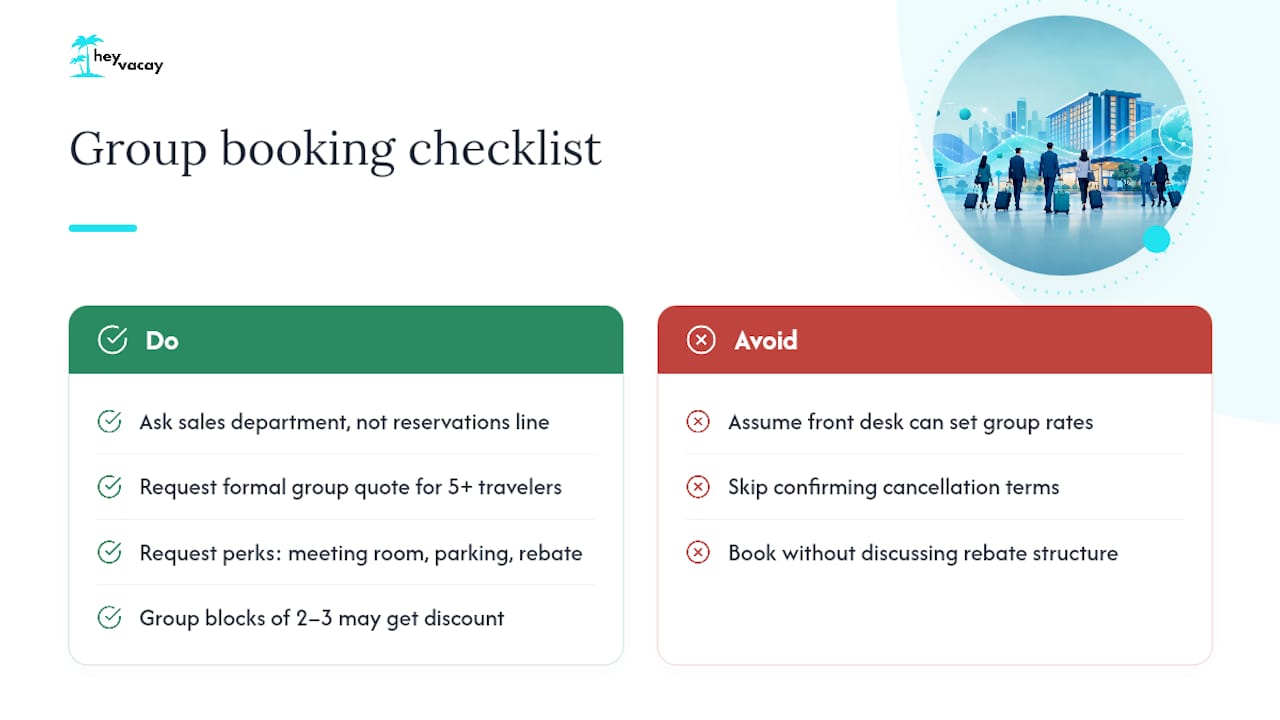
Traveling to the same conference or client site with two or more coworkers changes your negotiating position. Most hotels define a "group" booking as anywhere from five to ten rooms, but even smaller blocks of two or three rooms booked together sometimes qualify for a modest discount if you ask directly.
Contact the hotel's sales department, not the general reservations line, when you know multiple colleagues need rooms for the same dates. Sales teams handle group inquiries differently than individual bookings and often have rate flexibility that front-desk staff don't.
Group rates typically come with added value beyond the per-night price. Hotels frequently throw in a complimentary meeting room, discounted parking for the group, or a rebate structure where the group organizer earns a free night after a certain number of room-nights are booked.
If your trip involves five or more travelers, it's worth requesting a formal group rate quote even if your company isn't managing the booking centrally. Our guide on group hotel rates walks through when this makes sense and how to structure the ask so the sales team takes it seriously.
One practical note: group rates are usually less flexible on cancellation than individual refundable bookings. Confirm the cancellation terms for the block before everyone commits, especially if travel plans could still shift.
Utilize Business Travel Agencies or Corporate Travel Programs
Some individual travelers have access to a corporate travel program or a company-designated travel agency, even without realizing it. If your employer reimburses trips, check whether there's a preferred booking channel before you default to a consumer platform.
Travel management companies and corporate travel agencies negotiate volume-based rates with hotel chains that can beat public pricing, particularly in cities with heavy business travel traffic. The tradeoff is flexibility. These programs sometimes restrict you to a narrower set of approved properties, and last-minute changes can come with fees that a self-booked refundable rate wouldn't carry.
If your company doesn't offer a formal program, that doesn't shut the door entirely. Some travel agencies work with individual travelers on a fee or commission basis and can access rates that aren't publicly listed. Whether this makes sense depends on how often you travel and how much time you'd otherwise spend comparing rates yourself.
For most individual travelers booking their own trips without a company program behind them, running the metasearch and direct-site comparison covers most of the same savings a travel agency would find, without the added fee. Reserve the agency route for complex, multi-city trips where the time savings outweigh the cost.
Check for Perks That Save Money: Breakfast, Parking, and Wi-Fi
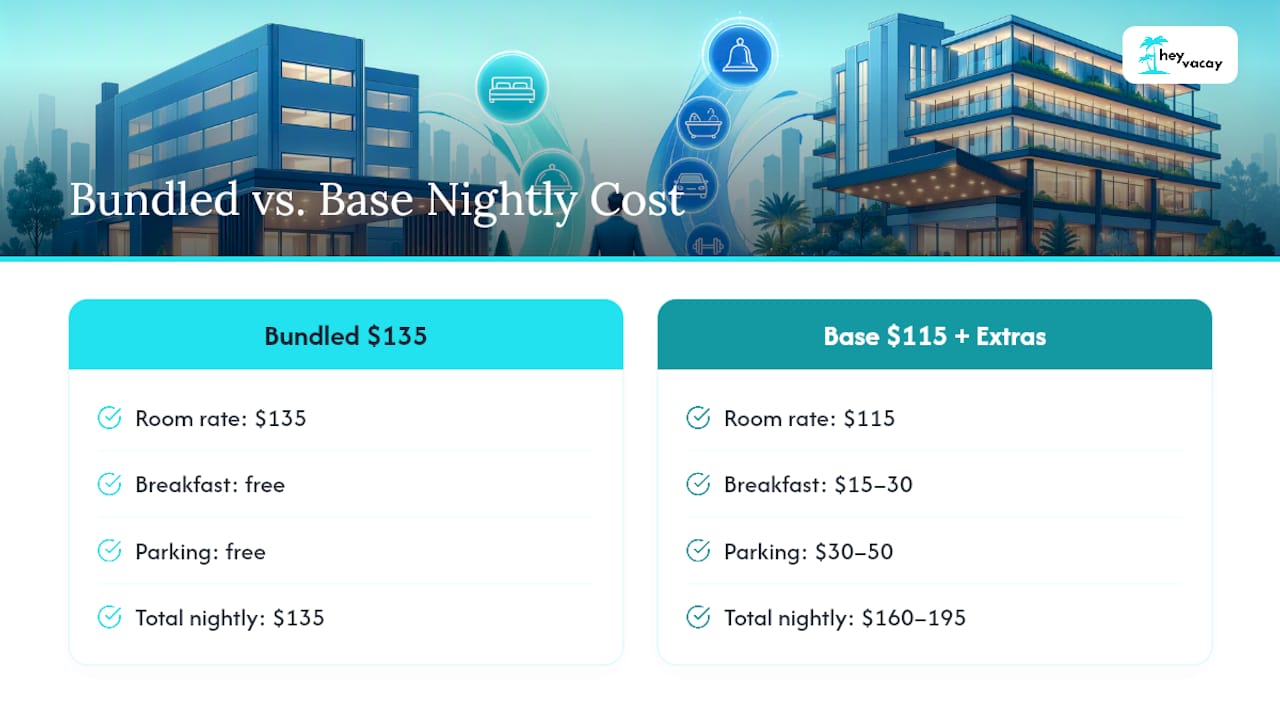
The nightly rate is only part of the real cost of a business trip. Free breakfast alone can save $15 to $30 a day compared to eating out near an unfamiliar hotel, and that adds up fast across a multi-night stay.
Parking matters more than most travelers budget for, especially in dense downtown areas where self-parking can run $30 to $50 a night at hotels that don't include it. A slightly higher room rate that bundles free parking sometimes beats a cheaper room rate plus a nightly parking fee.
Wi-Fi is table stakes for business travel, but not every hotel includes it free for standard rooms. Some properties reserve complimentary Wi-Fi for loyalty members, which is one more reason signing into a free loyalty account before booking pays off even when you're not chasing a member rate discount.
Before comparing two properties on price alone, check what each one bundles in. A $135 room with free breakfast and parking often beats a $115 room where both cost extra.
Use Credit Cards and Travel Rewards Built for Business Bookings
The right credit card turns every business hotel stay into a small, ongoing discount. Cards built around travel rewards typically offer elevated points or cashback specifically on hotel bookings, on top of whatever member rate or refundable deal you've already locked in.
Booking through your card's own travel portal sometimes unlocks an additional discount or bonus point multiplier beyond what you'd get booking the hotel directly. The tradeoff: portal bookings occasionally forfeit hotel loyalty point-earning, so compare the value of the card's bonus against the loyalty points and perks you'd lose.
Concentrating loyalty on one primary hotel chain when you travel frequently can be worth $30 to $60 a night in perks like free breakfast, lounge access, and late checkout. If your card and your preferred chain overlap, that combination compounds quickly. Compare hotel loyalty against booking-site perks before deciding where to park your travel spending.
HeyVacay was created to help automate the process of comparing metasearch rates, member pricing, and refundable options that travelers often do manually. This AI-assisted search aims to provide transparent pricing without hidden fees, so users can see the final price upfront.
We've watched travelers assume the cheapest-looking listing is automatically the best deal, only to discover a member rate or a bundled perk would have beaten it. The checklist in this guide works whether or not you use a tool to speed it up. What changes with automation is the time it takes to run that comparison on every single trip, not the logic behind it.
Try the five-minute checklist yourself on your next booking, with or without help.
— HeyVacay
Book Smarter With HeyVacay's AI-Assisted Hotel Search
This platform addresses the common challenge of comparing metasearch rates, direct member rates, and other discounts that travelers may overlook. By streamlining rate comparison, it aims to help users find competitive hotel prices with clear pricing and no hidden fees.
You can still run the manual checklist if you'd rather, but HeyVacay does the heavy lifting so you spend less time cross-checking rates and more time on the parts of your trip that actually need your attention. If you're planning your next business stay, start your search on HeyVacay and see what the same room costs when the comparison work is already done for you. Need help understanding how a rate was calculated or how your account works? Our help and support page walks through the details.
Sources
- How to Save Money on Hotels: A 2026 Field Guide for Real Travelers | Compass Draft
- How to Find Cheap Hotels in 2026: 7 Booking Strategies That Actually Save You Money
- How to Save Money on Hotels: The Budget Traveler's Guide
- Business Travel Guide 2026: Tips & Tools — TravelBuzzy