

Yes, splitting a hotel reservation into two bookings sometimes cuts your total bill, and it's worth checking whenever your stay crosses a weekend, sits on top of an event date, or runs four nights or longer. The test takes five minutes: price the full stay, then price the obvious split point separately.
TL;DR:
- Splitting a stay can save between 5 and 40 percent, especially when crossing high-demand nights, weekends, or local events, provided you compare segment prices to a continuous booking.
- Booking two reservations at the same hotel or switching hotels mid-stay can be worthwhile if the combined cost drops significantly and the move is quick and simple.
- Check cancellation policies, fees, inclusions, and loyalty credits before splitting, as hidden costs like resort fees or losing meal packages can erase potential savings.
- Timing your check-in and check-out carefully and packing efficiently reduces logistical costs, making splitting more practical and less stressful.
- Using AI-powered platforms like HeyVacay helps identify cost-effective split options across multiple hotels and automatically compares total prices with fees included.
Table of Contents
- Why Splitting a Stay Sometimes Lowers the Price
- How Do You Actually Book a Split Stay?
- What Should You Check Before You Split a Booking?
- How Do You Handle the Logistics of a Split Stay?
- HeyVacay's Take on Split-Stay Savings
- Check Your Split Options on HeyVacay
- Sources
- FAQ
Why Splitting a Stay Sometimes Lowers the Price
Hotels don't price every night the same way, even within one continuous stay. Rooms get sorted into rate buckets tied to demand, and a single expensive night, say a Saturday during a festival, can pull the price of every other night in your stay up with it. Book that same stretch as two separate reservations instead of one, and each chunk gets priced on its own terms.
Length-of-stay controls make this worse than most travelers realize. Hotels commonly use a restriction called closed-to-arrival, which blocks or repriced continuous bookings that span a high-demand night. Cornell's industry guidance on length-of-stay controls explains how these controls work and why they can make a five-night stay disproportionately expensive if even one of those nights is locked down. Splitting your dates into two separate reservations can sidestep that control entirely.
The savings show up most reliably in a few situations:
- Trips that straddle a weekend, where Friday and Saturday carry a premium the weekdays don't
- Stays that overlap a local event, conference, or festival on just one or two nights
- Trips crossing a season boundary, like the last week of low season into the first week of high season
- Any stay of four nights or more, where rate volatility has more room to work against you
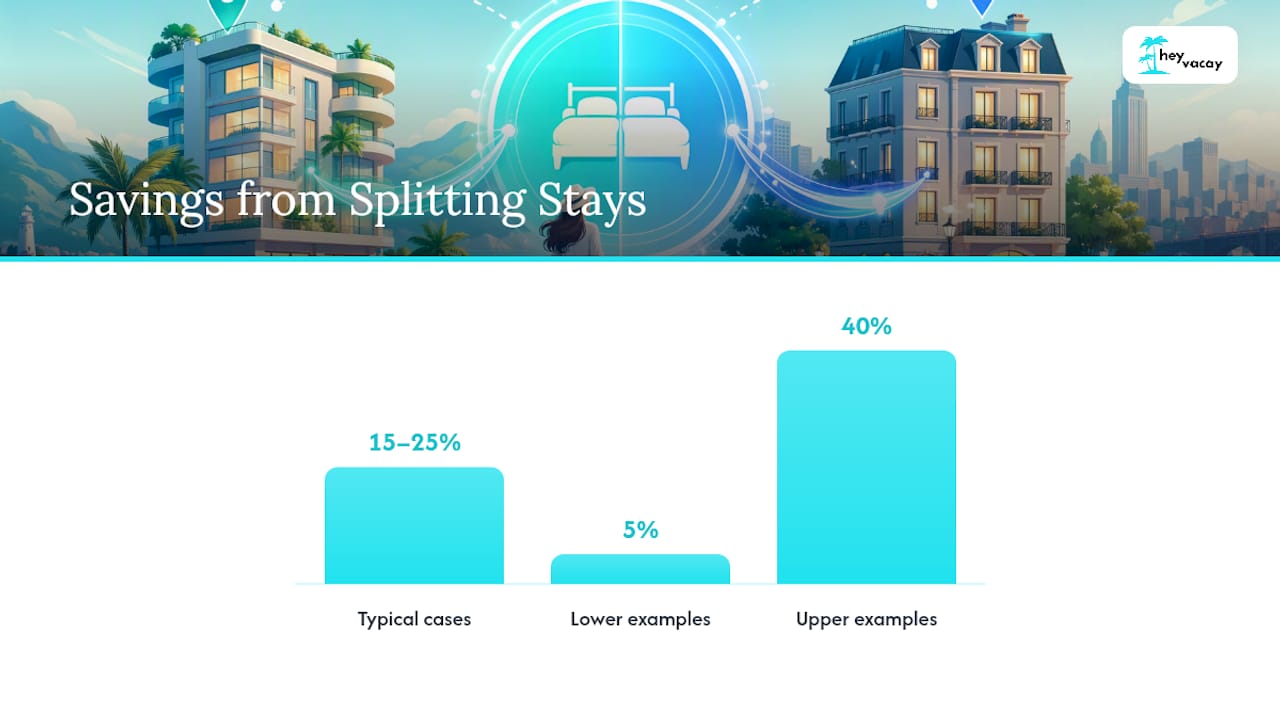
Statistic: Splitting one stay into two reservations can cut the total bill by roughly 15 to 25 percent in many documented cases, and broader examples across different date patterns show savings ranging from 5 to 40 percent depending on how sharply rates spike around the trigger night. The catch: those numbers assume you're not paying twice for things like resort fees or breakfast packages, which can eat the difference fast.
How Do You Actually Book a Split Stay?
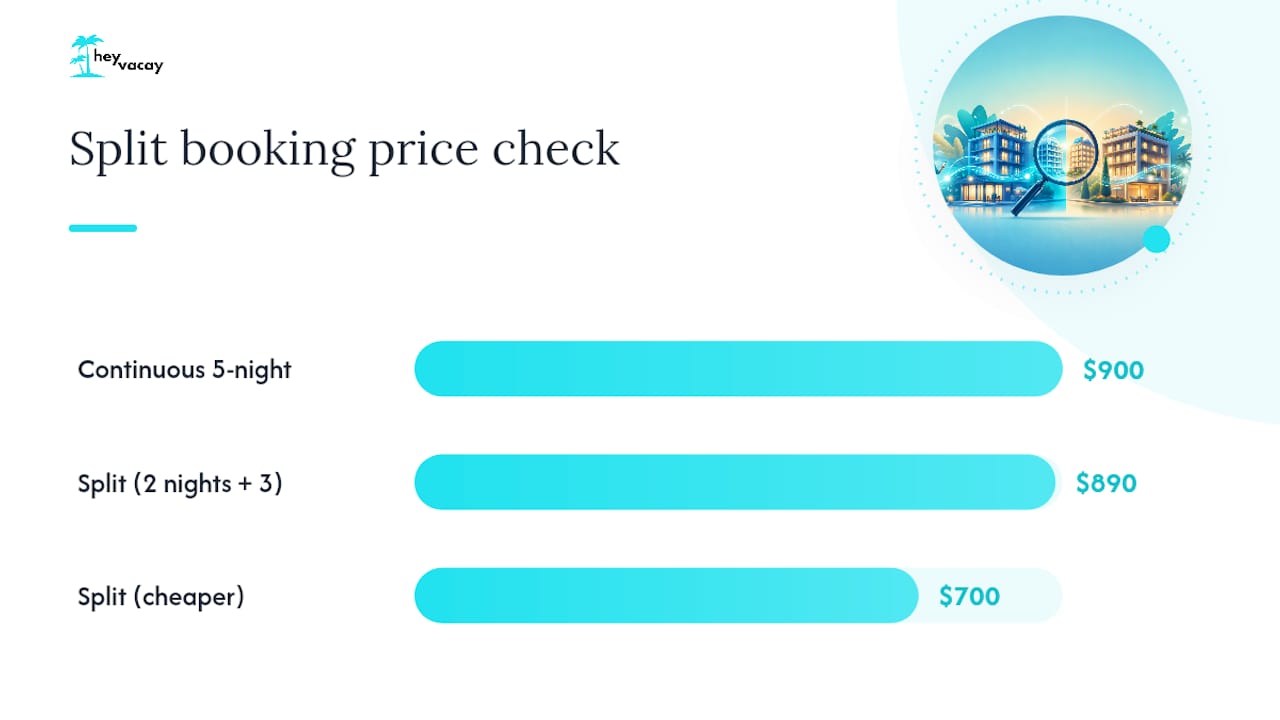
Start with the same price check every time: look up the full continuous stay, then separately price the segment before and after your suspected trigger night (the weekend, the event date, the season cutoff). Compare the sum of the two segments to the single continuous booking. If a five-night stay prices at $900 straight through but splits into $380 for two nights plus $410 for three nights, that $890 total barely moves the needle, not worth the hassle. If the split comes in at $700, it's worth booking that way.
From there, you have four practical routes:
- Book two consecutive reservations at the same hotel. This is the simplest method. Reserve the first block, then the second, under the same name and dates that connect. Tell the front desk at check-in that you have back-to-back reservations so they can try to keep you in the same room instead of forcing a move.
- Switch hotels mid-stay. Worth doing when the price gap is large enough to offset the hassle of repacking, and when the second property is within a short walk or cheap rideshare of the first. Don't switch hotels to save $20 if it costs you an hour and a taxi fare.
- Use group booking channels and pay the hotel directly. For multi-room or multi-family trips, group booking desks let you consolidate rooms under one negotiated rate while each payer settles up with the hotel rather than a third party, which keeps invoicing and cancellations clean.
- Use a multi-destination or circuit booking tool. Some booking platforms let you add multiple hotels and transport legs inside one itinerary record while keeping each hotel stay as its own entry. This is functionally a split booking, just packaged as one trip on the back end.
Pro Tip: When you split at the same hotel, ask if your loyalty number can be linked to both reservations before you arrive. Some properties won't credit night stays properly across two bookings unless the front desk merges them manually at check-in.
What Should You Check Before You Split a Booking?
A saving on paper can vanish once fees and fine print enter the picture, so run through this list before you commit to two reservations instead of one.
- Cancellation policies on both bookings. A nonrefundable rate on one segment and a flexible rate on the other creates mismatched risk, especially if your plans could shift.
- Per-reservation fees. Cleaning fees, resort fees, and service charges often apply per booking, not per stay, so two reservations can mean paying that fee twice.
- Package inclusions. If breakfast or parking is bundled into the room rate, check whether both segments include it or only one, since losing it on the second booking erases part of the saving.
- Loyalty and elite night credit. Confirmation and processing can vary depending on how the split booking was made, so add your member number to both reservations and confirm the hotel will count both toward night credit.
- Tax and invoice handling for group or multi-payer bookings. If more than one person is paying, confirm the hotel can issue separate folios or one combined invoice, whichever your group actually needs.
Statistic: The rule of thumb worth remembering is the 8% threshold: if the split total beats the continuous-stay price by less than that, the extra check-in and packing rarely justifies it.
How Do You Handle the Logistics of a Split Stay?
The money-saving math only holds up if the moving part doesn't cost you time, energy, or a second cab fare you didn't budget for.
- Ask the front desk directly whether you can stay in the same room across both reservations, especially at the same hotel. Housekeeping schedules sometimes allow it if you ask before your first check-in.
- If a room change is required, request early access to the new room or ask staff to hold your bags so you're not stuck waiting in a lobby between checkout and check-in.
- Time your check-out and check-in around the hotel's slower hours, typically midmorning, rather than the 3 p.m. arrival rush when front desks are busiest.
- Keep any hotel switch within a short walk or a low-cost transfer. A five-minute move preserves your saving; a 30-minute crosstown trip with luggage usually doesn't.
Pro Tip: Pack your first night's bag separately if you know you're switching hotels midway. You'll spend less time repacking in a lobby and more time actually on your trip.
HeyVacay's Take on Split-Stay Savings
Manually testing every possible split point across a five-night trip is tedious, and that's exactly the gap HeyVacay's approach to hotel search is built to close. Some travel booking platforms use AI to scan luxury and budget inventory and surface lower-priced combinations that a manual search often misses, including cases where breaking one stay into two reservations beats the continuous price.
Pricing transparency matters here too. A split booking only saves money if you can see the full cost of each segment, taxes and fees included, side by side. An ideal pricing display shows the full total up front, so you're comparing real numbers instead of a teaser rate that grows at checkout.
For trips that touch more than one city or property, HeyVacay's multi-city booking data shows how reordering nights across stops can lower a total itinerary cost, the same rate-bucket logic that makes single-property split stays work. If you're weighing whether to pay in full now or settle at the front desk, HeyVacay's breakdown of pay now versus pay at hotel is worth reading before you lock in either segment.
— HeyVacay
Check Your Split Options on HeyVacay
You don't need three browser tabs and a spreadsheet to find out if splitting your stay pays off. Run one multi-night search on HeyVacay, then try pricing your suspected split point right in the same search. Because HeyVacay pulls from AI-matched luxury and budget inventory with clear, all-in pricing, you're comparing real totals against each other instead of guessing which quote hides a resort fee.

If your trip involves a group, a mix of payers, or you're unsure whether to pay now or settle at the desk, HeyVacay's help and support page can walk you through invoicing and payment handling before you book. Start with a search on HeyVacay's hotel platform, test your split point, and book whichever version actually comes out cheaper.
Sources
The savings figures and booking mechanics referenced throughout this article draw from a handful of consistent sources: Cornell's industry guidance on length-of-stay controls, practitioner breakdowns on how splitting one hotel stay into two reservations lowers cost, and a companion piece on switching hotels mid-trip to cut a bill. For the mechanics of multi-hotel itineraries, Tourpaq's circuit booking documentation and Vio's support notes on how split booking works cover confirmation and check-in behavior in more detail. For background on why identical rooms show different prices depending on where and how you search, see Masklabs' explainer on location-based pricing variance.
- Circuit bookings (Tourpaq manual)
- How does Split Booking work? – Vio support
- The dos and don'ts of length-of-stay (Cornell industry guidance)
FAQ
Do Hotels Allow Split Payments?
Most hotels will let multiple guests or a group leader settle a bill across more than one payment method at checkout, but this is different from splitting the reservation itself into two separate bookings. For group trips, paying the hotel directly rather than routing payment through a third party keeps invoicing simpler for everyone involved.
Is It Better to Book a Hotel Through a Website or Directly?
It depends on the price gap, not a blanket rule. Compare the total cost, taxes and fees included, on both the hotel's own site and a search platform like HeyVacay, since AI-matched inventory sometimes surfaces a lower total than booking direct, especially across multi-night or split stays.
What Are the Best Hotels to Stay in Split, Croatia?
That depends entirely on your budget and neighborhood preference, whether you want to be inside the old town walls or closer to the waterfront promenade. Running a search on a platform like HeyVacay lets you compare current rates across neighborhoods rather than relying on a fixed "best of" list that goes stale fast.
Is Three Days in Split Enough?
Three days covers the old town, Diocletian's Palace, and a day trip or two comfortably, though it's tight if you're also trying to reach nearby islands. If your stay runs four nights or longer, that's also the point where checking for split-booking savings on your hotel starts to make sense.