
Hotels usually cost less for stays under five nights, solo travelers, and couples. Airbnb usually wins for groups of four or more and stays past a week, once you split the cost per person. The catch: cleaning fees and service charges can flip either result, so the only honest comparison is the all-in total, not the nightly rate you see in search results.
TL;DR:
- Airbnb usually becomes more cost-effective than hotels after staying for at least five to seven nights due to fee dilution and available discounts.
- When comparing total costs, include all fees, taxes, and extras, and divide by the number of travelers to get an accurate per-person price.
- Short stays of one to two nights nearly always favor hotels because cleaning and service fees inflate Airbnb costs for brief visits.
- Business travelers and solo trips benefit more from hotels due to amenities, loyalty programs, and flexible cancellation policies that often lower overall expenses.
- Relying on all-in total prices rather than nightly rates prevents hidden fees from skewing the comparison and ensures a truthful cost assessment.
Table of Contents
- Hotel vs Airbnb Cost: What to Add Up Before You Compare
- When Is Airbnb Cheaper Than a Hotel?
- When Do Hotels Beat Airbnb on Price?
- How to Calculate the True All-In Price Before You Book
- Booking Tactics That Actually Lower Your Total Cost
- Why the "All-In Price" Is the Only Number That Matters
- Compare Real Hotel Totals Before You Book
- Sources
- FAQ
Hotel vs Airbnb Cost: What to Add Up Before You Compare
The nightly rate you see on either platform is a starting bid, not a final price. Hotels bundle most of their markup into that one number, plus taxes and sometimes a resort fee. Airbnb spreads its markup across a nightly rate, a cleaning fee, a guest service fee, and often a local occupancy tax that gets added at checkout.
To compare apples to apples, add up these line items for both options:
- Base nightly rate multiplied by the number of nights
- Cleaning fee (Airbnb only, charged once regardless of stay length)
- Service or platform fee (both, though Airbnb's runs higher as a percentage)
- Occupancy taxes and local charges
- Resort or amenity fees (common at hotels in beach and casino markets)
- Parking, if not included
- Total divided by the number of travelers, not just the number of rooms
Skift's pricing analysis found the global average nightly rate for a one-bedroom Airbnb sits near $114, versus roughly $140 for a comparable hotel room. That gap looks decisive until you add fees, because Airbnb's average often excludes how hosts bundle cleaning and service costs into the guest-facing total. A $114 listing with a $90 cleaning fee on a two-night stay effectively becomes $159 a night, well above the hotel.
Run the math on two real scenarios. A couple booking two nights in a mid-size city might see a $130 hotel room with taxes landing near $290 total. The same couple booking an Airbnb at $110 a night plus an $85 cleaning fee and $30 service fee lands closer to $335, a worse deal despite the lower headline rate.
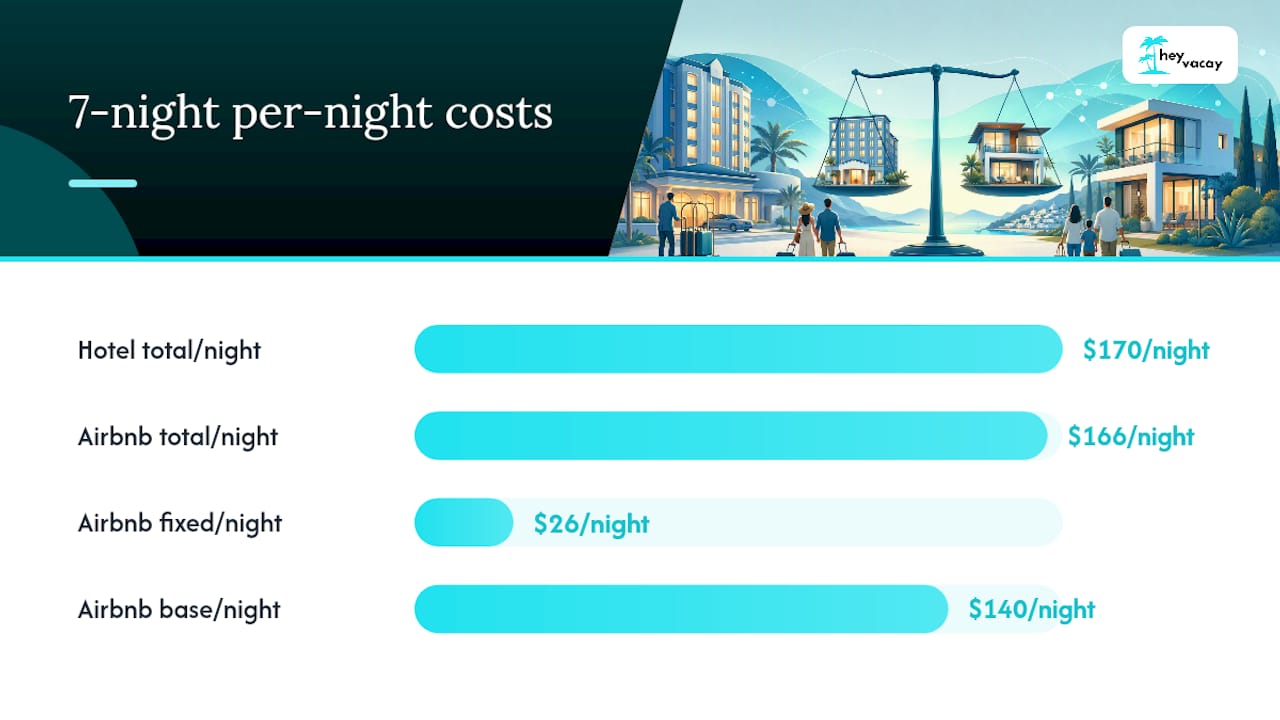
Now stretch it to seven nights for a family of four. The hotel runs $150 a night plus taxes, totaling around $1,190. An Airbnb at $140 a night with a $120 cleaning fee and $60 service fee comes to about $1,160, and that's before factoring in the money saved by cooking a few meals instead of eating out. The fixed fees matter far less once they're spread across more nights.
Pro Tip: Always toggle to "total price" if the platform offers it. Airbnb added this display option after years of criticism over hidden fees, and it's the single fastest way to stop comparing a fake number to a real one.
When Is Airbnb Cheaper Than a Hotel?
Airbnb pulls ahead once you cross two thresholds: enough nights to dilute the cleaning fee, and enough travelers to make per-property pricing beat per-room pricing. Here's where the data draws the line.
- Five to seven nights is the general breakeven point. Idyllic Pursuit's multi-city tracking found that many short Airbnb stays came in more expensive than comparable hotels once cleaning and service fees were added, with the rental typically pulling ahead only after five to seven nights. Below that, you're often paying a flat $100 to $250 cleaning fee for the privilege of unpacking your own suitcase.
- Weekly and monthly discounts change the math fast. Many hosts knock 10% to 20% off the nightly rate for stays of seven nights or longer, on top of the fee dilution you already get from staying longer. NerdWallet's cost analysis found a seven-night Airbnb stay ran about 32% cheaper than an equivalent hotel booking once those discounts and amortized fees were factored in.
- Group size multiplies the savings. Hotels price by the room, so a family of six needs two or three rooms. Airbnb prices by the property. NerdWallet's analysis found that for groups of six, a single large Airbnb tends to be cheaper than booking multiple hotel rooms, since cleaning and service fees are charged only once per property.
- Kitchens quietly do the heaviest lifting. A family that cooks four dinners during a week-long stay can save more on groceries than the entire cost difference between a hotel and a rental. That's before counting breakfast, which most hotels charge $15 to $25 per person to add.
- Secondary and off-peak destinations favor rentals more heavily. In markets with lower hotel-tax rates and softer seasonal demand, hosts have more room to discount, and the fixed fees stay flat while nightly savings widen.
The exceptions worth flagging: repeat rebooking with the same host sometimes gets fees waived, and destinations with weak hotel supply, think smaller ski towns or beach towns outside peak season, tend to make private rentals the default cheaper option almost regardless of stay length.
When Do Hotels Beat Airbnb on Price?
Short stays are where hotels reliably win. That math almost never favors the rental.
Solo travelers and couples face the same problem from a different angle: they're paying for an entire property's cleaning and service fee to house one or two people, when a single hotel room was built for exactly that headcount. Ohio University tourism expert Sandy Chen recommends picking lodging by trip purpose specifically because of this mismatch. Chen's guidance is straightforward: hotels for short and business trips, rentals for families and longer stays where a kitchen offsets other costs.
Business travel tilts even further toward hotels. Loyalty programs return real value here, since points, elite-tier upgrades, and free breakfast lower the effective cost in ways an Airbnb booking can't replicate. A traveler with mid-tier hotel status might get a free room upgrade, late checkout, and breakfast worth $30 to $40 a day, savings an Airbnb simply has no mechanism to offer.
A few other factors push the total in the hotel's favor even when the sticker price looks close:
- Cancellation flexibility. Most major hotel chains offer free cancellation up to 24 to 48 hours before arrival. Airbnb hosts set their own policies, and many enforce partial or no refunds within seven days of check-in, a real cost if your plans shift.
- Included amenities. Free Wi-Fi, parking, breakfast, and gym access all show up as separate line items you'd otherwise pay for near an Airbnb. Certain hotel amenities genuinely lower your total trip cost once you price them individually.
- Location premiums pay for themselves. A hotel in a walkable downtown core can eliminate $15 to $40 a day in rideshare or parking costs that a cheaper, farther-out rental would otherwise require.
- Predictability reduces risk. No host cancellations, no last-minute lockout issues, and 24-hour front desk support if something goes wrong. For business travelers on a tight schedule, that reliability has real financial value if a mishap would mean missing a meeting.
How to Calculate the True All-In Price Before You Book
Compare the two options using the same five-step formula every time, regardless of destination or trip length.
- Add the base cost. Multiply the nightly rate by the number of nights for both the hotel and the Airbnb listing you're considering.
- Add every mandatory fee. Cleaning fee, service or platform fee, and any local occupancy tax. Hotels usually fold this into a "taxes and fees" line at checkout; Airbnb itemizes it separately.
- Add anything you'd otherwise pay for separately. Parking, breakfast, Wi-Fi, resort fees. If the hotel includes them and the rental doesn't (or vice versa), assign a realistic dollar value to the missing item rather than ignoring it.
- Divide by the number of travelers, not the number of rooms or the number of nights. This step is where hotels quietly lose ground for groups, since a $200 room times two rooms is $400 split four ways, or $100 per person, while a $300 whole-home rental split six ways is $50 per person.
- Factor in transportation. A cheaper rental 20 minutes outside downtown can cost more overall once you add daily rideshare or gas money to reach restaurants and attractions.
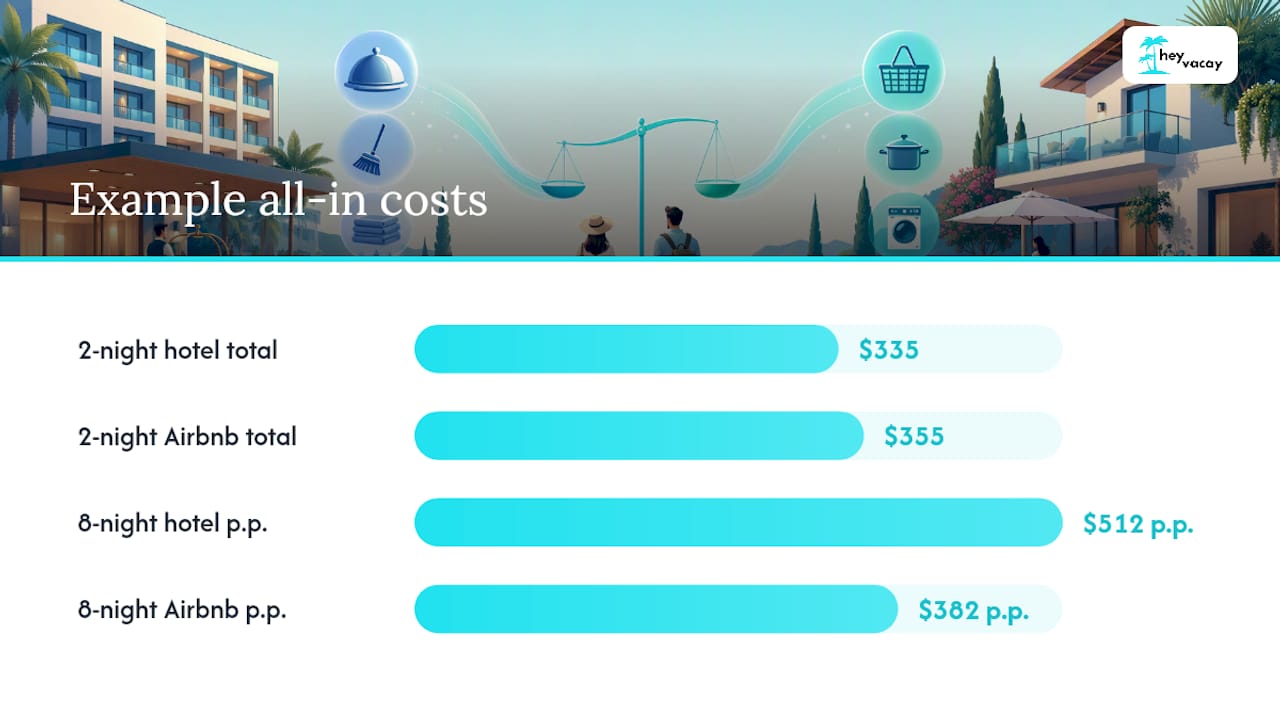
Worked example, two nights: A couple compares a $145 hotel room (totaling $335 with taxes) against a $120 Airbnb with an $80 cleaning fee and $35 service fee (totaling $355 for two nights). The hotel wins by $20, and it comes with free cancellation.
Worked example, eight nights: A group of five compares two hotel rooms at $160 a night ($2,560 with taxes) against a $220 whole-home Airbnb with a $150 cleaning fee ($1,910 total, or $382 per person versus $512 per person at the hotel). The rental wins by a wide margin once you split it per traveler.
Pro Tip: Before you finalize either booking, check if the platform offers a weekly or monthly discount toggle. Airbnb applies these automatically at seven and 28 nights, but only if the host has opted in, so the discount doesn't always show until you select those exact dates.
Booking Tactics That Actually Lower Your Total Cost
Run through a short checklist before you book either option, so you're comparing real totals instead of the number that shows up first in search results.
- Compare the full checkout total, not the nightly rate, on both platforms before deciding.
- Check the cancellation policy and assign it a dollar value if your plans have any chance of shifting.
- Tally what's included (breakfast, parking, Wi-Fi, kitchen) and price out what you'd pay for those separately with the other option.
- Add estimated transportation costs from the property to where you'll actually spend your time.
- Read the most recent reviews specifically for mentions of surprise fees or inaccurate listing photos.
- Book flexible dates when possible. Shifting a hotel stay by even one day off a weekend can drop the rate 15% to 25% in many markets, an approach detailed in booking-timing guidance from Wild Foodz.
- Ask about long-stay discounts directly if you're booking a week or more; some hosts negotiate below the listed weekly rate.
- Watch for last-minute pricing swings. Both hotels and rentals sometimes drop prices in the final 24 to 72 hours to fill inventory, but hotels are generally more consistent about it since occupancy targets drive their pricing algorithms.
| Trip type | Usually cheaper | Why |
|---|---|---|
| 1 to 2 nights, solo or couple | Hotel | Cleaning fee has no nights to dilute across |
| 5+ nights, family or group | Airbnb | Per-person cost drops sharply, kitchen offsets food spend |
| Business trip, short stay | Hotel | Loyalty perks, cancellation flexibility, central location |
| Group of 5 or more, any length | Airbnb | One cleaning fee split many ways beats multiple hotel rooms |
Platforms that show transparent, fee-included hotel pricing make the hotel side of this comparison easier to trust, since you're not left guessing what a resort fee will add at checkout.
Why the "All-In Price" Is the Only Number That Matters
Most of the advice floating around about hotel vs Airbnb cost treats the nightly rate as gospel, and that's exactly backward. The nightly rate is the least useful number in the whole comparison, because it's the one figure both platforms have the most incentive to distort. Hotels lowball it and recover the difference in resort fees and parking. Airbnb hosts lowball it and recover the difference in cleaning fees that can run higher than a night's stay.
Some platforms lean on AI to surface what a hotel actually costs after taxes and fees, rather than the teaser rate that shows up first.
We'd point families toward hotels specifically when amenities do real financial work, free breakfast, kids staying free, a pool that replaces a paid excursion, and toward short business trips where a central, loyalty-eligible hotel saves more in time and reliability than a rental could save in dollars. For everyone else running the math on a longer group trip, the rental math from this guide still applies. The tool should tell you the truth about the number, not talk you into a side.
— HeyVacay
Compare Real Hotel Totals Before You Book
Certain platforms exist for exactly the moment you hit in this guide: the point where you're staring at two "total price" numbers and need to trust that they're actually complete. Some use AI to search luxury and budget hotels side by side and surface the same properties, aiming to avoid resort-fee surprises buried at checkout.
What that gets you, in practical terms:
- Transparent, all-in pricing shown upfront instead of a teaser nightly rate
- AI-driven rate search across a wide range of hotel options so you're not manually checking a dozen tabs
- No hidden fees added at the final step of checkout
If you're weighing a hotel against a rental for an upcoming trip, start comparing hotel totals on HeyVacay and see the real number before you decide. And if you run into any booking questions along the way, HeyVacay's support team can walk you through it.
Sources
- Are Airbnbs More Cost Effective Than Hotels? - NerdWallet
- Are Airbnbs cheaper than hotels? What the numbers show - Skift
- Airbnb or hotel stay? Tourism expert shares what to consider before you book - Ohio University
- I tracked what Airbnb actually costs vs. hotels in 10 cities — Idyllic Pursuit
Related booking guidance, including family hotel booking tips and transparent pricing checks, is available on the HeyVacay blog.
FAQ
Is It Cheaper to Stay in a Hotel or an Airbnb?
It depends on stay length and group size: hotels are usually cheaper for stays under five nights and for solo travelers or couples, while Airbnb tends to win for groups of four or more staying five nights or longer, once cleaning fees are split across more nights and people.
What Is the 75/55 Rule in Airbnb Hosting?
There's no widely documented, standardized "75/55 rule" for Airbnb pricing or hosting, so treat any source claiming one as informal guidance rather than an official platform policy.
Why Do Some Travelers Prefer Hotels Over Airbnb?
Hotels offer predictable pricing, easier cancellation policies, daily housekeeping, front desk support, and loyalty perks like free breakfast or room upgrades, all of which lower the effective cost and risk for short or business trips.
How Do Cleaning Fees Affect the Hotel vs Airbnb Cost Comparison?
Cleaning fees are charged once per stay regardless of length, so they weigh heavily on short bookings and can push a one or two-night Airbnb stay above a comparable hotel room, while barely affecting the per-night cost of a week-long stay.