

Yes, you can often stack hotel discounts when you follow the right booking order and channel rules. The highest-probability combo is a loyalty or brand promo rate paired with a cash-back portal clickthrough, plus a targeted card statement credit, because each one attaches at a different stage: booking, post-click tracking, and post-purchase billing. Always confirm total price, including taxes and resort fees, before you pay.
TL;DR:
- Combining loyalty rates with cash-back portals and targeted card credits can maximize hotel savings, but the order of booking and validation is crucial.
- Using booking through a cash-back portal first, applying loyalty codes second, and confirming merchant category matches your card offers ensures maximum benefits.
- Discount restrictions include loyalty rates requiring accounts, portal tracking only on cookies, gift cards being non-refundable, and promo codes often excluding peak dates or specific room types.
- Manually stacking discounts is time-consuming but yields significant savings, while AI-driven upfront rates offer a faster, easier alternative for frequent travelers.
- Always verify total price including taxes and fees before payment, and save evidence of tracking confirmations to avoid losing rebates or credits.
Table of Contents
- How stacking works: booking channels and the order to test
- Discount types to consider and their restrictions
- Step-by-step stacking checklist to use before you book
- Worked examples and arithmetic: sample bookings showing stacked savings
- Safety, scams, and price-transparency rules that protect your savings
- Quick checklist and pro tips for repeat stackers
- Why AI-upfront rates can beat manual stacking
- Try a simpler way to find your best hotel rate
- Sources
- FAQ
How stacking works: booking channels and the order to test
Where you book determines what you can combine. Booking direct with a hotel brand preserves loyalty status, member rates, and brand promo codes, but it can exclude some third-party gift cards. Booking through an online travel agency (OTA) often unlocks its own member pricing but can void hotel-specific promo codes. Booking through a credit card's travel portal can trigger statement credits or portal points, but it sometimes strips out brand loyalty benefits entirely. Our comparison of hotel loyalty programs versus booking sites breaks down which channel protects which perk.
Some discounts apply right at checkout: promo codes, gift card balances, and portal cash back that tracks the moment you click through. Others post later, to your account or your card statement: targeted card offers, retroactive statement credits, and some loyalty point bonuses. Testing the wrong order can cost you one of these.
A workable sequence looks like this:
- Start from a cash-back portal or price-comparison tool so the click gets tracked before anything else happens.
- Land on the brand or OTA page and apply the loyalty rate or promo code at that point, not before.
- Check whether a gift card balance can be applied at final payment without breaking the portal's tracking cookie.
- Confirm your card offer's merchant category matches the booking channel before you enter payment details.
The most common failure modes are promo codes that only work on brand-direct bookings and card offers that require a specific merchant code the OTA doesn't trigger. Tools that help track price alerts and portal rates can flag these mismatches before you commit.
Discount types to consider and their restrictions
Before you build a stack, know what is actually available to combine. Each type behaves differently and carries its own fine print.
- Loyalty member rates and brand promos: Member-only rates and promo codes from hotel brands typically require an account login and sometimes a specific booking window.
- Credit-card statement credits and targeted offers: Card issuers can apply hotel credits when a booking runs through the correct channel and merchant code, and explainers show cardholders capturing up to $500 in Chase Sapphire Reserve hotel credits using this method.
- Cash-back portals: These pay a percentage back on qualifying bookings, but only if the portal's tracking cookie survives your entire session.
- Discounted gift cards: Stored-value vouchers bought below face value add savings but only make sense for confirmed, non-refundable plans since redemption rules can be strict.
- Promo codes, third-night-free offers, and package deals: These often exclude peak dates or specific room categories, so read the terms before assuming they apply.
- Price-drop and cancel-and-rebook tactics: If a rate falls after you book on a flexible cancellation policy, rebooking at the lower price captures the difference without losing your original perks.
Combining several of these in one booking is exactly the kind of multi-layered approach documented in stacking guides that pair discounted gift cards with cash-back portals and targeted card offers for larger net savings.
Pro Tip: Turn fixed-dollar statement credits into a bigger percentage win by applying them to smaller, cheaper bookings instead of your priciest stay.
Step-by-step stacking checklist to use before you book
Run through this sequence every time you plan to combine discounts. Skipping a step is the most common reason a stack partially fails.
- Identify your target rate and copy any promo or rate codes exactly as displayed.
- Confirm which booking channels, brand direct, OTA, or card portal, actually accept that code.
- Open your cash-back portal link first and verify tracking is active before you enter payment information; clear cookies or use a dedicated browser extension if tracking looks unreliable.
- Check whether a gift card or promo code still works once the portal session is open, and confirm the loyalty rate remains selected.
- Review your card's statement credit terms, including merchant category codes, enrollment requirements, and any minimum spend, and enroll ahead of time if the offer requires it.
- Calculate the final net price: subtotal minus every discount, plus taxes and resort fees, equals what you'll actually be charged.
- Compare that number against your confirmation email or hotel folio to confirm nothing was dropped.
- Save screenshots of the portal tracking screen, the promo code entry, and your final confirmation in case a credit doesn't post later.
Merchant category mismatches are the single biggest reason a targeted card offer fails to trigger, since a booking made through a card's travel portal instead of the hotel's own site can register under a different code entirely.
Pro Tip: Screenshot the cash-back portal's "tracking confirmed" page the moment it appears. It's the fastest evidence you'll have if a rebate never posts.
Worked examples and arithmetic: sample bookings showing stacked savings
Example A: A room costs $300 a night before fees. A loyalty promo takes 20% off the room rate, bringing it to $240. A targeted card offer then applies a flat $100 statement credit after the stay posts. Add a $25 resort fee and local taxes of 12% on the discounted room rate ($28.80), and the total charged at checkout is $240 plus $28.80 plus $25, or $293.80.
Loyalty points redeemed separately shave a further amount off a future stay, and a price-drop alert later triggers a cancel-and-rebook at a lower base rate, recapturing savings that would otherwise be lost once the booking was locked in.
Fixed-dollar fees change the math fast. A $25 resort fee on a $120 room is a bigger percentage hit than the same fee on a $400 suite, so stacking gains can shrink or disappear entirely on cheaper rooms once mandatory fees are added back in.
Documented tactics show that pairing gift cards, cash-back portals, and card offers can produce meaningful multi-layered savings, though the size of the win depends heavily on timing and which fees apply to the specific stay.

Safety, scams, and price-transparency rules that protect your savings
Deals that look too generous are the ones most likely to cost you. The FTC warns travelers to watch for fake free vacation offers and phishing emails that impersonate airlines or hotels, and recommends typing a vendor's URL directly rather than clicking a link in an unsolicited message. Our own breakdown of how reservation hijacks work covers the same red flags in more detail.
Sellers of short-term lodging must disclose required fees up front so consumers can compare total prices.
That principle comes from the FTC's Rule on unfair or deceptive fees, and it works in your favor: always force a total-price comparison, resort fees and taxes included, before deciding a stack is worth the effort.
- Call the hotel directly using a number from its official site if a deal looks unusual.
- Keep every confirmation email and screenshot in case a portal rebate or statement credit doesn't post within its stated window.
- Escalate a missing credit through your card issuer's dispute process only after the portal's or issuer's posting deadline has passed.
- Walk away from any offer that requires payment by gift card, wire transfer, or cryptocurrency.
Quick checklist and pro tips for repeat stackers
If you stack discounts often, a little organization saves more than any single promo does.
- Keep a saved template of your usual booking order and which card you use for which credit.
- Set calendar reminders for promo windows and card offer expiration dates so nothing lapses unused.
- Screenshot every tracking confirmation and promo application as you go, not after the fact.
- Skip the stack when blackout dates or non-combinable clauses would erase more value than the time you'd spend chasing it.
Pro Tip: If a promo excludes your loyalty tier or room category, check before you build the rest of the stack around it. That single check saves the most wasted effort.
Why AI-upfront rates can beat manual stacking
Manual stacking rewards patience, but patience has a cost. When I compare a full stack, checking channel rules, portal tracking, and card terms, against a single upfront total price, the time saved on the second option often outweighs a marginal discount. That's the case HeyVacay makes with its AI-driven upfront pricing: one price, no hidden fees, no verification chain. For frequent travelers or students who might otherwise assemble a stack for hours, an upfront rate can be the faster win, and our own analysis found students saving up to 40% with that approach compared to chasing card-based hotel discounts. Try the experiment yourself: run your best manual stack, then check it against an upfront quote.
— HeyVacay
Try a simpler way to find your best hotel rate
If the stacking math in this guide feels like more effort than the savings justify, that's exactly the gap HeyVacay was built to close. Instead of checking merchant codes, portal cookies, and promo exclusions, some platforms show an upfront total for luxury and budget hotels listed on other sites, using AI to surface lower prices without a chain of conditions attached.
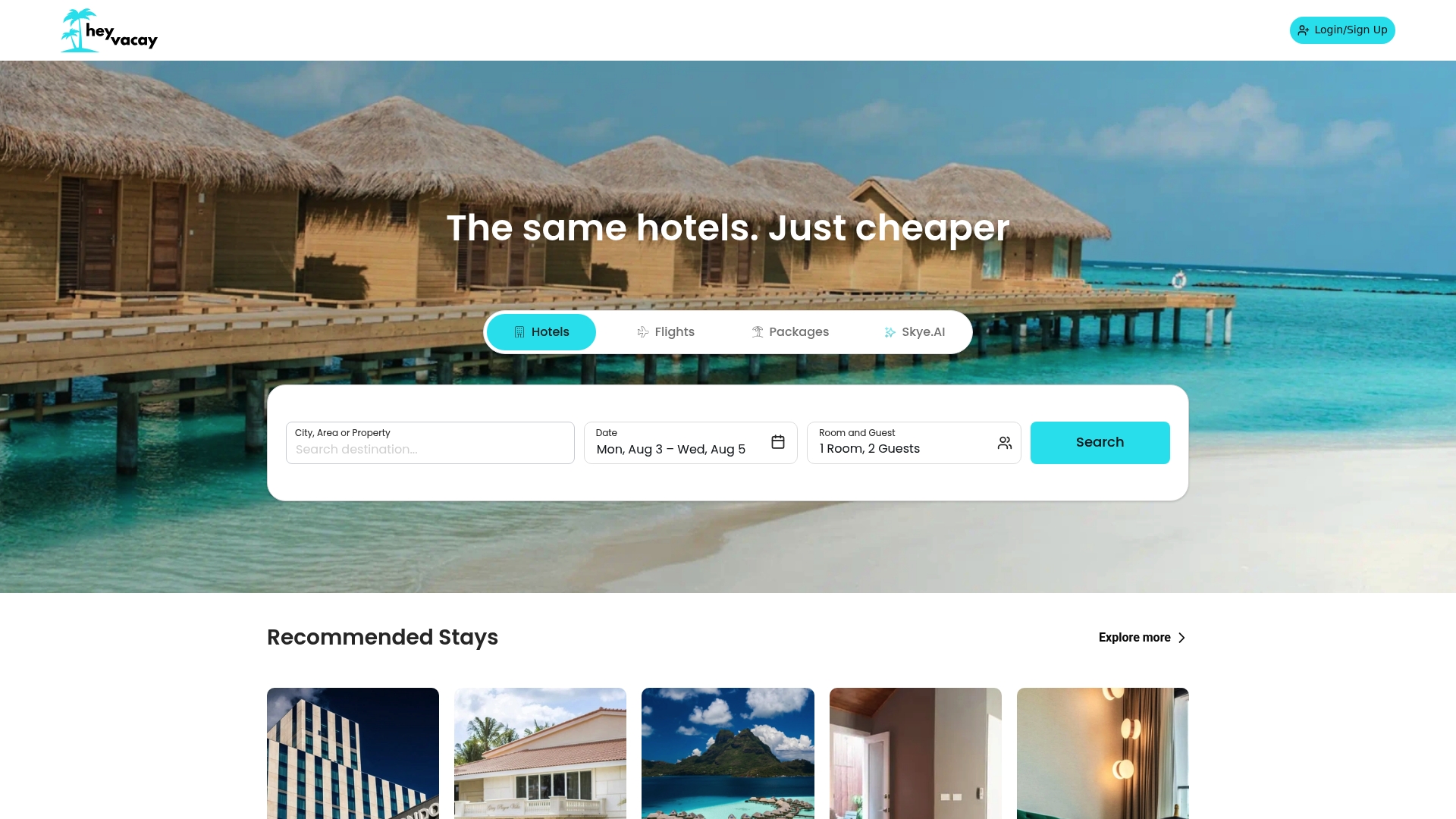
- Choose HeyVacay when you'd rather see one transparent number than reconcile five discount sources.
- Choose manual stacking when you have the time and a stay large enough to make the extra steps worth it.
- Either way, compare your final numbers before booking, since the cheaper total is the one that matters.
Check today's rate on our hotel search page and see how it stacks up against your own math.
Sources
- How to avoid travel website scams | Consumer Advice
- How To Stack Hotel Discounts & Promos For Maximum Savings... - God Save The Points
- How to get up to $500 in hotel credits with the Chase Sapphire Reserve®
FAQ
How to get 50% off on hotel bookings?
No single offer typically reaches that level alone, so the math depends on stacking multiple sources correctly, as shown in the worked example above.
What is the 15/5 rule in hotels?
There isn't a widely documented, standardized rule tied to hotel discounts or loyalty programs. If you've seen the term used elsewhere, treat it as an informal shorthand rather than an official policy and verify any specific claim directly with the hotel or program in question.
How to get a 10% discount from booking?
Checking the brand's own site directly, rather than a third-party OTA, often reveals these discounts since some promo codes only work on brand-direct bookings.
How to get a hotel discount code?
Hotel brand loyalty programs typically issue promo codes through email newsletters, app notifications, or limited-time promotions like the destination-specific deals some chains run seasonally. Signing up for a loyalty account and checking the brand's official promotions page before booking is the most reliable source, since third-party codes can carry restrictions that block combination with other discounts.